The Space Between: Tan Mu’s Synapse and the Gap Where Meaning Lives
The synaptic cleft is twenty nanometers wide. Twenty nanometers: twenty billionths of a meter, a distance so small that it cannot be seen with a light microscope, so small that it occupies roughly the same fraction of a millimeter that a millimeter occupies of a kilometer, so small that the only way to know it exists is to infer its existence from the behavior of the neurons on either side of it, which fire in sequences that imply a gap, a pause, a delay between the electrical signal that travels down the axon of one neuron and the chemical signal that crosses the gap to activate the receptors on the dendrite of the next, a delay of roughly one millisecond, which is the time it takes for the vesicles at the end of the axon to release their neurotransmitters into the cleft, for the neurotransmitters to diffuse across those twenty nanometers, for the receptors on the other side to bind them and open the ion channels that will trigger the next electrical signal, which will travel down the next axon to the next synapse, where the entire process will repeat, and repeat, and repeat, roughly ten to the fourteenth times per second across the roughly ten to the fifteenth synapses in the average human brain, a number so large that the brain itself cannot comprehend it, a number that the brain can only represent through the very synapses that the number describes, a number that is the brain's way of understanding itself, a self-referential loop that the painting named Synapse takes as its subject and its method, because the painting is also a loop, a representation of a structure that is itself a representation of the principle that nothing exists in isolation, that everything is connected to everything else through a gap, that the meaning of the system is not in the nodes but in the connections, not in the neurons but in the synapses, not in the things but in the spaces between the things, and that the spaces between the things are where the action happens, where the signal becomes a message, where the electrical impulse becomes a thought, where the chemistry becomes a feeling, where the twenty-nanometer gap becomes the difference between saying something and not saying it, between remembering and forgetting, between being awake and being asleep, between being alive and being not.
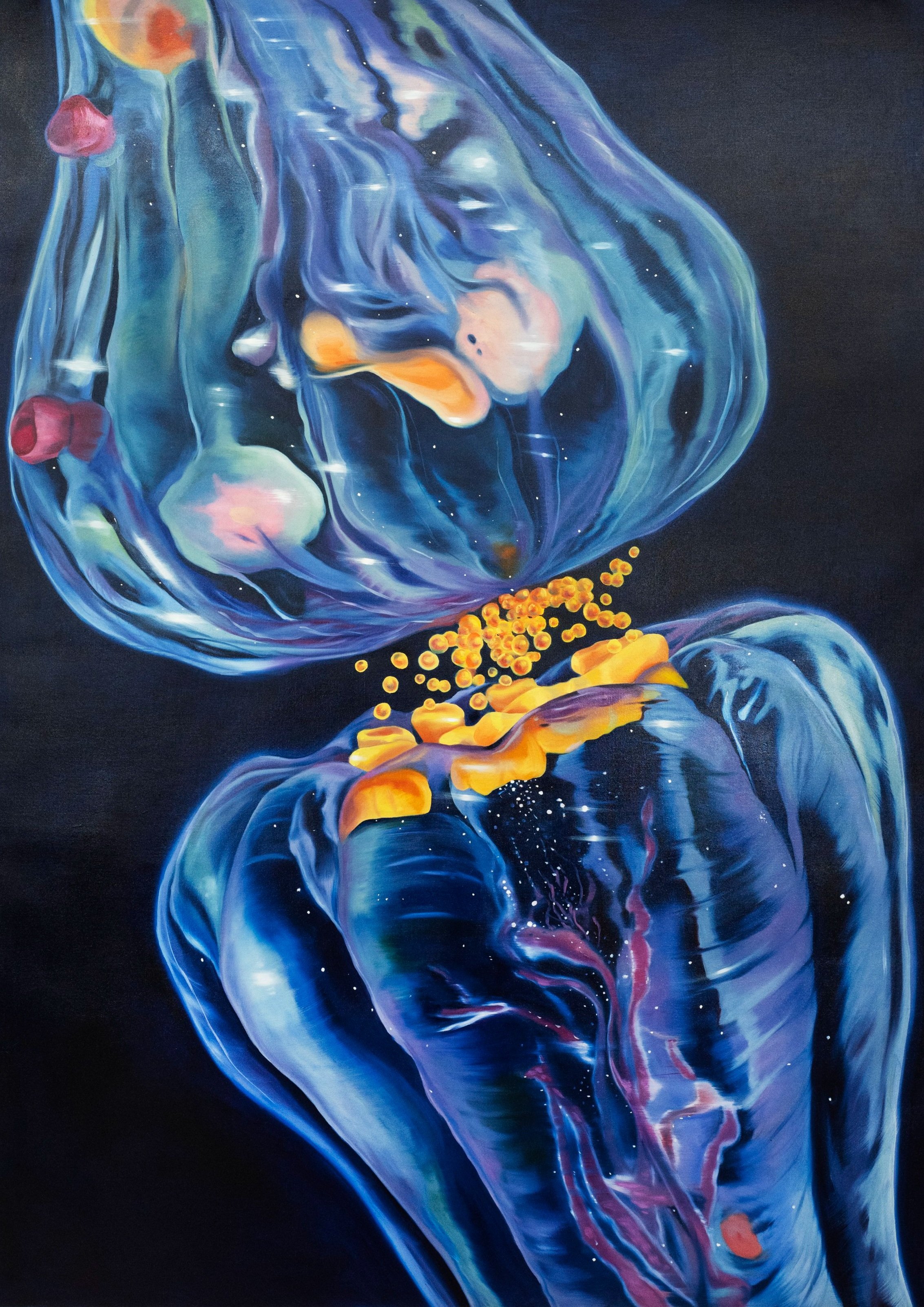
Synapse is a large painting, 193 by 244 centimeters, oil on linen, and its scale is essential to its argument. At this size, the viewer cannot take in the entire surface at a glance. The eye must move across the canvas, following the branching structures that extend from one cluster to the next, tracing the connections that link one node to another across stretches of painted ground, and the movement of the eye across the surface reproduces the movement of a signal across a network, a path from one point to another that is not direct but circuitous, not a straight line but a branching tree that divides and subdivides as it extends outward from a central mass toward the edges of the canvas, where the branches terminate in clusters of small luminous dots that read as the synaptic terminals, the places where the signal would cross the gap and reach the next neuron if there were a next neuron, but the painting ends at the edge of the linen and the signal has nowhere to go, which is also the condition of the synapse itself, which is a structure that exists in the gap between two neurons, a structure that has no meaning on its own, that cannot fire without a neuron on one side to send the signal and a neuron on the other side to receive it, that is defined not by what it is but by what it connects, and the painting makes this definition visible by extending the branches to the edge of the canvas and then stopping, leaving the viewer to imagine what lies beyond, what the next neuron would look like, what the next signal would carry, what the next synapse would do with the information that this synapse has just passed across its twenty nanometers of empty space.
The palette is organized around two registers: the warm register of the neuronal bodies and the cool register of the space between them. The neuronal bodies, the clusters of branching structures that occupy the center and the periphery of the canvas, are rendered in warm ambers, deep oranges, and touches of vermillion, the colors that a fluorescence microscope assigns to cells that have been tagged with fluorescent proteins, the colors that the brain's vasculature produces when the brain is active and blood flow increases to the regions that are firing, the colors of heat and metabolism and electrical activity. The spaces between the neuronal bodies are rendered in deep blues and near-blacks, the colors of the extracellular fluid that fills the synaptic cleft, the colors of the cerebrospinal fluid that surrounds the brain, the colors of the ocean that Tan Mu has painted in other works and that she has identified as a central element of her visual vocabulary, the colors of the medium through which the signal must travel before it reaches the next node. The contrast between the warm nodes and the cool spaces is the painting's central visual event. It is what the eye sees first and what the mind returns to, the way that warmth and coolness alternate across the surface, the way that the amber branches reach into the blue ground and the blue ground reaches back toward the amber branches, the way that the two registers touch but do not merge, maintaining the gap that the synapse requires in order to function, because a synapse that is closed is not a synapse but a short circuit, and a short circuit does not transmit information, it destroys it.
In the 1890s, Santiago Ramón y Cajal, a Spanish pathologist and anatomist, began producing drawings of neurons that would change the understanding of the nervous system. Using a silver nitrate staining method developed by the Italian biologist Camillo Golgi, Ramón y Cajal was able to visualize individual neurons against a background of unstained tissue, revealing for the first time the full extent of a single neuron's branching structure, its dendrites extending like a tree's canopy, its axon stretching outward like a trunk, its synaptic terminals branching at the far end like roots reaching toward the dendrites of other neurons that they would never touch. Ramón y Cajal's most celebrated drawing, the Purkinje neuron from the human cerebellum, completed around 1899, shows a single cell body from which hundreds of dendrites extend in a flat, fan-like array, each one branching into smaller and smaller subdivisions until the finest branches terminate in tiny points that are the places where the synapses would form, the places where the signal would cross the gap, the places where the neuron would connect to the thousands of other neurons that it communicates with, not by touching them, because neurons do not touch, but by releasing neurotransmitters into the synaptic cleft that separates them, the twenty-nanometer gap that Ramón y Cajal inferred from his observations but could not directly see, because the gap was too small for his microscope to resolve, and he had to argue for its existence on the basis of indirect evidence, on the basis of the way the neurons behaved, on the basis of the fact that no matter how closely he looked he could never find a neuron that was continuous with another neuron, they were always separated by a space, they were always adjacent but never contiguous, they were always connected but never touching, and the space between them was where the action happened, was where the signal became a message, was where the electrical impulse that traveled down the axon was converted into the chemical signal that crossed the gap and was converted back into an electrical impulse on the other side, a process of translation that Ramón y Cajal could not observe but could only infer, and the inference was so powerful that it would eventually be confirmed by the electron microscope in the 1950s, and the confirmation would show that the gap was exactly the size that Ramón y Cajal had suspected, a gap so small that no light could resolve it, a gap that was nonetheless the most important structure in the brain, because the brain's entire capacity for thought, for memory, for feeling, for consciousness itself, depends on what happens in that gap.
Ramón y Cajal's drawings are not photographs. They are interpretations, produced by a hand that was trained in both science and art, a hand that could see what the microscope revealed and then select from that revelation the elements that mattered most to the argument that the drawing was making, which was the argument that the nervous system is not a continuous web but a collection of individual cells that communicate across gaps, that the brain is not a single organ but a society of organs, that thought is not a substance that flows through the brain like water through a pipe but a process that occurs at the boundaries between cells, in the spaces where one cell ends and another begins and the signal must cross the void in order to reach its destination. The drawings are works of extraordinary beauty, as precise as scientific illustration and as expressive as portraiture, and they occupy a position at the boundary between art and science that is precisely the position that Tan Mu's paintings occupy, the position where the image serves both the argument and the aesthetic, where the drawing of a neuron is simultaneously a representation of a biological structure and a composition that satisfies the requirements of visual art, where the branches of the dendrite are simultaneously accurate descriptions of what the microscope shows and deliberate arrangements of line and space that produce a visual experience that the viewer cannot reduce to information alone.
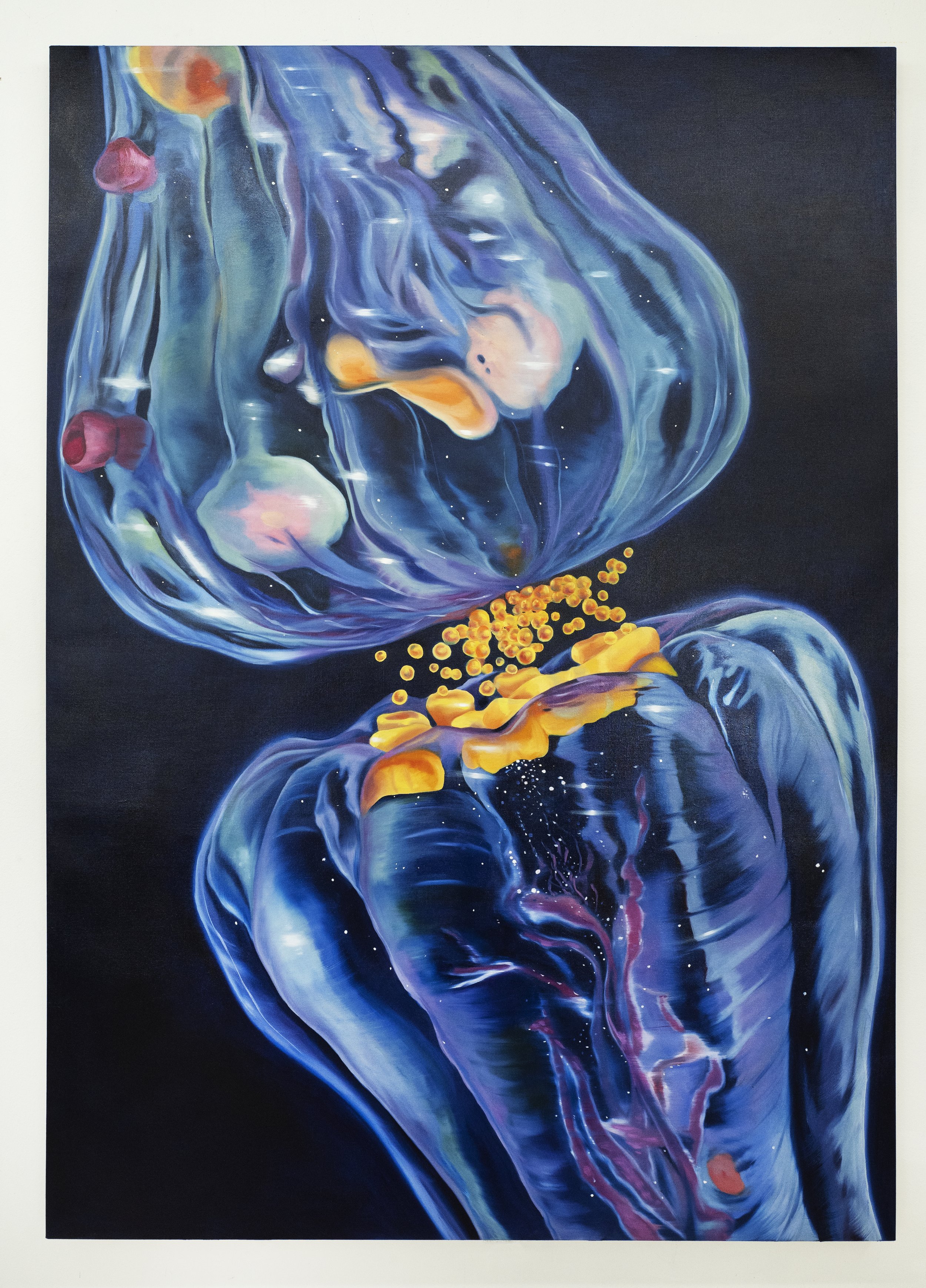
The synapse is the structure where Tan Mu's two domains of interest converge. Her Q&A for Synapse identifies the painting's subject as "the junction between two nerve cells" and describes it as a structure that "embodies a biological reality and a broader truth: nothing exists in isolation." The convergence is structural rather than metaphorical. The synapse is not a symbol for connection. It is the place where connection actually occurs, the physical site where the electrical signal becomes a chemical signal and then becomes an electrical signal again, the place where the message is translated from one language into another, the place where the gap is not an absence but a medium, not a void but a channel, not a problem that the system solves but a feature that the system requires, because the gap is what allows the signal to be modulated, to be strengthened or weakened, to be enhanced or inhibited, to be passed along or blocked, and the modulation is what makes the system capable of learning, capable of memory, capable of changing its response to the same stimulus based on what has happened before, capable of the thing that we call plasticity, which is the thing that we call thought, which is the thing that we call being alive and aware and able to respond to the world in ways that are not predetermined but are shaped by experience, shaped by the history of the signals that have crossed the gap before, shaped by the patterns that the synapse has formed over a lifetime of firing and not firing, of connecting and not connecting, of transmitting and not transmitting, of being the place where something happened or the place where nothing happened, and the accumulation of those happenings and non-happenings is what the brain is made of, not the neurons but the connections, not the cells but the gaps between the cells, not the things but the spaces between the things.
Tan Mu's mother was a windsurfer who spent years on the water, and Tan Mu grew up watching her navigate the interface between air and sea, the surface where two different media meet and produce the conditions for movement. The windsurfer does not control the wind. She reads it, she positions her body and her sail in relation to it, and she uses the force that the wind exerts on the sail to move across the surface of the water, which is also moving, in response to forces that the wind exerts on it at other points, at other times, at scales that the individual windsurfer cannot perceive but that produce the waves that she rides and the currents that she navigates and the conditions that she must adapt to in real time, without thinking, because thinking is too slow, because the body knows how to respond before the mind can formulate the response, because the synapses in the motor cortex and the cerebellum have been trained by thousands of hours of practice to fire in patterns that produce the correct movement without requiring conscious intervention, because the windsurfer's body has become a system that processes information at the speed of the synapse, which is the speed of chemistry, which is the speed of a neurotransmitter crossing a gap of twenty nanometers, which is fast enough to keep a person upright on a board in wind and water but too slow to be called computation, because computation is what machines do and what the synapse does is something else, something that involves chemistry and physics and the particular arrangement of proteins and receptors and ion channels that evolution has produced over billions of years of selection, and the result is a system that can windsurf across a lake in the wind, or paint a picture of a synapse on a canvas in a studio, or look at the painting and recognize in it the same branching structure that the eye's retina uses to process light, because the retina is also a neural network, and the visual cortex is also a neural network, and the entire brain is a network of networks, and the painting of the network is being seen by the network, and the network is recognizing itself in the painting, which is the most recursive thing that a network can do, which is to look at a representation of its own structure and understand that the representation is accurate, that the branching forms on the canvas correspond to the branching forms in the head of the person looking at the canvas, and that the recognition of the correspondence is itself a synaptic event, a firing of synapses that connects the visual cortex to the memory to the language centers to the motor cortex that produces the thought, the synapse is where the meaning lives.
Vija Celmins began making night sky paintings in the early 1990s, using charcoal and graphite on prepared paper to produce surfaces that appear to contain an infinite number of stars against an infinite black ground. Night Sky #19, completed in 1998, is a representative example: a rectangular field of dense black, roughly 30 by 40 centimeters, covered with points of varying brightness that the artist has built up through layer upon layer of charcoal, each point a small concentration of pigment against the dark surface, each one representing a star but also, and this is the crucial point, also simply being a point of pigment on a dark surface, a mark that the artist placed there for reasons that include the astronomical reference but that are not reducible to it, because the painting is also a painting, a surface with marks on it, a composition of lights and darks, a field of points that the eye reads as stars but that the mind knows are marks, and the tension between reading and knowing is where the painting operates, in the gap between the representation and the thing represented, in the space between the star and the mark that stands for the star, in the same space that the synapse occupies between the signal and the meaning, the gap where the chemistry happens, the gap where the translation occurs, the gap where the electrical becomes chemical and the chemical becomes electrical and the whole apparatus of thought is maintained by the continual crossing and recrossing of messages across a gap that no one can see but that everyone depends on, every moment of every day, without knowing it, without thinking about it, without even being aware that it is there, because the synapse is invisible not because it is hidden but because it is too small, twenty nanometers, the width of a gap that the mind cannot imagine because the mind has no experience of distances that small, the mind has no frame of reference for them, the mind can only represent them through the kind of analogy that Celmins uses when she makes a point of pigment stand for a star, or that Tan Mu uses when she makes a branching form of oil paint stand for a neuron, or that Ramón y Cajal uses when he makes a line of ink stand for an axon, because the thing itself cannot be seen by the unaided eye, because the thing itself exists at a scale that the eye cannot reach, because the thing itself is only available through the mediation of a technology, a microscope, a telescope, an MRI scanner, a painting, and the mediation is the point, because the mediation is what makes the invisible visible, and the visible is what the viewer can think about, and thinking about the visible is what the synapse makes possible, and the painting is a representation of the synapse that the synapse makes it possible to see, and the loop is closed, and the system is complete, and the point of pigment and the point of light and the point of neurotransmitter and the point of thought are all the same point, all crossing the same gap, all making the same journey across twenty nanometers of empty space, and the space is where the meaning lives.