The Needle and the Egg: Tan Mu’s IVF and the Scale of What We Can Now Choose
The human egg is the largest single cell in the body. It is roughly one hundred micrometers in diameter, which is to say roughly one tenth of a millimeter, which is to say visible to the naked eye, which is to say large enough that a trained embryologist can hold a pipette up to it, see it, and push a single sperm through its zona pellucida with a needle whose tip is narrower than a human hair. The sperm, by contrast, is one of the smallest cells in the body, roughly five micrometers in head diameter, invisible without magnification, a point of genetic material attached to a tail that propels it toward the egg with a force that is proportionally enormous but that in absolute terms would not move a grain of sand. The difference in scale between the egg and the sperm is one of the most dramatic size asymmetries in all of biology, and it is also a difference in mass, in volume, in mitochondrial content, in the quantity of cytoplasm that each cell contributes to the embryo, and in the amount of biological information that each cell carries, because the egg carries not only its half of the genetic material but also the mitochondria, the ribosomes, the proteins, and the signaling molecules that will direct the first hours of the embryo's development before the embryo's own genes begin to express themselves, which means that the egg is not just a cell but an entire developmental program in a single package, a self-contained set of instructions for building a body, while the sperm is essentially a delivery vehicle for its half of the genetic material, a torpedo with a payload, and the difference between them is the difference between a city and a letter addressed to that city, the difference between an environment and an instruction, the difference between something that can sustain life and something that can only direct it, and the procedure called ICSI, intracytoplasmic sperm injection, which is what the painting called IVF depicts, is the procedure in which a technician selects a single sperm and injects it through the zona pellucida of a single egg using a needle that is visible under a microscope, and the painting shows this procedure at the moment of injection, the needle entering the cell, the sperm about to be deposited in the cytoplasm, the egg about to receive the genetic material that will, if everything goes well, begin to divide and differentiate and grow into a human being, and the difference between the needle and the egg is the difference between the decision to intervene and the capacity to receive the intervention, and the painting holds both in the same frame, the vertical line of the needle and the circular form of the cell, and the tension between them is the tension that the painting is about.
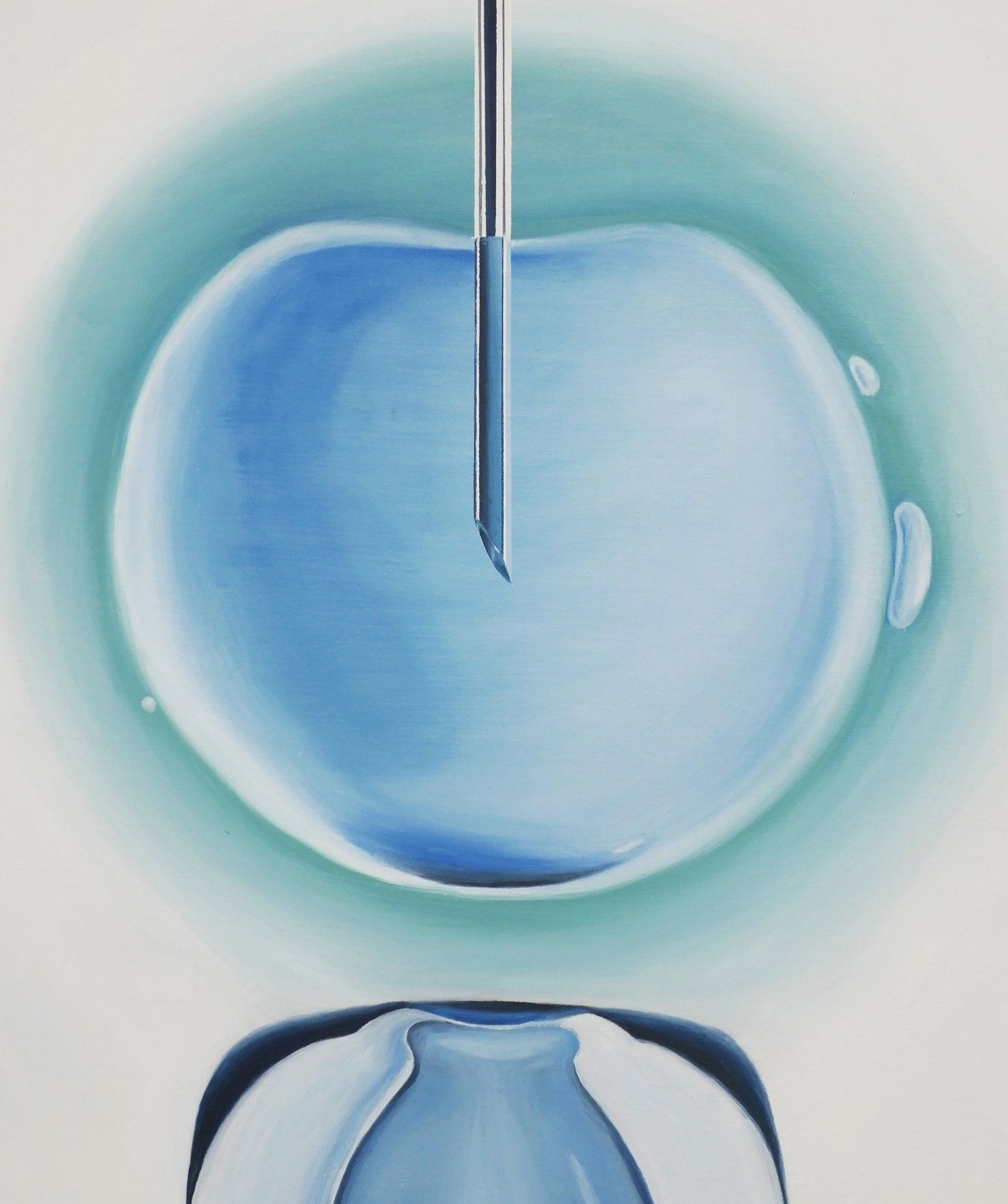
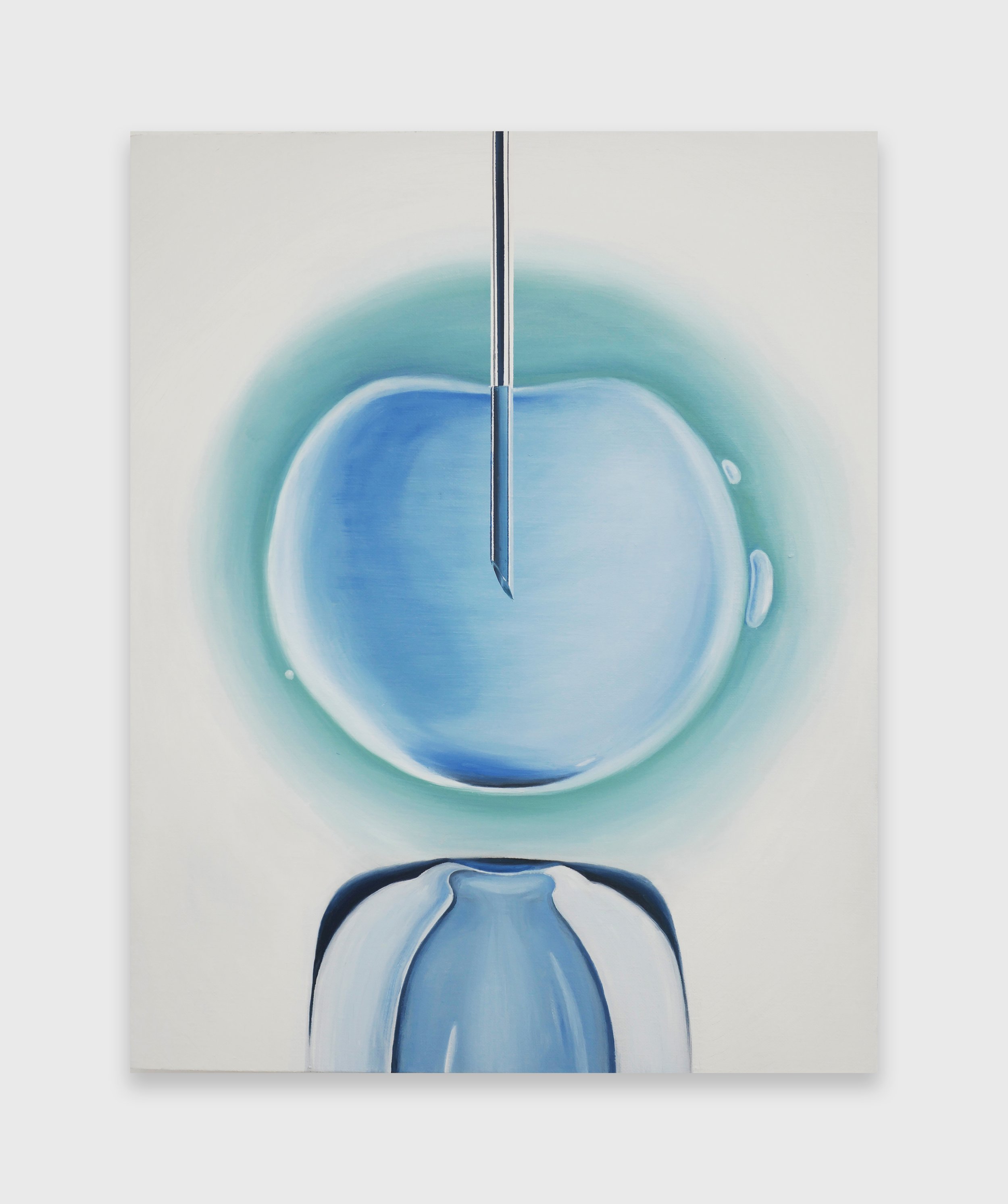
IVF is 51 by 41 centimeters, oil on linen, a small painting for a small subject, the proportions of a microscope slide or a Petri dish, the proportions of the clinical image that the painting translates from the screen of a laboratory monitor into the surface of a canvas. The composition is centered on a single egg cell rendered as a large circular form occupying the middle of the canvas, with a thin vertical needle entering from the left, its tip just penetrating the outer boundary of the cell. The palette is dominated by cool blues, the color that Tan Mu chose to reflect the clinical calm and neutrality of the laboratory environment, but also the color that evokes the purity and vulnerability of life at its earliest stage, the color of amniotic fluid and the color of the stain that the embryologist uses to highlight the zona pellucida, and the color of the medium that sustains the egg while it waits for the sperm to arrive, and the color of the screens that display the microscopic image, and the color of the gowns and the gloves and the walls and the lights in the rooms where the procedure takes place, all of it blue, all of it clinical, all of it designed to feel clean and controlled and neutral, as though the creation of a human being were a procedure that could be conducted in an environment of perfect calm, as though the decision to inject a sperm into an egg were a decision that could be made with the same detachment that one brings to a laboratory protocol, as though the needle were merely an instrument and the egg were merely a cell and the sperm were merely a delivery vehicle and the whole process were merely a medical procedure, which it is, which it also is, which it cannot help being, because the technology that makes ICSI possible is a medical technology, and the people who perform it are medical professionals, and the rooms where it happens are medical rooms, and the blue that fills the painting is the blue of medical rooms, the blue of sterilization and precision and the elimination of everything that is not the procedure, the blue of the environment that has been designed to make the creation of a human being feel like something that can be controlled.
The needle is rendered as a thin vertical line, precise and sharp, its tip a point of brighter blue against the darker blue of the cell's interior. The egg is rendered as a circular form with a visible zona pellucida, the thick outer layer that surrounds the mammalian oocyte, painted as a slightly lighter ring around the darker cytoplasm. Inside the cytoplasm, the texture of the paint suggests the granular structure of the cell's interior, the organelles and the mitochondria and the proteins that the egg carries in its cytoplasm, the developmental program that will direct the first divisions of the embryo, the program that makes the egg not just a cell but a cell that contains the instructions for building a body. The contrast between the needle and the egg is the painting's central formal tension: the vertical against the circular, the rigid against the soft, the instrument against the organism, the decision against the capacity. Tan Mu describes this contrast directly: the needle represents the precision and power of technological intervention, while the circular forms of the cells suggest softness, fragility, and potential. The painting holds both in the same frame, and the viewer is asked to hold both in the same thought, the power and the fragility, the control and the vulnerability, the decision to intervene and the capacity of the cell to receive the intervention and to transform it, against all odds, into a human being.
Georgia O'Keeffe began painting flowers in the early 1920s, and by 1924 she had produced a series of works that enlarged the forms of flowers, particularly irises and petunias, to scales that filled the canvas, scales at which the flower ceased to be a flower and became something else, a landscape of folds and curves and colors that the viewer could not immediately identify as botanical, that the viewer had to approach and examine and recognize, and the recognition, when it came, brought with it a shift in perception, a sudden understanding that the interior of a flower, when enlarged to the size of a canvas, reveals structures that the eye at normal scale never sees, structures that resemble organs and body parts and the interiors of bodies, structures that the flower has always contained but that the scale of normal vision has always concealed. Black Iris III, painted in 1926 and now in the collection of the Metropolitan Museum of Art, is a vertical composition that fills the canvas with the deep purple and black folds of an iris's petals, the center of the flower a dark cavity that reads simultaneously as a botanical feature and as something that the viewer recognizes from a different context, a context that the painting does not name but that the viewer cannot avoid seeing, because the scale of the image forces the comparison, because a flower at this size is no longer a flower, it is an interior, and the interior of a flower at this scale looks like the interior of a body, and the interior of a body at this scale looks like something that the viewer is not supposed to be seeing, something private, something internal, something that the normal scale of vision was designed to keep hidden, and the painting refuses to keep it hidden, it opens the interior and presents it to the viewer and says: look at this, this is what the inside of a living thing looks like when you magnify it enough to see what it actually is.
The connection to Tan Mu's IVF is structural and thematic rather than visual. O'Keeffe enlarged the flower to a scale that revealed its interior and made the viewer confront the resemblance between botanical structures and anatomical ones. Tan Mu enlarges the egg cell and the needle to a scale that reveals the ICSI procedure as what it is: an intervention into the interior of a living cell, a penetration of the zona pellucida by an instrument, a moment in which the natural process of fertilization is replaced by a technological one, a moment in which the decision about which sperm will fertilize which egg is made not by the competition of millions of sperm but by the judgment of a single technician looking through a microscope, and the judgment is a judgment about quality and viability and genetic fitness, and the judgment is made possible by a technology that has the capacity to select, to choose, to optimize, and the capacity to select and choose and optimize is the capacity that the painting is asking the viewer to think about, because the same technology that allows a couple struggling with infertility to conceive a child also allows a couple to select the sex of their child, to screen for genetic diseases, to choose the embryo with the highest probability of implantation, to edit the genes of the embryo before it is transferred to the uterus, to do things that the technology was not originally designed to do but that the technology makes possible because the technology is a tool and a tool does not care about the purpose for which it is used, a tool is neutral, a needle is neutral, an ICSI needle is a needle that penetrates an egg, and the question of what it means to choose which sperm fertilizes which egg is a question that the technology does not answer, because the technology only makes the choice possible, it does not make the choice, and the painting shows the moment of the choice, the moment of the injection, the moment when the needle enters the egg, and the viewer is left to decide what they think about it, whether it is medicine or manipulation, whether it is hope or control, whether the blue that fills the painting is the blue of healing or the blue of sterility, whether the needle is an instrument of life or an instrument of selection, whether the egg is a cell that can sustain a human being or a cell that can be optimized, edited, improved, and whether the improvement is the same thing as the life that the cell would have produced on its own, or whether it is something else, something that the technology has made possible but that the technology cannot name, a kind of life that did not exist before the needle entered the cell and that would not have existed without the needle, a kind of life that is the product of a decision rather than the product of a chance, a kind of life that is chosen rather than given, and the choosing is what the painting is about, the choosing and the needle and the egg and the blue that surrounds them both, the blue that is the color of the room where the choosing happens, the color of the calm in which the decision is made, the color of the technology that makes the decision possible, the color of the question that the painting does not answer but that it insists the viewer ask.
The history of IVF spans over half a century. In 1959, the first successful IVF birth in a nonhuman mammal was achieved. In 1978, Louise Brown was born in Oldham, England, the first human baby conceived through in vitro fertilization, and her birth was announced on the front page of every major newspaper in the world, because the birth represented a threshold that many people had believed would never be crossed, the threshold between natural conception and technological conception, the threshold between the random meeting of sperm and egg that occurs inside the body and the deliberate meeting of sperm and egg that occurs outside it, the threshold between chance and choice. In the decades since Louise Brown's birth, IVF has been refined and expanded and commercialized and debated and improved to the point where it is now a routine medical procedure available in most developed countries, and the debates that accompanied its introduction, the debates about whether it was natural, whether it was ethical, whether it was playing God, whether it was the beginning of a slippery slope that would lead to genetic optimization and designer babies and the commodification of human reproduction, have not been resolved but have been joined by new debates about genetic screening, preimplantation genetic diagnosis, mitochondrial replacement therapy, and CRISPR gene editing, each one an extension of the original decision to remove the egg from the body and fertilize it outside the body and then return it, each one a further step along the slope that the original critics warned about, each one a further application of the principle that the creation of human life can be directed by technology, and the principle is now so widely accepted that it no longer generates the outrage that it generated in 1978, because the children who were conceived through IVF are now in their forties and have children of their own, and the procedure that was once controversial is now ordinary, and the question of what the technology makes possible has shifted from whether it should be done at all to what else it can be used for, which is the question that Tan Mu's painting is asking, the question that the needle and the egg and the blue that surrounds them are asking, the question that the technology itself does not ask because the technology is a tool and a tool does not ask questions, a tool only makes things possible, and the possibility that the tool has made is the possibility of choosing, and the choosing is what the painting is about.
Helen Chadwick was a British artist who spent the last years of her life, from the early 1990s until her death in 1996, making work about fertility, reproduction, and the body's relationship to the technologies that mediate it. Her most famous work from this period is probably Piss Flowers, a series of sculptures made by casting the shapes that urine made in snow, but the work that connects directly to IVF is the series of photoworks and sculptures that she produced under the title Egg/Essence, in which she used microscopic imagery of her own eggs, harvested during an IVF procedure, to produce works that hovered between scientific documentation and aesthetic object, between the clinical and the personal, between the image of a cell and the image of a potential person, between the data that the microscope produced and the feeling that the data provoked in the woman whose cell it was. Chadwick described her IVF experience as one in which her body became both subject and object, both the source of the material and the audience for the images that the technology made from it, and the work that resulted from this experience was a body of art that refused to separate the scientific from the personal, that refused to treat the egg as merely a cell and the procedure as merely a protocol, that insisted on the emotional and psychological dimensions of what it means to have one's reproductive material extracted and examined and selected and injected, to have the most intimate process of one's body translated into a medical procedure that takes place in a room that one does not control, under conditions that one did not choose, by technicians whom one does not know, and to have the images of that procedure, the microscopic photographs of one's own eggs, become the raw material for an artwork that is simultaneously a record of a medical experience and a reflection on what it means to be a body that is being treated by a technology.
Chadwick's work and Tan Mu's painting share this insistence on the personal dimension of the technological. The IVF procedure is not merely a medical protocol. It is a moment in which the most fundamental process of human biology, the meeting of sperm and egg, the creation of a new individual, is taken out of the body and placed in the hands of a technology, and the technology makes it possible but it does not make it neutral, and the painting shows the moment of that transfer, the moment when the needle enters the cell, the moment when the decision is made, the moment when the natural process is replaced by the technological one, and the blue that fills the painting is the color of the technology, the color of the room where it happens, the color of the calm that surrounds the decision, and the viewer is left with the image of a cell and a needle and the knowledge that the cell could become a person, and the question of whether the person it becomes is the same person it would have become without the needle, or whether the needle has changed something that cannot be named, something that the technology can make possible but cannot describe, something that the painting can show but cannot resolve, the question of what it means to choose, to select, to optimize, to edit, to decide which sperm fertilizes which egg, to decide which embryo is transferred and which is discarded, to decide which life is worth living and which is not, to decide which genetic disease is worth screening for and which is worth carrying, to decide all of the things that the technology now allows us to decide, and the needle is still there, and the egg is still there, and the blue is still there, and the question is still there, and the painting does not answer the question because the question has no answer, only a procedure, only a needle, only an egg, only a cell that contains the instructions for building a body that the technology has made it possible to modify, and the modification is the meaning of the needle, and the vulnerability is the meaning of the egg, and the painting holds them both in the same blue frame and asks the viewer to look at them and to decide what they see.