The Circle That Contains Its Own Edge: Tan Mu's Gaze: Observable Infinity 02 and the Shape That Repeats Across Scale
The observable universe, the region of space from which light has had enough time to reach Earth since the Big Bang, has a comoving diameter of approximately 93 billion light years. It contains an estimated two trillion galaxies, each composed of hundreds of billions of stars, and each star surrounded by a system of particles whose behavior at the quantum level follows probability distributions rather than deterministic paths. The distance between the largest structures in the universe and the smallest objects known to physics spans roughly forty orders of magnitude. A galaxy cluster and a proton differ in size by a factor of ten to the fortieth power. And yet when Tan Mu looked at images of the observable universe, she noticed something that no telescope or particle accelerator would confirm but that her eye registered immediately: from a distance, the distribution of galaxies formed a circular structure that resembled an eye, and when the same image was flattened, it resembled the orbital model of an atom. The macroscopic and the microscopic shared a geometry. The universe looked like an eye, and the eye looked like an atom, and the atom looked like the universe.
Gaze: Observable Infinity 02 (2025) is the second painting in the Gaze: Observable Infinity series, following a 2024 version at 40 x 55 cm (16 x 22 in). The new work measures 36 x 61 cm (14 x 24 in), a more horizontal format that extends the circular composition laterally, giving the concentric rings room to breathe and the dark margins at the edges more weight. Both paintings take as their starting point the concept of the observable universe: the spherical volume of space centered on Earth from which light has reached us since the Big Bang. The boundary of this sphere is not a physical barrier. It is a horizon of visibility, the limit beyond which light has not yet had time to travel. What we see when we look at the observable universe is not everything that exists. It is everything that exists within our particular light cone, defined by our position in space and our moment in time.
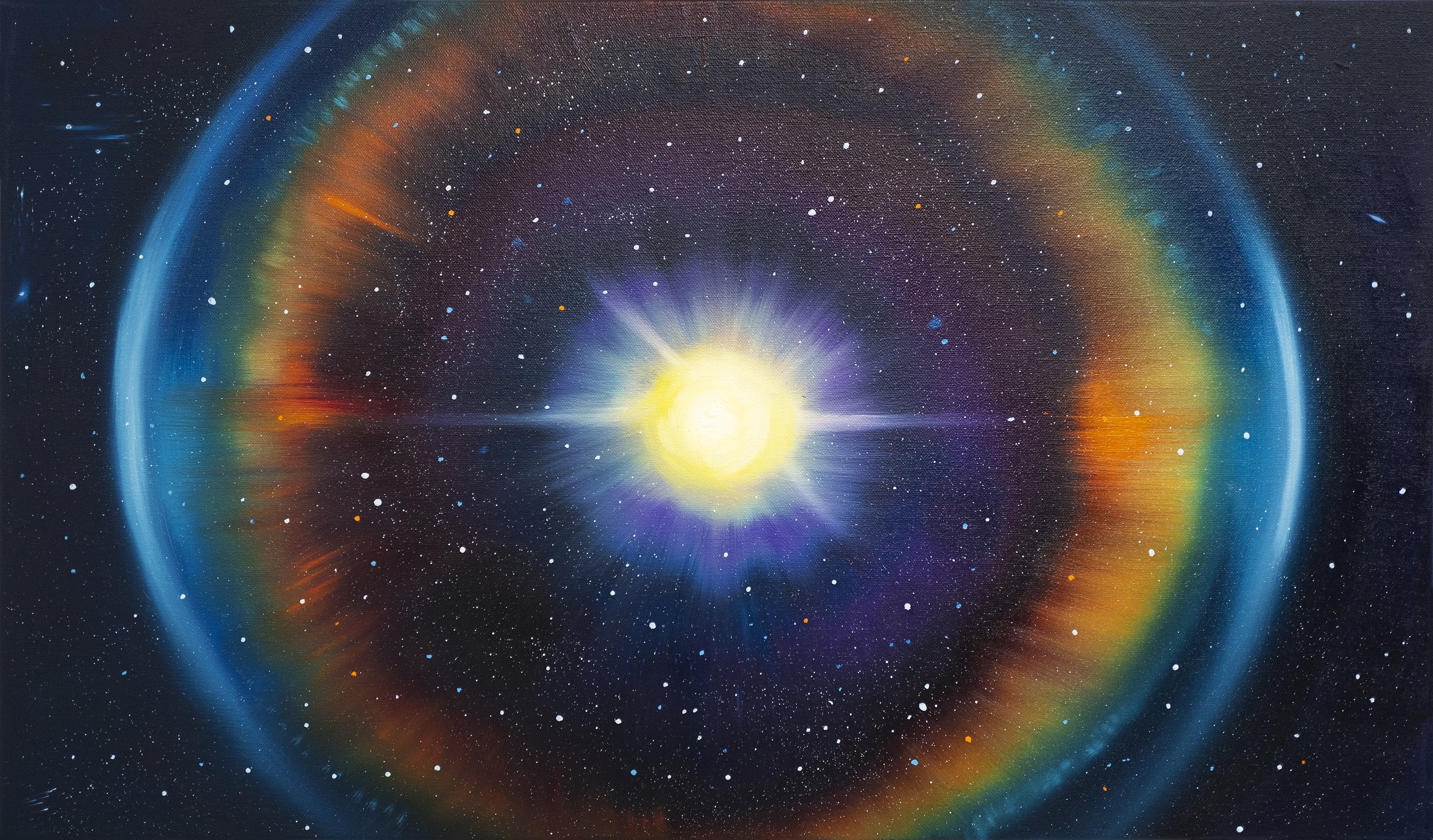
The surface of Gaze: Observable Infinity 02 is built around a central radiant form that reads simultaneously as a pupil, a star, and a nucleus. Surrounding this core, concentric rings of color radiate outward through zones of deepening darkness: blues, purples, and finally a black so saturated it functions as a boundary rather than a color. The transition from the bright center to the dark edge is not smooth. Each ring carries its own internal variation, with bands of lighter and darker pigment creating the impression of density fluctuations, as though the rings were not decorative borders but zones of accumulated matter and energy. The texture of the center differs from the texture of the outer rings. Where the core is built from thick, wax-heavy oil paint applied in concentrated marks that catch the light and cast tiny shadows, the outer rings are laid down in thinner, more fluid passages that let the dark ground show through. The result is a surface that is densest at its center and most transparent at its edges, mirroring the way galaxies cluster most densely at the center of the observable universe's mass distribution and thin out toward the cosmic horizon.
The horizontal format of the 2025 version, 36 x 61 cm compared to the 2024 version's 40 x 55 cm, changes the painting's relationship to the viewer's body. Where the earlier version approached a square, compressing the rings into a tighter vertical format, the new version stretches them laterally, allowing the outer rings to unfold and the dark margins to establish their own visual weight. The dark areas at the left and right edges of the canvas are not empty. They are painted with the same care as the luminous center, their surfaces carrying the same subtle variation in tone and texture, but their darkness makes them function as a frame within the frame, a boundary that defines the limits of what can be seen. This boundary is the painting's representation of the cosmological horizon, the edge beyond which no light reaches us, and the fact that it occupies a significant portion of the canvas makes the visible universe feel like an island of light in an ocean of unknowable darkness.
Robert Delaunay's Simultaneous Disks (1912-1913) presents a composition of concentric colored rings that expand outward from a shared center, overlapping and intersecting to produce the sensation of color vibrating in the eye. Delaunay called his theory "simultaneity," a term he borrowed from the chemist Michel Eugène Chevreul, who had studied how adjacent colors influence each other's perceived intensity. For Delaunay, the concentric circle was not merely a geometric motif. It was the fundamental structure of visual perception itself. He believed that the eye does not see static colors but experiences them as relations, as movements, as forces that generate each other in the act of looking. The Simultaneous Disks paintings make this belief tangible: the rings pulse and rotate, producing the optical sensation that the painting is in motion even though it is entirely static.
Tan Mu's concentric rings share this optical dynamism but deploy it toward a different end. Where Delaunay's disks generate pure visual sensation, detaching color from any referent outside the canvas, Gaze: Observable Infinity 02 anchors its rings in a specific cosmological structure. The rings are not abstract. They correspond to zones of galactic density, regions where matter has accumulated under gravitational attraction and where the distribution of galaxies creates a pattern that, when viewed from a sufficient distance, resolves into concentric shells. Delaunay wanted to free color from representation. Tan Mu wants color to carry representation. The deep blues and violets in her outer rings are not arbitrary chromatic choices. They correspond to the way the cosmic microwave background, the afterglow of the Big Bang, appears when mapped by instruments like the Planck satellite: fluctuations in temperature rendered as fluctuations in color, the oldest light in the universe translated into a visual palette that happens to share its spectrum with the painting's own chromatic range. The coincidence is not an accident. The colors of the cosmic background and the colors of the painting both emerge from the same physical phenomenon: the distribution of energy across a field, where concentration produces brightness and dispersal produces darkness. Delaunay intuited that color is relational. Tan Mu demonstrates that color is also cosmological.
The concept of the observable universe is, by definition, a statement about the limits of observation. We can see only what light has had time to reach us from. The radius of the observable universe is roughly 46 billion light years in every direction, but this radius is not a property of the universe itself. It is a property of the observer's position within it. An observer standing in a galaxy 10 billion light years away would see a different observable universe, centered on their own position, with a different boundary and a different set of visible structures. There is no single view. There is only the view from here, and the view from here is defined by what light can reach us within the time the universe has existed. The boundary is not a wall. It is a horizon, and like all horizons, it recedes as you approach it. The further out we look, the further back in time we see, because the light from distant galaxies has taken billions of years to reach us. The edge of the observable universe is also the beginning of time. To look outward is to look backward, and the concentric rings in Tan Mu's painting carry this temporal dimension within their visual structure: the center is the present, the outer rings are the past, and the dark margin is the limit beyond which the past becomes inaccessible.
The cosmic microwave background, the radiation that permeates the entire observable universe and provides the earliest image we have of cosmic structure, was first detected in 1965 by Arno Penzias and Robert Wilson at Bell Labs in Holmdel, New Jersey. They were testing a sensitive radio receiver and could not eliminate a persistent background noise that appeared equally in every direction they pointed the antenna. The noise was not equipment malfunction. It was the afterglow of the Big Bang, a wall of radiation emitted roughly 380,000 years after the universe began, when the plasma of protons and electrons cooled enough for light to travel freely. This radiation has been traveling through space ever since, stretching with the expansion of the universe from visible light into microwave frequencies. When mapped by instruments like the Planck satellite, it appears as a pattern of minute temperature fluctuations: regions slightly warmer and slightly cooler than the average, corresponding to the density variations that would eventually become galaxies, clusters, and the cosmic web. The pattern is a photograph of the universe when it was less than four hundred thousand years old, and it is also the template from which all subsequent structure grew. The concentric rings in Tan Mu's painting do not depict the cosmic microwave background directly. But they share its logic: a field of concentric variation radiating outward from a central concentration, where the fluctuations in density and temperature are encoded as fluctuations in color and paint density. The painting translates the cosmological into the painterly not by illustrating it but by sharing its organizational principle.
Tan Mu's observation that the observable universe resembles an eye when viewed from a distance, and an atom when flattened, is not a metaphor. It is a structural observation about the distribution of matter and energy across scales. The cosmic web, the large-scale structure of the universe formed by galaxies and dark matter clustering along filaments, exhibits a pattern of central concentration and peripheral thinning that recurs at every scale from galaxy clusters down to the distribution of electrons in an atom's orbital shells. This is not because the universe is fractal in a strict mathematical sense. It is because the forces that govern matter at every scale, gravity, electromagnetism, the strong and weak nuclear forces, all produce structures that concentrate mass and energy at their centers and dissipate it toward their edges. The circle is not a symbol that appears at one scale and is imposed on another. It is the shape that emerges whenever matter organizes itself under force, regardless of whether that matter is a galaxy or a proton.
Tan Mu has described the process of discovering this isomorphism in visual terms. "From a distance, I noticed a circular structure forming, one that resembled an eye or even an embryo," she has said. "When flattened, it began to resemble the structure of an atom." The word "flattened" is precise. She is not saying that the observable universe and the atom look the same from the same vantage point. She is saying that when you change the representation, when you adjust the scale or the projection, the same geometry reveals itself. This observation aligned with her reading of research on sparse autoencoders, neural network architectures that learn to represent complex data in compressed, low-dimensional forms. The paper she cites, The Geometry of Concepts: Sparse Autoencoder Feature Structure, demonstrated that when large language models learn concepts, the features they develop organize themselves into geometric structures like parallelograms and simplices, shapes that recur across domains and scales. The finding resonated with Tan Mu because it suggested that the visual isomorphism she had observed between the universe and the atom was not an illusion of scale but a genuine structural correspondence, one that mathematical frameworks could detect even when the eye could not.
Yiren Shen, writing about Tan Mu's Gaze series in 2025, located the paintings' significance in what she called "the reversibility of the gaze." "The universe does not merely exist to be observed," Shen argued. "In Tan Mu's rendering, it acquires the capacity to observe in return. The concentric rings become an iris, the central luminosity becomes a pupil, and the viewer who looks into the painting finds that the painting is looking back." This formulation captures the painting's central dynamic, but it undersells the specificity of what is looking back. The gaze that returns from Gaze: Observable Infinity 02 is not a human gaze. It is the gaze of structure itself, of matter organized in concentric rings regardless of scale, looking back at the observer who has organized it in the same way. The eye that the viewer sees in the painting is not a metaphor projected onto the cosmos. It is the shape that matter takes when it distributes itself under force, and the viewer recognizes it as an eye because the viewer's own eye is made of matter distributed under the same forces. The circle is seeing itself.
The 2025 version's wider format intensifies this reversibility by giving the dark margins more room to operate. In the 2024 version, the luminous center dominated the composition, with the dark edges compressed into narrow strips at the top and bottom of the nearly square canvas. In the 2025 version, the dark margins stretch laterally, creating a landscape of darkness on either side of the bright center. This compositional change shifts the emphasis from the gaze itself to the boundary that defines it. The dark margins are the cosmological horizon, the edge of what can be known, and they occupy almost as much canvas area as the luminous rings. The painting is not just about what the universe looks like from the center. It is about what the center looks like from the edge, and what the edge looks like from the center. The viewer standing in front of the canvas is positioned at both locations simultaneously: at the center of the observable universe, where all light converges, and at its boundary, where all light ends. The rings hold both positions at once, and the dark margins on either side make that duality impossible to avoid.
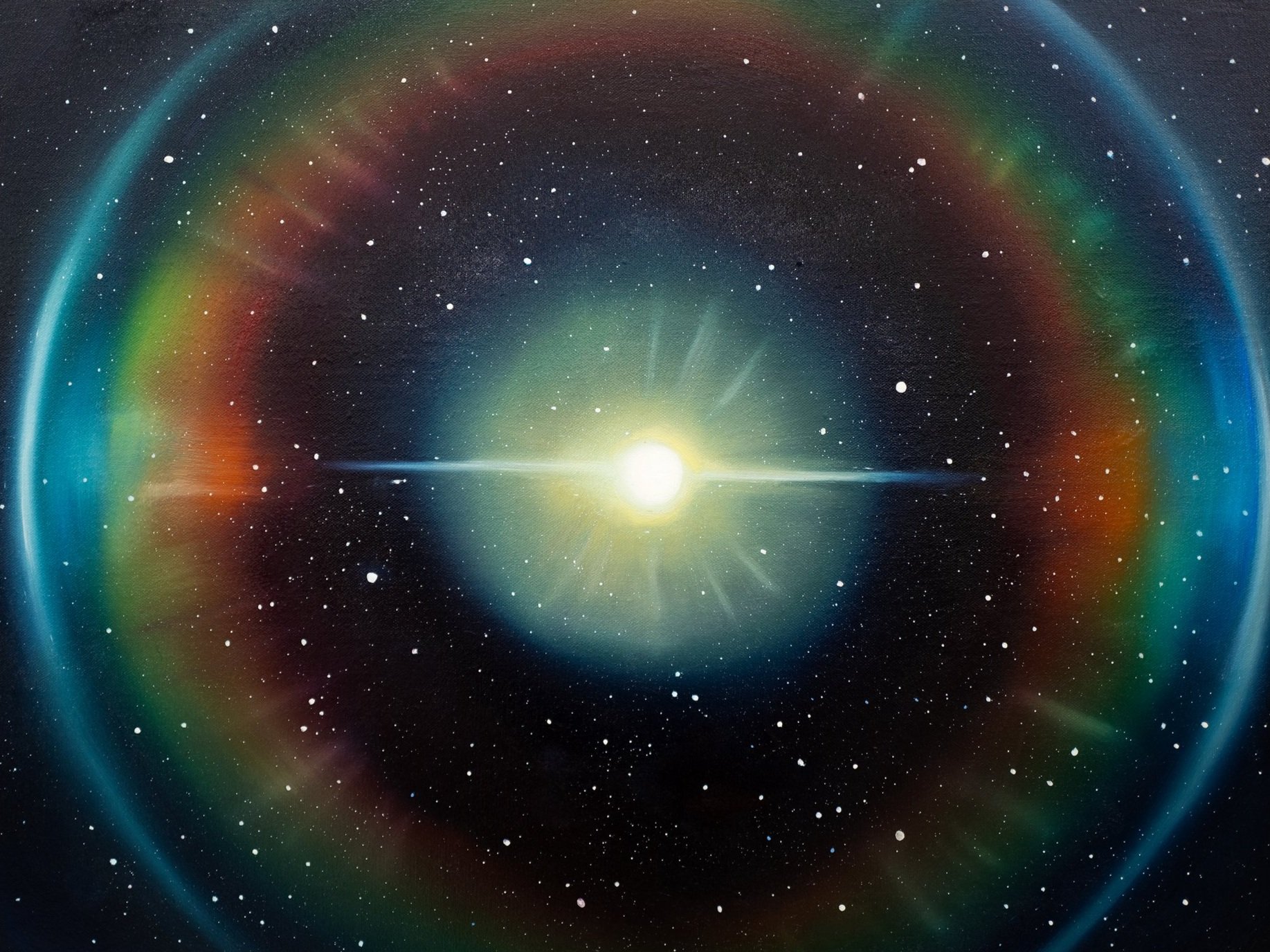
The title Gaze: Observable Infinity 02 carries a precise tension in its second word. "Observable" is a qualifier. It says: this is not infinity itself. This is infinity as it can be seen, infinity conditioned by the limits of perception and the speed of light. The painting does not claim to represent the infinite. It claims to represent what the infinite looks like when it passes through the filter of observation, when it resolves into a pattern that a finite eye can register. The concentric rings are not infinity. They are the trace infinity leaves in the visible world. And the number 02 in the title signals that this is a second pass, a second attempt to capture something that cannot be captured in a single iteration. The first version, painted in 2024 at 40 x 55 cm, compressed the rings into a nearly square format. The second version, at 36 x 61 cm, stretches them laterally, giving the dark margins room to establish their own gravity. The two paintings are not before and after. They are two observations of the same structure from slightly different positions, the way two observers in different galaxies would see different observable universes but the same underlying geometry.
The gaze that returns from the canvas is not the cosmos looking at you with understanding. It is the cosmos looking at you with the same geometry that your own eye uses to see. The pattern recognizes itself. The circle that contains its own edge, the scale that folds back on itself, the structure that is the same at the top and the bottom of forty orders of magnitude: this is what the painting holds, and it holds it in the space between an eye and a universe that share a single shape.