The Second That Split the Atmosphere: Tan Mu's Eruption and the Instant Energy Becomes Form
On January 15, 2022, at 04:14:45 UTC, the Hunga Tonga-Hunga Ha'apai volcano erupted with a force equivalent to roughly four to eighteen megatons of TNT. The explosion was heard in Alaska, six thousand miles away. The shockwave circled the Earth multiple times, detected by barometers in every continent. The ash plume reached thirty-five kilometers into the atmosphere, punching through the tropopause and injecting sulfur dioxide and water vapor into the stratosphere at concentrations measurable for months afterward. The tsunami generated by the eruption reached the coasts of Japan, the Americas, and the Arctic within hours. Undersea cables connecting Tonga to the global internet were severed, cutting the nation off from all digital communication for five weeks. The satellite photo of a disconnected Tonga, shared instantly with the world, traveled through space while the cable that should have carried it lay broken on the ocean floor. For a brief period, the island existed in a state of total communicative isolation, visible from orbit but unreachable by signal.
Tan Mu's Eruption (2022) takes as its subject not the aftermath of this event but the instant of release. Oil on linen, 76 x 61 cm (30 x 24 in), the painting presents an overhead view of the volcanic eruption, seen from above as if through a satellite's lens, with two crossing lines overlaid on the composition that evoke the targeting marks of machine vision. The format is vertical, orienting the viewer above the event rather than at a distance from it. The eruption fills the canvas: a central column of energy expanding outward in concentric waves of ash, steam, and displaced atmosphere. Tan Mu painted the work on the day the eruption occurred, responding to the event in real time, and she has described the process of completing the seven paintings in the Eruption series over approximately ten days, each one produced in a single sustained session of roughly ten hours. The painting is a time capsule of a fraction of a second, sealed over the course of a day.
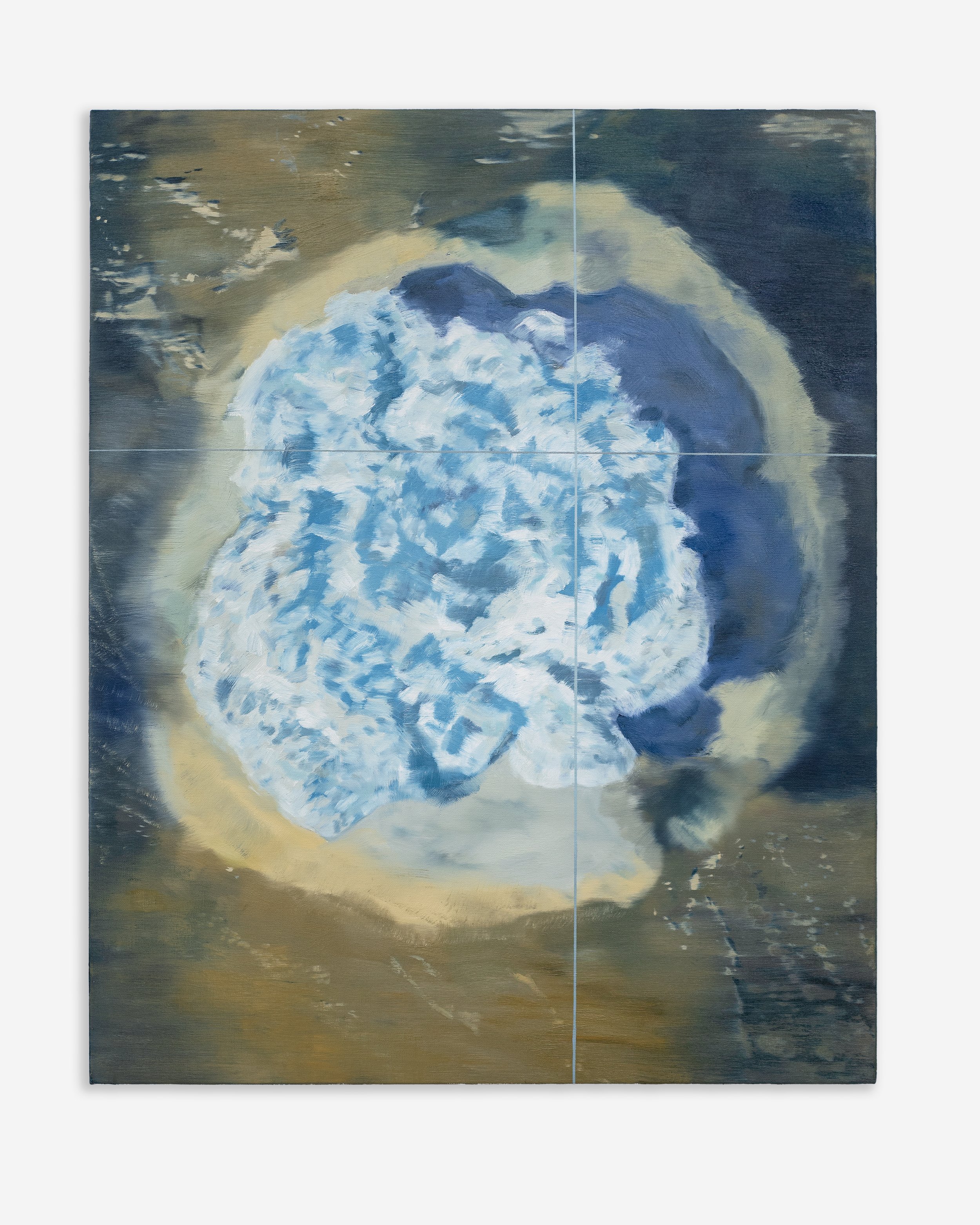
The surface of Eruption is built from layers of oil paint that accumulate toward the center of the composition, where the explosive force is greatest. The outer edges of the canvas show a dark, nearly black ground, thin enough in places that the linen weave is visible beneath it. As the eye moves inward, the paint thickens: bands of deep gray and brown give way to lighter tones of ash and ochre, and finally to a central zone of intense luminosity where whites, pale golds, and flashes of orange-red mark the point of maximum energy release. The transition from dark to light is not smooth. It proceeds in surges, as though each ring of color were a separate pressure wave moving outward from the explosion's center. The paint in this central zone is applied with more body than the surrounding rings, raised above the surface in ridges that catch the light and cast tiny shadows, making the point of eruption the most tactile part of the painting. This is where the painting's surface corresponds most directly to its subject: the place of maximum violence is also the place of maximum paint.
The two crossing lines that overlay the composition are rendered in a thinner, more precise hand than the surrounding eruption. They are straight where everything else expands, mechanical where everything else is organic. These lines do not follow the radial logic of the explosion. They cut across it at diagonal angles, dividing the canvas into quadrants and imposing a coordinate system on the chaos beneath them. Tan Mu has described these marks as evoking machine targeting, the kind of crosshair overlay that satellite imagery and military reconnaissance systems use to identify and fix locations. Their presence introduces a second mode of seeing into the painting: the eruption is not only witnessed but targeted, not only observed but measured and calibrated. The natural event and the technological apparatus that records it occupy the same surface, and the crossing lines make that co-occupation explicit.
In 1842, Joseph Mallord William Turner exhibited Snow Storm: Steam-Boat off a Harbour's Mouth Making Signals in Shallow Water, and Going by the Lead. The Author Was in This Storm on the Night the Ariel Left Harwich, a painting whose title nearly matches its canvas in ambition. The work depicts a steamboat caught in a swirling vortex of wind, water, and snow, rendered in concentric arcs of white, gray, and brown paint that obscure the horizon and dissolve the distinction between sea and sky. Critics at the time were baffled. John Ruskin, who would become Turner's most eloquent defender, described the painting as "one of the very grandest [Turner] ever produced," but the Royal Academy audience saw only chaos. Turner himself reportedly told a critic who asked about the painting that he had asked his mother whether she could tell what it was, and she replied that it was a "snow storm" and that was enough. The painting's power lies precisely in the way it refuses to prioritize legibility over sensation. The viewer does not see the steamboat first and the storm second. The viewer sees the storm, and the boat is discovered within it, a small dark mass at the center of the vortex, visible only after the eye has adjusted to the turbulence around it.
Turner's late paintings, produced between 1835 and 1851, constitute one of the most sustained investigations in Western art into the representation of energy, atmosphere, and the dissolution of solid form into environmental force. In works like The Slave Ship (1840), Rain, Steam and Speed (1844), and the snowstorm painting, Turner developed a technique of building form through successive layers of translucent pigment, allowing earlier marks to show through later ones, so that no single layer ever achieves final authority over the surface. The result is a visual field in which objects emerge from and dissolve back into the atmosphere that surrounds them. The steamboat in the snowstorm painting does not sit on top of the waves. It materializes out of them, its dark hull emerging from the vortex of white and gray that constitutes the storm, and it threatens at any moment to be reabsorbed by the forces that made it briefly visible.
Turner's snowstorm and Tan Mu's eruption share more than their subject matter. Both paintings place the viewer inside a vortex of energy rather than at a safe distance from it. Both use concentric compositional structures that radiate outward from a center of maximum intensity. Both dissolve the boundary between the event and its environment: in Turner's painting, the sea, the sky, and the storm merge into a single atmospheric field; in Eruption, the volcanic plume, the displaced atmosphere, and the shockwave merge into a single expanding structure. And both paintings impose a technological frame on the natural event. Turner's title specifies that the steamboat was "making signals," a detail that inserts communication technology into the heart of the storm. Tan Mu's crossing lines perform a similar function: they are the apparatus of measurement overlaid on the apparatus of destruction. The difference is one of emphasis. Turner's signals are a small, human element within the storm, a fragile attempt at communication in the face of overwhelming force. Tan Mu's crosshairs are not fragile. They are the product of the same technological infrastructure that makes the eruption visible in the first place, the satellite imaging system that captured it from orbit and transmitted the image around the world while the cable that should have carried it lay severed on the ocean floor.
The eruption of Hunga Tonga-Hunga Ha'apai was not only a geological event. It was also a communications event. The severing of the undersea cable that connected Tonga to Fiji and from there to the rest of the world produced a condition that is rare in the twenty-first century: total informational isolation. For five weeks, the people of Tonga could not reach the outside world, and the outside world could not reach them, except through satellite phones held by a handful of officials. The disaster was both physical and infrastructural. The volcano destroyed homes, contaminated water supplies, and displaced thousands. The cable cut compounded these effects by making it impossible to coordinate relief, share information, or even confirm that survivors existed. The eruption and the cable cut were not separate events. They were the same event understood at two scales: the geological and the communicative, the release of energy and the rupture of the network that carries information.
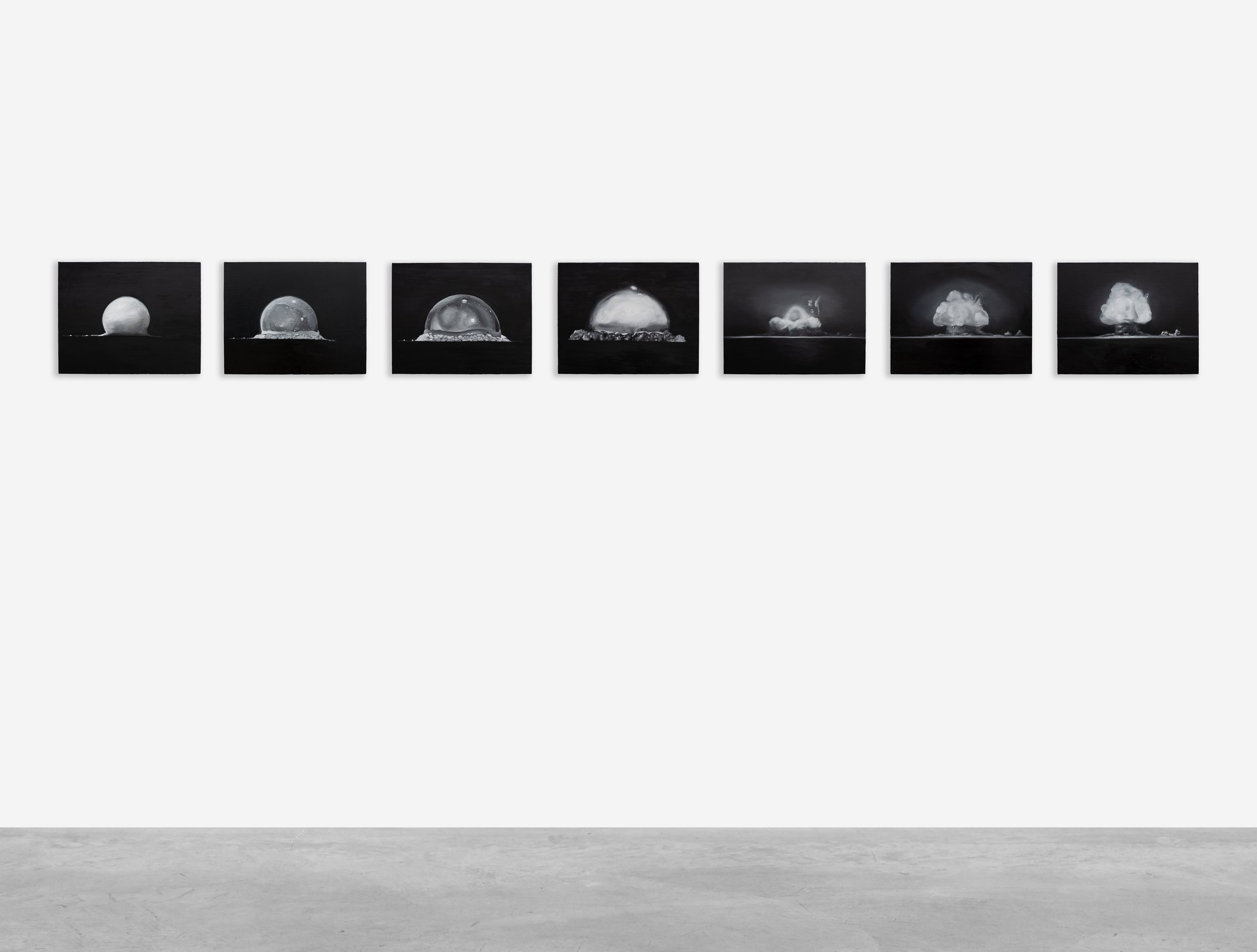
Tan Mu's Q&A for the Eruption series locates the paintings within a broader fascination with moments where accumulated energy crosses a threshold and becomes visible. "I am especially drawn to the instant when an immense amount of energy erupts, whether it is man-made or natural," she has said. "This fascination also appears in my Eruption series, where I depict underwater volcanic eruptions and disruptions in submarine cables. In each case, moments of rupture and explosion generate new orders and unknown conditions." The phrasing is precise. She does not say that the eruption destroys order. She says it generates new orders. The crossing lines, the severed cable, the shockwave that circled the Earth: these are not the collapse of a system but the emergence of a new configuration, one in which the same forces that destroy infrastructure also make it visible. The satellite image that documented the eruption traveled through space because the cable that should have carried it was destroyed. The technology of observation and the technology of communication, usually aligned, were forced into separation by the same event.
Danni Shen, writing about Tan Mu's practice in 2024, identified what she called the "threshold moment" as the central organizing principle of the Eruption series. "Each painting in the series captures not the before or the after but the instant of transformation," Shen argued, "the fraction of a second when accumulated pressure becomes visible force, when the underground becomes the above-ground, when what was hidden reveals itself as an event that reshapes everything around it." This formulation captures the temporality of the paintings precisely. They are not documentary images of a volcanic eruption as seen from a satellite. They are records of a threshold, the moment when the invisible becomes visible, when pressure that has been building in the earth's mantle crosses the point of no return and erupts into the atmosphere with enough force to be heard six thousand miles away.
The process Tan Mu describes for the Eruption series reinforces this threshold logic. She completed each of the seven paintings in a single day, working for approximately ten hours with full concentration and without interruption. "Each painting represents a fragment of time, transformed into a visual record," she has said. "It felt as though I was stretching time, entering that brief instant and examining its impact from within. There was something deeply connected to the idea of creation itself. Each day felt like the birth of something new, almost as if I were conducting an experiment with time." The analogy between the volcanic eruption, which releases geological pressure accumulated over centuries in a matter of seconds, and the painter's concentrated session, which compresses hours of focused labor into a single finished surface, is not decorative. It is structural. Both the eruption and the painting are events that convert stored energy into visible form, and both take a quantity that was invisible, geological pressure in one case, sustained attention in the other, and make it manifest in a single act of release.
The crossing lines in Eruption also carry an additional meaning that connects to Tan Mu's broader practice. In the Signal series, lines represent submarine cables carrying data across ocean floors. In Eruption, lines represent the targeting apparatus that makes the event legible as data. The same visual element, the straight line traversing a field of energy, serves opposite functions across the two series. In Signal, the line is the conduit that carries information. In Eruption, the line is the frame that isolates and identifies the event. The submarine cable and the satellite crosshair are both technologies of connection, but they connect in opposite directions: the cable connects places to each other, the crosshair connects an event to a coordinate system. When the eruption severs the cable, these two modes of connection are forced into collision. The painting holds both on the same surface: the expanding vortex of natural energy and the precise, mechanical grid that makes it visible. The result is not a synthesis. It is a collision, and the collision is the painting's subject.
The concept of vibration ties the Eruption series to Tan Mu's broader preoccupation with oscillation as a structural principle. In an interview about the Eruption paintings, she described the experience of making them as analogous to the experience of playing music, an activity she has practiced since childhood. "When playing the piano," she said, "each key produces a sound, a vibration. I see a visual equivalent in the Eruption series: each painting is a vibration, a frequency captured in paint." The analogy is not decorative. A musical vibration is a periodic disturbance in air pressure that propagates outward from its source, creating waves that the ear registers as pitch. A volcanic eruption is a periodic disturbance in geological pressure that propagates outward from its source, creating waves that the atmosphere registers as sound, that the ocean registers as tsunami, and that barometers around the world register as a pressure pulse circling the planet. Both are forms of energy release that generate waves. The painting that captures the eruption is a vibration of a different order: a visual vibration, a frequency translated from pressure into pigment, from geological time into the time of a single day's concentrated work.
The 76 x 61 cm format gives the eruption enough room to expand without overwhelming the viewer. The vertical orientation places the column of ash and steam directly in front of the viewer's body, as though the eruption were rising from a point below the canvas and extending toward a point above it. The crossing lines, because they are rendered in a thinner, more deliberate hand, appear to float above the surface of the eruption, as though they belong to a different layer of reality. And they do. The eruption belongs to the earth's mantle and the ocean floor. The crosshairs belong to the satellite, the algorithm, the targeting system. The painting holds both layers simultaneously and refuses to resolve them into a single image. What you see depends on which layer you attend to, and the shift from one layer to the other is the experience of the painting: first the explosion, then the frame that contains it, then the explosion again, seen through the frame. The threshold is not only in the eruption. It is in the viewer's attention, which oscillates between the force that destroys and the apparatus that records, between the energy that bursts and the grid that fixes it in place.