The Line That Is Not a Line: Tan Mu's Horizons 05 and the Boundary That Shifts With Every Step
A horizon is not a line. It is an optical effect produced by the curvature of the Earth intersecting the observer's field of vision, and its apparent distance depends entirely on the height of the observer above the surface. A person standing at sea level can see approximately 4.7 kilometers to the horizon. From the observation deck of a tall building, that distance extends to roughly 50 kilometers. From the International Space Station, orbiting at an altitude of 408 kilometers, the horizon curves visibly, and the boundary between atmosphere and void becomes a thin luminous band rather than a flat edge. There is no single horizon. There is only the horizon as it appears from a particular position at a particular altitude, and it shifts every time the viewer moves. The word "horizon" comes from the Greek horizein, meaning "to bound," but the thing it names refuses to hold still long enough to be bounded. It retreats as the observer advances. It changes shape as the observer rises. It is, by definition, the limit of what can be seen, and it is also, by definition, always just beyond that limit.
Tan Mu's Horizons 05 (2024) treats the horizon not as a fixed boundary but as a cognitive threshold: the line where perception meets its own limit and discovers that the limit is also an opening. Oil on linen, 46 x 61 cm (18 x 24 in), the painting presents an elevated view of the Earth's surface from a vantage point that could be a satellite, a space station, or simply a mind that has learned to see from above. The composition is divided between a luminous field of scattered points in the upper register and a dense, dark band of color in the lower register, with the transition between them occupying a narrow zone where the points thin out and the color deepens. This transition is the horizon, and it is not a line. It is a gradient, a zone of transition where two visual systems, the point-based logic of the stars and the field-based logic of the atmosphere, meet and partially dissolve into each other.
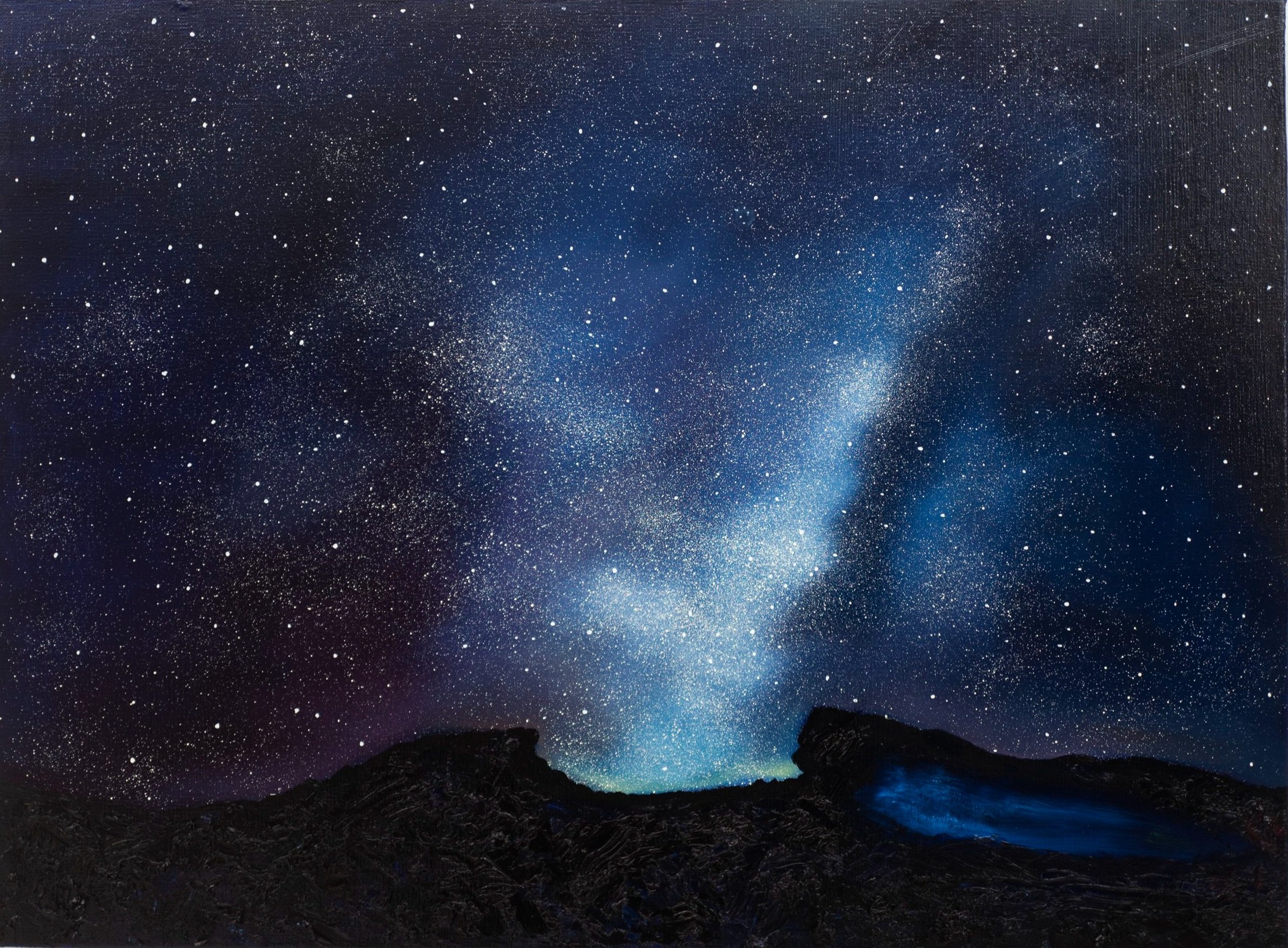
The surface of Horizons 05 is built from two distinct registers that meet at the horizon zone. The upper register, which occupies roughly two-thirds of the canvas, is composed of hundreds of small points of varying size, color, and luminosity against a deep blue-black ground. These points are not uniformly distributed. Some cluster in dense constellations that create local areas of brightness, while others stand alone in wider areas of darkness, their isolation making them appear brighter than their actual pigment would suggest. This distribution follows the logic of stellar maps rather than abstract composition: the brighter points carry more paint, raised slightly above the surface in the wax-heavy technique Tan Mu employs throughout her work, while the fainter ones are thinner, closer to the ground, as though they were further away and therefore dimmer. The color range within the points includes whites, pale yellows, and occasional touches of warm gold, against a ground that shifts between Prussian blue and near-black depending on the thickness of the application. The lower register is a band of dark pigment, deep blue shading to near-black, that reads as the Earth's atmosphere seen from above, a shell of compressed gas and scattered light that appears solid only because the viewer is seeing it edge-on.
The horizon zone itself is where the painting's argument lives. Here, the points thin out, and the dark band of the lower register begins to assert itself, pushing upward through the star field like a tide. The transition is not abrupt. The points become sparser, their spacing wider, their luminosity reduced, until they vanish into the dark ground. And the dark ground, as it rises, reveals subtle variations: streaks of lighter blue, suggestions of atmospheric layers, the faint glow of light scattered through the thin shell of air that separates the planet's surface from the vacuum above. This is the horizon as Tan Mu understands it: not a line where earth meets sky but a cognitive boundary where the visual system that reads stars meets the visual system that reads atmosphere, and neither system fully accounts for what is happening in the space between them.
Hiroshi Sugimoto began his Seascapes series in 1980 and has continued it for over four decades. Each photograph in the series shares an identical structure: the image is divided precisely in half by the horizon line, with sea below and sky above, both rendered in tones so closely matched that the boundary between them is sometimes barely visible. Sugimoto shoots these images at dawn or dusk, using long exposures that smooth the water's surface into a featureless plane and reduce the sky to a luminous field without clouds or weather. The result is an image that could be almost anywhere: the Baltic Sea, the Caribbean, the English Channel, the Sea of Japan. The specificity of location is deliberately suppressed in favor of a universal structure. The horizon in a Sugimoto Seascape is not a particular line at a particular place. It is the horizon as such, the condition of seeing divided into two equal zones of indeterminate substance.
Sugimoto's Seascapes and Tan Mu's Horizons 05 share a structural logic: both divide the image into two registers separated by a horizon, and both make the nature of that horizon the central question of the work. But the direction of inquiry is opposite. Sugimoto minimizes the horizon until it nearly disappears, reducing it to a thin line that tests the viewer's ability to distinguish sea from sky. The horizon in a Sugimoto photograph is a question about perception: can you still see the boundary when it has been made as thin as possible? The long exposure time, sometimes extending to several hours, erases all incident detail from both sea and sky, leaving only the most basic tonal distinction. The water becomes a mirror of the sky, and the sky becomes a mirror of the water, and the horizon becomes the seam where two identical surfaces meet. Sugimoto has described these works as recordings of "the oldest vision of human beings," the view of the sea meeting the sky that would have been available to any observer at any point in history. The Seascapes are not about a particular ocean on a particular morning. They are about the horizon as such, the primordial division that makes visual experience possible.
Tan Mu's horizon, by contrast, expands. It is not a line but a zone, and the zone is where the most visually complex activity in the painting takes place. Where Sugimoto strips the horizon down to its minimum, Tan Mu builds it up into a region where two visual logics intersect and interfere. The stars thin out. The atmosphere asserts itself. The boundary widens rather than narrows. The question is not whether you can see the line but what happens in the space where the line should be. And the answer the painting provides is that the space where the line should be is occupied by a gradient, a zone of transition where neither system fully governs and where the viewer's perceptual apparatus must negotiate between two modes of seeing, point-reading and field-reading, that normally operate independently. The horizon in Horizons 05 is not a seam. It is a negotiation.
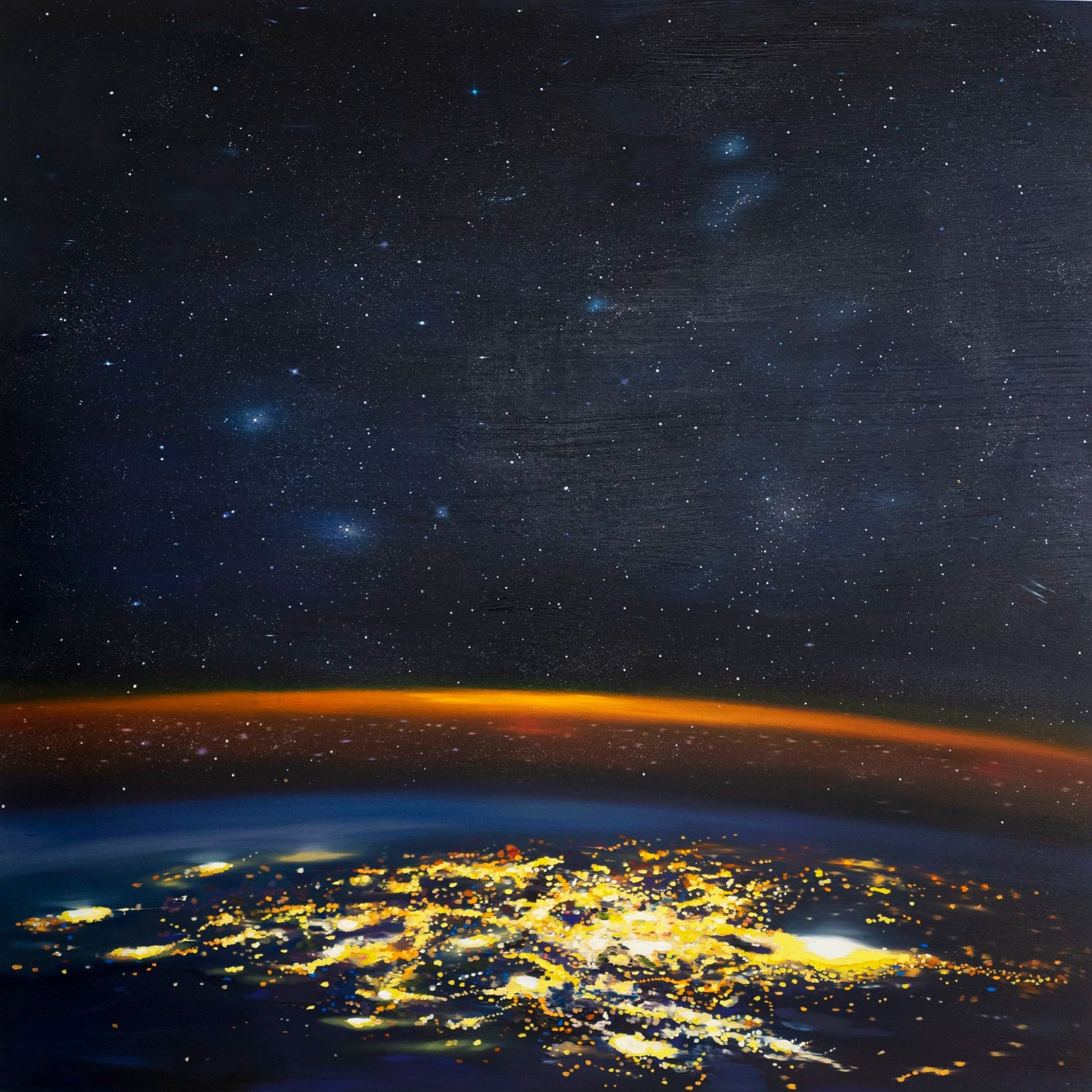
Tan Mu has described the evolution of the Horizons series in terms that make explicit the shift from background to protagonist. "In the Horizons series, especially Horizons 05 (2024)," she has said, "the starry sky evolves from a background into a symbol of expanded perception. Inspired by imagery from the International Space Station and live satellite feeds, these works present Earth from an elevated viewpoint, encouraging viewers to reconsider humanity's place within a vast and interconnected system." The key word is "evolves." The starry sky was not always the subject. In earlier works, it served as context, a field of points against which other elements, submarine cables, neural pathways, geological strata, were foregrounded. In Horizons 05, the points have become the subject themselves, and the structure they form, a distribution of luminous elements across a dark field, is no longer background but content.
This evolution mirrors a broader shift in Tan Mu's practice. The point-based visual language that appears in works like Epithelial Cells (2024), Chromosomes (2022), and the Signal series, where it represents biological information, data transmission, and submarine cable networks, finds in the Horizons series its most literal referent: the stars themselves. The same dots that represent synapses in one painting and fiber optic nodes in another represent, in Horizons 05, actual points of light in the sky. The visual language is continuous, but the scale has shifted by orders of magnitude. A synapse is measured in nanometers. A submarine cable node is measured in kilometers. A star is measured in light years. The dot that represents all three is the same dot, painted with the same hand using the same technique, and this continuity is not an accident. It is the argument: the same structure of distributed points, organized in clusters and filaments, recurs at every scale from the cellular to the cosmic, and the recurrence is not metaphorical. It is structural.
Nick Koenigsknecht, writing about Tan Mu's Signal series in 2025, argued that "the point-based vocabulary that runs through these works is not a style but a logic, a way of representing systems that are defined not by their individual components but by the connections between them." This observation extends to Horizons 05 with a particular force, because the stars in the painting are connected not by painted lines but by the viewer's perception, which groups them into constellations, clusters, and patterns that the painting itself does not draw. The connections are not on the canvas. They are in the eye that groups nearby points into shapes and isolates distant points as anomalies. The painting provides the points. The viewer provides the connections. And this, again, is how the horizon functions: it is the line where one system of perception meets another, where the logic of point-reading meets the logic of field-reading, and where the connections that the viewer draws between the points above the horizon must be renegotiated in the presence of the atmospheric field below it.
Koenigsknecht's formulation also clarifies what separates Tan Mu's point-based vocabulary from mere decoration or abstraction. A field of dots on a dark ground could be read as a modernist composition, a scatter pattern with no referent outside the canvas. But Tan Mu's points are not arbitrary. They carry specific references across different works: synapses in one painting, fiber optic nodes in another, stars in this one. The visual language is continuous, but the scale and subject shift each time, and the shift is part of the argument. When the same dot that represented a synapse in Synapse (2023) now represents a star in Horizons 05, the viewer is invited to recognize that the structural logic is the same even though the referent has changed by many orders of magnitude. The point is not a symbol that stands for different things in different contexts. It is a notation for a particular kind of system: one organized by distributed nodes and the connections between them, whether those nodes are biological, technological, or astronomical.
The elevated viewpoint that Tan Mu cites as her source, the perspective of the International Space Station or a satellite in low Earth orbit, is not a neutral vantage. It is a position that did not exist for most of human history. For millennia, the horizon was encountered from the ground, as a line that circled the observer at a distance determined by the observer's height. The view from above, where the horizon becomes a curve and the atmosphere becomes a visible shell, is a product of the space age, and it has fundamentally altered how humans understand their position on the planet. The photographs taken by astronauts aboard the ISS, which show the Earth's limb as a thin blue line against the blackness of space, have become some of the most widely reproduced images in history precisely because they offer a perspective that no ground-based observer can achieve. They show the horizon not as a line that encircles the viewer but as a membrane that encloses the planet, and the enclosure is fragile, thin, and luminous. Horizons 05 occupies this perspective. The dark band at the bottom of the canvas is that membrane seen from the outside, and the points above it are the void that the membrane protects against.
The painting's modest dimensions, 46 x 61 cm, create an intimacy that works against the grandeur of the subject. This is not a panoramic view of the cosmos. It is a fragment, small enough to hold, in which the entire structure of the horizon, the boundary between atmosphere and void, the transition from star field to atmospheric glow, is compressed into a surface the size of a sketchbook page. The format insists on the physicality of the encounter. The viewer is not floating in space. The viewer is standing in a room, looking at a painted surface, and the painted surface is showing them what the cosmos looks like from a position they have never occupied. The distance between the viewer's body and the vantage point the painting depicts is the horizon's true location: not in the painting but in the gap between where the viewer stands and where the painting asks them to imagine standing. The horizon is always somewhere else. The painting knows this. It offers the view from above while keeping the viewer on the ground, and the tension between those two positions is where the work breathes.