The Field That Harvests Light: Tan Mu's Solar Farm and the Grid Rewriting the Land
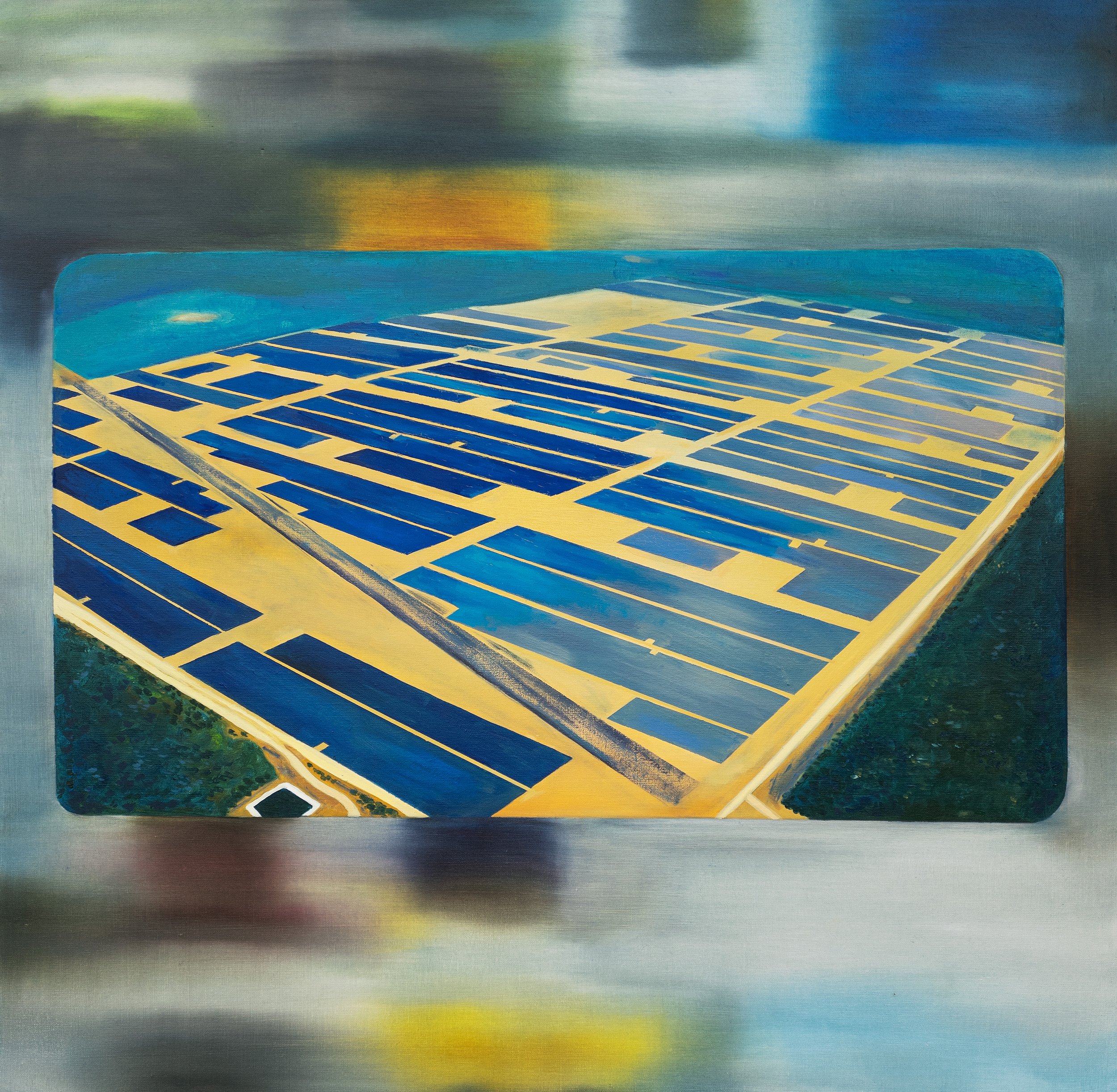
A square painting holds a square field. The format is not incidental. At 76 x 76 cm, Tan Mu's Solar Farm (2022) encloses its subject in a proportion that mirrors the geometric regularity of the solar panel array it depicts: rigid, planar, deliberately bounded. The painting's own edges perform the same operation of containment that the array performs on the landscape, drawing a perimeter around something that, in reality, sprawls. Within that square, rows of photovoltaic panels stretch toward a horizon that the elevated viewpoint keeps perpetually visible, a thin luminous margin where the grid ends and the atmosphere begins. This is a painting about what happens when a landscape stops being a landscape and becomes a circuit, and the square format makes that conversion legible from the first glance.
The source image for this work came from a phone camera. Tan Mu has said so directly. She was living in Florida at the time, driving on highways and passing airports where vast fields of panels unspooled beside the road, and she photographed what she saw. The phone, held at an angle somewhere between a passenger's casual documentation and a satellite's dispassionate recording, produced an image that was already mediated before the first stroke of paint touched linen. The painting thus begins not from direct observation of the land but from an observation of an observation, a screenshot of a screen, and this layered mediation is not incidental to the work's meaning. It is the work's meaning. Solar Farm records the moment when looking at infrastructure became indistinguishable from looking at a phone, and when a field of panels harvesting sunlight became, through the same gesture, a field of pixels harvesting attention.
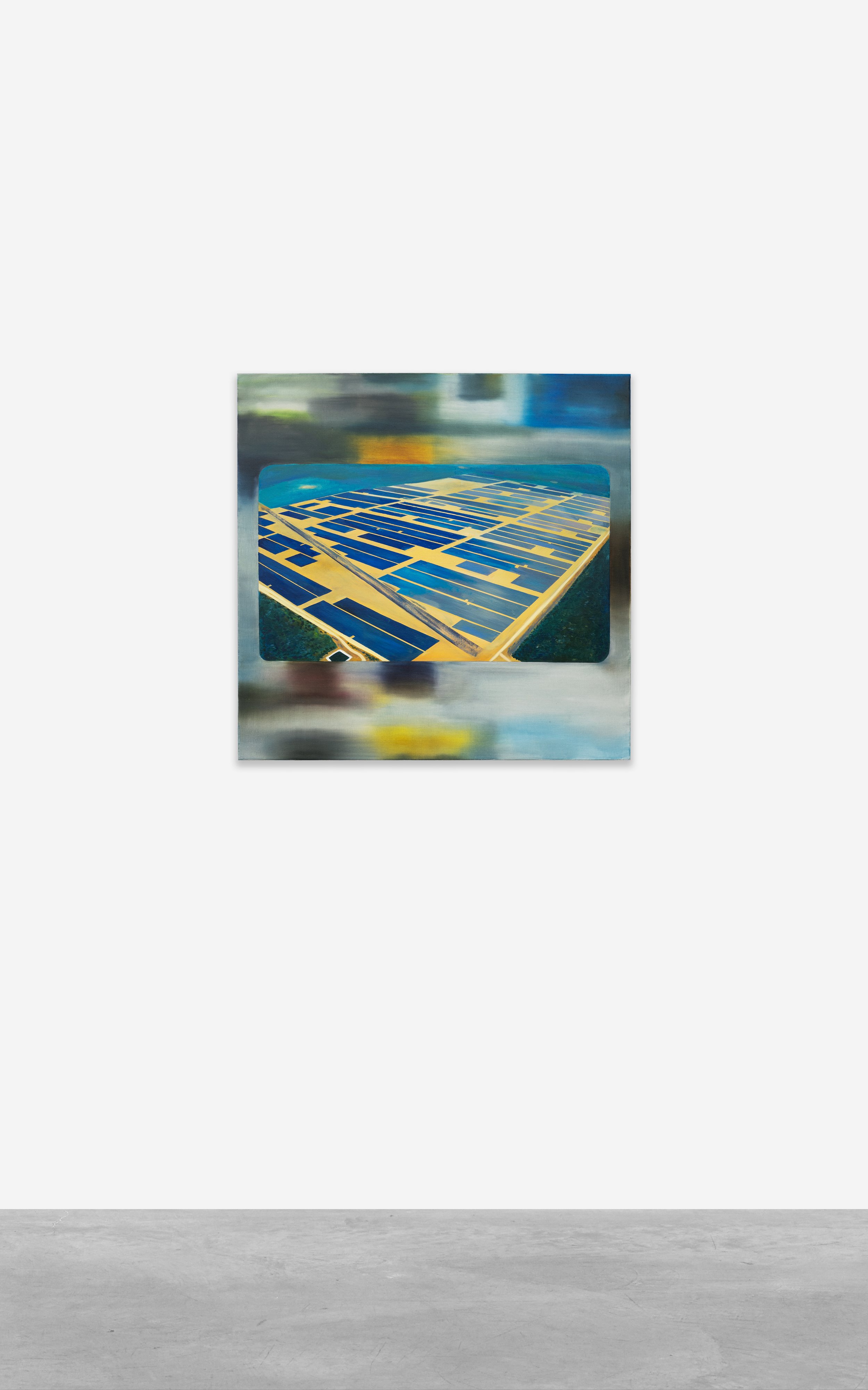
Oil on linen, 76 x 76 cm (30 x 30 in). The square format is uncommon in Tan Mu's output, where landscape-oriented rectangles dominate, and the choice tells. Most of her infrastructure paintings, from the submarine cable maps of the Signal series to the data centers and quantum computers, adopt horizontal formats that suggest panoramic reach, maps unrolling, networks extending beyond the frame. The square of Solar Farm does something different: it crops. It selects a bounded portion of a much larger installation and treats it as a self-contained unit, the way a circuit board isolates a functional module within a larger system. The panels within the painting are arranged in neat rows and columns, their dark blue and near-black surfaces catching reflected highlights that shift across the surface depending on the imagined angle of the sun. The surrounding terrain, rendered in blurred and desaturated greens and browns, recedes around the array like the margins of a printed circuit, the negative space that makes the traces legible.
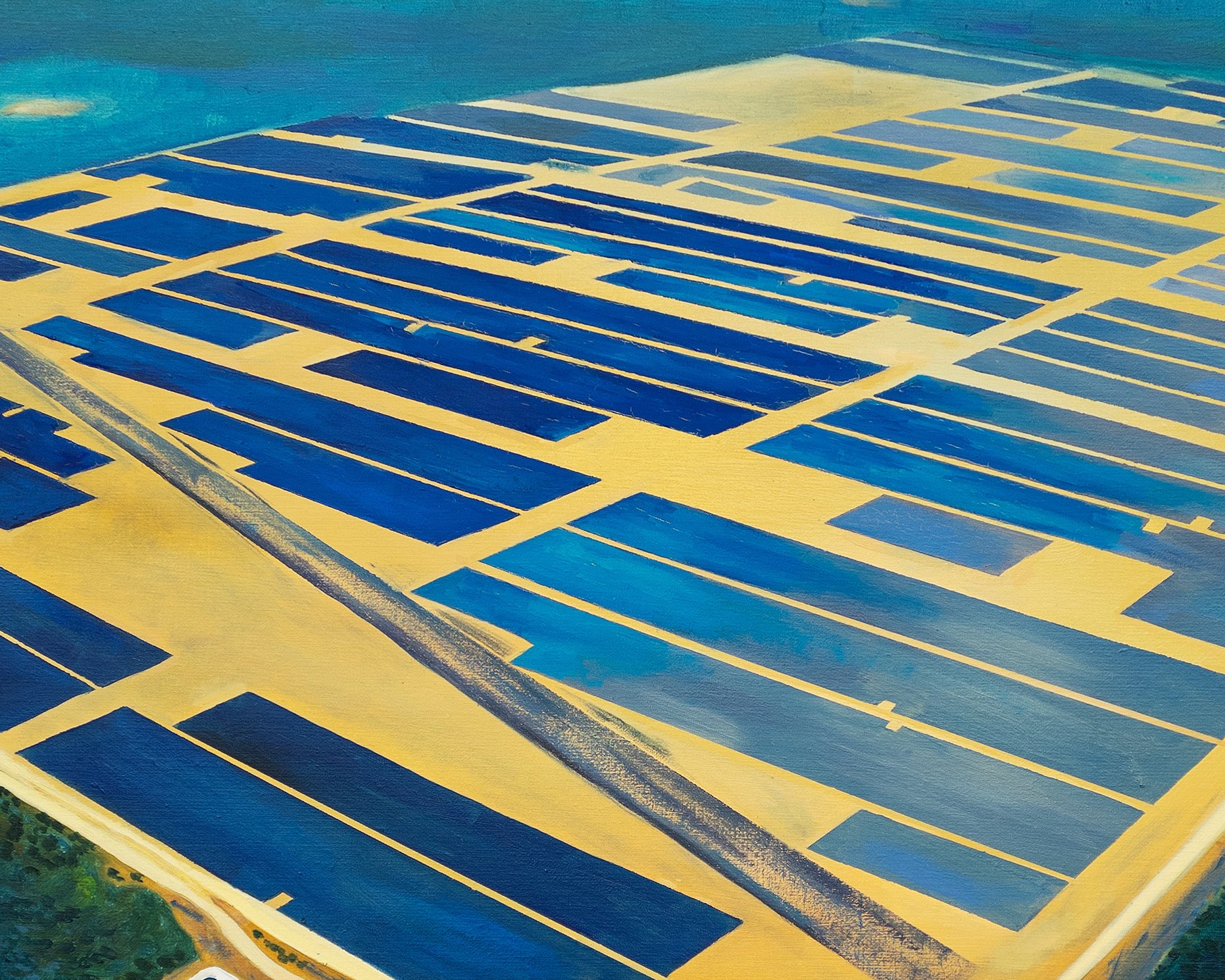
At viewing distance, the array reads as a single imposing form: a dark rectangular mass implanted in the landscape with the authority of a military installation. The panels appear nearly black, their surfaces absorbing light rather than reflecting it, which produces an initial visual paradox. These are devices designed to harvest light, yet in the painting they appear to swallow it. Only as the viewer moves closer does the surface reward sustained attention. Individual panels emerge from the collective darkness. Subtle tonal shifts register the angle of each module: some flash cerulean where the imagined sun strikes at a low angle, others hold a deep indigo that borders on violet, and still others reflect a pale celadon that reads as sky bounced off glass. These color shifts are not decorative. They are the painting's argument made visible. Each panel is a discrete unit of capture, oriented at a specific angle to maximize absorption, and the color variation across the array is the index of that orientation. The painting makes the physics of photovoltaic collection legible as chromatic variation, so that looking at the surface becomes, in a small way, analogous to what the panels themselves do: registering differences in the angle and intensity of incident light.
The background of the painting is blur. Not the atmospheric blur of a landscape dissolving into haze, but the deliberate, digital blur of a phone camera struggling to reconcile foreground focus with peripheral information. Tan Mu has embedded this quality into the paint itself. The edges of the panel array soften and bleed into the surrounding terrain, and the terrain beyond the array dissolves into broad, unfocused strokes where green and brown and a muted ochre merge without clear delineation. This is not the blurred background of a traditional landscape where depth of field creates a gentle recession into atmosphere. This is the blurred background of a screenshot, where the phone's computational photography engine has decided that the solar panels are the subject and the rest is disposable context. The painting preserves that hierarchy of attention that the phone imposed, and in preserving it, makes it visible as a decision rather than a natural condition. The land surrounding the array is not out of focus because it is far away. It is out of focus because the device photographing it assigned it a lower priority than the panels.
In 1877, Claude Monet exhibited a group of paintings at the Third Impressionist Exhibition that would change how painting registered industrial modernity. The Gare Saint-Lazare series, seven canvases depicting the railway terminus in western Paris, placed steam locomotives and iron-and-glass architecture at the center of pictorial attention with a directness that scandalized viewers accustomed to landscape painting that excluded the marks of contemporary industry. In Arrival of a Train (1877, Fogg Art Museum), the locomotive pushes toward the viewer through a cloud of steam that Monet renders as a luminous veil of white, blue-gray, and faint gold. The train shed's iron ribs arch overhead like the vaulting of a modern cathedral, and the steam fills the space between iron and glass with a radiance that competes with the daylight streaming through the roof. The painting does not show a train arriving at a station. It shows light arriving at a surface: the glass roof, the iron framework, the steam cloud, the stone platform, each one a receptor transforming incident light into a different register of color and atmosphere.
Monet was not documenting the railway. He was painting what the railway did to vision. The steam, the iron, the glass: these were not subjects but media, surfaces that refracted and redirected light in ways that the pastoral landscapes of the Barbizon School could not account for. The station was a machine for producing visual effects, and Monet's brushwork registered each effect as a separate event: the way steam diffused the hard geometry of the roof, the way iron railings cast shadows that fragmented the platform into a pattern of dark and light bars, the way the entire enclosed space functioned as a camera obscura in which light was endlessly captured, redirected, and released. Tan Mu's own account of Solar Farm cites Monet directly: "I often think about Impressionist painters such as Claude Monet, who documented industrial transformations in their time. His paintings of train stations and factories not only captured new technologies but later became valuable historical records." The citation is not decorative. It is structural. The parallel between Monet's steam and Tan Mu's photovoltaic surfaces holds because both artists found in an industrial technology a new grammar for light. Monet's steam was a medium that transformed the light of the station into visible atmosphere; Tan Mu's panels are media that transform sunlight into electricity, and she renders them as surfaces that transform sunlight into paint. In both cases, the technology is not merely depicted but enacted, its function reproduced in the painting's own visual logic.
What Monet's Gare Saint-Lazare and Tan Mu's Solar Farm share is not a superficial similarity of subject, the one showing trains and the other showing solar panels, but a structural operation: each painting identifies a technology that converts energy from one form to another and makes that conversion visible as a visual event. Monet's station converted coal into steam into motion into the visual spectacle of diffused light. Tan Mu's solar farm converts photons into electrons into current into the visual spectacle of refracted color across panel surfaces. The painting registers the second conversion not through illustration but through the behavior of its own paint, which shifts from the precise geometry of the array to the atmospheric blur of the surrounding land in a way that mirrors the solar farm's own boundary: the moment where energy harvesting ends and unimproved terrain begins. Monet, painting the Gare Saint-Lazare, stood inside the machine. Tan Mu, painting the solar farm, holds a phone above it, at the remove that contemporary technology demands. That remove is part of the subject.
The solar farm, as a category of infrastructure, emerged from a specific convergence of policy, capital, and land use. The first large-scale photovoltaic installations appeared in the early 2010s, built on former agricultural land in Germany, Spain, and the American Southwest, where flat terrain and high insolation made the economics favorable. By the time Tan Mu painted Solar Farm in 2022, global installed solar capacity exceeded one terawatt, and solar farms had become a visible feature of the landscape in southern Europe, the American Sun Belt, and across China's northwestern provinces. In Florida, where Tan Mu was living at the time, solar farms had spread along highway corridors and around airports, the kind of infrastructure you see from a car window or a departure lounge and then forget, because the geometry of the panels, however striking, does not invite sustained looking in the way a mountain range or a coastline does.
Tan Mu describes encountering these farms while driving on highways and flying near airports. "What fascinates me visually is how sunlight refracts across their surfaces, producing subtle shifts in color and reflection that change throughout the day." The fascination is specifically visual and specifically durational: the panels are not static objects but dynamic surfaces whose appearance changes with the angle of the sun, the time of day, the weather conditions. A solar farm photographed at midday looks different from a solar farm photographed at golden hour, which looks different from a solar farm photographed under overcast skies. This is not a metaphor for something else. This is what the panels do. They are orientation-dependent receptors of light, and their visual identity is a function of the light they receive. The painting's chromatic range, from the near-black of absorptive surfaces to the cerulean and celadon flashes of reflected skylight, is a compressed record of this variability, a catalog of the conditions the panels might register across a single day.
Tan Mu also frames the solar farm as a symbol of land use transformation: "Historically, land was cultivated primarily for food production. Today, large areas are repurposed to host solar panels that harvest energy instead." The observation is precise and it names a real shift. The same acreage that once grew wheat or soybeans now produces kilowatts. The soil remains, the sun remains, but the organism that mediates between them has changed: from chlorophyll in plant cells to silicon in photovoltaic modules, from biological photosynthesis to semiconductor physics. The grid of panels replaces the furrows of plowed earth with a different kind of row, one that is geometric rather than organic, rectilinear rather than curved, and whose yield is measured in megawatt-hours rather than bushels. The painting registers this replacement not as a loss or a gain but as a fact of the contemporary landscape, the way Monet registered the railway cutting through the Parisian suburbs: not as nostalgia for pre-industrial farmland, not as celebration of progress, but as the condition of the present, which painting is equipped to observe and record.
In 1977, Walter De Maria installed The Lightning Field on a remote plateau in western New Mexico: four hundred stainless steel poles arranged in a rectangular grid one mile by one kilometer, each pole sharpened to a point and grounded to the earth. The work was designed to attract lightning during the summer monsoon season, and photographs of strikes hitting the poles have become iconic images of Land Art. But De Maria himself insisted that lightning was a rare event at the site, occurring on only about sixty days per year, and that the work's primary experience was not the spectacular strike but the sustained contemplation of the poles in changing light: sunrise, midday, sunset, moonlight. The poles, polished to a mirror finish, reflected the sky during the day and became dark verticals against the horizon at dusk. They registered atmospheric conditions the way a thermometer registers temperature: passively, continuously, without emphasis.
The Lightning Field and Solar Farm share a structural logic that goes beyond their superficial resemblance as grids of vertical elements in flat landscapes. Both works depend on the sky for their visual identity. De Maria's poles are receivers of light, both the dramatic electrical discharge of a lightning bolt and the quotitarian illumination of an ordinary afternoon. Tan Mu's panels are receivers of light, converting photons into electrical current. Both grids impose a geometric order on the landscape that is foreign to its natural contours: the Catron County plateau was arid grassland before De Maria's crew drilled four hundred holes in it, and the Florida flatland was pasture or scrub before construction crews poured concrete footings and mounted silicon arrays. Both works, viewed from an elevated position, produce a pattern that reads simultaneously as a drawing on the land and as a functional system embedded within it. And both works raise the question of whether the grid is an imposition or an extension: does it mark the landscape as conquered territory, or does it reveal that the landscape was always already a system of flows and energies, sunlight and weather, that the grid merely makes legible?
The answer the paintings give is different from the answer the installations give, because paintings do not impose grids on real land. They depict grids that already exist. De Maria had to hire surveyors and drill rigs and pour concrete and wait for lightning. Tan Mu had to photograph an installation that someone else had built, crop the image on her phone, and translate it into oil on linen. The difference matters. Solar Farm is not an earthwork. It is a painting of an earthwork, or more precisely, a painting of an energy installation that shares certain formal qualities with earthworks. This distinction is what allows the painting to incorporate the phone screenshot as a compositional element without becoming a critique of either the solar farm or the phone. The screenshot is not an irony. It is the condition of contemporary seeing. Tan Mu's observation about the elevated, "almost game-like" perspective she chose, "similar to what one might see from an airplane window or within a video game interface," is not a deflection from the subject's seriousness. It is an acknowledgment that the subject, in 2022, is encountered through screens more often than through direct experience, and that painting, which is slow and deliberate, can register the conditions of that encounter with a precision that the phone camera alone cannot.
Saul Appelbaum, writing about the Signal series in his 2025 essay "Dreaming in Public," introduced the concept of arbitration as a way of understanding Tan Mu's practice. Drawing on his architectural thesis "Architectonic Silence: Arbitrating Noise," Appelbaum argues that the paintings and the accompanying performance "unfold through a process of arbitration: deciding, judging, mediating between input and output." The term is useful here, where the painting mediates between three inputs: the solar farm as physical infrastructure, the phone screenshot as the mediating technology through which the farm was first seen, and the conventions of landscape painting as the tradition through which the farm is made visible to a viewer expecting a certain kind of picture. Tan Mu arbitrates between these inputs in a specific way: she preserves the phone's computational focus hierarchy (sharp panels, blurred land) while translating its digital flatness into the material depth of oil paint, where layers of pigment can hold both the reflective surface of a solar panel and the atmospheric recession of distant terrain within the same square format. The arbitration produces a painting that looks like a landscape but behaves like an interface, where the viewer's attention is directed by the same logic of selective focus that the phone's camera applies automatically, except that here, the focus is the result of a painter's deliberate choice rather than an algorithm's default setting.
Tan Mu's own framing of Solar Farm as a potential "archaeological record of our current energy infrastructure" places the painting within a tradition of documentary landscape that extends well beyond Monet. The ambition is explicitly archival: "As technology continues to evolve, works like Solar Farm may one day function as archaeological records of our current energy infrastructure." This is not a modest claim. It positions the painting as a future artifact, a document that will outlast the infrastructure it depicts, the way Monet's railway paintings outlasted the specific locomotives and station architecture they recorded. Scholars have used Monet's Gare Saint-Lazare paintings to study the air quality and industrial emissions of 1870s Paris, extracting environmental data from the color and density of the steam. If Solar Farm survives into a future where photovoltaic technology has been superseded or the specific panel designs it depicts have become obsolete, the painting will carry information that no satellite image or phone screenshot retains: the way a particular generation of solar panels looked at a particular angle in a particular latitude, rendered with the attention that only a slow, material practice can provide. The phone screenshot archives the event of looking. The painting archives the event of seeing.
The painting also incorporates a detail that most viewers will not notice unless they look closely at the periphery of the array. Tan Mu describes "blurred visuals from my photo gallery" dissolving into the background, a reference to the phone's interface layer that hovers above the camera image: the thumbnails of other photographs, the frame of the photo app, the status bar with its clock and battery indicator. In the painting, this interface layer becomes a painterly effect, a ghostly overlay of shapes and colors at the edges of the composition that suggests a second order of information beneath or beside the solar panels. It is the most conceptually ambitious passage in the work, because it introduces a second landscape: not the Florida terrain surrounding the farm, but the digital terrain of the phone itself, the gallery of images that any user accumulates over months and years, each one a window onto a different event, a different place, a different screen. The solar farm sits within this gallery as one image among many, and its status as an energy installation competes with its status as a phone photo, a social media post, a swipeable moment in an infinite feed. The painting holds both statuses simultaneously without resolving the tension between them. The farm is real infrastructure. The farm is also a thumbnail.
At three meters, the painting resolves into its compositional logic: a square of ordered geometry against a field of atmospheric indistinction. At thirty centimeters, the painting opens into its material logic: the visible weave of linen beneath the thinned passages of the background, the raised impasto of the panel surfaces where the paint has been built up to catch actual light, the way the edge of the array wavers slightly where the phone's autofocus began to lose its grip on the subject. These are not accidents. They are the painting's way of making the mediation legible. The impasto on the panels registers as a raised surface that catches the gallery light, so that the painted panels reflect real light in the same way that real solar panels reflect sunlight. The thinned washes of the background sink into the linen and become matte, absorbing light rather than reflecting it, so that the distinction between the technological surface and the natural surface is enacted by the paint itself. The viewer standing close enough to see these differences is also close enough to see the grain of the linen, which is a weave, which is a grid, which is the same pattern that structures the panel array, the phone screen, and the painting's own square format. The grid appears at every scale, from the macro of the solar farm to the micro of the canvas fiber, and the painting's materiality makes this structural echo something the viewer can touch.
The question that Solar Farm ultimately poses is not whether solar energy is good or bad, whether the transformation of agricultural land into energy infrastructure is a gain or a loss, or whether phone-mediated seeing is degraded or enriched. These are questions for policy and for cultural criticism. The painting's question is more specific and more durable: what does a landscape look like when its primary crop is light? The answer it gives is that such a landscape looks like a grid, but a grid that breathes, that shifts color with the time of day, that blurs at its edges where the algorithm loses interest, that sits inside a phone gallery alongside photos of friends and meals and sunsets, and that can, in the hands of a painter who is willing to spend hundreds of hours with it, become something that neither the phone nor the solar farm could be on their own: a record of the act of attention itself, the moment when a person driving past a field of panels decided that this was worth looking at, and decided that the looking was worth the labor of painting, and decided that the painting was worth the patience of a viewer who might stand in front of it long enough to notice that the panels are reflecting the same light that the gallery is using to illuminate the canvas, so that the painting and the infrastructure it depicts are, for as long as the gallery lights stay on, performing the same function: harvesting light.