The Portrait Before the Person: Tan Mu's Turf and the Image That Made the Father
There is a category of photograph that belongs to no album. It was taken by a stranger, published in a newspaper, circulated among readers who never met the person in the frame, and archived in morgue files and microfiche reels that nobody outside the profession will ever open. It is a public image of a private person, and its existence precedes the knowledge of anyone born after the shutter clicked. Tan Mu's Turf (2021) begins with a photograph from exactly this category: a sports news image of her father, a professional soccer player in 1980s China, seated on the pitch in a moment the artist herself never witnessed. The photograph reached her not through family storytelling or a worn print pulled from a drawer but through the archive of public media, a document that recorded her father's existence in a register she could not access until long after the event had passed. The painting that results from this encounter is not a portrait of a man. It is a portrait of the distance between a daughter and the photograph that made her father visible before she could see him.
Oil on linen, 41 x 51 cm (16 x 20 in). The format is modest by the standards of Tan Mu's larger canvases, closer in scale to the intimate dimensions of her early works like Moldavite (2020) and MRI (2021) than to the commanding scales of Emergence (2022) or the Signal series. The modesty of the format serves the subject. This is not a painting that declares itself across a gallery wall. It is a painting that sits in the hand's reach, the size of a document or a photograph held at reading distance, and its scale enacts the intimacy of the encounter it depicts: one person looking at one image of one man she knows but cannot remember in this moment. The linen surface, visible beneath thin washes of gray and black, provides a faintly textured ground that the paint does not fully conceal, and this partial exposure of the support functions as the painting's first argument. The weave of the linen is the substrate, the material fact beneath the image, just as the man's existence as a living athlete was the substrate beneath the photograph that recorded him.
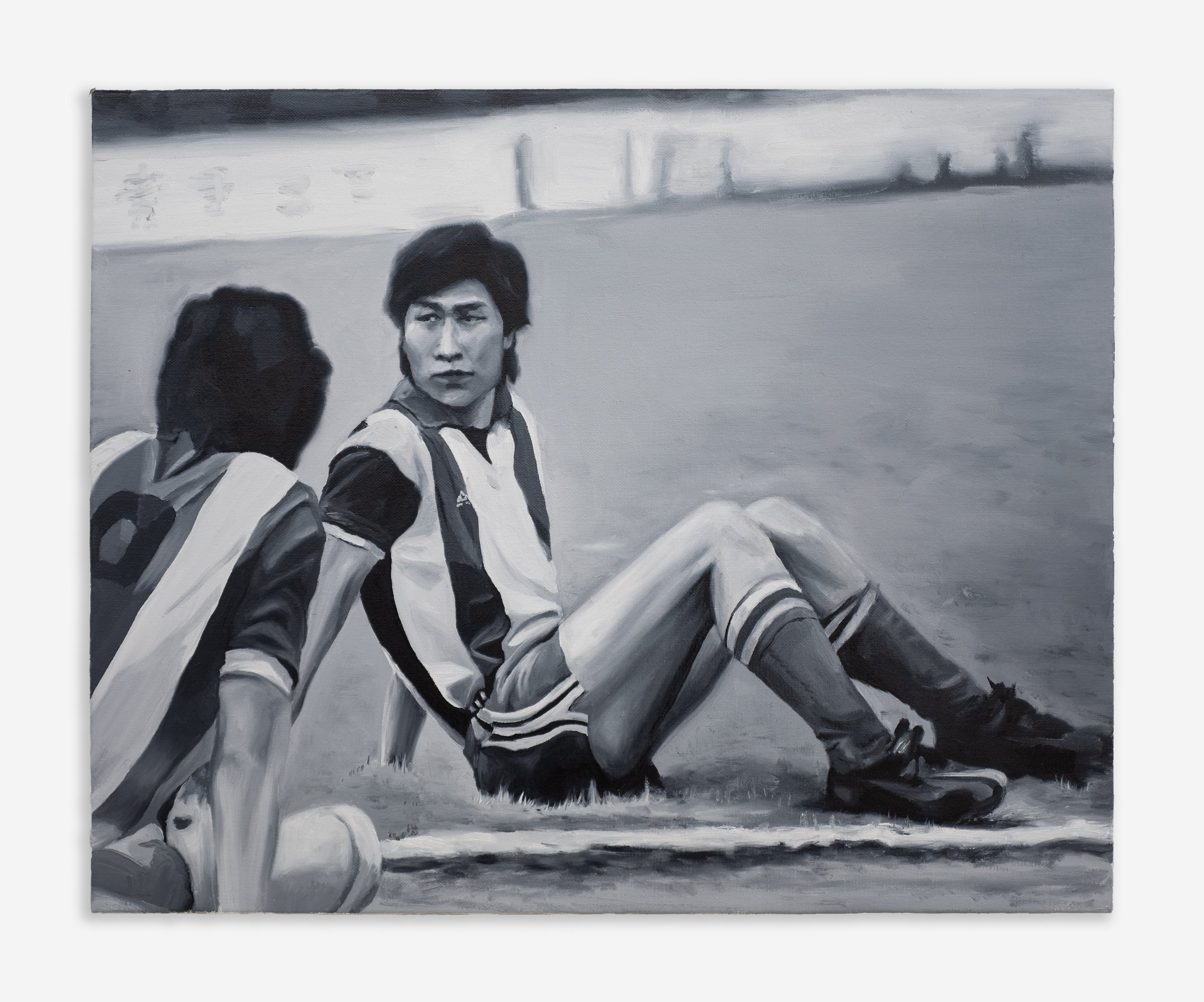
The palette is almost entirely monochrome. Grays shift from warm to cool across the surface: a charcoal that verges on brown in the darker passages, a platinum that leans toward blue in the lighter ones, and a range of intermediate tones that the artist has calibrated with the precision of a printer's halftone screen. There is no color in the conventional sense, no red or yellow or green, and this absence is deliberate. Tan Mu has described the black-and-white palette as a way of "removing the image from a specific moment in time and placing it into a more reflective, suspended space." The monochrome echoes "the language of archival photography and historical documentation," and it reinforces "the idea that this is a moment retrieved rather than remembered." The painting does not pretend to还原 the experience of being on the field. It reproduces the experience of looking at a photograph of the field, and the experience of looking at a photograph is always an experience of looking at a surface that withholds as much as it reveals. The black-and-white palette withholds the particularity of color in the same way that the photograph withholds the particularity of lived experience: selectively, structurally, as a condition of its medium.
The figure is seated, occupying the lower half of the composition. His posture is that of an athlete at rest: legs extended or folded, torso slightly forward, weight settled into the ground. The soccer pitch stretches behind him in an expanse of pale gray that reads as grass stripped of its green, a field reduced to a tonal value. The painted marks that describe this ground are broad and horizontal, laid in with a confidence that suggests they were applied quickly, in a single session, as if the artist wanted to reproduce not the texture of grass but the speed with which a photograph renders grass as a field of undifferentiated tone. At the figure's edges, the paint softens and blurs, especially at the shoulders and along the silhouette of the legs, where the distinction between body and background begins to dissolve. This blur is not impressionistic atmosphere. It is the blur of a low-resolution photograph enlarged beyond its intended size, the pixelation of a newsprint halftone pushed past its threshold of legibility. Tan Mu has painted the photograph's failure to resolve as much as she has painted the photograph's subject.
In 1965, Gerhard Richter painted Uncle Rudi, a work based on a family photograph showing his mother's brother in the uniform of the Wehrmacht. Rudi died in the war, and the photograph was one of the few traces of his existence that survived. Richter rendered the image in the black-and-white palette that would define his early practice, blurring the figure with a soft vertical drag of the brush that made the uniform, the face, and the standing pose seem to waver on the edge of disappearance. The painting does not commemorate Rudi. It records the difficulty of seeing Rudi through the layers of history, family silence, and national guilt that separate the painter from the photograph. The blur is not a stylistic mannerism. It is a materialization of distance. Richter described his photo-paintings as attempts to make paintings that were "not a means to an end, but an end in themselves," and he meant that the painting should not pretend to offer access to the person in the photograph but should instead make visible the conditions under which that person becomes visible at all: through a camera, through a print, through a historical archive that carries its own biases and erasures.
Turf and Uncle Rudi share a structural logic that goes beyond their superficial resemblance as black-and-white paintings derived from family photographs. Both works take as their subject a male relative who existed in a specific professional and historical context that the painter did not directly experience. Both works use the monochrome palette to mark the image as archival rather than present, a document retrieved from a time the painter cannot enter. Both works employ painterly blur at the figure's edges to register the inadequacy of the photograph as a vehicle for memory, the way it softens and loses information when it travels across time. And both works refuse the sentimental reading that would reduce them to family memorials. Richter's Rudi is not mourned in the painting; he is made visible as a problem of representation. Tan Mu's father is not celebrated in Turf; he is made visible as a problem of inheritance. In both cases, the painting asks not "who was this person?" but "through what mediation does this person become available to me?" The question is epistemological before it is emotional, and the painting's materiality, its deliberate restriction to the gray scale, its refusal to fill in what the photograph could not record, enacts that priority.
The difference between the two paintings is also instructive. Richter painted Uncle Rudi in the wake of a national catastrophe. The Wehrmacht uniform carried meanings that extended far beyond the family: it was the uniform of an army that committed atrocities, and the family photograph of a soldier in that uniform could not be separated from the collective guilt of the nation that fielded the army. Turf carries no such collective burden. The soccer field in 1980s China is a stadium, not a battlefield, and the father's profession, while it placed him in the public eye, did not place him on the wrong side of history. The distance that the painting registers is not the distance of moral reckoning but the distance of generational time: the simple, irreducible fact that the artist was not yet born when the photograph was taken, and that her knowledge of her father in this context comes entirely through the image. Where Richter's blur registers the impossibility of seeing through shame and silence, Tan Mu's blur registers the impossibility of seeing through the absence of experience. The father in the photograph is not hidden by guilt. He is hidden by the calendar. He existed before the daughter who would paint him, and the photograph is the only bridge across that gap.
The photograph of Tan Mu's father was published in sports media. This fact matters because it determines the kind of image the photograph is and the kind of relationship the painter can have to it. A family photograph is a private document, taken for domestic circulation, intended for the album or the mantelpiece. It carries the warmth of personal occasion and the authority of presence: someone who loved the subject held the camera. A sports news photograph is a professional document, taken by a photojournalist for public circulation, intended for the broadsheet or the magazine. It carries the authority of the event and the detachment of the professional eye: someone who was assigned to cover the game pressed the shutter. The difference is not just one of audience but of ontology. The family photograph exists because the family wanted it. The sports photograph exists because the event demanded it. When Tan Mu paints from the sports photograph, she is painting not from a token of affection but from a record of occurrence, an image that testifies not to the father's warmth or character but to the fact that he was there, on that field, at that time, visible to a camera that did not know him.
This distinction, between the photograph that wants to remember and the photograph that needs to record, runs through the entire practice. The submarine cable map records where the cables lie. The satellite image records what the landscape looks like from orbit. The electron micrograph records what the cell wall looks like under magnification. None of these images were made for the painter. All of them were made for technical, scientific, or journalistic purposes, and the painter enters them after the fact, as a secondary reader who finds in the image something the original photographer or instrument operator did not intend. Turf extends this logic to the most personal territory in the practice: the family. The father in the photograph is, for the purposes of the painting, not fundamentally different from the submarine cable in the map or the embryo in the micrograph. He is a subject captured by a technology of record, and the painter's relationship to him is mediated by that technology in exactly the same way. This is not a cold observation. It is a structural one, and Tan Mu makes it herself: "Just as satellites, data centers, or containers carry information across space, this photograph carried a piece of my family history across time."
Marlene Dumas has spent a career painting people she never met. Working from photographs sourced from newspapers, police files, polaroids, and pornography, she produced a body of work in which the distance between painter and subject is not a deficit but a condition. The Painter (1994), one of her most recognized works, depicts a child's face in two versions side by side, one with eyes open and one with eyes closed, both derived from a photograph of a child in a hospital bed. The child is not identified. The source image is not attributed. The painting does not tell the viewer who this was or what happened. It presents a face, a gaze, and a withdrawal of gaze, and it leaves the viewer to negotiate the emotional terrain without biographical guidance. Dumas has written that she paints "to find out what I think about what I see," and the emphasis falls on the seeing, not the knowing. The painting is a record of visual encounter, not a report on the subject's life.
Dumas's practice illuminates something specific about Turf that the Richter comparison alone cannot. Richter painted a family member he knew through family narrative, even if that narrative was marked by silence. Dumas paints strangers she knows only through images, and her paintings acknowledge that the image is the only form of access available. Tan Mu occupies a position between these two modes. Her father is not a stranger. She knows him, grew up with him, carries his features in her face. But the photograph that Turf depicts shows him at a time before she existed, in a role she can only imagine, captured by a camera that treated him as a public figure rather than a parent. The father in the photograph is, in Dumas's terms, both someone she knows and someone she does not, and the painting exists in the space where those two conditions overlap. He is a stranger in the archive and a relative at the dinner table, and the painting's refusal to sentimentalize or to clarify this duality is what gives it its peculiar tension. The black-and-white palette does not make him more remote. It makes him more accurate. It records him as the photograph recorded him: as a figure in a public image, visible to a camera but not yet visible to the daughter who would one day look for him there.
Li Yizhuo, in her 2022 essay "Imaginary of an Image," observed that Tan Mu's canvases "do not aim at diagnosing the modern spectacles from a distance. They conjure up a kind of vitality and depth of their own." The observation is precise, and it applies to Turf with particular force. The painting does not diagnose the sports media apparatus that produced the photograph. It does not critique the circulation of athletes' images or the gender dynamics of 1980s Chinese professional sport. It does something more radical: it treats the photograph as a vital object in its own right, an artifact that carries real information about a real person in a real moment, and it reproduces that artifact with the care that a conservator brings to a fragment of pottery. The vitality that Li Yizhuo identifies is not the vitality of the father on the field. It is the vitality of the photograph itself, the image that survived the moment, that crossed the distance between the stadium and the studio, and that offered itself to the painter as the only available trace of a world that no longer exists. The painting honors the photograph not as a proxy for the father but as the thing that made the father visible across time.
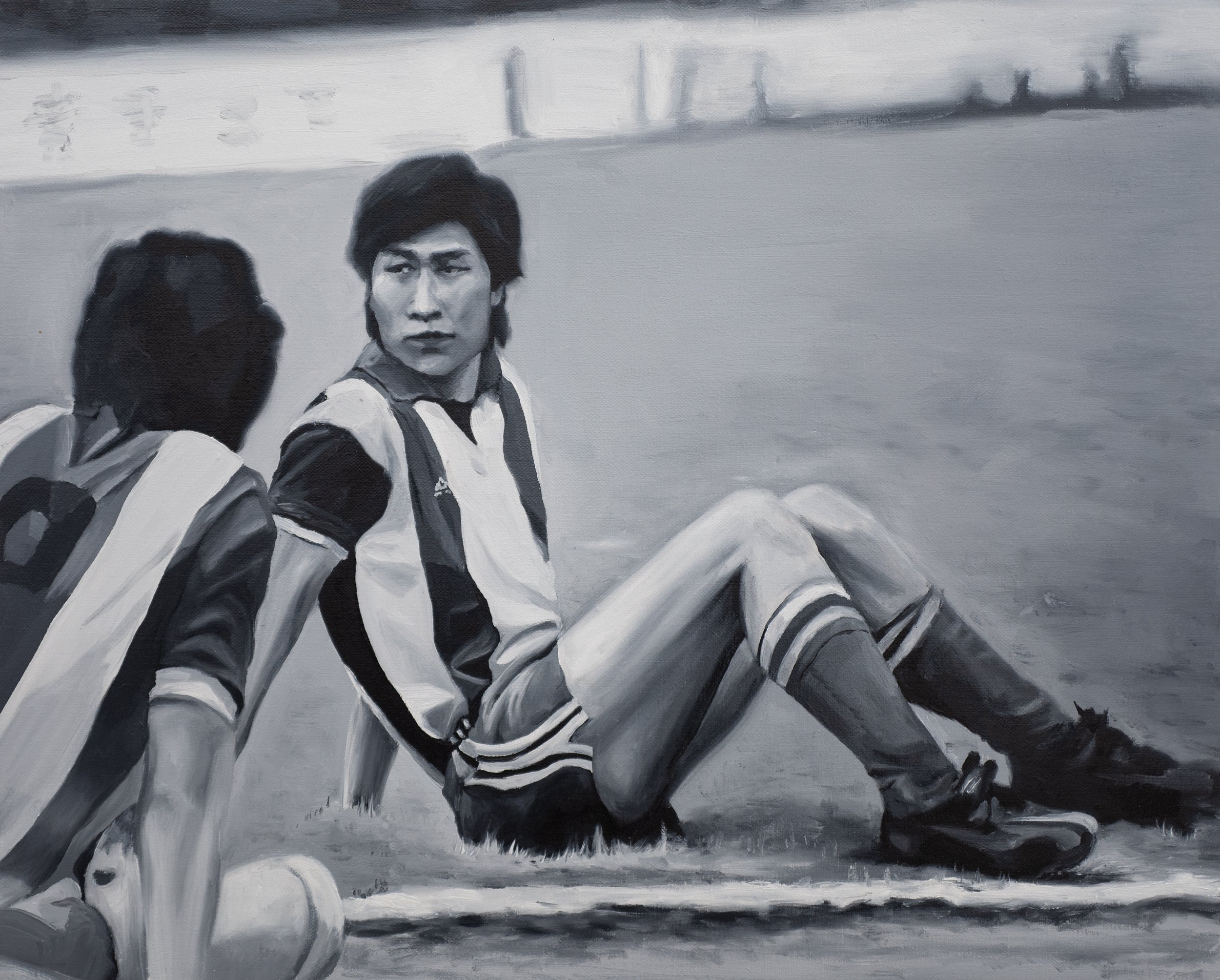
Tan Mu describes the moment of her father's retirement and her own birth as coincident: "My father's decision to retire coincided with my birth, linking personal life decisions with generational transition." The word "coincided" is exact and it carries more weight than a casual biographical note. The father left the field at the moment the daughter entered the world, and the photograph in the sports archive is the record of a man on the field, which is to say, a man before the daughter existed. The painting, made decades later, is the daughter's attempt to see the father in the only context where she cannot have seen him: before she was there to see. This is not nostalgia. Nostalgia requires memory, and Tan Mu has been explicit about the fact that she has no memory of this event. "That image existed publicly, circulated through sports media, yet it was never something I personally witnessed. In that sense, it functions as a kind of inherited memory rather than a lived one." Inherited memory is the term that names the condition precisely: a memory received rather than made, a mental image constructed from an external record rather than from direct experience. The painting is not a window onto the father's world. It is a window onto the process of inheriting that world through the only channel available, the photograph that outlasted the game.
The field in Turf is not a landscape. It is a stage. Tan Mu names it directly: "The soccer field becomes a stage where lineage, choice, and trajectory intersect." The stage metaphor is not decorative. It identifies the field as a site of performance rather than of habitation, a place where one appears in a defined role for a defined period, and the photograph records that appearance with the detachment of a theater photographer documenting a production. The painted figure sits on this stage in the posture of an actor between scenes, still in costume, no longer performing, waiting for the next entrance or the final curtain. The retirement that coincided with the artist's birth was, in the stage metaphor, the final curtain, and the photograph captured the actor before the curtain fell, in the liminal moment between performance and departure. The painting enters this liminal space and stays there, suspended between the action and the exit, between the athlete's career and the father's afterlife, between the public image and the private man.
The word "turf" itself carries a double register that the painting makes productive. In the context of soccer, turf is the playing surface, the green grass on which the game unfolds. In the context of territory, turf is ground claimed and defended, a domain belonging to a particular person or group. Both meanings apply. The father's turf is the field on which he played, the professional domain where his identity as an athlete was constituted and recorded. But the father's turf is also the territory of paternity, the ground of inheritance and lineage that the daughter claims by painting him. The painting occupies both turfs simultaneously: the field of play and the field of relation, the ground where the athlete performed and the ground where the father and daughter meet across the distance of time and the mediation of the photograph. That the two grounds are the same physical space, a rectangle of grass in a Chinese stadium in the 1980s, is the fact that makes the painting's argument hold. The father's professional identity and his personal identity are not two separate stories. They are the same story told in two registers, and the photograph that recorded one register is the only access the daughter has to the other.
What Turf ultimately achieves is not a reconciliation of the two registers but a demonstration of their inseparability. The painting does not reveal the father behind the athlete. There is no father behind the athlete. The athlete is the father, at this moment, in this photograph, and the daughter who was not yet born can only know him through the record that the public world made of him. The painting accepts this condition without resentment. It does not mourn the absence of a more intimate image. It treats the sports photograph not as a second-best substitute for a family snapshot but as the primary document of a life that was, for a time, lived in public. In doing so, it reframes the question that inherited memory always poses. The question is not "what was he really like, away from the camera?" The question is "what does it mean that the camera was there, that it saw him, that its record survived, and that I, who was not there, can now see what it saw?" The answer the painting gives is that this is not a deficit of knowledge but a specific form of knowledge, one that comes through images rather than through experience, and that the painter's task is not to fill in what the image lacks but to make visible what the image is: a carrier of information across time, a device for transmitting the presence of a person who cannot be present, a technology of memory that works whether or not the person remembering was there to remember. The father sat on the turf. The camera recorded him sitting. The daughter found the record. The painting is what happened next.