The Vial Between Fear and Relief: Tan Mu's Vaccine and the Object That Held the Pandemic
By the end of 2020, the image of a small glass vial had become the most widely circulated object photograph on the planet. Pfizer and BioNTech released the first official photograph of their COVID-19 vaccine vial on November 9, 2020, and within hours it appeared on the front pages of newspapers, the home screens of news apps, and the feeds of every social media platform from Weibo to Twitter. The vial was small, roughly the size of a thumb, with a purple cap and a label bearing a lot number. Its contents, a lipid nanoparticle suspension carrying messenger RNA, were invisible to the camera. What the photograph showed was glass, plastic, and liquid: three materials that together constituted the most anticipated pharmaceutical product in a generation. Tan Mu saw that photograph, and she saw in it something the news photographers did not intend. She saw a container whose meaning had already exceeded its contents, a vessel that held not only thirty micrograms of modified nucleoside RNA but the accumulated weight of a year's isolation, grief, political conflict, and collective hope. Vaccine (2021) is the painting that resulted from that seeing.
Oil on linen, 36 x 28 cm (14 x 11 in). The format is small, almost precious, comparable in scale to Moldavite (2020) and MRI (2021), two other works in Tan Mu's practice that isolate a single object against a dark ground. The modesty of the dimensions is not incidental. The vaccine vial is a small object, and the painting's scale registers that smallness as a fact of the subject rather than as an artistic limitation. A larger canvas would have inflated the vial to a size it does not possess in reality, and such inflation would have falsified the relationship between the object and the world it entered. The vial was small. The pandemic was vast. The painting holds both truths by refusing to enlarge the one to match the other.
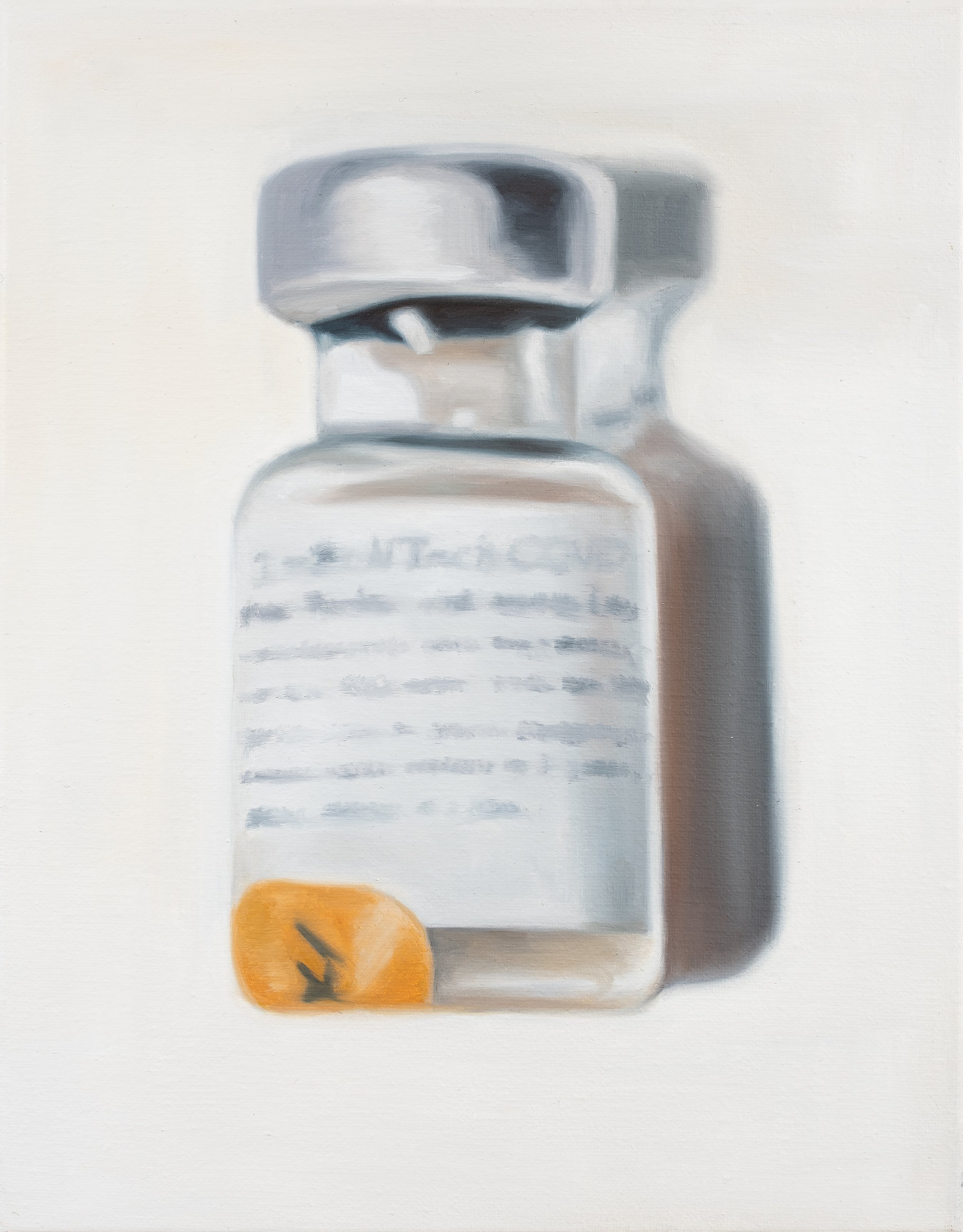
The vial occupies the center of the composition, rising from the lower third of the canvas toward a point just above the horizontal midpoint. The background is a deep, near-black field of umber and indigo, so dark that the linen weave is almost invisible beneath it, as if the paint has been built up in enough layers to seal the surface completely. Against this ground, the vial glows. Its glass walls catch an implied light source from the upper left, producing a slender crescent of pale gold along the left edge and a broader band of reflected cerulean across the right face. The liquid inside reads as a translucent amber, darker at the base where the volume of suspension is thickest and lighter toward the shoulder of the vial where the glass curves inward toward the neck. The neck itself narrows to a small aluminum cap painted in a cool lavender that shifts toward purple where the imagined light strikes its crimped edge. Below the cap, a thin paper label wraps the upper third of the vial, rendered in a dry, off-white that carries the faintest suggestion of printed text without resolving into legible characters.
The surface quality of the painting divides into two distinct registers. The background is matte, dense, and absorptive, a field of paint that seems to swallow light rather than reflect it. The vial is luminous, built up in thin glazes that allow underlying layers to shimmer through, so that the glass appears to contain depth rather than merely reflect it. This division of surface behavior is the painting's central material argument. The dark ground is the pandemic's field of uncertainty: the lockdowns, the mounting death counts, the political failures, the isolation. The vial is the point of concentrated attention within that field, the object onto which the world projected its need for resolution. By making the ground absorptive and the vial luminous, the painting reproduces the optical and emotional logic of looking at a light source in a dark room: everything else recedes, and the eye fixes on the only point that emits rather than absorbs.
Giorgio Morandi spent decades painting bottles. Not bottles in use, not bottles as symbols, not bottles in the service of allegory or social commentary, but bottles as objects arranged on a shelf in his Bologna studio, painted again and again across a career that spanned fifty years. In works like Still Life (1956, Museum of Modern Art, New York), a group of four or five vessels, some tall, some squat, some opaque, some translucent, stand on a shallow surface against a wall the color of old plaster. The light is even and diffuse, arriving from no single direction, casting no sharp shadows. The vessels are painted in muted tones of cream, pale rose, and faded ochre, with occasional passages of thin gray-blue that register as reflections of the studio walls. Morandi mixed his paints with such care, and applied them with such deliberate thinness, that the surface of each vessel seems to breathe, its color shifting imperceptibly as the viewer moves, as though the paint were still wet.
Morandi's bottles are not metaphors. They are objects, and Morandi's devotion to them, his refusal to paint anything else for half a century, was a devotion to the act of seeing an object in all its irreducible specificity. He was not interested in what the bottle signified. He was interested in the bottle as a visual phenomenon, a thing that occupied space, caught light, and changed appearance as the conditions of viewing changed. His still lifes are exercises in sustained attention, and their power lies in the way they make the viewer conscious of the duration required to see an object with anything approaching the painter's level of care. A Morandi painting does not show you what a bottle looks like. It shows you what a bottle looks like after you have been looking at it for a very long time.
Vaccine shares this devotion to the object as a visual phenomenon, but it operates in a different register because the object it depicts cannot be separated from the meanings that accumulated around it during the pandemic. Morandi's bottles were chosen precisely because they carried no particular cultural charge. They were ordinary kitchenware, thrift-store finds, things nobody would miss if they disappeared. The vaccine vial, by contrast, was the most charged object of 2020: a tiny vessel that millions of people were waiting to receive, that governments were scrambling to procure, that pharmaceutical companies were racing to produce, that anti-vaccine activists were condemning, that news organizations were photographing with the reverence usually reserved for relics. Tan Mu isolates this object with the same formal discipline that Morandi brought to his bottles, but the isolation does something different here. Where Morandi's isolation drained the object of external meaning, leaving only its visual presence, Tan Mu's isolation concentrates the object's external meaning, compressing a year's worth of cultural projections into the space around a single vial. The dark ground does not neutralize the vial's significance. It amplifies it. The vial glows against the darkness not because the paint is brighter but because everything else has been removed, and the viewer's attention has nowhere else to go.
The Pfizer BioNTech vaccine, designated BNT162b2, was the first mRNA vaccine authorized for emergency use in humans. It was developed in less than eleven months, a timeline that compressed what had previously been a decade-long process into less than a year. The speed was achieved through a combination of prior research on mRNA technology, massive parallel clinical trials, regulatory fast-tracking, and an unprecedented level of global collaboration among scientists, manufacturers, and governments. The vaccine works by delivering messenger RNA encased in lipid nanoparticles into human cells, where the RNA instructs the cells to produce the spike protein found on the surface of the SARS-CoV-2 virus. The immune system recognizes the spike protein as foreign and mounts a response that confers protection against subsequent infection. The entire mechanism depends on the integrity of a delivery system that is, at its core, a small glass vial containing a clear liquid suspension. If the cold chain breaks, if the vial cracks, if the lipid nanoparticles degrade, the entire chain of immunological cause and effect collapses. The vial is both the container and the condition of the technology's existence.
Tan Mu's interest in the vial extends beyond its medical function to what she calls its status as a "cultural artifact of the pandemic." The phrase is precise. An artifact is something made by human work, something that survives from a particular period and carries information about that period to future viewers. A cultural artifact is an artifact whose significance exceeds its function, whose meaning in the collective imagination has grown larger than the purpose it was designed to serve. The vaccine vial was designed to hold a pharmaceutical suspension. It became, during 2020 and 2021, a symbol of hope, a flashpoint of political debate, a marker of inequality between nations that could afford it and nations that could not, a visual shorthand that news photographers deployed whenever they needed an image that said "pandemic response" without words. Tan Mu recognizes this accumulated significance and treats it as the vial's primary attribute: "The vial is not depicted as a pharmaceutical product, but as a container of layered significance. It holds scientific knowledge, political tension, public anxiety, and collective hope all at once." The painting does not illustrate these layers. It holds them the way the vial holds the suspension: by containing them within a single form that makes them coexist without resolving their contradictions.
In the opening years of the seventeenth century, the Spanish painter Juan Sánchez Cotán produced a series of still lifes that remain among the most disquieting images in the history of Western art. In Quince, Cabbage, Melon and Cucumber (c. 1602, San Diego Museum of Art), four ordinary vegetables are suspended in a black void that reads not as darkness but as an absence so total it threatens to consume the objects within it. The quince and the melon hang from strings, as if they were celestial bodies or pendulums frozen mid-swing. The cabbage sits on a stone ledge that protrudes from the bottom of the frame, its leaves curling into the darkness. The cucumber extends diagonally across the ledge, its form cutting through the black space with a precision that borders on violence. The vegetables are rendered with a realism so meticulous that each leaf, each dimple in the melon's skin, each curve of the cabbage's rib seems to have been observed rather than invented. Yet the space they occupy is not a kitchen or a pantry. It is an architectural void, a recessed niche with stone walls that disappear into impenetrable shadow, and the vegetables float within it like offerings on an altar that no longer has a god.
Sánchez Cotán's still lifes have been read as religious allegories, as meditations on the vanity of earthly things, and as demonstrations of mathematical perspective. All of these readings are plausible, but none of them accounts for the peculiar intensity of the paintings, which is not the intensity of allegory but the intensity of attention. The vegetables in these paintings are not symbols of transience or mortality. They are vegetables, observed with a care so extreme that the act of looking seems to have become a form of devotion. The black void behind them does not symbolize death. It is the ground of attention itself, the space that remains when everything extraneous has been removed and only the object and the viewer's gaze remain. Sánchez Cotán painted the way a naturalist paints a specimen: with the conviction that looking closely enough at a single thing reveals something about the structure of the world that casual looking cannot reach.
The structural parallel between Sánchez Cotán's Quince, Cabbage, Melon and Cucumber and Tan Mu's Vaccine is not one of subject or even of period but of compositional logic. Both works isolate a small number of ordinary objects against a dark ground that denies them any contextual information beyond the stone ledge or the implied shelf. Both works use the dark ground not as a symbol of absence but as a technology of concentration, a way of forcing the viewer's attention onto the object by eliminating every possible distraction. Both works render their subjects with a precision that exceeds the requirements of documentation and enters the territory of contemplation, where looking becomes a durational act and the object rewards sustained attention with increasingly subtle information. And both works understand that the object, isolated and attended to with sufficient care, begins to radiate meanings that have nothing to do with its function and everything to do with the act of isolating and attending. The quince is just a quince until it hangs in a black void, at which point it becomes a quince plus the entire history of human attention to quinces, which is to say, it becomes an object that holds more than it contains. The vaccine vial is just a vial until it sits at the center of a dark canvas, at which point it becomes a vial plus the accumulated weight of a pandemic's worth of fear and hope, which is to say, it becomes what Tan Mu calls it: a cultural artifact.
The difference between the two works is instructive because it reveals something about how the dark ground functions differently in the seventeenth century and the twenty-first. Sánchez Cotán's void is metaphysical. It represents the space in which the object exists before and after its encounter with the viewer's gaze, the space of pure being that precedes and outlasts human attention. The vegetables hang in that void as if they had always been there, as if the painter had merely drawn back a curtain to reveal them in their eternal arrangement. Tan Mu's dark ground is historical. It represents the specific conditions of 2020 and 2021: the darkness of lockdown, the isolation of quarantine, the uncertainty that surrounded every aspect of daily life during the pandemic's peak. The vial does not hang in an eternal void. It emerges from a specific darkness, the darkness of a particular moment in history, and its glow is not the glow of metaphysical presence but the glow of collective expectation, the light that an object emits when millions of people are looking at it at the same time and projecting onto it the same set of contradictory desires.
Danni Shen, in her 2024 profile "In the Studio with Tan Mu" for Emergent Magazine, observed that Tan Mu's paintings "alternate between zooming into the human body and expanding outwards, stretching toward the far reaches of the visible universe," and that the photographs on which they are based "have often been made possible by microscopes or satellites." The observation holds for Vaccine with a specific twist. The vaccine vial is neither microscopic nor satellite-scale. It is the size of a human thumb, the most intimate of scales, and it was visible to anyone who looked at a news feed in late 2020. Yet the technology it contains, the mRNA mechanism, is invisible, operating at the molecular level, and the impact it produces, the immunological protection of billions of people, is planetary in scope. The vial is the point where all three scales converge: it is an object you can hold in your hand that contains a mechanism you cannot see and produces an effect you cannot measure without global epidemiological infrastructure. The painting registers this convergence by making the vial both the most legible thing in the composition and the most opaque. You can see its glass walls, its amber liquid, its lavender cap. You cannot see what any of these elements mean, what they contain, what they will do. The painting holds the vial at that threshold of legibility, visible but not transparent, present but not fully known.
Tan Mu's own account of the work makes a specific claim about its relationship to her earlier paintings of genetics and human DNA. "The mRNA technology in particular felt like a continuation of my long-standing interest in genetic codes, but now embedded within an urgent social reality." The word "now" does the work. It marks the transition from the conceptual distance at which she had previously approached genetic science, in works like IVF (2020) and Chromosomes (2022), to the immediate, lived pressure of a moment when genetic technology became the difference between life and death for millions of people. The vaccine did not represent genetics in the abstract. It delivered genetics, in the form of messenger RNA, directly into the bodies of the people who received it, and it did so at a speed and scale that made the technology's existence a matter of daily conversation, political debate, and emotional intensity. The painting acknowledges this shift from the abstract to the urgent by grounding its subject in a concrete object rather than a scientific image. IVF depicts a laboratory procedure. Chromosomes depicts a genetic structure. Vaccine depicts a thing you could hold, a glass vial with a purple cap, and this concreteness is what gives the painting its capacity to function as what Tan Mu calls a cultural artifact: an object whose significance accumulates around it because it is recognizable, tangible, and embedded in a shared historical experience.
The label on the vial is blank. Tan Mu has rendered it as a pale rectangle of off-white with no visible text, no lot number, no pharmaceutical branding. The absence is deliberate and it enacts a specific argument about representation and meaning. A labeled vial is a specific product: Pfizer lot number such-and-such, manufactured on such-a-date, authorized under such-an-emergency-use-protocol. A blank-labeled vial is a type: the vaccine vial as a category, the form that circulated across news media regardless of which manufacturer or which country. By erasing the label, Tan Mu universalizes the object without abstracting it. The vial remains concrete, specific, and present. It remains a glass vessel with a lavender cap and amber contents. But it no longer refers to a single product or a single company. It refers to the entire category of objects that entered the world's imagination during 2020 and 2021, all of the vials from all of the manufacturers, all of the photographs that circulated across all of the platforms, all of the hopes and fears that were projected onto a small glass container because there was nothing else onto which they could be projected. The blank label makes the vial a vessel in a second sense: not only the vessel that holds the mRNA suspension but the vessel that holds the pandemic's accumulated significance, a container that receives whatever the viewer brings to it.
What Vaccine ultimately achieves is the transformation of a pharmaceutical object into an object of contemplation without losing its pharmaceutical specificity. The vial does not become a symbol. It does not stand for hope or science or global cooperation in the way that a dove stands for peace. It remains a vial, painted with the same attention to glass, liquid, and reflected light that Morandi brought to his bottles and Sánchez Cotán brought to his hanging quince. The difference is that this vial carries a weight that Morandi's bottles and Cotán's vegetables do not, because this vial was produced in a moment when every human on the planet was waiting for it, and the painting registers that weight not by adding symbols or inscriptions but by concentrating the conditions under which the vial was seen: the dark ground of the pandemic, the luminous presence of the object, and the blank label that receives whatever meaning the viewer needs it to hold. The painting does not tell you what the vaccine means. It shows you what it looked like to stand in the dark and see the thing that might let you leave.