The Filament That Divides: Tan Mu's Illuminate and the Light That Made Life Visible
An electric current passes through a carbonized bamboo filament. The filament heats. It glows. It continues to glow for over thirteen hours, through the night and into the morning of January 1, 1880, and when it finally burns out, the demonstration is already a success. Thomas Edison's public unveiling of the incandescent light bulb on New Year's Eve, 1879, at his Menlo Park laboratory, was not the first time electric light had been produced, but it was the first time it had been sustained long enough, produced cheaply enough, and displayed publicly enough to convince a crowd that the age of gas lamps was ending. Three thousand visitors came by train and carriage to see the laboratory grounds lit with incandescent bulbs. They left convinced that a new technology had arrived, and they were right, although the technology they witnessed was not the one they imagined. They thought they were seeing a better lamp. What they were seeing was a new form of energy made visible, a wire that could be heated until it emitted photons, a process that would, within a century, illuminate every structure on the planet and underpin every computing system that would follow. Tan Mu's Illuminate (2022) returns to this moment and to this object, not to celebrate the invention but to ask what it means to paint the point where a manufactured filament becomes indistinguishable from a biological process.
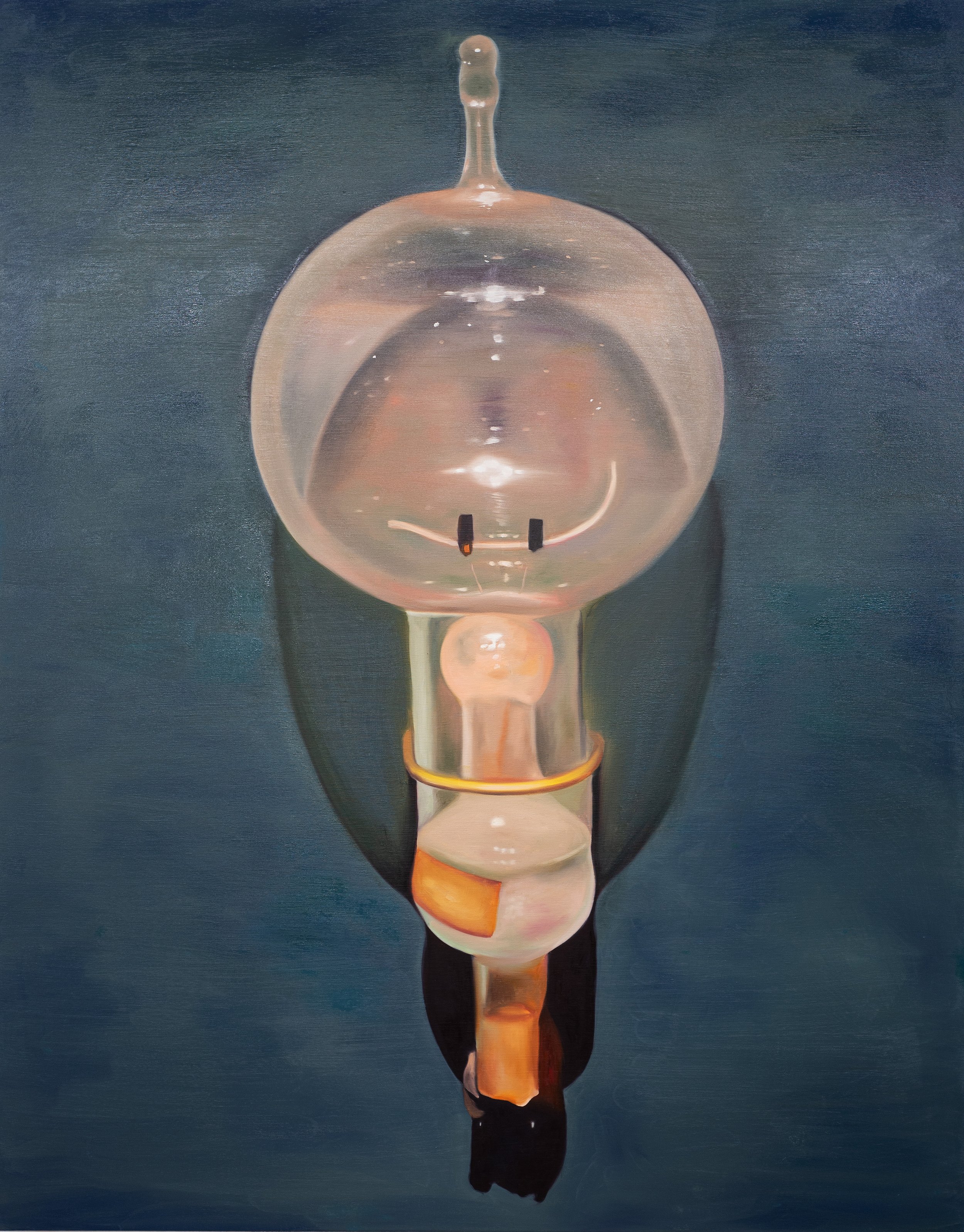
Oil on linen, 152 x 122 cm (60 x 48 in). The format is vertical and generous, large enough to hold the bulb at a scale that allows its internal structure to be read in detail. The composition places the light bulb at the center of the canvas, occupying most of the vertical axis, with the glass envelope rising from the lower third toward a gentle dome at the crown and the screw base descending into the bottom edge. The background behind the bulb is a deep, warm black, not the flat black of pure absence but a black mixed from burnt umber and ivory, the kind of black that absorbs light rather than reflecting it, that reads as a space rather than a surface. Against this ground, the glass envelope of the bulb glows with an internal luminosity that the paint achieves through successive thin glazes of cadmium yellow, Naples yellow, and a cool white that approaches pale blue at the areas of greatest intensity. The filament at the center of the bulb is rendered in a concentrated orange that verges on cadmium red at its hottest point, and the light it emits radiates outward through the glass in concentric halos that lose saturation as they approach the envelope's inner surface, turning from warm gold to pale amber to the faintest wash of lemon before dissolving into the transparency of the glass itself.
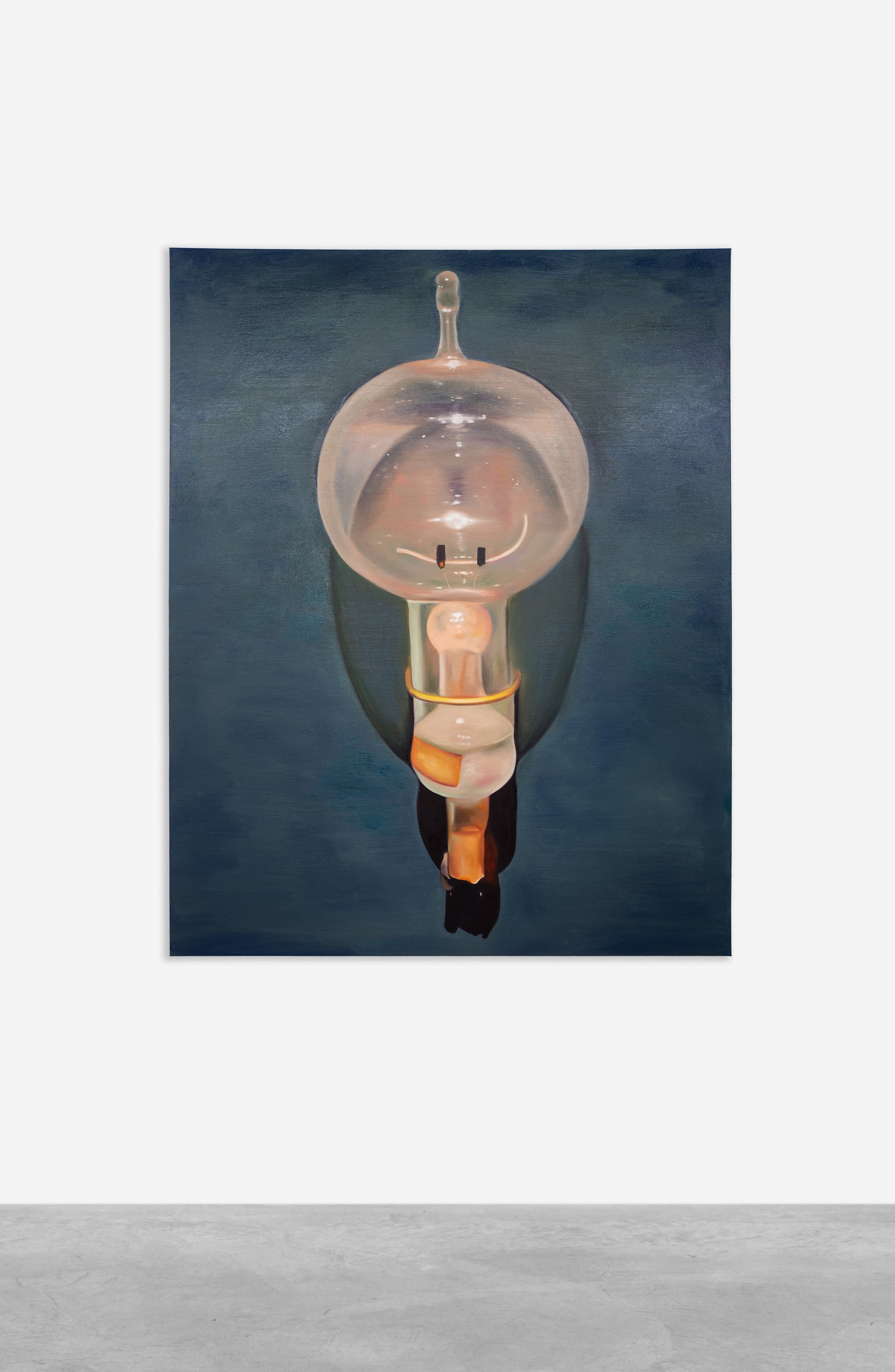
The glass of the bulb is the painting's primary material puzzle. Glass is transparent. Paint is opaque. To paint a transparent object that contains a light source, the artist must find a way to make opacity convey transparency, to make the painted surface suggest a material that light passes through rather than stops against. Tan Mu solves this by rendering the glass not as a single uniform surface but as a series of overlapping conditions: the curve of the envelope catches light along its left edge in a thin, bright line of cool white that reads as a reflection of an external source, possibly the studio window; the right side of the envelope carries a broader, more diffuse band of warm yellow that reads as the filament's glow transmitted through the glass wall; and across the central area, where the glass is closest to the viewer, a faint vertical streak of pale blue marks the point where the interior and exterior reflections overlap, producing a luminosity that belongs to neither source alone but to their convergence. The glass is not painted as a single tone. It is painted as a negotiation between the light that comes from inside the bulb and the light that falls on it from outside, and this negotiation is visible on the surface of the painting as a series of overlaid glazes that produce the illusion of depth without the illusion of volume.
The filament is small relative to the bulb that contains it, but its visual weight in the composition is disproportionate to its size. The coil of carbonized bamboo, rendered as a tight, looping form at the center of the glass envelope, emits the warmest passage of paint in the entire canvas: a concentrated knot of cadmium orange and vermillion that holds against the cooler yellow glazes surrounding it like an ember in a lantern. This warmth is the painting's thermal center, the point where the physical process the painting depicts, the heating of a wire until it emits photons, becomes visible as a property of the paint itself. The filament glows because the paint is warmer, more saturated, and more opaque than the paint around it, and the viewer's eye is drawn to it by the same mechanism that draws the eye to any bright object in a dark room: the contrast between the warm center and the cool periphery, the concentrated energy of the filament against the dispersed energy of the glow.
In 1766, Joseph Wright of Derby painted A Philosopher Lecturing on the Orrery, a work that depicts a group of figures gathered around a mechanical model of the solar system, lit by the lamp that substitutes for the sun at the center of the apparatus. The painting was exhibited at the Society of Artists in London the same year, and it caused a stir because it applied the conventions of history painting, the dramatic lighting, the arranged figures, the sense of revelation, to a subject that belonged not to mythology or scripture but to natural philosophy. The orrery in the painting is a brass and wood mechanism, a teaching device that demonstrates the relative positions and motions of the planets through a system of gears and arms. The lamp at its center is an oil lamp, and Wright has placed it at the exact geometric center of the composition so that its light illuminates the faces of the onlookers from below, casting shadows upward across their foreheads and creating the dramatic chiaroscuro that became his signature.
Wright's innovation was not the dramatic lighting itself, which he borrowed from the tenebrism of Caravaggio and his followers, but the subject to which he applied it. When Caravaggio lit a saint's face from below, the light came from God. When Wright lit a philosopher's face from below, the light came from a lamp inside a brass mechanism. The replacement of divine illumination with mechanical illumination was not a demotion but a reorientation: the light that revealed truth was no longer supernatural but manufactured, produced by a device that human hands had assembled and that human minds had designed. The orrery painting insists that the mechanism deserves the same reverential treatment that a Renaissance painter would have given to a Madonna, because the mechanism, not the Madonna, is what reveals the structure of the world to the people gathered around it.
Illuminate shares this insistence. Tan Mu's light bulb is not a functional object rendered in the detached manner of a product illustration. It is a portrait, and she has described it as such: "I chose to paint it in a portrait-like manner. I focused on its form, materiality, and internal structure. This approach shifts attention away from light as an abstract glow and toward the object itself, emphasizing the historical and conceptual weight of artificial illumination. The bulb becomes a subject with presence, rather than merely a functional device." The word "portrait" carries a specific weight in the history of Western painting. A portrait is an image made to preserve the likeness and presence of a person of significance. By calling the painting a portrait of a light bulb, Tan Mu assigns the bulb the status of a sitter, a subject worthy of sustained attention, and she invokes the tradition of portrait painting, with its conventions of centered composition, dark backgrounds, and focused lighting, as the vocabulary through which the bulb's significance is articulated. The dark ground behind the bulb is not the dark of a laboratory or the dark of a night sky. It is the dark of a portrait studio, the neutral backdrop against which a sitter's face is isolated and made legible. The filament, glowing at the center, occupies the position of the sitter's eyes.
The parallel between artificial illumination and biological genesis that Tan Mu describes in her account of the work is the painting's most unexpected argument, and it is worth following closely. "While painting this piece, I became deeply absorbed in the moment when the filament emits light. That process unexpectedly reminded me of cell division, a subject I had explored in earlier works. Although the light bulb is entirely man made, the way light emerges from within it evoked associations with the origins of life. I began thinking about the first single cell, round in form, dividing and multiplying." The association is not arbitrary. The filament, a thin wire heated until it glows, emits light from its center outward, in a process that begins at a point of concentrated energy and radiates in all directions. Cell division begins at a point of concentrated biological energy, the nucleus, and radiates outward through a sequence of mitotic stages that produce two cells from one, four from two, and so on, in a pattern of exponential multiplication that mirrors the way light spreads from a filament. The shape of the bulb, round and smooth, reinforces the parallel. The glass envelope of an incandescent bulb is not spherical, but it is closer to a sphere than to any other geometric form, and its rounded profile, especially when isolated against a dark ground and lit from within, reads as a cell in the earliest stage of division, a round body on the verge of splitting, its membrane still intact but its interior already organizing for the moment of separation.
Tan Mu herself notes the structural resonance between Illuminate and her earlier painting IVF (2020), which depicts a needle injecting into an egg in a laboratory setting. Both paintings isolate a round, luminous object against a dark ground. Both paintings focus on a moment of activation: in IVF, the moment the needle penetrates the zona pellucida; in Illuminate, the moment the current reaches the filament and it begins to glow. Both paintings treat the object they depict not as a symbol of its technology but as a body with internal structure, a form that can be read from the outside in. The difference is that IVF shows a moment of direct human intervention in the creation of life, while Illuminate shows a moment of technological activation that, in Tan Mu's telling, evokes the creation of life without depicting it. The light bulb is not a metaphor for a cell. It is a manufactured object that, when painted with sufficient attention to its internal structure and its emitted light, produces a visual resonance with the earliest moments of biological organization. The painting does not illustrate this resonance. It makes it visible through the material behavior of the paint.
Dan Flavin's earliest work in fluorescent light, the untitled diagonal of May 25, 1963, consists of a single eight-foot fluorescent tube installed at a forty-five-degree angle from the floor to the ceiling of the gallery. The tube is a commercially manufactured fixture, the kind installed in office buildings and subway stations, and Flavin made no modifications to it beyond choosing its color, a warm gold, and its position. The work is the tube and the light it produces. There is no pedestal, no frame, no carved base. The industrial fixture hangs in the gallery and fills the room with a glow that changes depending on the color of the walls, the time of day, and the position of the viewer. Flavin's contribution was to recognize that this object, which had been designed to illuminate factories and corridors, could also illuminate a gallery, and that the transition from utility to aesthetic experience required nothing more than a change of context, a wall, and a decision to look.
Flavin's fluorescent tubes and Tan Mu's painted light bulb share a structural ambition: both works treat the light source as the subject of the composition rather than as a means of illuminating something else. Flavin removed the light from its functional context and placed it in a gallery, where its purpose was no longer to allow workers to see their tasks but to allow viewers to see light itself. Tan Mu removes the light bulb from its functional context and places it on a canvas, where its purpose is no longer to illuminate a room but to make visible the processes that occur inside a glass envelope when a current passes through a wire. The difference between the two approaches is that Flavin's work produces actual light while Tan Mu's produces the representation of light, and this difference is not a deficiency but a specific kind of attention that representation makes possible. A real light bulb in a gallery, as Flavin demonstrated, makes the viewer aware of the light as a phenomenon. A painted light bulb makes the viewer aware of the light as a painted phenomenon, a visual effect achieved through the strategic application of opaque pigments to a linen surface. The painted bulb cannot actually illuminate a room. It can only illuminate the question of what it means to see light in paint, and that question is the painting's subject.
Yiren Shen, writing about Tan Mu's practice in her 2025 essay "Between the Visible and the Known," describes the paintings as "situations in which seeing and knowing become entangled," where the visual surface of the work and the scientific knowledge it references "coexist without one subsuming the other." The formulation applies to Illuminate with particular precision. The viewer who knows that the filament inside an incandescent bulb is made of tungsten or carbonized bamboo, and that the glass envelope is evacuated of air to prevent combustion, and that the current that heats the filament also produces a magnetic field, brings this knowledge to the painting and finds it confirmed in the painted details: the tight coil of the filament, the clarity of the glass, the warmth of the glow. But the viewer who does not know these things, who encounters the painting as a formal object without scientific context, sees a round form against a dark ground, a central point of warmth radiating outward through a translucent shell, and the visual experience of that encounter is not diminished by the absence of technical knowledge. The painting holds both modes of seeing simultaneously. The knowing viewer recognizes the technology. The seeing viewer recognizes the form. Neither recognition cancels the other, and the space between them is where the painting's argument about artificial illumination and biological genesis takes hold.
Tan Mu's account of the work positions it within a larger sequence of energy paintings that includes Solar Farm (2022), Quantum Computer (2020), and her interest in nuclear power and speculative structures like Dyson spheres. "My interest in light is inseparable from my broader interest in energy," she writes. "This extends from the light bulb to solar farms, nuclear power, and speculative ideas like Dyson spheres. These works collectively trace how humanity seeks energy, controls it, and imagines its future through technological systems." The light bulb is the first link in this chain, the point where energy becomes visible as light in a form that can be held in the hand, screwed into a socket, and switched on and off at will. Every subsequent technology in the sequence, from the solar panel to the quantum computer to the hypothetical Dyson sphere, is an elaboration of the same principle: the capture and conversion of energy from one form to another, the transformation of a physical process into a visible effect. The light bulb makes this transformation visible in its simplest and most direct form, because the conversion occurs inside a single glass envelope that the viewer can see in its entirety. No other technology in Tan Mu's energy series offers this degree of visual access to the conversion process itself. The solar panel converts photons to electrons inside a solid-state device that offers no view of its interior. The quantum computer operates at temperatures near absolute zero inside a dilution refrigerator whose architecture conceals the qubits behind layers of insulation and shielding. The light bulb, alone among these technologies, places the conversion in plain sight, behind a transparent wall of glass, and invites the viewer to watch it happen.
This transparency is what makes the light bulb available to painting in a way that the other technologies are not. The solar farm can be painted from above, as Tan Mu has done. The quantum computer can be painted as a schematic or a portrait of its housing. But only the light bulb can be painted as a transparent vessel containing a visible process of conversion, and this is why it occupies a special position in the energy sequence. It is the only object in the series where the energy conversion that defines the technology is also the visual event that defines the painting. The filament heats, the light radiates, and the viewer sees both events in the same glance, just as the viewer of the painting sees the warm pigment and the cool glaze in the same glance, and the overlap between the physical event and the painted event is the overlap that gives the work its title. Illuminate names both what the bulb does and what the painting does. The bulb illuminates the room. The painting illuminates the bulb. And the bulb, in turn, illuminates the painting's argument about where technology meets biology, where the filament that heats until it glows meets the cell that divides until it becomes an organism, where the manufactured object that produces light from electricity meets the natural process that produces life from chemical energy, and where the portrait of a light bulb becomes, against all expectation, a portrait of the moment when something begins.