The Hand That Burns and the Hand That Stays: Tan Mu's Touch and the Temperature of Presence
A thermographic camera does not see skin. It sees heat. It converts the infrared radiation that every warm body emits into a mapped spectrum: yellows and oranges where blood runs close to the surface, deep blues where the ambient air holds its own cooler register. The technology was designed for surveillance, for military reconnaissance, for detecting intruders in the dark. In March 2020, it became something else. Thermal scanners appeared at airport gates, hospital entrances, office lobbies. A raised temperature became a gate that could bar you from entering a building, boarding a flight, rejoining a workplace. The body's warmth, that most fundamental proof of being alive, was recast as a liability, a signal to be intercepted and measured. In the same months, the most elementary form of human contact, the handshake, became a vector of transmission. Touch itself turned dangerous. It was this convergence that produced Tan Mu's Touch (2022), a painting that holds a thermographic image of a hand against a field of cold blue and asks what remains when warmth becomes a data point and contact becomes a memory.
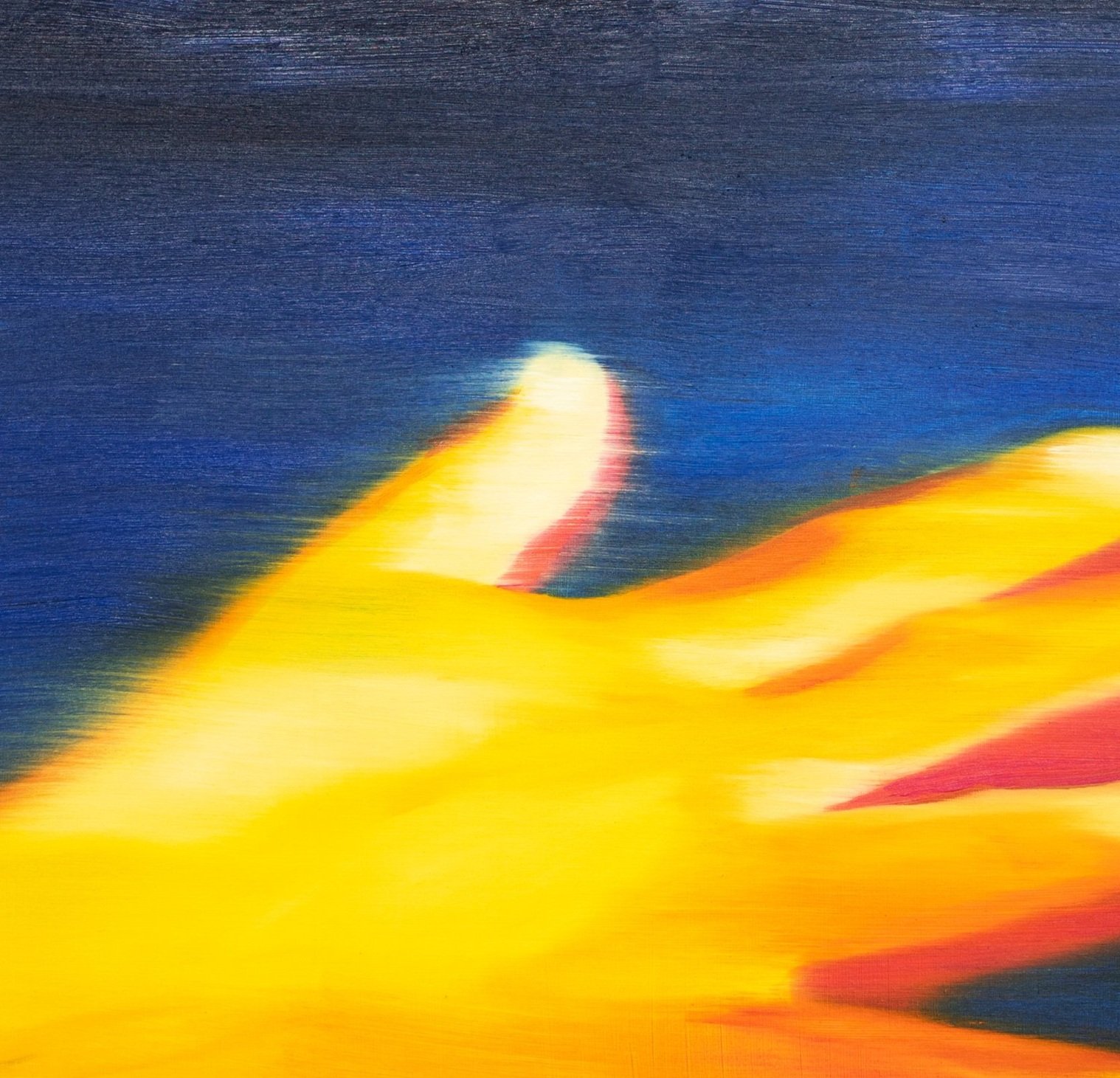
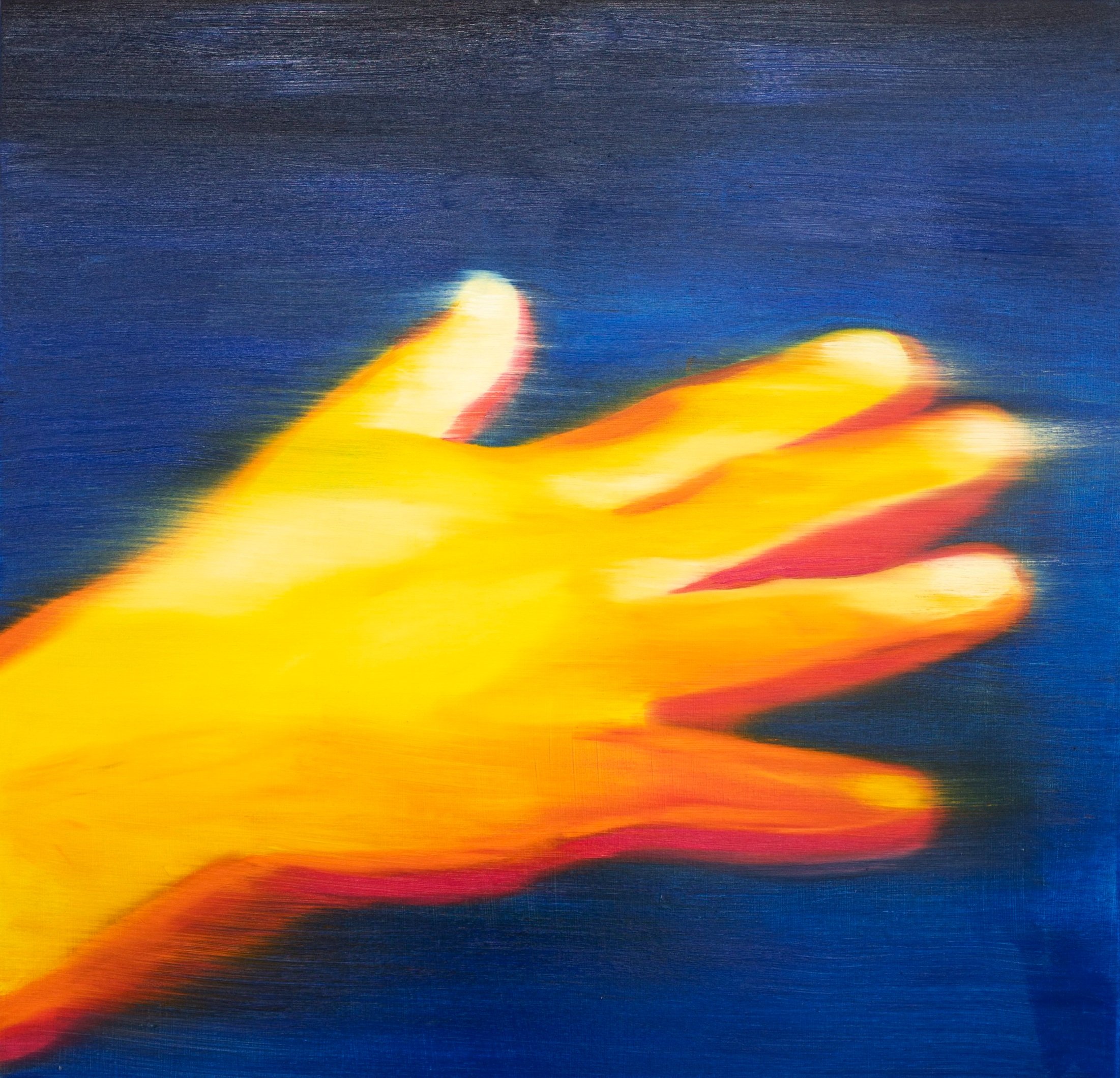
The painting is square, 76 by 76 centimeters, oil on linen. That square format is itself a declaration. It refuses the panoramic sweep of landscape, the vertical authority of portraiture. It holds the hand in a field that is neither window nor mirror but something closer to a screen: a thermal readout, a medical image, a data visualization. The hand fills most of the canvas, five fingers splayed with the openness of someone pressing their palm flat against an invisible surface. The warm tones radiate from the palm and fingertips, where blood concentration is highest, graduating through amber and orange toward the cooler periphery of the wrist and the spaces between the fingers. The background is a deep, saturated blue, the color that thermographic imaging assigns to temperatures below the threshold of human warmth. Against this blue, the hand reads like a heat signature floating in cold space, a body transmitting its presence into an indifferent medium.
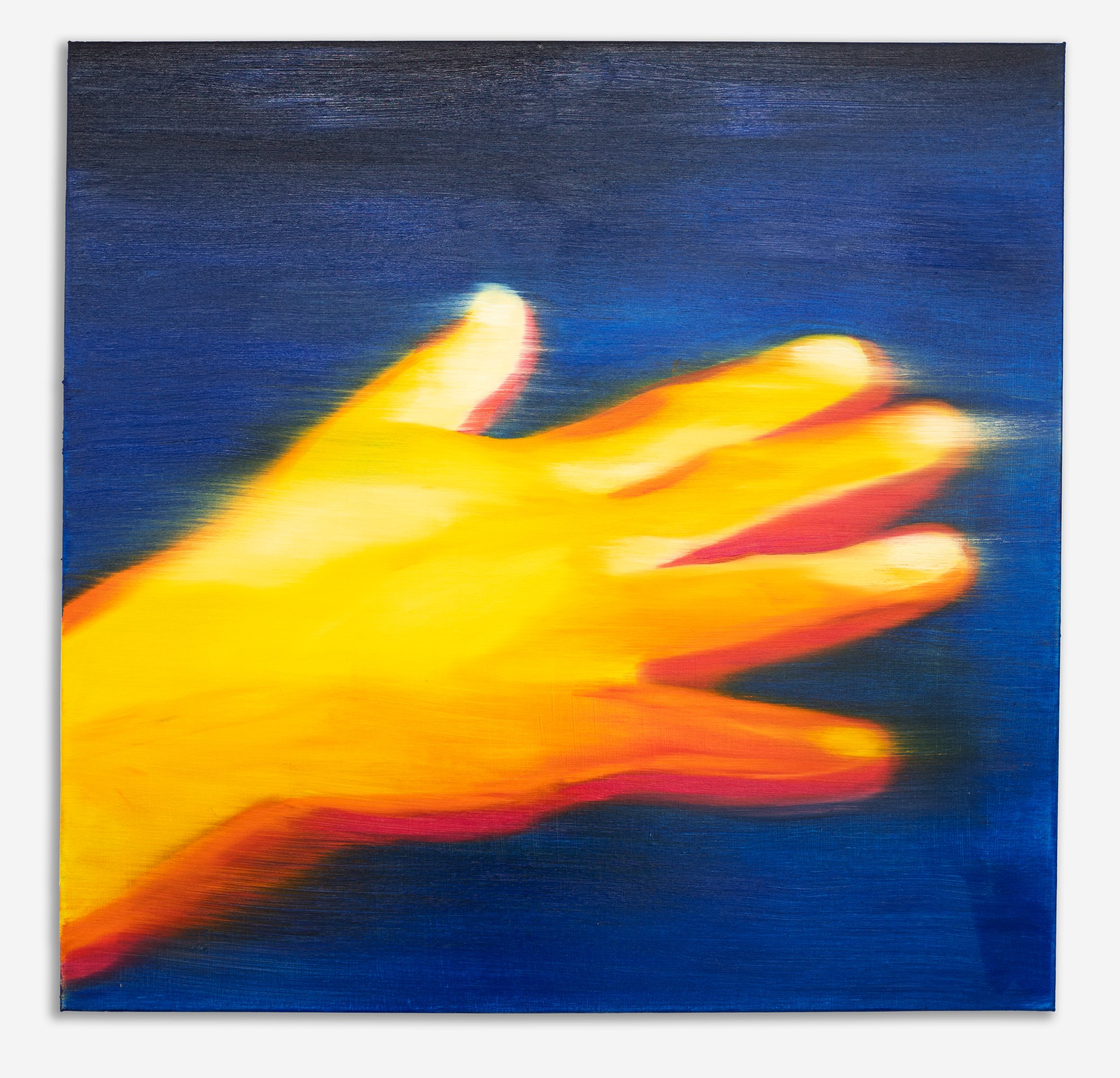
The surface of the painting rewards close inspection. Tan Mu renders the thermographic gradient with a deliberate softness, blurring the boundary where warm tissue meets cold air. There are no hard edges on the hand itself. The contour dissolves into the blue field at its margins, as though the body were slowly losing its thermal definition, its heat leaking into the surrounding void. This blur is not romantic haze. It is the physics of infrared radiation made visible: the hand does not end at the skin's surface. Its thermal signature extends outward, dissipating according to the same laws that govern how a warm body cools. At arm's length, the colors cohere into a recognizable form. Up close, the brushwork reveals itself as a series of small, layered decisions, each one negotiating the transition from one temperature band to the next. The linen support, visible in certain passages where the paint thins, adds a weave pattern that the thermographic camera would never register but that painting insists on including. It is a reminder that this image passed through human hands twice: once when the thermal camera captured the data, and again when the painter's hand reconstituted that data in oil.
That doubling is the painting's central tension. The thermographic image was made by a machine that translates warmth into color without any capacity to feel warmth. It records the phenomenon of touch without the experience of touching. Tan Mu takes this machine-made image and remakes it through the most tactile medium available, oil paint pressed from brush onto woven linen. The instrument that creates the image and the instrument that the image depicts are the same: a hand. But the hand in the painting does not touch anything. It presses against nothing. It radiates heat into a vacuum. In a moment when the entire world was relearning the physics of aerosol transmission, when every surface was potentially contaminated and every encounter with another body carried risk, the hand that touches nothing becomes an image of the hand that can touch nothing. The painting registers loss through the very medium, oil paint, that is defined by contact and pressure and the physical trace of the maker's body.
The Cueva de las Manos, located in the Pinturas River canyon in Santa Cruz, Argentina, contains hundreds of hand stencils made between 7,300 and 10,000 years BCE. The method was straightforward: a hand placed flat against the rock wall, pigment blown through a hollow reed or bone tube over the hand, and when the hand was removed, a negative image remained. The rock received the pigment; the hand blocked it. What survives on the wall is the absence of the hand, the shape left by the body's occlusion. The hands vary in size. Many belong to adolescents. Some show missing fingers, possibly from ritual amputation, possibly from frostbite, possibly from the limitations of the stencil process itself. They appear in clusters, overlapping and dense, painted in reds, oranges, yellows, whites, and blacks derived from mineral pigments available in the canyon. The cave preserves a record of repeated bodily presence over centuries. Generation after generation placed their hands against the same wall and left the same mark: I was here. My hand covered this surface. My warmth pressed against this stone.
The structural parallel to Tan Mu's painting is exact, and it is the one the artist herself identifies. Both the cave stencil and the thermographic scan register the human hand through a technological mediation. The reed tube and the infrared sensor occupy the same structural position: an apparatus that converts bodily presence into a visual trace. The cave painter's pigment, blown in a fine mist, settles around the occluding hand the way infrared radiation settles around the thermal signature of a living body. Both produce a negative image in a specific sense. The cave stencil is literally negative: pigment surrounds the hand's silhouette, and the hand itself is the void. The thermographic image is negative in a different register. It shows the hand as a pattern of heat against cold, presence against absence, but the person whose hand was scanned has long since stepped away from the detector. What remains on both surfaces, rock and canvas, is a trace: the record of contact that no longer exists.
The distance between these two technologies of the hand measures the distance the painting asks its viewer to hold in mind. The cave stencil is intimate by definition. Someone's actual hand pressed against actual stone. The breath that blew the pigment through the tube was the breath of the person whose hand was on the wall. The thermographic scan, by contrast, registers the hand from a distance, through a lens, without contact. The machine reads the infrared radiation the body emits involuntarily, whether the person consents to being seen or not. It does not need cooperation. It does not need touch. It converts the warmth that the body cannot help but produce into data that can be stored, transmitted, analyzed, and acted upon without the body's knowledge. Where the cave stencil required a hand willing to press itself against stone, the thermal scan requires only that a body pass through its field of view. This is the shift that Touch dramatizes: from a technology of voluntary presence to a technology of involuntary detection, from a mark you choose to leave to a signature you cannot prevent from being read.
Thermography, in its medical and military applications, functions as a technology of screening. It sorts bodies by temperature, identifying those whose heat falls outside the expected range. During the COVID-19 pandemic, this sorting became routine. Infrared cameras scanned crowds at train stations, shopping mall entrances, and hospital doors. A fever flagged you. A normal reading let you pass. The body was reduced to a single data point, its thermal register, and that data point determined whether you could enter a space, join a gathering, return to work. Tan Mu's Q&A for Touch makes this explicit. She describes temperature becoming "a central marker of health" during lockdown, and thermal imaging and AI-based monitoring deployed in public spaces as tools that "reduced the body to data points, reinforcing a sense of distance and surveillance." The painting does not illustrate this condition. It embodies it. The hand in the painting is a thermal readout, a body already converted into information. The viewer sees what the camera sees, not what a person feels. Warmth is color. Contact is geometry. Presence is a gradient.
And yet the painting refuses to let the hand remain pure data. The blur at the edges, the visible linen weave, the texture of oil paint applied in layers, all of these insist on the hand that made the image as much as the hand that the image depicts. The painting is a thermographic scan reconstituted by the most manual, most tactile, most hand-dependent medium in the history of image-making. Every brushstroke is an act of touching. The painting's subject is the loss of touch, but its method is an unbroken chain of physical contact. This contradiction is not a flaw. It is the argument. Tan Mu paints the technologized hand with the hand that technology has not yet found a way to replace. She uses oil paint, a substance that must be mixed by hand, applied by hand, corrected by hand, to depict a body whose warmth has been captured by a machine that will never feel warmth. The medium of touch protests the content of touchlessness.
Mona Hatoum's Corps Étranger (1994) installs the viewer inside a cylindrical projection chamber. On the floor, a circular video screen plays footage from an endoscopic camera that was inserted into the artist's own body: the mouth, the stomach, the vagina, the colon. The camera moves through internal passages, their pink walls pulsing slightly with the rhythm of Hatoum's breathing and heartbeat. A second channel plays footage from a camera that filmed the surface of her body at close range: skin, hair, pores, the navel. Both sets of images are projected at a scale that fills the viewing chamber, surrounding the standing viewer with a body that is simultaneously inside and outside, intimate and alien. The title, Corps Étranger, translates as "foreign body," the medical term for any object that enters the body from outside, but it also means "strange body," and it is this double meaning that structures the work. Hatoum submits herself to medical imaging technologies originally designed for diagnosis and surveillance, turning them back toward the body they were built to examine. The endoscope sees what the eye cannot. It reveals internal architecture that belongs to the person whose body it is but that she has never seen. The technology that was meant to make the body legible to the clinical gaze makes it strange, unfamiliar, foreign even to itself.
The parallel to Touch is structural. Both works take a technology of bodily surveillance, thermal imaging and endoscopy respectively, and submit it to aesthetic treatment that exposes the violence of its original function. Hatoum's endoscope invades; the thermal camera monitors from a distance. But the effect is comparable. The body is rendered as data, as image, as information to be read by an apparatus that has no capacity for the experience of being a body. Hatoum pushes this further than Tan Mu, making the viewer complicit in the invasive gaze, literally standing inside the projection, surrounded by the interior of a body that is not theirs and cannot consent to being seen. Tan Mu's approach is more restrained but equally precise. The hand in Touch does not invade or expose. It simply exists, radiating warmth into a cold field, readable but not violated. The difference registers a specific historical condition. Hatoum made Corps Étranger in 1994, when medical imaging was a specialized tool, encountered primarily in clinical settings. Tan Mu made Touch in 2022, after two years in which thermal surveillance had become ambient, ordinary, inescapable. The temperature scan was not something you sought out. It was something that happened to you as you entered a building. The hand in Tan Mu's painting does not resist the camera. It cannot. It simply continues to produce the heat that the camera is there to detect.
Danni Shen, writing in Emergent Magazine (2024), observes that Tan Mu's paintings "serve as a kind of witness to human socio-technological histories," and that while the works "rarely feature figures," the human "collaboration and connections" remain the central theme. Touch is the painting where this observation is most literally true. The human figure is present only as a thermal profile, a pattern of heat without a face, without an identity, without any marker of individual personhood beyond the warmth that all living bodies share. The painting witnesses a moment when the body's most involuntary emission, its heat, became the basis for inclusion or exclusion from social space. It witnesses this through a medium that restores to that same thermal data the tactile specificity that the camera stripped away. The brushwork insists on the hand behind the image. The linen weave insists on the surface on which the image was made. The blur at the edges insists on the gradual, physical process by which heat dissipates into air. Every material choice in the painting pushes back against the dematerializing logic of the thermal scan, not by rejecting the technology but by re-embedding its output in the conditions of embodied making that the technology was designed to bypass.
Tan Mu describes the pandemic as feeling "like an enclosed space, almost like a cave." The simile is exact and deliberate. The cave is the Cueva de las Manos, where hands pressed against stone left traces of presence that survived for nine thousand years. The lockdown was also an enclosed space, where hands reached for screens instead of other hands, where the only contact with other bodies was mediated through cameras and microphones and temperature scanners. The painting makes the comparison explicit. The thermographic hand and the cave stencil are both traces left by hands that have since withdrawn. Both are records of presence in the absence of the body that produced them. Both were made through a technological apparatus: the hollow reed, the infrared sensor. Both convert a moment of contact into a durable image. The nine-thousand-year gap between them is the measure of how much the apparatus has changed, and how little the impulse has shifted. The hand still reaches out. The surface still receives. What has changed is the distance between the hand and the surface it marks, and the institutional power that stands between them.
In the cave, the hand that pressed against stone chose to be there. The person whose hand is on the wall wanted to leave a trace, wanted to say: I was here, my body occupied this space, my breath carried pigment to this surface. The stencil is an act of assertion. The thermographic scan is an act of extraction. The body does not choose to emit infrared radiation. It cannot stop producing heat. The camera collects what the body cannot help but release. The shift from stencil to scan is the shift from voluntary self-inscription to involuntary data capture, from a hand that announces itself to a heat signature that betrays the body whether it wants to be seen or not. Touch holds both registers simultaneously. The hand in the painting reads as both an assertion of presence and a record of detection, both a gesture of reaching out and a profile captured from a distance. The ambiguity is the painting's subject. In a time when touch became dangerous and warmth became a diagnostic signal, the hand that reaches out and the hand that is read without consent occupy the same palm.
The square format reinforces this. A portrait is typically vertical, framing the face as the seat of identity. A landscape is horizontal, offering a view into depth. The square declares neither face nor vista. It declares equivalence. The hand and the blue field that surrounds it occupy the same plane. There is no background, no foreground. There is only a thermal surface, a mapped zone where warm tones and cool tones define a topography of heat. The square treats the hand not as a person but as a data field, which is precisely how the thermal camera sees it. And yet the painting, made by hand, in oil, on linen, refuses to let the hand remain only a data field. The visible weave of the linen, the softened edges of the thermal gradient, the thickness of paint where the palm radiates most intensely, these are records of a different kind of touch. The hand that made the painting and the hand the painting depicts are the same organ seen through two different technologies, nine thousand years apart.
The stenciled hands in the Cueva de las Manos number over eight hundred. They were made by many people over many generations, clustering and overlapping on the same rock surfaces, some red, some white, some black, some orange, each one the trace of a specific hand pressed against a specific wall at a specific time. They are not signatures. They do not carry names. They are more elemental than that. They say: a hand was here. A body produced enough warmth and pressure and intention to leave a mark that survived the maker by millennia. Tan Mu's Touch says the same thing with different tools. The hand in the painting does not carry a name. It does not have a face. It carries only its heat, rendered in the colors that a machine assigns to temperature, reconstituted in a substance that requires the heat and pressure and intention of a living hand. What the thermal camera flattens into data, the painting restores to the register of making. The hand that burns and the hand that stays are one hand, caught between two technologies that could not be more different in their intentions, and could not be more similar in what they record: the fact that a body was here, and that it was warm.