The Point Before Multiplication: Tan Mu's Zygote and the Logic of Beginning
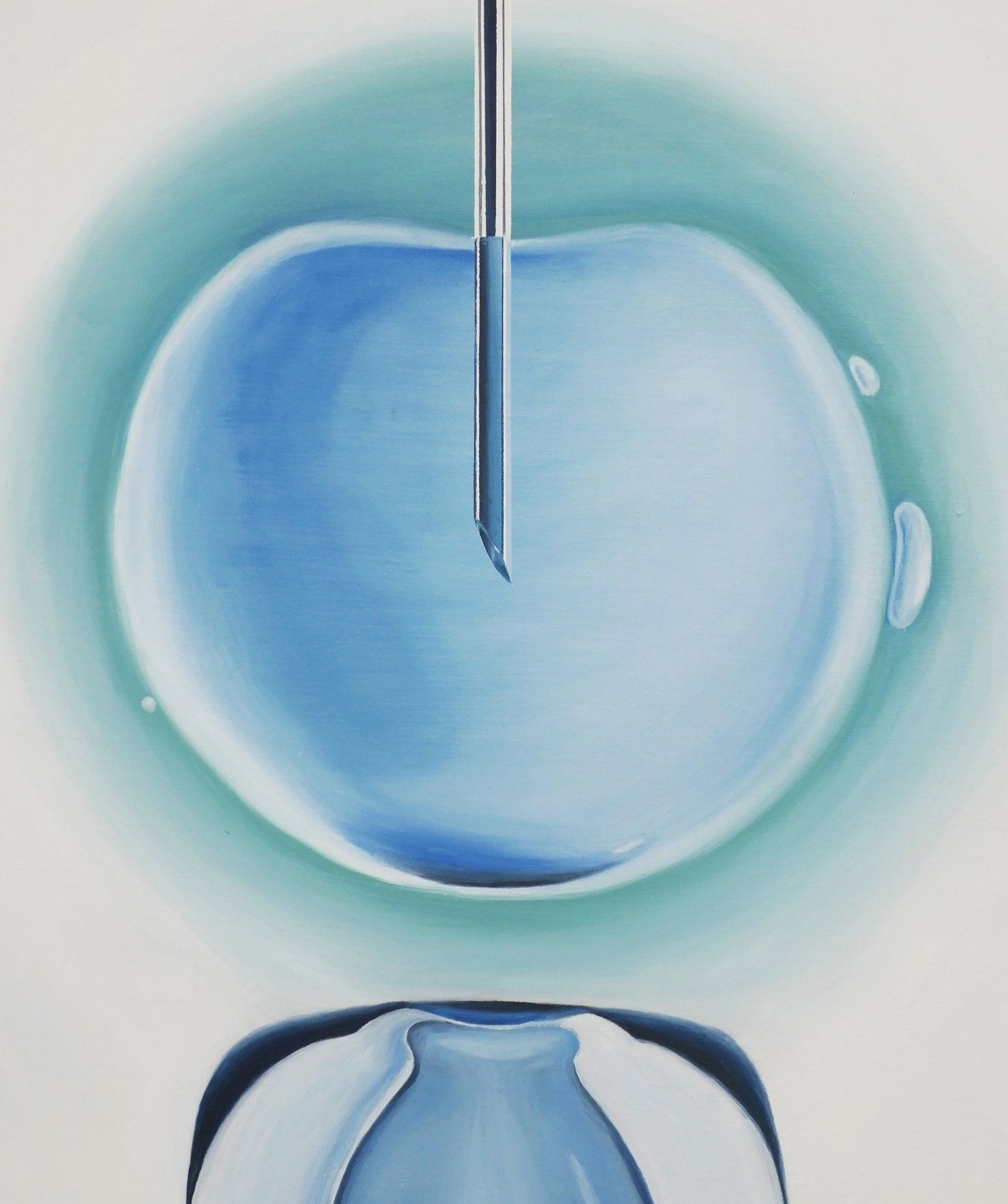
A human body contains approximately thirty-seven trillion cells. Each one descends, through an unbroken chain of divisions, from a single cell that existed for roughly twenty-four hours before it split. That cell, the zygote, is the most temporary structure in human biology and the most consequential. It has no tissue, no organ, no specialized function. It is pure potential held in a membrane roughly a tenth of a millimeter across, visible only under magnification, and it persists only long enough to become something else. Tan Mu's Zygote (2021) is a painting of this vanishing point, the instant before multiplication begins, rendered at a scale that invites the viewer close enough to see the paint's surface while depicting something that can never be seen with the unaided eye.
The painting sits at the beginning of a sequence. IVF (2020) documented the clinical architecture of assisted reproduction. Embryo (2022) and First Week (2022) traced cell division forward into recognizable form. Zygote arrives before all of them, at the moment when two gametes have fused but the first cleavage has not yet occurred. Tan Mu describes this work as the starting point of her inquiry into life's origins, both conceptually and visually. The zygote is not merely one subject among others in her biological series. It occupies a distinct position: the cell that is not yet a body, the origin that is not yet a process, the single point from which all subsequent complexity unfolds. She speaks of the replication of genes following a mathematical logic that fascinates her, of the zygote carrying infinite potential and uncertainty, and of her awareness that her own body once began in this form. The painting records that recognition.
At arm's length, Zygote presents a circular or ovoid form suspended against a dark ground. The shape hovers, weightless, centered on the linen support. The surrounding darkness is not flat black but a deep composite of indigo and charcoal, built in thin translucent layers that allow the weave of the linen to surface at intervals, giving the ground a faintly tactile irregularity. Against this darkness, the cell glows. The palette moves through pale rose, warm ivory, and a thin band of golden ochre at the perimeter, where the cell membrane catches what might be light from a microscope's illumination ring. Interior gradations shift from translucent pink at the edges to an almost white luminosity at the core, where the pronuclei, the merged nuclei of sperm and egg, have not yet fully combined. Tan Mu has described working with large fields of color and fluid brushstrokes to convey the texture and structure of the fertilized egg, and the painting's surface bears this out: the interior of the cell is not modeled with tight hatching or stipple but washed with broad, overlapping strokes that leave soft edges where one hue meets another. At thirty centimeters, the surface reveals its method. Thin paint pooled and pulled across the linen, each stroke carrying a slightly different saturation, building the cell's interior as a field of cumulative warmth rather than a diagram of cellular anatomy.
The painting measures 40.6 x 50.8 cm (16 x 20 in), a modest format that places the cell at roughly life-scale for a scientific illustration but vastly larger than the actual zygote, which measures approximately 100 to 120 micrometers in diameter. The scale decision is precise. The canvas is small enough to hold in two hands, intimate enough that the viewer must step close to see the gradations of color inside the cell's boundary. This closeness reproduces the conditions of laboratory observation: the zygote is something you approach, something that reveals itself only when you reduce the distance between your eye and its surface. At three meters, the cell becomes a pale disc floating in a dark field, nearly abstract, the details of its interior dissolved into a soft glow. The shift between these two viewing distances enacts the painting's central tension: the zygote is a specific biological object with a precise identity, and it is a form of pure luminosity, a point of light in darkness that could be a cell, a star, or the first mark on an empty ground. Tan Mu herself has described the experience of painting this subject as "almost cosmic, as if I were painting a celestial body that was simultaneously vast and microscopic." The format supports this oscillation. It is neither a miniature that insists on the cell's tininess nor a monument that declares its importance. It is a painting that asks you to come near and stay.
Odilon Redon spent decades painting things that could not be seen. His charcoal noirs of the 1860s and 1870s, and the pastels and oils that followed, gave form to dreams, hallucinations, and the interior life of the imagination. The Eye Like a Strange Balloon Mounts Toward Infinity (c. 1882), a lithograph from the series To Edgar Poe, presents a enormous disembodied eye rising above a landscape, tethered by nothing, ascending into an empty sky. The eye is not a portrait of an organ. It is a vehicle for thought: a form that carries the mind beyond the visible world while remaining anchored in recognizable anatomy. Redon's eye is both body and metaphor, a physical structure transformed into a philosophical instrument.
Tan Mu's zygote operates in a similar register. It is a biological object rendered with enough specificity to be identifiable, but it floats in a darkness that detaches it from any laboratory context, any clinical frame. Where Redon's eye ascends, Tan Mu's cell hovers. Both works isolate a single organ of perception or origin and suspend it in a ground that reads as infinite space. The darkness in Zygote functions the way Redon's empty skies function: it is not a background but a condition, a field of unknowing that the illuminated form addresses without dispelling. Redon wrote that his art "gives visibility to what is invisible," and Tan Mu's project aligns with this aspiration. The zygote is invisible not because it is imaginary but because its scale places it beyond unaided perception. The painting does what the microscope does, but it does it in paint, and in doing so it transforms the scientific image into something that circulates outside the laboratory. The cell in Zygote is not illustration. It is the result of an act of translation that, like Redon's translations of dream into lithograph, changes the terms under which the subject can be encountered. The zygote in a petri dish is data. The zygote on linen is an object of contemplation.
The distinction matters because of what the zygote is. It is not an organ with a function. It is not a tissue with a structure. It is a single cell that contains, in its DNA, the complete instructions for building a body, but that has not yet begun to follow them. It exists in a state of pure latency. Everything that will become a person is present, but nothing has been expressed. Danni Shen, writing in Emergent Magazine, observes that Tan Mu's paintings "serve as a kind of witness to human socio-technological histories," and the biological works extend this witnessing to the body's own history. The zygote is the moment before history begins, the instant in which the body's entire future exists as compressed information. In genetics, this is called totipotency: the capacity of a single cell to develop into any cell type in the organism. The zygote is the only totally totipotent cell in human development. Every division that follows narrows the range of possibility. Stem cells are pluripotent, then multipotent, then unipotent, their potential constrained with each specialization. The zygote stands at the apex of this pyramid, the one cell that can become everything, and it holds that position for less than a day.
The fertilization process that produces the zygote involves a sequence of events that unfolds with mechanical precision. A sperm penetrates the zona pellucida, the protective layer surrounding the egg. The egg's cortical granules release enzymes that harden the zona, preventing additional sperm from entering. The sperm's pronucleus and the egg's pronucleus migrate toward each other inside the cell, their chromosomes align on the mitotic spindle, and the first cell division begins. This sequence is not random. It follows a program encoded in the DNA, a set of instructions that has been executing since the first organisms reproduced billions of years ago. Tan Mu identifies this logic explicitly. "The replication of genes follows a mathematical logic that deeply fascinates me," she writes. "It mirrors how ideas evolve from an initial impulse into complex structures." The zygote is not merely a cell. It is a computation: a set of instructions beginning to run.
Georgia O'Keeffe's flower paintings, produced across the 1920s and 1930s, enlarged botanical forms to scales that forced the viewer into an intimate encounter with reproductive anatomy. Jimson Weed/White Flower No. 1 (1932), now the most expensive painting by a woman sold at auction, presents the opened blossom of a datura plant at nearly a meter across. The stamens and pistil, the flower's reproductive organs, fill the center of the canvas in pale cream and green against white petals. O'Keeffe consistently denied that these paintings carried sexual symbolism, but the formal fact remains: she took the reproductive structures of plants and painted them at a scale that made them unavoidable. The viewer could not glance past them. The flower's sex had to be seen.
Tan Mu's enlargement of the zygote performs a related operation, though the politics of the gaze have shifted. O'Keeffe painted flowers at a time when the female body's reproductive capacity was a subject of social control, prohibition, and debate. The flower paintings inserted reproductive anatomy into the gallery by substituting botanical form for human form, allowing the stamen to stand in for what could not be shown. Tan Mu paints the zygote in a moment when reproductive technology, from IVF to CRISPR gene editing, has made the earliest stages of human development into contested territory. The zygote is not a metaphor for reproductive capacity. It is the literal site where reproduction begins. By painting it, Tan Mu brings the same anatomical unflinchingness that O'Keeffe brought to the flower, but she applies it to the human cell directly, without botanical mediation. The zygote is not a stand-in for the body. It is the body at its most reduced, its most essential, and its most programmable.
The difference in scale strategy is also instructive. O'Keeffe's flowers are monumental, commanding the wall, insisting on the viewer's attention through sheer size. Zygote is modest. It asks rather than demands. This modesty corresponds to the subject. The zygote is not a spectacle. It is a private event that occurs in darkness, inside the body or inside a culture dish, visible only to those who seek it out. The painting's format reproduces this privacy. You must choose to come close. You must choose to look. The zygote will not meet you halfway. It does not perform. It waits, in the way that the actual zygote waits, holding its totipotent information in suspension until the conditions for division are met.
Tan Mu has described the painting process for Zygote as intuitive and immediate, working with large fields of color and fluid brushstrokes to convey the fertilized egg's texture and structure. This description distinguishes Zygote from works in the Signal series, where cable routes are mapped with specific reference to TeleGeography data, or from the Protocol Lexicon paintings, where each canvas pairs a domain name with a precise typographic rendering. The biological paintings, particularly those that depict microscopic subjects, require a different relationship between source image and painted surface. The microscope provides a photograph, but the photograph does not dictate the painting's internal logic. Tan Mu enters what she calls "a dialogue with the essence of the cell itself," a formulation that positions the painting not as transcription but as interpretation. The zygote's boundary in the painting is not the hard edge of a scientific illustration. It softens into the dark ground, its membrane a zone of transition rather than a line of containment. The interior gradations are not color-coded temperature zones of a thermographic scan. They are the painter's response to what she has seen under magnification, filtered through her hand and her memory of the image. The result occupies a space between documentation and invention, between the cell as it appears under the lens and the cell as it is imagined from the inside.
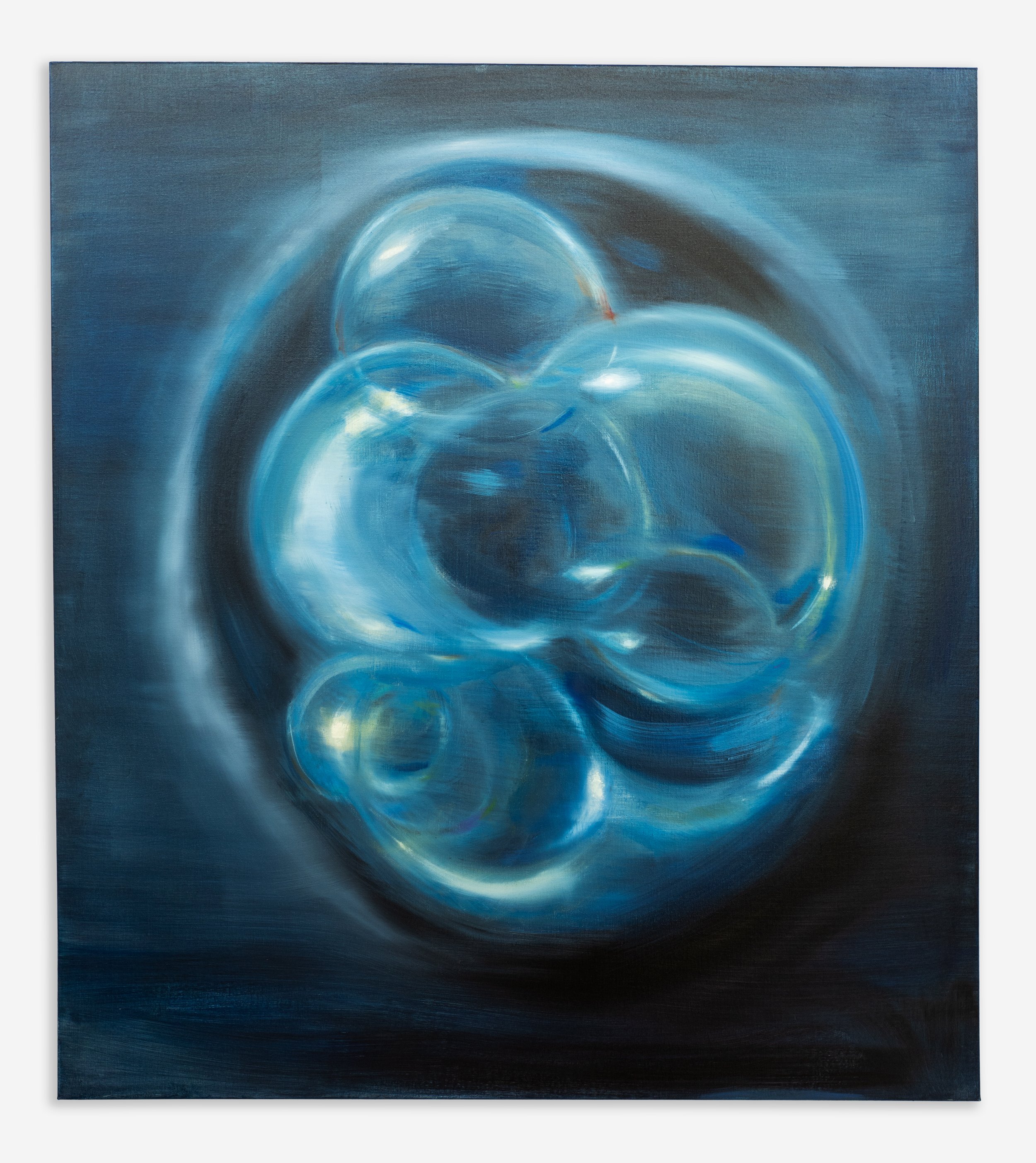
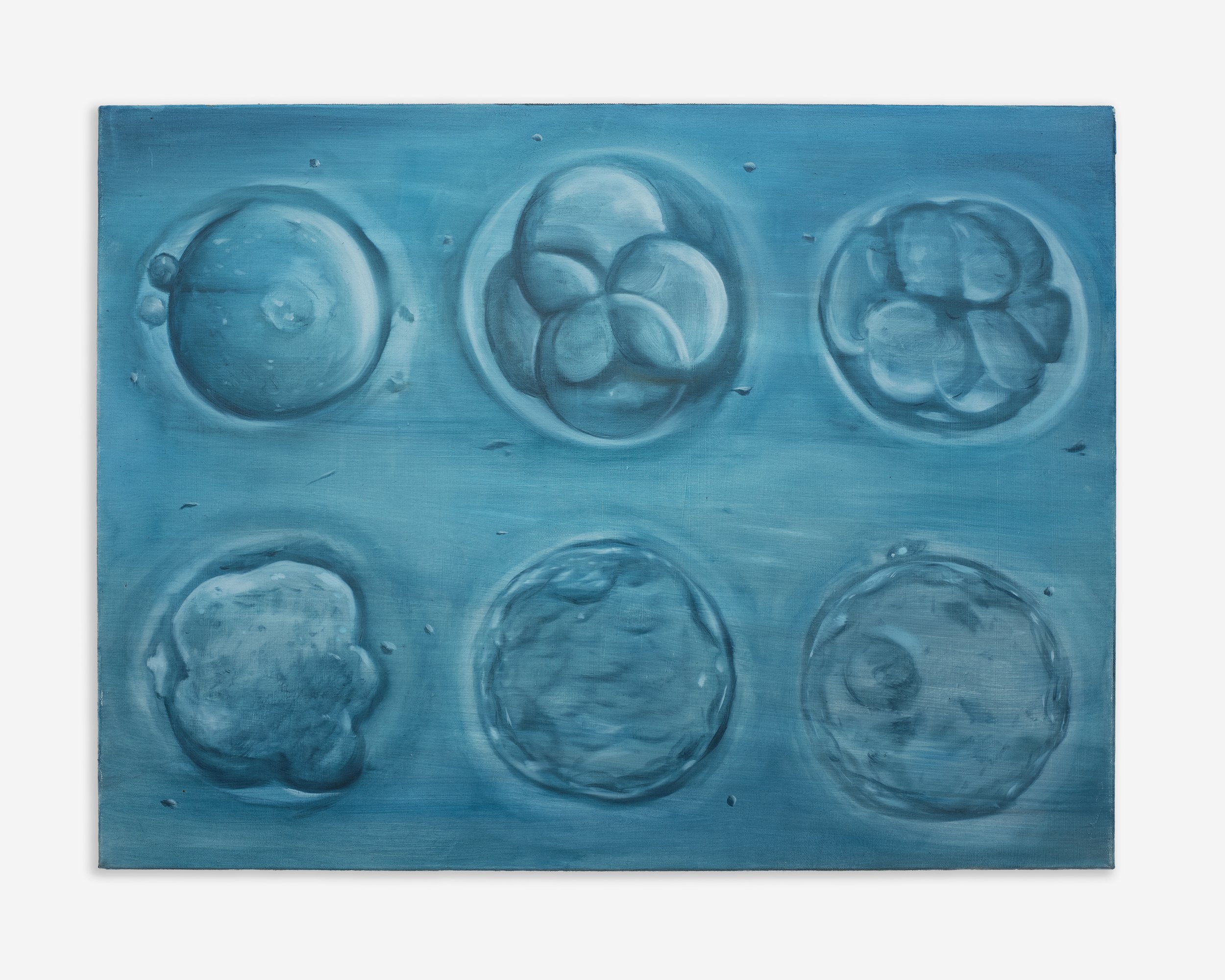
The zygote's position in Tan Mu's broader practice is worth stating precisely. It is not an outlier. It is the first work in a sustained inquiry into biological origins that includes IVF, Embryo, First Week, and Chromosomes. Each of these paintings documents a later stage in the same process. IVF shows the clinical apparatus that makes fertilization possible outside the body. Embryo shows the multicellular structure that forms after the first several divisions. First Week documents the blastocyst stage, when the cell mass has begun to differentiate. Chromosomes renders the genetic structures that carry the program the zygote executes. Zygote precedes all of them. It is the point of departure, the single cell before it has done anything except exist. The painting's stillness reflects this condition. There is no motion in Zygote, no division in progress, no morphological change under way. The cell holds. The moment is the moment before everything starts.
Li Yizhuo, writing on Tan Mu's DAWN exhibition in 2022, observed that the canvases "do not aim at diagnosing the modern spectacles from a distance. They conjure up a kind of vitality and depth of their own." The observation applies with particular force to Zygote, where the distance between viewer and subject is not spatial but scalar. The zygote is not distant in the way a satellite photograph of Earth is distant. It is distant because it is too small to be seen, because it exists at a scale that the human eye cannot register without technological mediation. The painting collapses this scalar distance, bringing the invisible into visibility, but it does not pretend that the collapse is transparent. The viewer knows, looking at the pale form on the dark ground, that this is not what a zygote looks like to the naked eye. The painting is explicit about its own mediation. It shows the cell as it appears through a microscope, through the filter of the artist's hand, through the conventions of oil paint on linen. Each of these mediations adds a layer of translation. The painting does not conceal them. It builds its meaning from them.
What remains after the mediations are accounted for is the zygote itself, or rather the idea of the zygote as the origin point of a body that will, if the program runs without interruption, become a person. Tan Mu's recognition that her own body once took this form is not sentimental. It is structural. The zygote is the only cell in the human body that every living person has been. It is the universal form of human origin, shared across every individual regardless of sex, race, age, or circumstance. Every body that has ever lived began here, at this scale, in this configuration, holding the same totipotent potential. The painting of this cell is therefore not a painting of a particular zygote. It is a painting of the condition that precedes every particular body, the common ground from which all human difference emerges. The zygote does not yet have a sex. It does not yet have features. It does not yet have a history. It is pure beginning, and it persists in that state for less than a day before the program starts running and the narrowing of possibility begins.
The final resonance of Zygote lies in this narrowing. The painting holds the cell in its totipotent state, suspending it before the first division, preserving the moment when everything is still possible. But the viewer knows what the cell cannot yet know: that the program will run, that specialization will constrain, that the thirty-seven trillion cells that will eventually compose a body are already encoded in the DNA coiling inside this single luminous sphere. The painting's stillness is not peace. It is the stillness of a system at maximum potential, the silence before the first instruction executes. Every subsequent painting in the biological series documents a step away from this condition, a further commitment to form, a further reduction in what the cell can become. Zygote sits at the far end of the series, not chronologically but logically, the point at which nothing has yet been lost. It is the portrait of a cell that has not yet decided what it will be, because it has not yet needed to decide. The decision will be made for it, by chemistry, by timing, by the same mathematical logic that Tan Mu finds in gene replication. The cell does not choose. The program runs. And the cell that contained everything divides into two cells that each contain half of everything, and then into four, and then into eight, and the totipotent moment passes, and the body begins to specialize, and the single point of light in the dark ground becomes, irreversibly, a structure with parts.