The Gaze That Turned Back: Tan Mu's Mars 03 and the Machine That Learned to See Itself
On January 8, 2024, the Mars rover Curiosity turned its Mastcam-Z camera away from the Martian landscape it had been photographing for nearly a decade and directed it at its own body, producing a composite self-portrait that shows the rover's armored chassis, its six wheels embedded in rust-colored regolith, and its camera mast tilted at an angle that approximates the position of a human head looking down at its own hands. The image was not a novelty. Curiosity and its predecessor rovers, Spirit, Opportunity, and Perseverance, have all produced self-portraits, and each one has been circulated in the press as a moment of unexpected pathos: the machine that looks at itself, the camera that photographs the camera, the extension of human vision that turns that vision back on its own instrument and sees, in the reflection, not the landscape it was built to observe but the apparatus that does the observing. The self-portrait of a Mars rover is a category error made visible. The rover was designed to look outward, at rocks and regolith and the stratigraphy of ancient lake beds, and in looking outward it has produced some of the most detailed images of an alien landscape ever made. But when it looks inward, at its own body, it produces an image that is not about Mars at all. It is about the apparatus of seeing, and the apparatus, seen from the outside, looks like a creature, and the creature looks like it is thinking, and the thought it appears to be having is the thought that the philosopher Thomas Nagel asked in his 1974 essay "What Is It Like to Be a Bat?": what is it like to be this thing, looking out at this landscape, from this position, through these eyes?
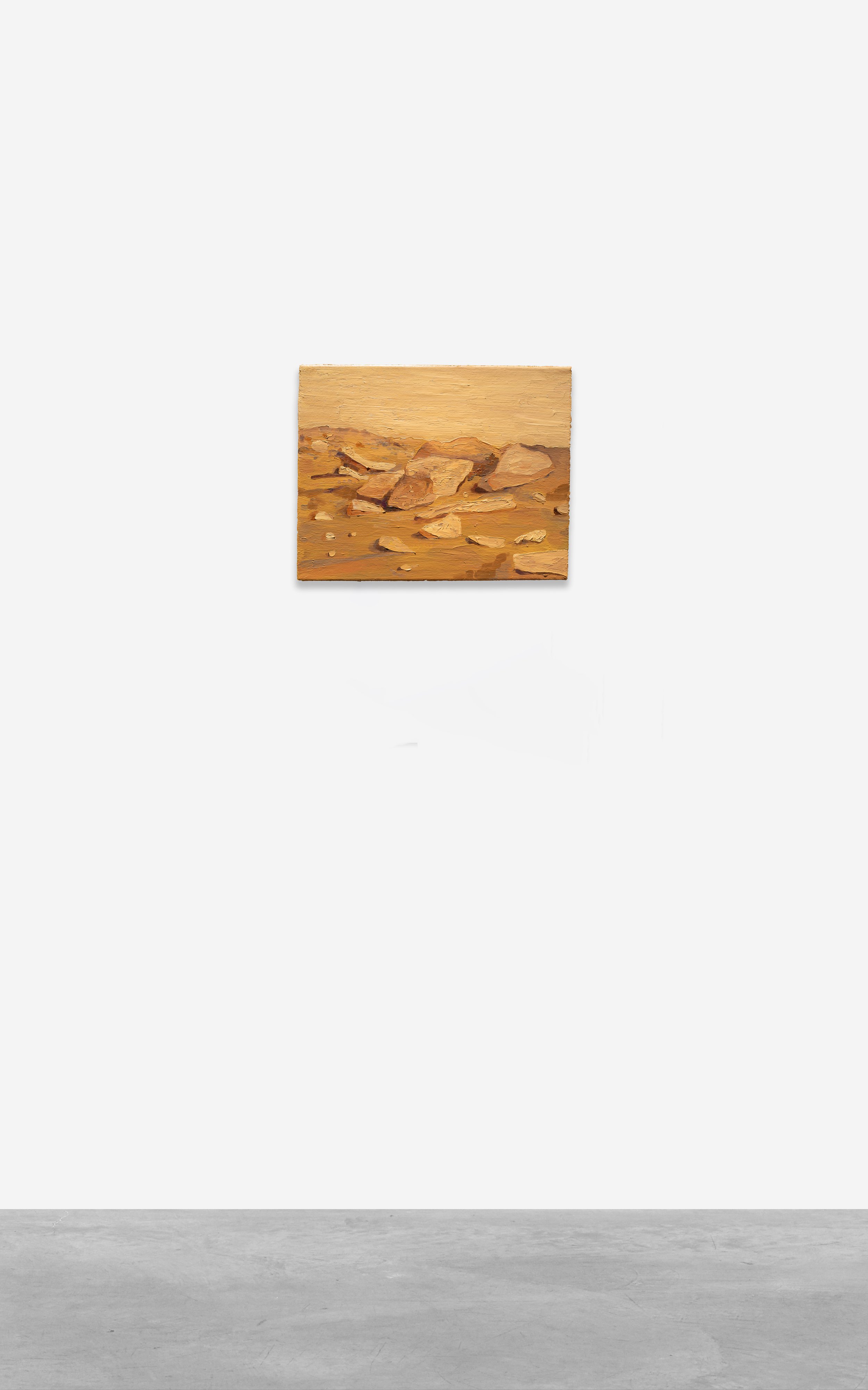
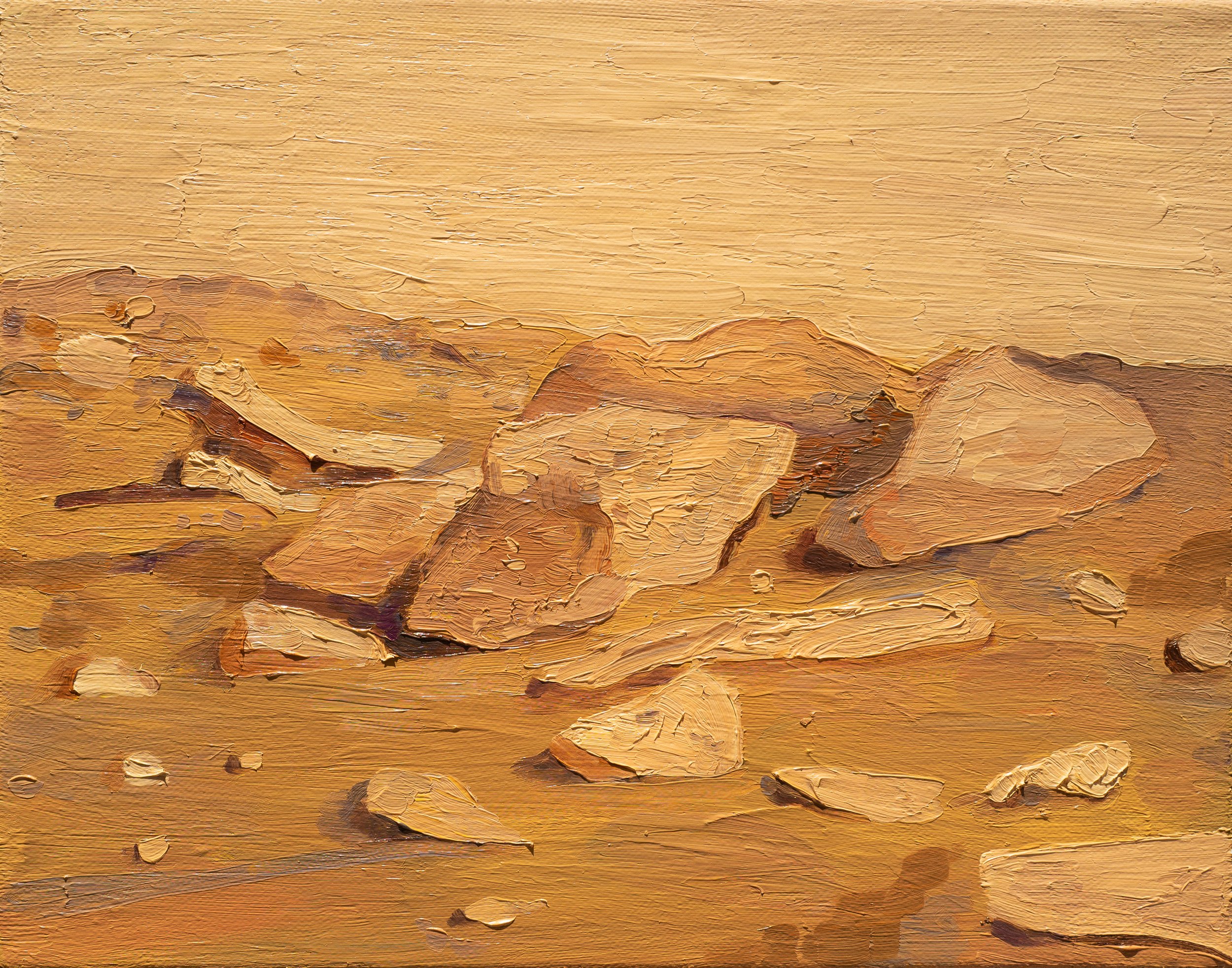
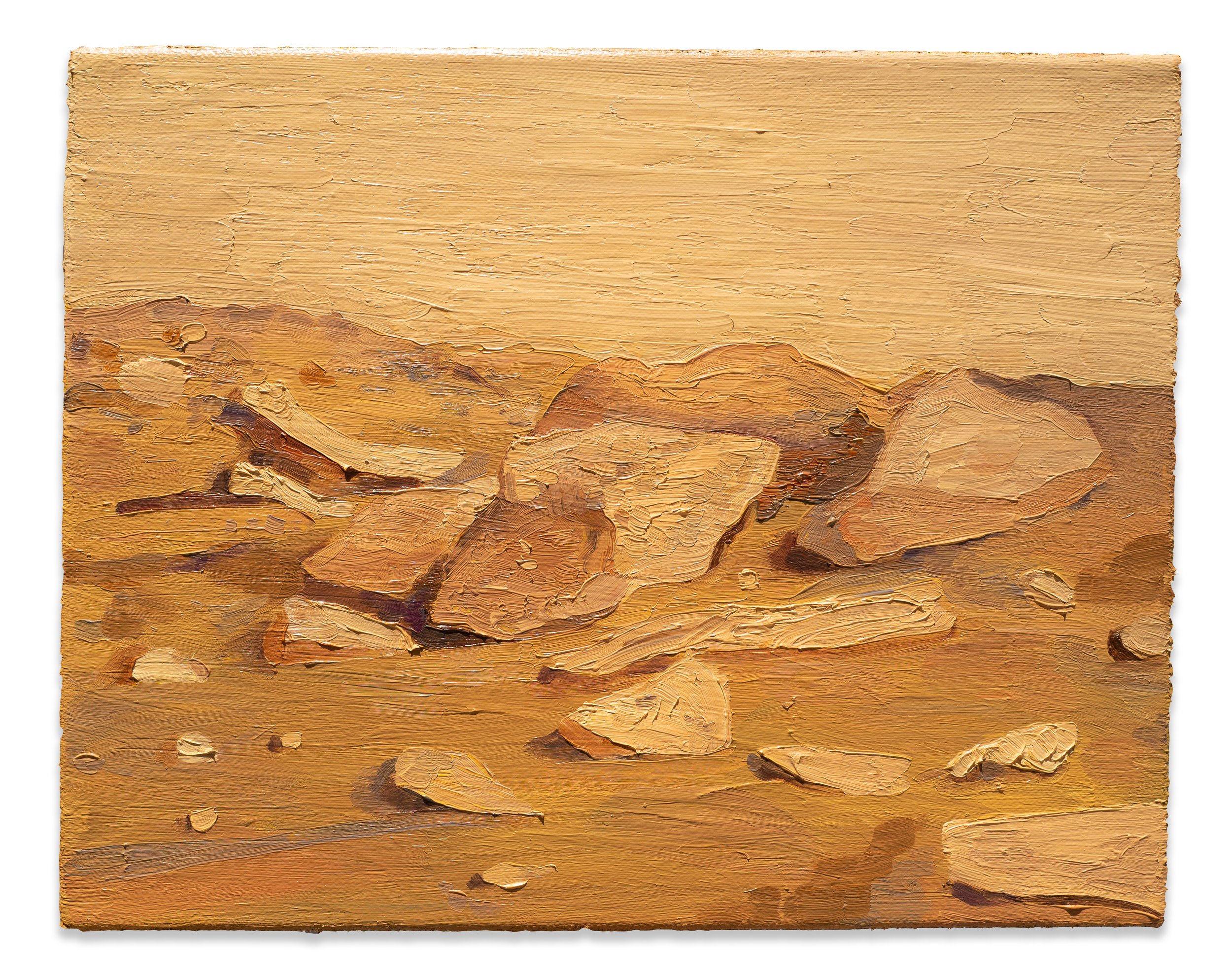
Mars 03 (2025) is an oil on linen painting, 46 x 36 cm (18 x 14 in), that depicts the Martian surface as seen through the lens of a rover camera. The painting is oriented vertically, with the landscape occupying the lower two-thirds of the canvas and a pale ochre sky filling the upper third. The ground is rendered in a palette of rust, burnt sienna, and deep iron oxide, with occasional passages of pale sand and dark volcanic rock that break the monochrome with accents of near-black and near-white. The surface texture of the painting is key to its argument. The Martian regolith is not smooth. It is composed of fine dust, coarse sand, and angular fragments of basaltic rock that have been shattered by impacts and eroded by wind into shapes that are simultaneously jagged and rounded, sharp-edged and wind-smoothed, and Tan Mu renders this texture with short, overlapping strokes of oil paint applied in multiple layers, each one slightly different in hue and value, building a surface that reads as geological strata when viewed from a distance and as individual brush marks when viewed up close. The sky is rendered in a thin wash of pale ochre over the linen ground, allowing the weave of the fabric to show through in a way that suggests the fine dust particles suspended in the thin Martian atmosphere, particles that scatter the reddish light of the sun and give the sky its characteristic butterscotch hue. This is not the blue sky of Earth. It is the sky of a planet with an atmosphere one percent as dense as ours, an atmosphere too thin to scatter blue light effectively but thick enough to hold enough iron oxide dust to tint the entire sky the color of rust.
The composition of Mars 03 places the viewer at ground level, looking out across a flat expanse of regolith toward a low ridge of rock that runs across the horizon at approximately one-third of the way down from the top of the canvas. This is the rover's perspective, the view from the mast of a machine that stands roughly two meters above the ground, and it is a view that no human body has ever occupied. The horizon on Mars is closer than the horizon on Earth because Mars is smaller, and a two-meter observer on a planet with a radius of 3,390 kilometers sees a horizon that is approximately 3.4 kilometers away, compared to a horizon that is approximately 5 kilometers away for an observer of the same height on Earth. The painting encodes this proximity in the placement of the horizon line, which sits lower in the visual field than an Earth-based viewer would expect, creating a subtle but persistent sense that something is wrong with the distance, that the landscape is too close, that the horizon is not where it should be. This disorientation is not an error. It is a precise rendering of the geometry of a smaller planet, and it produces, in the viewer who notices it, the same category of cognitive dissonance that the rover's self-portrait produces: the recognition that this is a view from somewhere that the viewer's body has never been, and that the somewhere is not a metaphor but a specific place with specific physical properties that differ from the properties of the place where the viewer is standing.
Vija Celmins began making drawings of the surface of Mars in 2008, working from photographic source material provided by the NASA Mars Reconnaissance Orbiter and other missions, and she has continued to work with this material at intervals for the past two decades, producing a body of work that now includes drawings of the Moon, the ocean surface, the desert floor, and the night sky, all of which share a method: the translation of photographic source material into a medium that predates photography by centuries, using a hand that applies graphite or charcoal to paper with a patience that transforms the mechanical image into a manual one. Celmins's Mars drawings, which include several versions of the Martian surface executed in graphite on paper, are among the most sustained engagements with the visual language of planetary science in contemporary art. The drawings are not illustrations of Mars. They are translations of the visual information that a satellite camera records into the visual information that a hand can produce, and the translation changes the information in ways that are not immediately obvious but that accumulate as the viewer spends time with the drawing. The photographic source material has a uniform resolution across the entire image plane, because the camera's sensor records every pixel with the same level of detail. The drawing has a variable resolution, because the hand can choose where to concentrate detail and where to leave the surface sparse, and the choice of where to concentrate is an act of interpretation that the camera cannot make.
Celmins's Mars drawings and Tan Mu's Mars 03 share a subject and a method, and the differences between them are as revealing as the similarities. Both artists work from photographic source material produced by NASA missions. Both translate that material into a traditional medium, Celmins in graphite on paper, Tan Mu in oil on linen. Both produce images that are not replicas of the source photographs but interpretations of them, filtered through the physical constraints and the aesthetic decisions of their respective mediums. But Celmins works in graphite, a dry medium that produces a surface of uniform texture and tonal range, and Tan Mu works in oil, a wet medium that produces a surface of variable thickness, opacity, and brush direction. Celmins's Mars surface reads as a flat plane of uniformly distributed visual information, each grain of graphite equivalent to every other grain, each mark of the pencil carrying the same weight and the same degree of attention. Tan Mu's Mars surface reads as a field of differentiated marks, some thick and opaque where the geological features demand weight, some thin and translucent where the atmosphere thins and the light diffuses, and some barely present at all where the linen shows through, producing the effect of dust particles suspended in thin air. The difference between these surfaces is the difference between a view that is everywhere equally detailed and a view that is focused, weighted, and directed, and the directed view is the view of a body, or in this case a machine that stands in for a body, that has chosen to look at one thing more carefully than another. The rover does not see the surface of Mars with uniform attention. It focuses on the rocks that its operators have directed it to examine, and it passes over the regolith between them with the indifference of a traveler on a highway who notices the scenery only when the scenery changes. Tan Mu's painting replicates this directed attention by varying the density and intensity of its brush marks, producing a surface that is not a map of Mars but a record of a specific gaze, the gaze of a machine that has been told where to look and that looks there with the single-minded intensity of an instrument designed for observation.
The Mars rover's self-portrait is a specific instance of a general phenomenon that Danni Shen, writing in Emergent Magazine in 2024, has described as the point at which "technology is not something separate from humanity, but an extension shaped by emotion, materiality, and lived experience." The rover was built to look outward, and when it looks inward it produces an image that its builders did not anticipate and could not have designed, an image of the apparatus of seeing that reveals the apparatus as a thing that sees. This is not a metaphor. The camera on the mast of the Curiosity rover is a functional instrument that captures light and converts it into electrical signals that are transmitted back to Earth, where they are decoded and assembled into images that scientists use to study the geology of Mars. When the camera is pointed at the rover's own body, it captures the same light and converts it into the same electrical signals, and the resulting image is processed by the same algorithms and displayed on the same screens. The self-portrait is not a different kind of image from the landscape photographs. It is the same kind of image, produced by the same instrument, processed by the same software, and viewed by the same eyes. The difference is not in the image but in the subject. When the camera looks outward, the subject is Mars. When the camera looks inward, the subject is the camera. And the camera, seen from the outside, looks like a body, and the body, seen in the context of an alien landscape, looks like a creature that might be thinking, and the thought it appears to be having is the thought that Tan Mu's painting articulates without stating: what does it mean to see, and what does it mean to be seen, and what happens when the instrument of seeing becomes visible to itself?
Caspar David Friedrich's Wanderer Above the Sea of Fog (1818, Hamburger Kunsthalle) is the most recognized image of a human figure seen from behind, contemplating a landscape that stretches to the horizon. The wanderer stands on a rocky outcrop, his back to the viewer, his dark coat and blond hair visible against the pale fog that fills the valley below. He faces a landscape of peaks and ridges that emerge from the fog like islands from a sea, and the fog itself extends to the horizon, where it dissolves into a luminous haze that suggests a world beyond the visible but does not show it. The painting has been read as an allegory of Romantic subjectivity, the individual confronting the sublime force of nature, and as a meditation on the act of looking itself, since the wanderer's position between the viewer and the landscape makes him both a figure in the scene and a surrogate for the viewer's own gaze. We look at him looking at the landscape, and in looking at him we become aware of our own position as observers, standing in a gallery, looking at a canvas, which is also a position of contemplation, and the painting makes this position visible by placing the wanderer in it and making the wanderer's position analogous to our own.
Friedrich's wanderer and the Mars rover in Tan Mu's painting share a structural position that is not immediately obvious because their physical forms are so different. Friedrich's wanderer is a human body in a dark coat, standing on a rock. The rover is a machine on wheels, standing on regolith. But both occupy the same structural role in their respective compositions: they stand between the viewer and the landscape, facing away from the viewer, looking out at a terrain that extends to the horizon, and their position as intermediaries makes them both the subjects and the objects of the gaze. Friedrich's wanderer is the subject of his own gaze, looking out at the landscape, and the object of our gaze, looked at by us as he looks. The rover is the subject of its own camera's gaze, looking out at the Martian surface, and the object of Tan Mu's painterly gaze, rendered in oil on linen by a hand that has translated the machine's visual output into a human medium. In both cases, the figure in the composition stands at the point where two gazes intersect, the gaze that looks outward at the landscape and the gaze that looks inward at the figure, and the intersection is the site where the act of seeing becomes visible to itself. Friedrich makes this visible through the convention of the Rückenfigur, the figure seen from behind. Tan Mu makes it visible through the choice of perspective: the painting is composed from the rover's point of view, looking out at the Martian surface, and the viewer who stands in front of the painting occupies the same position that the rover's camera would occupy if the camera were looking at the surface instead of at its own body. The painting does not show the rover. It shows what the rover sees. And by showing what the rover sees, it makes the viewer occupy the rover's position, which is the position of a machine that has been built to see, and the experience of occupying that position, even for the few minutes it takes to look at a painting, is the experience of seeing as a machine sees, with directed attention and without the distractions of a body.
Tan Mu's interest in Mars is not an interest in the planet as a geological object. It is an interest in the gaze that the planet makes possible, and the gaze is specifically the gaze of a machine that has been built to extend human vision beyond the range of the human body. The rover is not a camera on a tripod. It is a mobile laboratory equipped with seventeen cameras, each one designed for a specific purpose: navigation, hazard avoidance, close-up examination of rock surfaces, wide-angle landscape survey, and, in the case of the mast-mounted cameras, stereo imaging that produces the three-dimensional depth perception necessary for a human operator to drive the rover across the surface from a distance of hundreds of millions of kilometers. The rover does not see the way a human sees. It sees in stereo, in multiple wavelengths, at multiple resolutions, and it processes what it sees through algorithms that enhance contrast, correct for lens distortion, and stitch multiple frames into composites that present a wider field of view than any single camera can capture. The result is a visual experience that is continuous with human vision, because it was designed by humans for humans, but that is also fundamentally different from human vision, because it has been optimized for the specific task of navigating and studying a surface that no human eye has ever seen directly. Tan Mu's painting takes this optimized, stitched, composite visual experience and renders it in a medium that is the opposite of optimized: oil on linen, applied by hand, one stroke at a time, each stroke a decision about color and thickness and direction that no algorithm made and no satellite dictated. The painting is not a reproduction of the rover's visual output. It is a translation of it, and the translation introduces what the algorithm excludes: the weight of the hand, the opacity of the pigment, the texture of the linen, and the judgment of the painter about where to concentrate detail and where to let the surface breathe.
The small format of Mars 03, 46 x 36 cm, is the format of intimacy, not of spectacle. Mars is a big planet, and the images that NASA releases to the public are often big too, composites of hundreds of frames stitched together into panoramas that span the full width of a computer screen and invite the viewer to scroll across them as though traversing the surface. Tan Mu's painting does not invite scrolling. It invites standing, at a distance of one or two meters, in a room where the painting is the only object that demands attention. The scale of the canvas corresponds to the scale of the human body, not the scale of the planet, and the experience of looking at it is an experience of looking at something small that represents something large, a reduction in scale that is also a concentration of attention. The rover's cameras capture the surface of Mars in a resolution that would allow a geologist to identify individual mineral grains. The painting captures it in a resolution that allows a viewer to see individual brush strokes. The difference is not a loss. It is a choice. The painting has chosen to render the surface at the resolution of the human hand, not the resolution of the machine sensor, and the choice produces a surface that is simultaneously Martian and manual, a surface that belongs to both the planet and the painter, and that exists in the space between the camera's exhaustive detail and the eye's selective attention, a space that is neither purely mechanical nor purely human but somewhere in between, where the gaze that the machine extends and the gaze that the hand directs meet and merge into a single act of seeing that is neither fully one nor fully the other, and that, in the moment of merging, becomes something that neither the machine nor the hand could produce alone: a view of an alien surface that is also a record of a human body looking at it, painted at a scale that a body can hold, in a medium that a body can touch, by a hand that chose, stroke by stroke, where to look and how hard to look and when to stop.