The Form That Holds Everything: Tan Mu's First Week and the Quiet Order at the Beginning
Within twelve hours of fertilization, the single cell that results from the merger of sperm and egg has not yet divided. It exists in a state that embryologists call the zygote, a term derived from the Greek zygotos, meaning yoked or joined, because the two pronuclei, the one contributed by the sperm and the one contributed by the egg, sit side by side within the same cell membrane, each containing its own set of chromosomes, each waiting for the moment when the cell will divide and the two sets will merge into a single genome that will direct the development of every cell in the body that is about to be built. The zygote is not yet an embryo. It is not yet a body. It is not yet anything that a casual observer would recognize as alive. It is a sphere, roughly one tenth of a millimeter in diameter, contained within a translucent membrane called the zona pellucida, and it floats in the fallopian tube in a state of apparent stillness that belies the intensity of the molecular events taking place inside it. The DNA is replicating. The cytoplasm is reorganizing. The proteins that will drive the first cell divisions are being synthesized from the messenger RNA that the egg cell stored during its decades of dormancy in the ovary. Everything that will become the body is present in this single cell, not as a miniature person but as a set of instructions encoded in the sequence of nucleotide bases that make up the genome, and the instructions are being read for the first time, and the reading is the beginning of everything that will follow, and the cell that contains them is the smallest and the most consequential object that a human eye will ever see through a microscope, and it is the subject of Tan Mu's First Week.
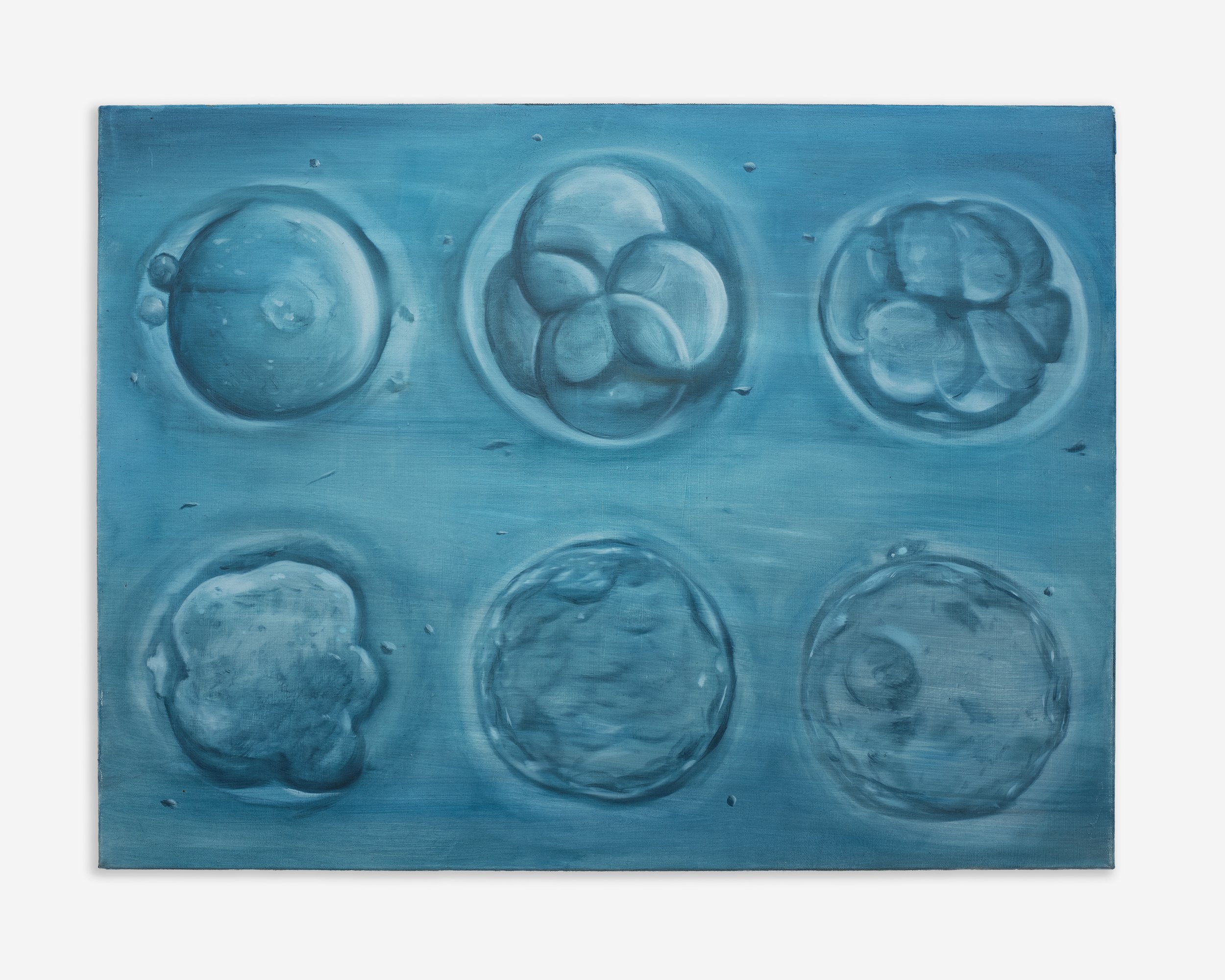
First Week (2022) is an oil on linen painting, 46 x 61 cm (18 x 24 in), that depicts the earliest stages of embryonic development, from the single-celled zygote through the first several rounds of cell division that transform the zygote from one cell into two, from two into four, from four into eight, and from eight into the morula, a compact sphere of cells that will go on to become the blastocyst and then the embryo. The composition is horizontal, with a central circular form, the zygote or the early-stage embryo, set against a dark ground that reads as the interior of the reproductive tract, a field of deep indigo and near-black that provides the visual context for the luminous organic forms that float within it. The central form is rendered in layers of translucent and opaque paint that create the impression of a three-dimensional sphere seen in cross-section, with an outer membrane of pale ivory, a middle layer of soft peach and rose, and an inner core of warmer tones, gold and amber, that suggest the metabolic activity taking place inside the cell. The surrounding field is not empty. It contains smaller forms, cells that have divided from the zygote and are beginning the process of differentiation, each one rendered as a smaller version of the central sphere, with its own membrane, its own interior gradient, and its own luminosity, which is slightly less intense than the luminosity of the central form, as though the energy of the original cell were being distributed among its descendants with each division, each daughter cell receiving a portion of the original light.
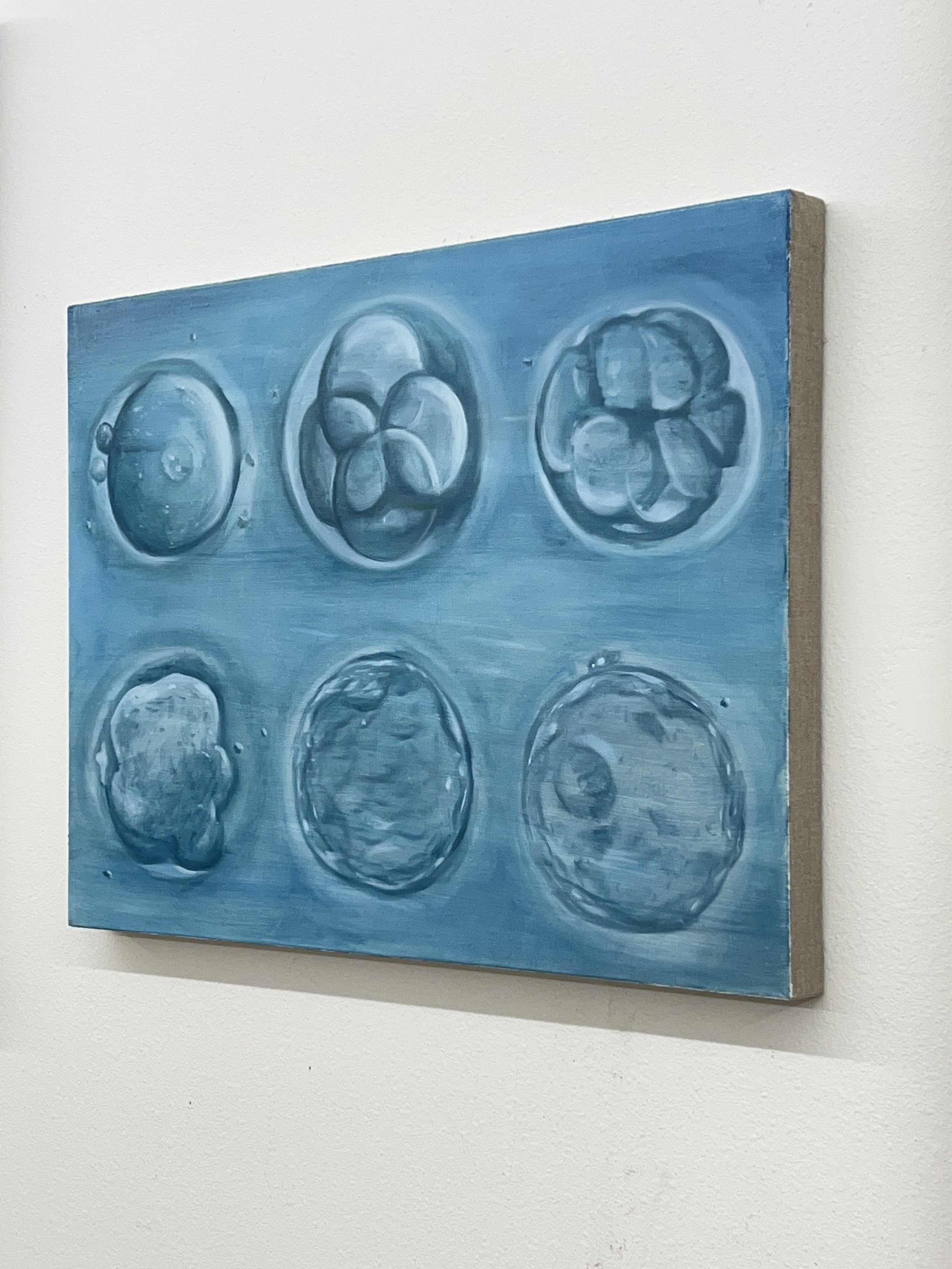
The surface of First Week is built from thin glazes of oil paint laid over a dark ground, with the luminous forms painted in thicker, more opaque layers that sit above the surface and catch the light when the viewer moves past the canvas. This variation in surface height, from the dark, flat ground to the raised, rounded forms of the cells, creates a subtle relief that is visible at close range and that disappears when the viewer steps back, producing an experience of the painting that changes with distance in a way that mirrors the experience of looking through a microscope, where the adjustment of the focal length reveals or conceals detail depending on the magnification. At close range, the viewer can see the individual brush marks that compose each cell membrane, the thin lines of pale ivory that define the boundary between the interior and the exterior of each form, and the tiny points of brighter pigment within the interior that suggest the organelles and the metabolic processes that are too small to resolve individually but that the painting registers as a generalized luminosity, a glow that emanates from the center of each form and fades toward its edges. At a distance of one meter, these details merge into the overall impression of luminous spheres floating in a dark medium, and the painting reads as a depiction of embryonic development that is faithful to the visual logic of the microscope without being a literal transcription of any single micrograph.
Arthur Dove painted Nature Symbolized No. 2 in 1911, producing one of the earliest fully abstract paintings in American art. The work, now in the collection of the Museum of Modern Art, consists of a central circular form surrounded by radiating lines and smaller circular elements that suggest a natural phenomenon, a sunrise, a flower, a cell, a star, viewed not from the outside but from the inside, as though the phenomenon itself were generating the visual field rather than being observed from a position outside it. Dove had been working as a commercial illustrator in New York when he met Alfred Stieglitz in 1908, and under Stieglitz's encouragement he abandoned illustration and began making paintings that extracted from natural forms their essential shapes and rhythms, reducing the landscape to a set of curves, circles, and lines that preserved the feeling of the original scene while discarding its literal appearance. Dove called these works "extractions," and he described his method as the removal of everything from the visual experience that was not essential to its emotional impact, leaving only the forms that carried the weight of the feeling. Nature Symbolized No. 2 is an extraction of the experience of watching the sun rise over a body of water, and what remains after the extraction is a central circle of warm gold, a set of radiating lines that suggest light emanating from the circle, and a set of smaller circles and curves that suggest the reflection of the light on the water and the movement of the atmosphere around it. The painting does not look like a sunrise. It looks like what a sunrise feels like when you are inside it, surrounded by the light and the warmth and the motion of the air, rather than looking at it from a distance.
Dove's extractions and Tan Mu's embryonic paintings share a logic of biological abstraction that is not immediately obvious because they come from different moments in art history and different traditions of practice, but that becomes clear when the works are compared side by side. Dove extracted from natural forms their essential shapes and rhythms, reducing the sunrise to a circle and a set of radiating lines, and he did so in the conviction that the essential shapes carried the emotional weight of the experience, and that the literal appearance was secondary. Tan Mu extracts from embryonic forms their essential visual logic, reducing the zygote to a luminous sphere set against a dark ground, and she does so in the conviction that the visual logic of the microscope image is not a distortion of reality but a revelation of it, a way of seeing the biological process that is unavailable to the unaided eye and that the painting makes available through the medium of oil on linen. The central circle in Dove's extraction and the central sphere in Tan Mu's embryonic painting are both luminous forms surrounded by a dark field, and both function as sources of light that generate the visual field rather than existing within it. The difference is one of subject and source. Dove's source is the landscape, and his extraction produces an abstraction that refers to the landscape without depicting it. Tan Mu's source is the micrograph, and her extraction produces a painting that refers to the biological process without transcribing it, and the result, in both cases, is a work in which the central form holds the entire visual field together by emitting the light that makes the rest of the composition visible. The zygote in First Week and the sun in Nature Symbolized No. 2 are both origins, both sources of luminosity, and both central forms that organize the visual field around them, and the visual logic that makes them central is the same logic: the eye is drawn to the brightest point in the composition, and the brightest point in both compositions is the point where life begins, whether the life of the day or the life of the body.
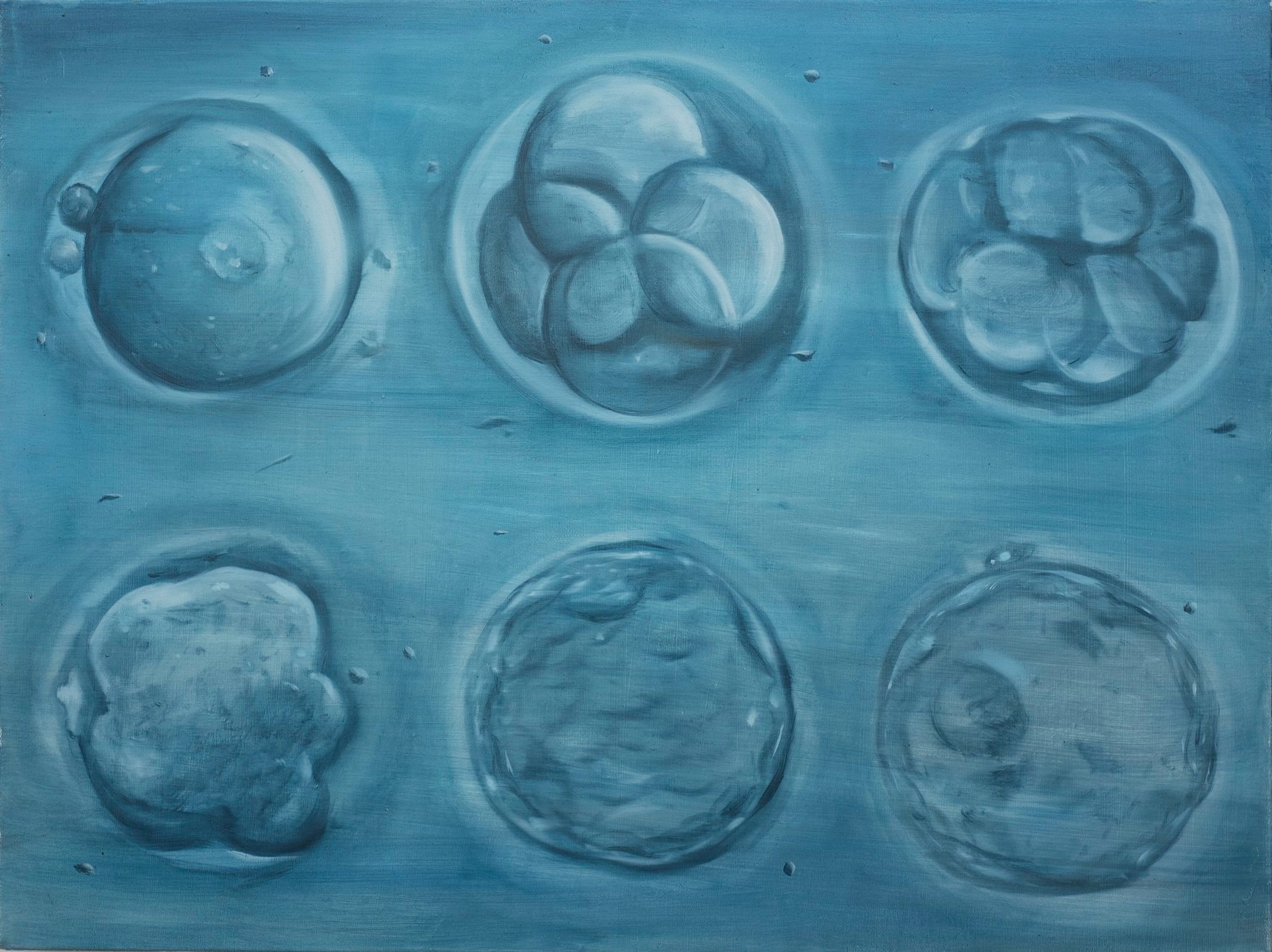
The process that First Week depicts is called cleavage, and it is one of the most remarkable events in all of biology. Within hours of fertilization, the zygote begins to divide, and the divisions occur at a rate that is extraordinary by the standards of any other cell in the body. The first division produces two cells. The second produces four. The third produces eight. The fourth produces sixteen. By the end of the first week, the embryo consists of approximately one hundred cells, organized into a hollow sphere called a blastocyst, and each of these cells is smaller than the original zygote because the total mass of the embryo has not increased. The embryo has not grown. It has divided. The same amount of cytoplasm that was present in the single cell of the zygote has been partitioned among the hundred cells of the blastocyst, each one receiving its own nucleus, its own set of chromosomes, and its own complement of organelles, but none of them receiving any new material from outside. The embryo lives on the reserves that the egg cell accumulated during its decades of dormancy in the ovary, and it will continue to live on those reserves until it implants in the uterine wall and establishes a connection with the mother's blood supply, at which point the reserves are exhausted and the embryo begins to grow for the first time. Tan Mu describes this process in terms that emphasize the visual logic of the transformation rather than its biological specifics: "First Week traces the earliest biological progression of an embryo, focusing on the transformation from a single fertilized cell into a more complex structure. It emphasizes the abstract beauty and quiet order present at the very beginning of life, where form is minimal yet full of potential." The phrase "quiet order" is precise. The cleavage process is orderly. The divisions occur at regular intervals, the cells are arranged in predictable patterns, and the embryo at each stage looks like a geometric object, a sphere, a cluster of spheres, a hollow ball, that could be the product of a mathematical rule rather than a biological one. This orderliness is what makes the embryo so compelling as a visual subject, and it is what Tan Mu renders in paint: the quiet order of a process that is following a set of instructions that are written in the language of nucleotide bases and that are being executed with a precision that no human engineer could match.
Ernst Haeckel published Kunstformen der Natur, or Art Forms in Nature, in ten installments between 1899 and 1904, producing one of the most influential visual documents in the history of biology. Each installment contained ten lithographic plates, drawn by Haeckel himself from his own observations and from the observations of his colleagues, depicting organisms from across the animal kingdom in arrangements that emphasized their geometric regularity and their aesthetic appeal. The plates show radiolarians, diatoms, jellyfish, sea anemones, corals, bryozoans, and a hundred other groups, each one rendered with a precision and a decorative sensibility that blurs the boundary between scientific illustration and art. Haeckel's purpose was explicitly both scientific and aesthetic. He believed that the forms of nature were inherently beautiful, and that the artist's task was to reveal this beauty by selecting the most symmetrical, the most regular, and the most visually striking organisms and arranging them in compositions that highlighted their geometric properties. The result was a series of images that presented the natural world as a cabinet of wonders, each organism a small masterpiece of form, each plate a curated collection of masterpieces arranged according to principles of visual harmony that owed as much to Haeckel's training as a painter as to his training as a biologist.
Haeckel's Art Forms in Nature and Tan Mu's First Week share a conviction that biological forms are inherently visual, that they possess a beauty that is not imposed by the observer but discovered in the structure of the organism itself, and that the task of the artist who works from biological source material is to reveal this beauty rather than to embellish it. But where Haeckel's plates present multiple organisms in symmetrical arrangements that emphasize their decorative properties, Tan Mu's painting presents a single organism at a single stage of its development, in a composition that emphasizes not its decorative properties but its structural logic. The zygote in First Week is not decorated. It is not surrounded by other organisms that complement its form. It sits alone in a dark field, generating its own light, dividing according to its own rules, and the painting's argument is not that the zygote is beautiful, which it is, but that its beauty is a consequence of its structure, and that the structure is a consequence of the instructions encoded in its genome, and that the instructions are being executed with a precision that no painter could match and no decorator could improve. Yiren Shen, in her 2025 conversation with Tan Mu for 10 Magazine, described the artist's practice as one that "makes visible what was previously invisible," and the description applies to First Week with particular force, because the process that the painting depicts is one that takes place inside the body, in a location that no unaided eye can see, and at a scale that no unaided eye can resolve, and the painting makes it visible not by magnifying it but by translating it, from the visual language of the micrograph into the visual language of oil paint, a language that does not require a microscope to read.
Tan Mu connects the embryonic forms in First Week to the broader pattern of spherical structures that recur throughout her practice, from the cross-section of the fiber optic cable to the cross-section of the embryo to the cross-section of the planet seen from orbit. "Spherical forms fascinate me because they embody universality and interconnectedness," she writes. "Whether seen in the structure of an embryo, the cross section of a fiber optic cable, or the vast geometry of the cosmos, these shapes reflect fundamental systems of energy flow and organization. They function as symbols of both the microcosm and the macrocosm, holding immense complexity within a seemingly simple form." The observation is structural, not metaphorical. The embryo is spherical because the sphere is the shape that minimizes surface area for a given volume, and the zygote, as a single cell contained within a membrane, is a volume that has minimized its surface area. The fiber optic cable is cylindrical, which is a sphere extended along one axis, because the cable is a volume that has been optimized for the transmission of light along a single direction. The planet is spherical because gravity pulls all matter toward the center of mass, and the sphere is the shape that results when every point on the surface is equidistant from the center. These are not metaphors. They are instances of the same physical principle, the principle of energy minimization, operating at different scales and in different media, and the principle produces the same shape at every scale because the shape is the optimal solution to the same problem: how to contain a volume with the least surface area. The painting makes this structural connection visible by rendering the embryonic sphere in the same visual language, luminous form against a dark ground, that Tan Mu uses for the planetary sphere and the cable cross-section, and the visual connection is not an analogy that the painter imposes. It is a recognition of a pattern that the physics imposes, and the physics imposes it at every scale, from the zygote to the planet, because the mathematics of optimization does not care about the size of the object it is optimizing. It cares about the relationship between volume and surface area, and the sphere is the answer, and the answer is the same at every scale, and the painting shows this by making the zygote look like a planet and making the planet look like a zygote, and the resemblance is not decorative. It is physical.
The format of First Week, 46 x 61 cm, is intimate, a size that the viewer holds in the hands rather than surveys from across a room, and the intimacy is appropriate to the subject, because the subject is the smallest and most private stage of human development, a stage that takes place inside the body, in darkness, in silence, before the body has a nervous system that could experience light or sound. The painting does not attempt to reproduce the experience of the embryo, which has no experience, because it has no nervous system and therefore no consciousness. It attempts to reproduce the experience of looking at the embryo through a microscope, an experience that is available only to those who have access to the technology that makes it possible, and that is, in principle, available to anyone who is willing to look through the eyepiece and see what is there. What is there is a sphere of luminous cells dividing in a dark field, following a set of instructions that are older than the body that is executing them, older than the species that the body belongs to, older than the kingdom that the species belongs to, and as old as the first cell that divided into two and began the process that has produced every living thing that has ever existed on this planet. The instructions are simple. Divide. Differentiate. Organize. The result is complex beyond comprehension. The painting shows the simplicity. The complexity is implicit in the simplicity, because the simplicity is the instruction, and the instruction is the beginning, and the beginning is the form that holds everything that will follow, and the form is a sphere, and the sphere is luminous, and the luminosity is the visual evidence of the metabolic activity that is executing the instructions, and the instructions are running, and the cells are dividing, and the embryo is becoming, and the painting stands still at the beginning, holding the form that holds everything, in a medium that holds still, on a surface that holds still, in a room that holds still, while the process that the painting depicts continues, in every body that is alive at this moment, in the same way, with the same instructions, following the same quiet order, in the dark.