The Circle That Held You: Tan Mu's A Sunday Afternoon in the Park and the Geometry of Distance
On May 17, 2020, a photographer named Johannes Eisele stood in Domino Park in Brooklyn and pointed his camera down at the grass. Below him, dozens of white circles, each roughly eight feet in diameter, were painted on the lawn in three neat rows. Inside each circle, a small group of people sat on blankets or towels, talking, reading, sunbathing, stretching. No circle was occupied by more than one household. No one sat between the circles. The circles were not a suggestion. They were a mandate, implemented by the park's management to enforce social distancing during the COVID-19 pandemic, and their visual effect was immediate and unmistakable: the open field of the park, which had previously been an undifferentiated space where anyone could sit anywhere, was transformed into a grid of controlled units, each one a permission slip for proximity and a prohibition against contact beyond its boundary. The photograph, published by CNN under the headline "Domino Park circles keep New York City sunbathers in check," circulated widely. It showed a public park that looked like a parking lot for people. It showed leisure as a regulated activity. It showed freedom and confinement occupying the same grass at the same time.
Tan Mu's A Sunday Afternoon in the Park (2022) is a painting of that photograph. Oil on linen, 61 x 76 cm, it transforms Eisele's aerial documentation into a composition that is simultaneously a landscape, a diagram, and a portrait of a specific historical moment. The title is not an accident. It echoes, with deliberate precision, Georges Seurat's A Sunday Afternoon on the Island of La Grande Jatte (1884-1886), a painting that also depicts a Parisian public park on a weekend afternoon, also populated by figures pursuing leisure in a space that is simultaneously open and regulated. Tan Mu's Q&A for this work confirms the connection: "The title deliberately echoes Georges Seurat's A Sunday Afternoon on the Island of La Grande Jatte, creating a conversation between a historical image of leisure and a contemporary moment shaped by crisis." The conversation is not a comparison. It is a structural claim. Seurat's painting and Tan Mu's painting share the same subject: the public park as a space where social relations are performed under conditions that are not fully visible to the people performing them.
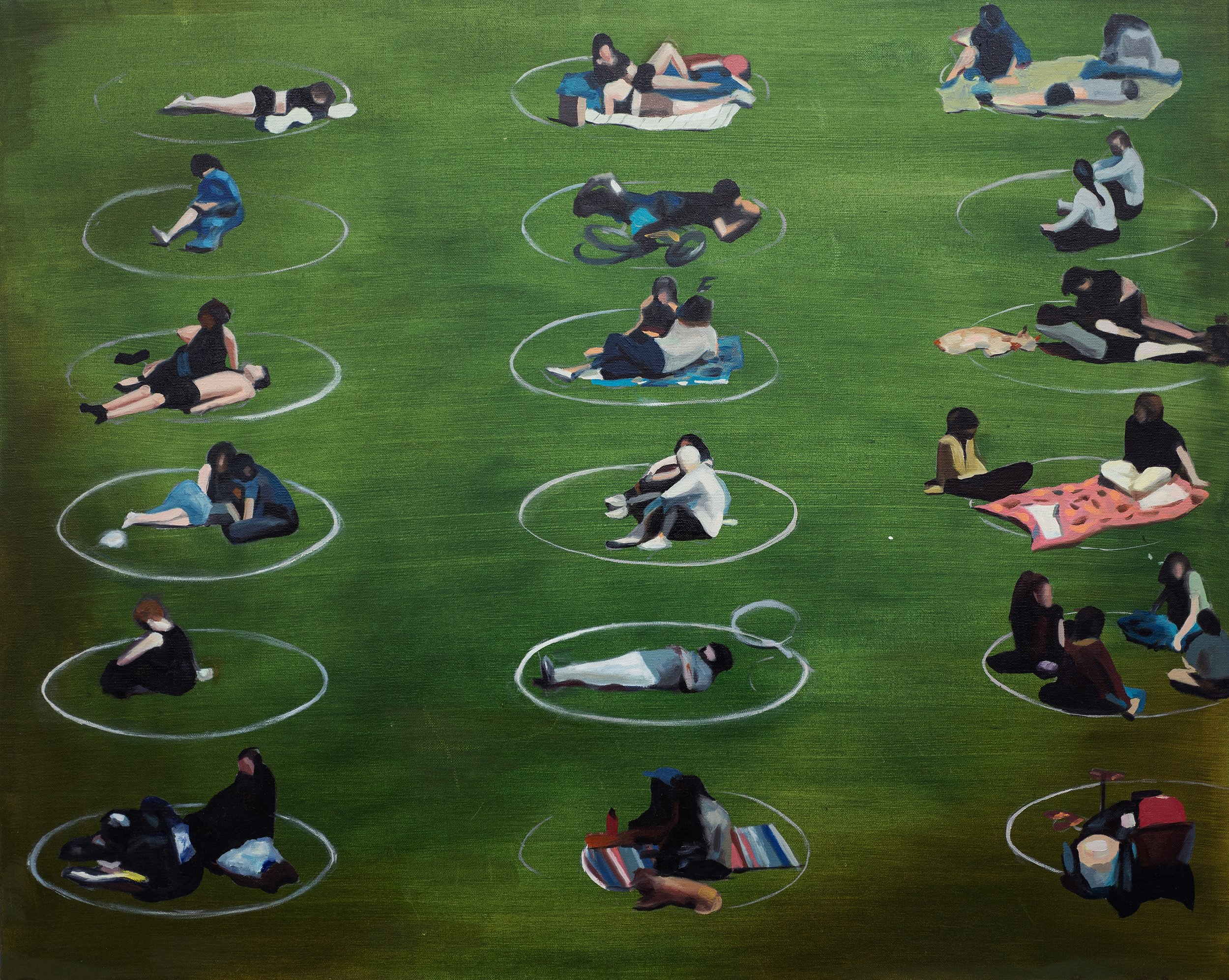
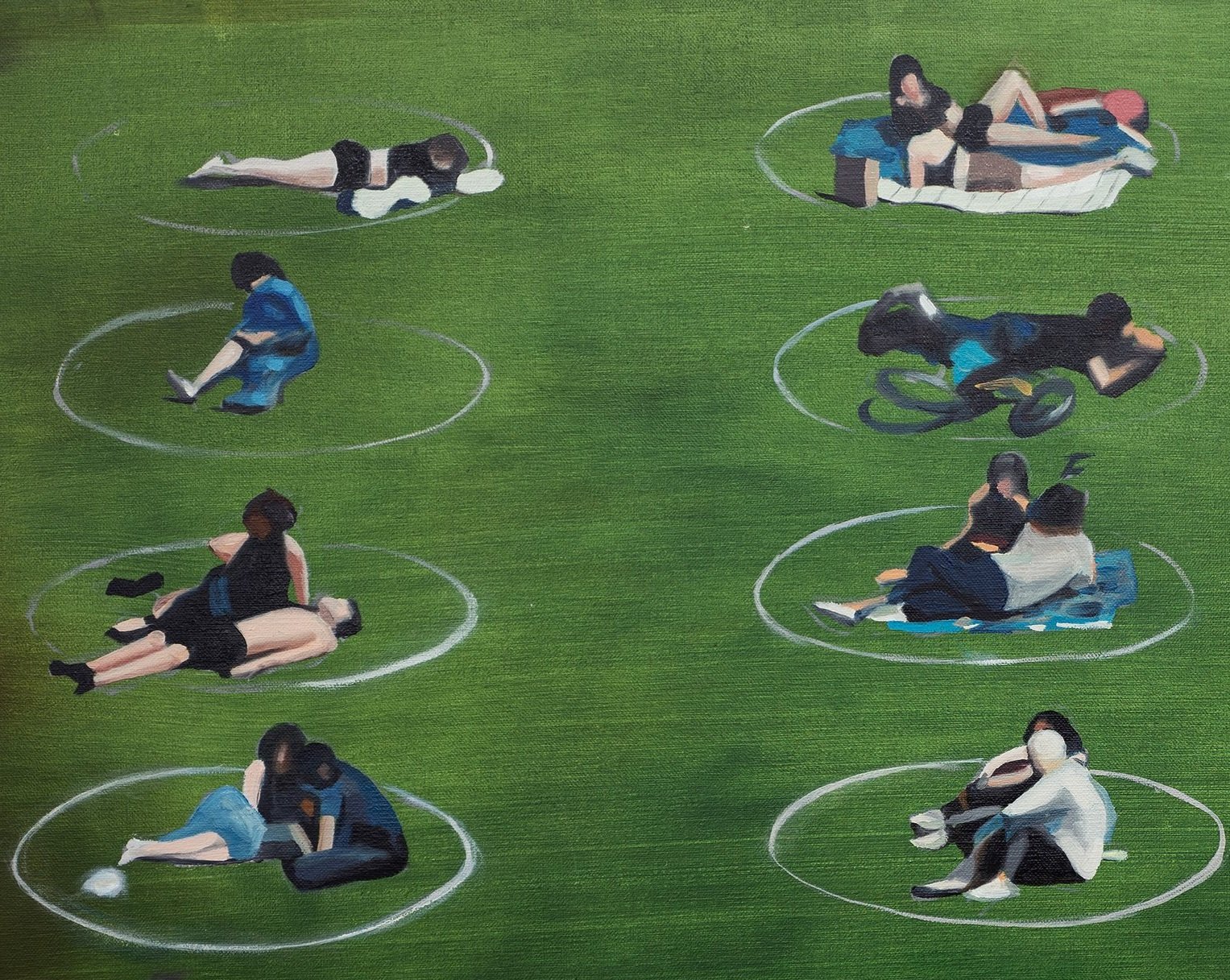
The painting's surface is divided into two distinct zones that correspond to two distinct modes of mark-making. The first zone is the grass, which occupies roughly two-thirds of the canvas and is rendered in bold, open brushstrokes of green that vary from a cool viridian in the shadows to a warmer, more yellow-green where the light falls across the lawn. These brushstrokes are loose and gestural, the kind of mark that records the movement of the arm rather than the appearance of individual blades. They do not describe grass. They enact the experience of looking at a field of grass from above, where the individual stalks dissolve into a continuous texture that shifts in value according to the light. The second zone is the circles, which are rendered in a flat, opaque white that sits on top of the grass like a stencil applied to a surface. The circles are not blended into their surroundings. They are placed on top of them. The white paint has a different character from the green: it is denser, more matte, less gestural. It does not flow. It declares. The contrast between the two zones, the gestural green below and the geometric white above, produces the painting's central visual tension: the organic and the imposed, the flowing and the rigid, the park as a field of open possibility and the park as a grid of controlled enclosures.
Within each circle, the figures are rendered as small marks of color, each one a concentrated daub of paint that represents a person engaged in a specific activity: sitting, lying, stretching, talking. The figures are not individuated. They are not portraits. They are units of presence, each one occupying a circle, each circle occupying a row, each row occupying a field. The composition reads as a grid, but it is a grid composed of circles, not squares, and this distinction matters. A square grid divides space into equal units that share edges. A circle grid divides space into equal units that are separated by the interstitial grass. The people in Tan Mu's painting do not share walls with their neighbors. They share the space between circles, which is the space of prohibition. The grass between the circles is the distance you must not cross. It is the space that the pandemic made visible, the space that was always there in any crowded park, the gap between one stranger's blanket and another, but that no one had ever thought to paint white lines around. The pandemic did not invent social distance. It made it geometric.
At the center of the composition, occupying the single circle in the foreground row that faces the viewer directly, is a woman in a white mask. Tan Mu describes this figure as "a quiet anchor for the painting, inviting a direct encounter." The mask is rendered in the same opaque white as the circles, producing a formal connection between the figure and the geometry that contains her. The mask and the circle are made of the same material. They are both white, both flat, both imposed. The mask covers the face the way the circle covers the grass: by drawing a boundary around a zone of permitted activity and declaring everything outside that boundary off-limits. The woman's face is not visible beneath the mask. Her expression is not readable. She is present, but her presence is mediated by the same geometry that governs her position in the park. The mask and the circle are not metaphors for each other. They are instances of the same principle: the principle that proximity must be regulated, that the body must be contained, that the distance between one person and another is no longer a matter of choice but a matter of rule.
Georges Seurat's A Sunday Afternoon on the Island of La Grande Jatte (1884-1886) is a painting of a public park on the Seine, populated by Parisians of various social classes engaged in leisure activities: walking, sitting, fishing, playing instruments, watching other people watch them. The painting is famous for its technique, the pointillist method of building form from thousands of small dots of complementary color that blend optically in the viewer's eye. But its subject is not technique. Its subject is the social choreography of a public park, the way the space organizes its occupants into patterns of proximity and distance that reflect the class structure of the society that produced them. The figures in La Grande Jatte are not grouped randomly. They cluster by social type: the bourgeois couples strolling along the riverbank, the working-class families sitting on the grass, the solitary fishermen at the water's edge, the military officer standing at attention, the woman with the monkey on a leash who has been variously identified as a prostitute and a pet owner. Each group occupies its own zone of the park, and the zones are arranged in a spatial hierarchy that mirrors the social hierarchy of 1880s Paris. The park is not a democratic space. It is a designed space, and Seurat's composition makes the design visible.
Seurat's spatial design operates through what the art historian Félix Fénéon called "the systematic application of the scientific method" to painting. The figures are placed at carefully calculated intervals, their distances from each other determined not by the logic of social interaction but by the logic of pictorial composition. The result is a painting in which the social relations of the park are made legible through geometry. The space between one figure and the next is as meaningful as the figures themselves. This is the structural connection to Tan Mu's painting. In A Sunday Afternoon in the Park, the geometry is no longer implicit. It is explicit. The circles on the grass are Seurat's compositional distances made visible, painted white, and imposed from the outside by a park authority rather than emerging from the internal logic of the composition. Seurat's painting shows a park where social distance is produced by class. Tan Mu's painting shows a park where social distance is produced by a virus. Both paintings make the distance visible. Seurat hides it in the composition. Tan Mu paints it on the grass.
The source photograph for Tan Mu's painting was taken on May 17, 2020, roughly two months after New York City entered lockdown. By that date, over 20,000 New Yorkers had died from COVID-19. The city's hospitals had been pushed to capacity. Refrigerated trucks had been parked outside morgues to store the overflow of bodies. The lockdown had confined millions of people to apartments, many of them small, many of them shared, many of them without private outdoor space. The parks were the only place where New Yorkers could go to be outside, and the parks were now governed by a new set of rules: masks required, distance mandatory, capacity limited. Domino Park, a six-acre green space on the East River waterfront in Williamsburg, was one of the first parks in the city to implement the circle system. The circles were painted by park staff in a single morning. They were not a recommendation. They were enforced by park rangers who walked the grounds and asked anyone sitting outside a circle to move inside one. The circles were the urban design response to a biological emergency, and their simplicity was their genius. No signage was needed. No announcement was required. The geometry spoke for itself. Sit here. Not there. This far apart. Not closer. The circle was the most elementary unit of spatial control: a boundary drawn around a permitted zone, with the implied threat that stepping outside the boundary constituted a violation.
Tan Mu's description of the painting as engaging "with the utopic ideologies of control and function" is precise. The word "utopic" is doing specific work. The circles in Domino Park were presented as a public health measure, a way of keeping people safe while allowing them to be outside. They were, in that sense, utopic: they promised a world in which safety and freedom could coexist, in which the park could remain open and the virus could be held at bay, in which the geometry of distance was a form of care. But the same geometry that protected also regulated. The same circles that permitted presence also mandated separation. The same white paint that designated a safe zone also designated a containment zone. The word "control" in Tan Mu's description is not a synonym for safety. It is a description of the mechanism by which safety was enforced. The painting does not take a position on whether the control was justified. It renders the control visible. It makes the geometry legible. And in making it legible, it makes it available for thought in a way that the original photograph, circulated as news, could not. The photograph documented the circles. The painting examines them.
Sophie Calle's The Hotel (1981) is a series of photographs and texts documenting the artist's experience working as a chambermaid in a Venice hotel over twelve days. In each room, Calle photographed the belongings left by the guests, read their letters and diaries, examined their suitcases, and made notes about their habits. The resulting work presents a portrait of intimacy at a distance: the maid knows the guests' private lives without ever meeting them, without ever being seen by them, without ever entering into a relationship that the guests consented to. The hotel, in Calle's work, is a space where proximity is enforced by architecture. The maid enters the room because the door is open. The guest's belongings are visible because the room is small. The privacy that the hotel promises, a private room, a locked door, a space of one's own, is revealed as a fiction maintained by the guest's ignorance of who enters the room in their absence. Calle's maid is the invisible counterpart to the guest's visible presence. She is the distance made flesh, the person who exists in the space between one guest's departure and the next guest's arrival, in the interval of cleaning and preparation that makes the room available for the next act of temporary occupancy.
Tan Mu's A Sunday Afternoon in the Park shares Calle's interest in the spaces between bodies as spaces of meaning, not mere absence. In Calle's hotel, the space between one guest and the next is the space where the maid works, where the sheets are changed, where the private becomes briefly public. In Tan Mu's park, the space between one circle and the next is the space where the virus travels, where the distance is enforced, where the geometry of public health becomes visible as a geometry of control. The grass between the circles is not empty. It is charged. It is the space of prohibition, the space where you cannot sit, cannot walk, cannot be. It is the negative space that gives the positive space its meaning. The circles in A Sunday Afternoon in the Park are not containers. They are permissions. And the grass between them is not a border. It is a prohibition. The painting makes this visible in a way that the photograph could not, because the painting has the formal vocabulary to differentiate between the two zones. The grass is painted in gestural brushstrokes that evoke openness and freedom. The circles are painted in flat, opaque white that evokes rule and boundary. The contrast is not subtle. It is the painting's argument, rendered in paint.
Danni Shen, writing about Tan Mu's studio practice in her 2024 profile for Emergent Magazine, observes that the paintings "serve as a kind of witness to human socio-technological histories" and that Tan Mu's image sourcing is "typically triggered by a current event, which leads to the exploration of that event within a particular clue." The photograph of Domino Park was such an event. It circulated on news feeds and social media in May 2020, and it struck Tan Mu immediately. In her Q&A, she describes being "immediately struck by the visual power of the scene," a phrase that locates the origin of the painting not in a political judgment about pandemic policy but in a visual judgment about pandemic form. The circles on the grass were visually powerful before they were politically charged. They were a form that could be painted. The painting began with the form, and the meaning followed. This is consistent with Tan Mu's practice across the entire body of work: the image comes first, the argument comes second, and the argument is always grounded in the formal properties of the image, not imposed on them from outside.
The format of the painting, 61 x 76 cm, is landscape-oriented but modest in scale. It is not a mural. It is not a billboard. It is a painting that sits comfortably on a wall at eye level, inviting the viewer to step close and read the figures inside the circles, then step back and see the grid they form. This dual reading, close-up intimacy and distance overview, mirrors the dual experience of being inside a circle and looking at the circles from above. From inside a circle, you see the people next to you, the grass beneath you, the sky above. You see the boundary of your own enclosure. From above, as in the painting, you see the grid. You see that your circle is one among many. You see that the distance between circles is the same everywhere. You see that the geometry is systematic, not personal. The painting offers both views simultaneously. It holds the experience of containment and the experience of overview in the same frame. The masked figure at the center of the foreground circle looks out at the viewer, and the viewer, standing at painting distance, looks down at the grid. The encounter is mutual. The figure is contained by the circle. The viewer is contained by the frame. Neither can leave without stepping outside the boundary that makes them visible.
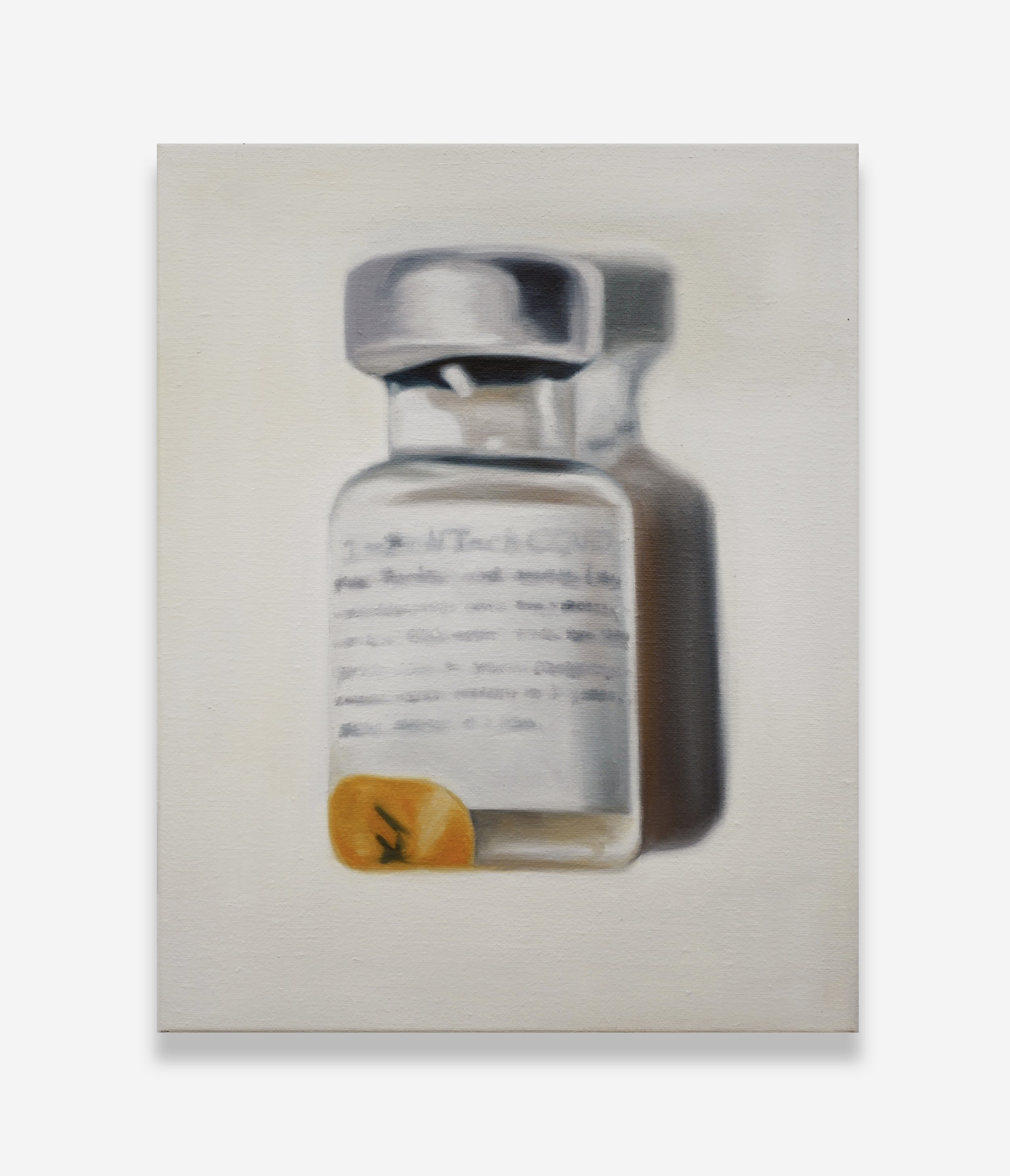
Tan Mu has described the personal experience that underlies this painting. In March 2020, when the lockdown began, she was in New York City, painting at home, communicating through digital platforms, watching the city around her transform from a space of spontaneous encounter into a space of regulated distance. "Physical distancing limited direct contact," she recalls, "and communication shifted almost entirely to digital platforms. This environment of isolation prompted me to reflect deeply on separation, connection, and how public and private spaces were being redefined." The paintings that emerged from this period, including A Sunday Afternoon in the Park, Isolation (2020), and Vaccine (2021), form a cluster of works that document the pandemic not as a medical event but as a spatial event. The pandemic, in these paintings, is not a virus. It is a reorganization of space. It is the moment when the distance between bodies, which had always been a matter of social convention and personal choice, became a matter of geometry and law. The circles on the grass did not create social distance. They made it legible. They gave it a shape and a boundary and a color. They turned an invisible social convention into a visible physical fact. And Tan Mu turned that fact into a painting that holds both meanings at once: the circle that protects you and the circle that holds you.
The three rows of circles in A Sunday Afternoon in the Park are not random. They are arranged in a regular grid that suggests a parking lot, a spreadsheet, or a military formation, any system in which individuals are assigned to discrete positions in a predetermined pattern. The regularity of the grid is the painting's most unsettling visual feature. A park is not supposed to be regular. A park is supposed to be open, unstructured, a space where people spread out according to their own preferences, clustering in the shade on hot days, claiming a spot near the water, finding a patch of grass that suits their mood. The grid replaces preference with position. It replaces mood with assignment. It replaces the open field, which is the park's reason for existing, with a controlled array. The people inside the circles are still enjoying the park. They are still sunbathing, reading, talking. But they are doing these things inside a geometric enclosure that was not designed for their comfort but for their compliance. The painting captures the moment when comfort and compliance became indistinguishable, when the pleasure of being outside was inseparable from the rule that made being outside possible.
Seurat's La Grande Jatte was exhibited in 1886 at the eighth and final Impressionist exhibition. The painting was understood, from the beginning, as a work about social order. The contemporary critic Joris-Karl Huysmans described the figures as "frozen puppets," and the painting has been read, ever since, as a critique of the rigid social codes that governed Parisian leisure. Whether Seurat intended this critique or was simply recording what he saw is a question that has never been resolved. What is not in question is the painting's formal structure: the rigid spacing of the figures, the absence of physical contact between them, the way each person or group occupies its own zone of the park without overlapping or intersecting with any other. This spacing is what makes La Grande Jatte feel both populated and empty at the same time. The park is full of people, but the people are not together. They are adjacent. They are proximate. They are in the same space, but they are not in the same experience. Tan Mu's painting takes this adjacency and makes it explicit. In La Grande Jatte, the distance between figures is implicit, produced by composition. In A Sunday Afternoon in the Park, the distance is explicit, produced by white paint on grass. Seurat's painting shows a park where distance is social. Tan Mu's painting shows a park where distance is geometric. The arc from 1886 to 2020 is an arc from social convention to physical law. The distance that Seurat observed as a cultural practice, Tan Mu observes as a mandate enforced by a global emergency. The circle that Seurat drew with composition, Tan Mu draws with paint. And the paint is white, the color of blankness and of permission, the color of the page and the color of the flag of surrender, the color that both allows and forbids, the color that says: you may be here, but only here, and only this far from the next person, and only for as long as the emergency lasts, which is to say, for longer than anyone expected, and with consequences that no one predicted, including the realization that the distance between people, once it has been made visible, can never be entirely unseen.