The Nozzle at the Beginning: Tan Mu's 3D-Printing House and the Portrait of a Machine Learning to Build
In 2015, a Chinese company called Winsun attached a robotic arm to a rail, loaded it with a cement-based composite, and printed a two-story house in the Suzhou Industrial Park. The process took less than twenty-four hours. The walls rose in continuous extruded ribbons, each layer deposited on top of the one before, the material curing as it went. There were no bricks, no mortar, no crews of laborers, no scaffolding. There was a nozzle, and there was the path it traced, and there was the house that resulted from the intersection of the two. Winsun's demonstration was not the first time additive manufacturing had been applied to construction. Researchers at the University of Southern California had been experimenting with contour crafting since the early 2000s, and Enrico Dini's D-Shape printer in Italy had produced stone-like structures from sand and binder. But Winsun's project was the first to claim, with the weight of a completed building behind it, that 3D printing could produce habitable shelter at a fraction of the cost and time of conventional construction. The claim was not universally welcomed. Construction industry associations in China questioned the safety standards. Structural engineers noted that the technology had not been tested under seismic conditions. And the image of the machine, a gantry-mounted arm extruding grey paste in a spiral, looked less like architecture than like a wasp building a nest.
Tan Mu's 3D-Printing House (2022) is a painting of this machine. Oil on linen, 76 x 61 cm, it depicts a moment from a demonstration video produced by a company designing 3D-printed habitats for future Mars missions. The nozzle is the central element. It extrudes a thick ribbon of composite material in a continuous curve, building the wall of a small structure layer by layer, the way a potter coils clay, the way a spider spins silk, the way a wasp secretes paper. Tan Mu calls the painting "a portrait of technology," and the word "portrait" is doing specific work. A portrait is not a documentation. It is a representation that claims to capture something essential about its subject, not merely its appearance but its character, its disposition, its potential. Portraits of people have always served this function. Portraits of machines are rarer, and they raise a different set of questions. What is the character of a nozzle? What is the disposition of an extrusion head? What potential resides in a machine that can build a house in less than a day?
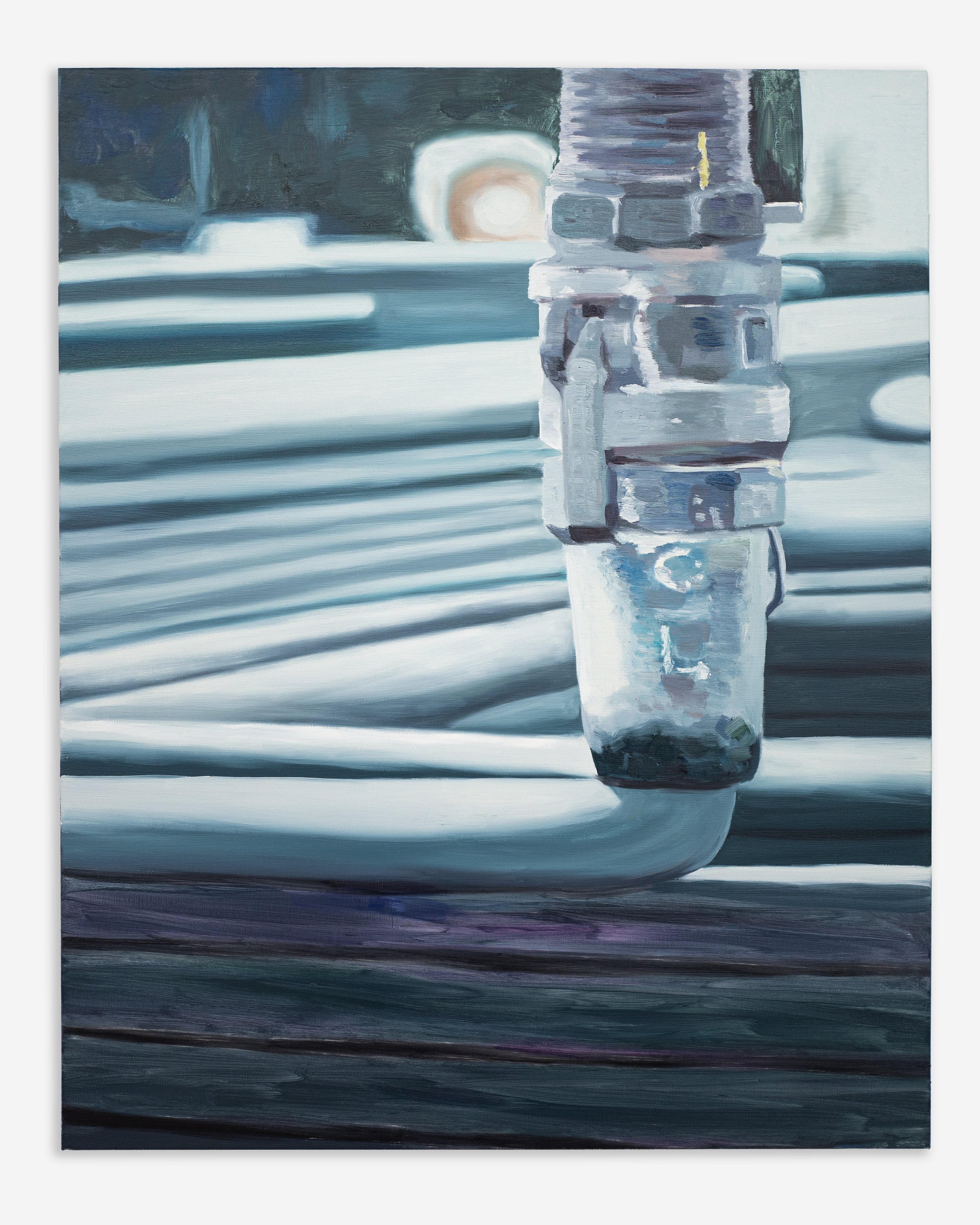
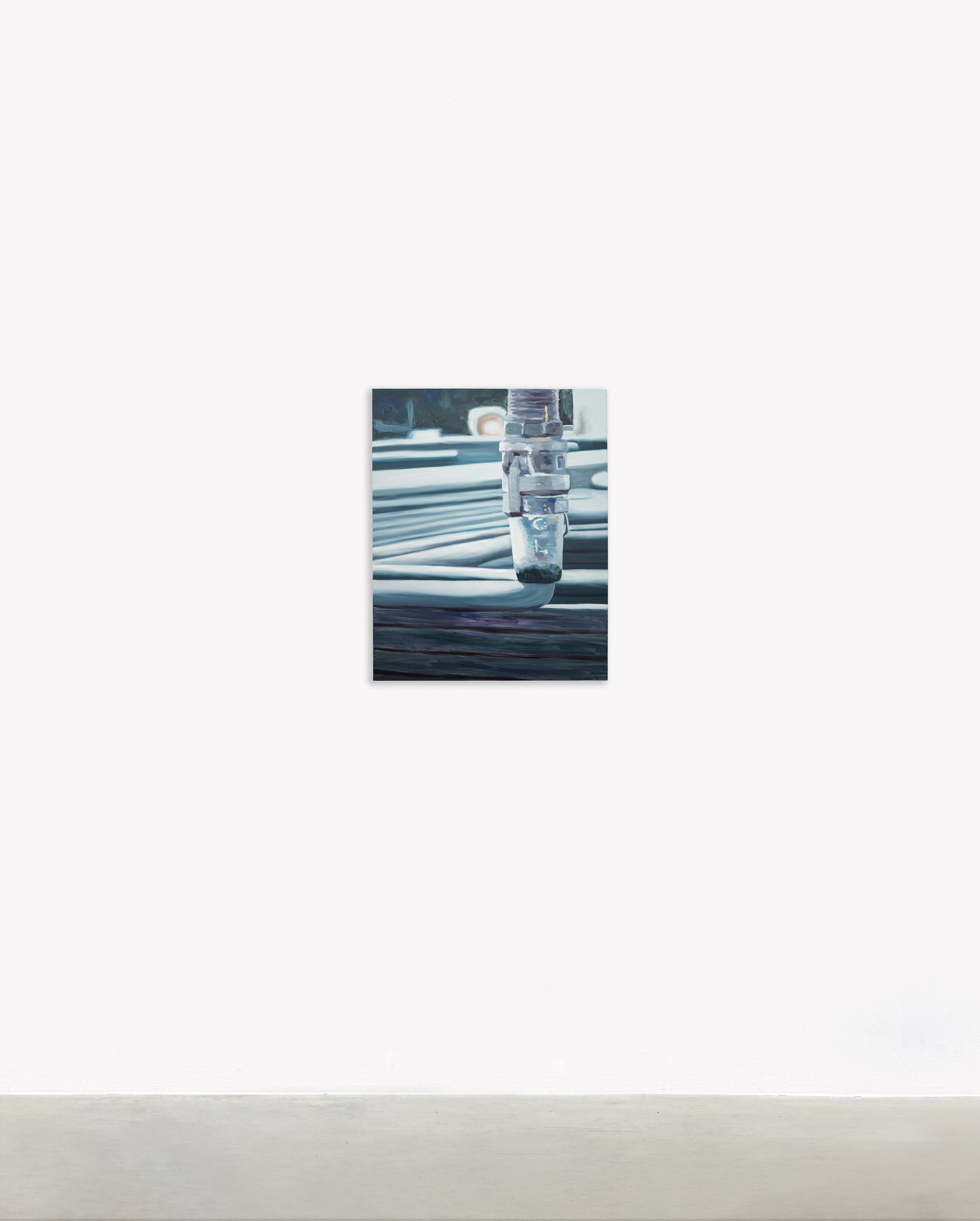
The painting is 76 by 61 centimeters, a modest format that places the viewer at reading distance from the surface. At this scale, the nozzle fills most of the canvas. It is not a small element in a larger scene. It is the scene. The nozzle is rendered in a muted steel grey with highlights of cool white along the upper edge where the light catches the metal. The extruded material, a cement composite mixed with unspecified additives, emerges from the nozzle in a continuous ribbon of warm grey, slightly lighter than the wall it is building. The wall itself, visible in the lower portion of the canvas, shows the striated texture of additive construction: each layer is a thin horizontal band, perhaps eight millimeters thick in the real structure, scaled up in the painting to a visible ridge that catches a thin line of shadow from the nozzle overhead. The result is a surface that reads like geological strata, the way sedimentary rock reveals its history in horizontal bands, except that these bands were laid down not over millennia but over minutes.
The color palette is restricted. The background is a dark, near-black grey that reads as the interior of a construction facility or the shadow of a Mars habitat test site. The nozzle and its extruded ribbon occupy the center, rendered in shades of grey and off-white that glow against the dark surround. There is no sky, no landscape, no human figure. The only light source appears to come from the nozzle itself, or from the process of extrusion, as though the act of building generates its own illumination. This is not a documentary choice. It is a formal one. By eliminating all context, Tan Mu forces the viewer to confront the nozzle as a self-contained entity, a mechanism whose purpose is visible in its action. The nozzle does not need a house to justify its existence. The nozzle builds. That is what it does. The house is a byproduct. The painting knows this, and it makes the viewer know it too.
Tan Mu's Q&A for this work is unusually specific about her research process. She contacted the Chinese company that pioneered architectural 3D printing to ask about technical details. She learned that the technology offered advantages in cost, speed, and earthquake resistance, but faced resistance from traditional construction industries. She followed the technology's expansion into the Middle East, where regulatory frameworks allowed faster experimentation, and into the United States, where companies began printing affordable housing communities. She also noted that some companies were exploring the technology's potential for extraterrestrial settlement, specifically for constructing habitats on Mars. This last detail is the one the painting engages. The source image is not from a construction site on Earth. It is from a demonstration video for Mars. The nozzle is building a house for a planet where no human has yet set foot. The painting is a portrait of a machine that is learning to build before its inhabitants arrive.
Charles Sheeler's Criss-Crossed Conveyors (1927) is a photograph, not a painting, but it is one of the most influential portraits of industrial machinery in American art. Sheeler photographed the Ford Motor Company's River Rouge plant in Dearborn, Michigan, as part of a commission from the advertising firm N.W. Ayer and Son. The resulting photographs, and the paintings Sheeler based on them, established the visual language of American industrial portraiture: clean lines, geometric rigor, the machine as an object of aesthetic contemplation rather than social critique. Criss-Crossed Conveyors presents a lattice of pipes and conduits rising from the factory floor in a pattern that Sheeler found architecturally satisfying. The composition is precisely framed, the tones are even, and there is no visible human presence. The machinery fills the frame the way a portrait subject fills a canvas. Sheeler was not documenting the conditions of industrial labor. He was making the machine visible as a formal object, with its own geometry, its own rhythm, its own right to occupy the frame.
Tan Mu's 3D-Printing House shares Sheeler's conviction that industrial machinery deserves the attention traditionally reserved for human subjects. But where Sheeler's industrial portraits celebrate the machine's completed form, its finished geometry, its arrival at a state of permanent function, Tan Mu's portrait captures the machine in process, mid-extrusion, at the moment of making rather than the moment of being. Sheeler's conveyors are static. They are not conveying anything. They are architectural elements, and their beauty lies in their structural completeness. Tan Mu's nozzle is active. It is extruding. The ribbon of material emerging from it is in motion, or appears to be, and the wall it is building is incomplete, a partial structure still under construction. The painting does not present the machine as a monument. It presents the machine as an event. The difference is crucial. Sheeler's Ford plant photographs were made in the 1920s, when American industrial power was at its peak and the factory was a symbol of achieved dominance. Tan Mu's nozzle is painted in 2022, when 3D-printing construction is still in its early stages, still experimental, still contested. The technology has not yet arrived. It is still becoming. A portrait of a technology at the moment of its becoming is a different kind of portrait than one of a technology that has already arrived. It is more tentative, more speculative, and more honest about the fact that the future is not guaranteed.
The science behind 3D-printed construction is straightforward in principle and complex in execution. The process, called contour crafting or additive manufacturing for construction, uses a computer-controlled nozzle to deposit layers of cementitious composite material in a pattern determined by a digital model. Each layer bonds to the one below it through chemical adhesion and partial interpenetration of the wet material. The result is a wall that has no mortar joints, no cold seams, and no weak points where individual bricks or blocks meet. The wall is a monolithic structure, continuous from foundation to roofline, built by a single machine following a single set of instructions. The advantages are structural: a 3D-printed wall, when properly engineered, has higher compressive strength than a conventional masonry wall because the material is continuous rather than assembled from discrete units. The advantages are also economic: the process uses less material than conventional construction because the nozzle deposits material only where it is needed, eliminating waste from cutting bricks to size or pouring excess concrete into forms. And the advantages are temporal: a 3D printer can complete the walls of a small house in twelve to twenty-four hours, compared to the weeks or months required by conventional methods.
The limitations are equally real. The material must be precisely formulated to extrude evenly and cure quickly enough to support the next layer without slumping. The nozzle path must be calculated to avoid collisions with previously deposited material. And the resulting structure, while strong in compression, may require additional reinforcement for tensile loads, particularly in earthquake zones, where the continuous wall can behave like a single rigid element that cracks along its entire length rather than at discrete joints. Tan Mu's research revealed that the Chinese company she contacted had addressed the earthquake question with specific engineering solutions, and that the technology had gained recognition for its seismic performance. But the resistance from traditional construction industries, she noted, persisted. The nozzle is building the house, but the house is not yet welcome in the neighborhood.
The Mars connection is not incidental to the painting. Tan Mu states that the source image comes from a demonstration video showing a prototype for 3D-printed habitats designed for future Mars missions. This is not a speculative embellishment. NASA and several private companies have been developing 3D-printing technologies specifically for extraterrestrial construction since at least 2015, when NASA launched its 3D-Printed Habitat Challenge. The logic is simple: launching construction materials from Earth to Mars costs approximately $54,000 per kilogram. Any structure built on Mars must be built from Martian regolith, the loose rock and dust that covers the planet's surface, mixed with a binder that can either be transported from Earth or synthesized from Martian resources. The 3D printer solves this problem by treating the planet itself as the building material. The nozzle does not need to carry bricks. It carries the recipe for turning local dust into walls. The habitat is not imported. It is grown from the ground up, the way a coral reef grows from the calcium carbonate secreted by the organisms that live on it, except that the organism is a machine and the reef is a house.
Bernd and Hilla Becher's Framework Houses of the Siegen Industrial District (1959-1974) is a typological study of a specific architectural form: the Fachwerkhaus, or half-timbered house, built by ironworkers and mine owners in the Siegen region of Germany between the seventeenth and nineteenth centuries. The Bechers photographed each house from the same angle, under the same overcast sky, at the same distance, producing a grid of images that reveals the structural logic of the form through repetition. Each house is a variation on a type. The type is defined by the exposed timber frame, the infill panels of brick or slate, and the gabled roof. The variations are in the arrangement of the timbers, the size and placement of windows, and the decorative treatment of the joints. The Bechers' project was not architectural documentation. It was an argument about industrial form. By presenting the houses as a typology, they demonstrated that the Fachwerkhaus was not a folk tradition but an industrial system: the timber frame was the structure, the infill was the cladding, and the gable was the roof, and every house in the grid was a configuration of these three elements, the way every circuit board is a configuration of traces, components, and substrates.
Tan Mu's 3D-Printing House shares the Bechers' conviction that industrial form is worthy of the same sustained visual attention that art history has traditionally reserved for painting, sculpture, and architecture. But where the Bechers' typological method requires repetition, dozens of examples arranged in a grid to reveal the type beneath the variation, Tan Mu's painting requires only one. The nozzle is the type. It is the generative element from which all 3D-printed structures will descend. Every 3D-printed house, whether built in Suzhou, Dubai, or on the surface of Mars, will be produced by a nozzle following a path dictated by a digital model. The nozzle is the ancestor. The houses are the descendants. The painting does not need a grid because the nozzle contains the entire future of the typology within its form. This is what Tan Mu means by "portrait of technology." A portrait captures the essence of an individual at a specific moment. The nozzle in 3D-Printing House is captured at the moment before the technology becomes commonplace, when it still holds its "most radical potential," as Tan Mu describes it. The Bechers photographed types that had already been built, inhabited, and in many cases abandoned. Their houses were historical. Tan Mu's nozzle is prophetic. It is not a portrait of what has been built. It is a portrait of what will be built.
Nick Koenigsknecht, writing about Tan Mu's work in his 2025 essay for the BEK Forum, notes that her paintings "transform data cables into gestural constellations that oscillate between calculation and intuition." The observation applies to 3D-Printing House as well, though the data in this case is not a cable network but an extrusion path. The ribbon of composite material that emerges from the nozzle follows a trajectory calculated by software. It is a machine instruction rendered in cement. And yet, in the painting, the extruded ribbon has a tactile quality that exceeds its computational origin. The paint used to depict the cement ribbon is applied in a way that mimics the ribbon itself: a continuous stroke, slightly raised, with a rounded cross-section that catches a thin highlight along its upper edge. The painting technique enacts the printing technique. The brush becomes the nozzle. The oil becomes the cement. The linen becomes the Martian regolith. This is not a metaphor that the painting illustrates. It is a structural correspondence that the painting performs. The viewer sees a nozzle depositing material, and the material being deposited is paint, and the paint is being deposited by a brush, and the brush is being wielded by an artist who has spent months studying the nozzle's behavior. The painting is not about 3D printing. It is a 3D printing. It is a different material, deposited by a different nozzle, on a different substrate, following a different path, but the logic is the same: a continuous extrusion of material, layer upon layer, building a structure that did not exist before the process began.
The surface of the painting reinforces this correspondence. The extruded ribbon in the composition is rendered with a thickness and a texture that rises slightly above the surrounding paint, creating a tactile ridge that the eye reads as a physical layer and the fingertip, if it could reach, would confirm as one. The wall beneath the nozzle shows the accumulated ridges of previous passes, each one a separate stroke of paint, each one slightly different in width and opacity, producing a surface that is not uniform but cumulative, the way a 3D-printed wall is not uniform but cumulative, each layer bearing the trace of its own deposition. The linen substrate, visible in the margins of the composition, provides the ground on which the painting builds itself, the way the construction site provides the ground on which the nozzle builds the house. The painting's material structure mirrors the printing process it depicts. This is not an illustration of additive manufacturing. It is an instance of it, performed in a different register.
Tan Mu's description of the painting as a "portrait of technology" is precise because it names the genre the painting inhabits. A portrait does not merely represent its subject. It makes a claim about the subject's significance. When Holbein painted Henry VIII, he was not documenting the existence of a king. He was asserting, through pose, costume, scale, and expression, that this particular king embodied a particular kind of power. When Tan Mu paints a 3D-printing nozzle, she is not documenting the existence of a machine. She is asserting that this particular machine, at this particular moment, embodies a particular kind of transformation: the transformation of shelter from a human activity into a computational one. The house, for as long as humans have built them, has been the product of human hands, human labor, human judgment. The 3D printer transfers that production from the hand to the nozzle, from the body to the algorithm, from the site to the screen. The nozzle does not need to know what a house is. It needs to know the path. The path is the house. The nozzle follows the path, and the house appears. This is not a metaphor for automation. It is a description of a process in which the distinction between the tool and the product has collapsed. The nozzle is the house's skeleton, its circulatory system, and its birth canal, all at once.
The painting's modest format, 76 x 61 centimeters, is appropriate to a portrait. A portrait does not need to be monumental. It needs to be intimate. It needs to bring the viewer close enough to see the face, or in this case the nozzle, as an individual entity with specific features and specific behaviors. The nozzle in 3D-Printing House is not a generic machine. It is a specific nozzle, at a specific angle, at a specific moment in the extrusion process. The ribbon of material emerging from it has a specific curvature, a specific thickness, a specific texture. These are the portrait's equivalent of a sitter's expression, posture, and costume. They are what make this nozzle this nozzle, rather than any nozzle. And they are what make the painting a portrait rather than a diagram. A diagram abstracts away the particular in favor of the general. A portrait preserves the particular and finds the general within it. Tan Mu finds the general within the particular by painting the nozzle at the moment when the technology it represents is still young enough to hold radical potential, before it has become routine, before it has disappeared into the background of daily life the way the assembly line, the conveyor belt, and the steam engine have all disappeared. The painting preserves the nozzle in its early state, the way a portrait preserves a person in their youth, not because youth is more important than age, but because the potential that youth holds is the most honest thing that can be said about a person, or about a technology, at the beginning.
The Mars connection in 3D-Printing House extends the painting's argument beyond terrestrial construction. Tan Mu notes that some companies are exploring 3D printing's potential for extraterrestrial settlement, "constructing habitats on Mars." The nozzle is not only building houses on Earth. It is being trained to build houses on a planet where no construction labor exists, where the materials are different, where the gravity is one-third of Earth's, and where the margin for error is measured in human lives rather than in dollars. The Mars context does not make the painting speculative. It makes it urgent. The same technology that can build affordable housing in Suzhou can build survivable shelter on Mars. The nozzle does not care which planet it is on. It cares about the path. And the path, as Tan Mu has consistently argued across her body of work, is what connects the local to the global, the present to the future, and the hand that paints to the machine that builds. The nozzle is the path made physical. It is the moment when the algorithm exits the screen and enters the world. It is the point of contact between the digital model and the built environment. And it is, in this painting, a subject worthy of portraiture because it represents the earliest stage of a technology that will reshape the most fundamental human activity: making shelter from the materials at hand, whether those materials are cement composite on a construction site in China or regolith on the surface of Mars.