The Filament That Divided: Tan Mu's Illuminate and the Light That Made Itself Alive
On New Year's Eve, 1879, Thomas Edison invited three thousand people to his laboratory complex in Menlo Park, New Jersey, to witness the public demonstration of an invention he had been refining for over a year. The invention was a carbon filament incandescent lamp, and the demonstration was less a scientific presentation than a theatrical event. The grounds of the laboratory were strung with lights. The railway company ran special trains from New York. The newspapers had been briefed in advance. When the switch was thrown and the current flowed through the carbonized cotton thread inside the glass bulb, the thread began to glow, and the glow did not stop. It held. It held for thirteen and a half hours, which was longer than any previous filament had lasted, and in that duration, in that persistence of light from a manufactured object, the crowd understood that something had changed. The light was not the light of a flame, which flickers and gutters and requires constant tending. It was the light of a current, which flows as long as the generator turns and the circuit holds. It was a light that did not need to be fed. It needed only to be switched on. The era of controlled, sustained, artificial illumination began that night, and it has not ended.
Tan Mu's Illuminate (2022) is a painting of the object that made that era possible. Oil on linen, 152 x 122 cm, it depicts a single carbon filament light bulb, rendered at a scale large enough to make the bulb's internal structure legible: the glass envelope, the vacuum inside, the filament coiled in a tight horseshoe between two electrodes, the base that screws into the socket. The painting does not show the light radiating outward from the bulb in rays or a glow. It shows the bulb itself, in Tan Mu's words, "in a portrait-like manner," focusing on "its form, materiality, and internal structure." The portrait analogy is precise. A portrait does not show what the subject does. It shows what the subject is. And what the light bulb is, in this painting, is a glass container holding a thread of carbon that has been heated until it emits visible radiation. The emission is present in the painting as a warm, amber glow that suffuses the interior of the glass envelope, but the glow does not fill the canvas. It is contained within the bulb, the way warmth is contained within a body, the way light is contained within a cell when the first mitochondrion began to produce ATP and the single-celled organism that contained it became, for the first time in the history of the planet, something that could see its own interior illuminated from within.
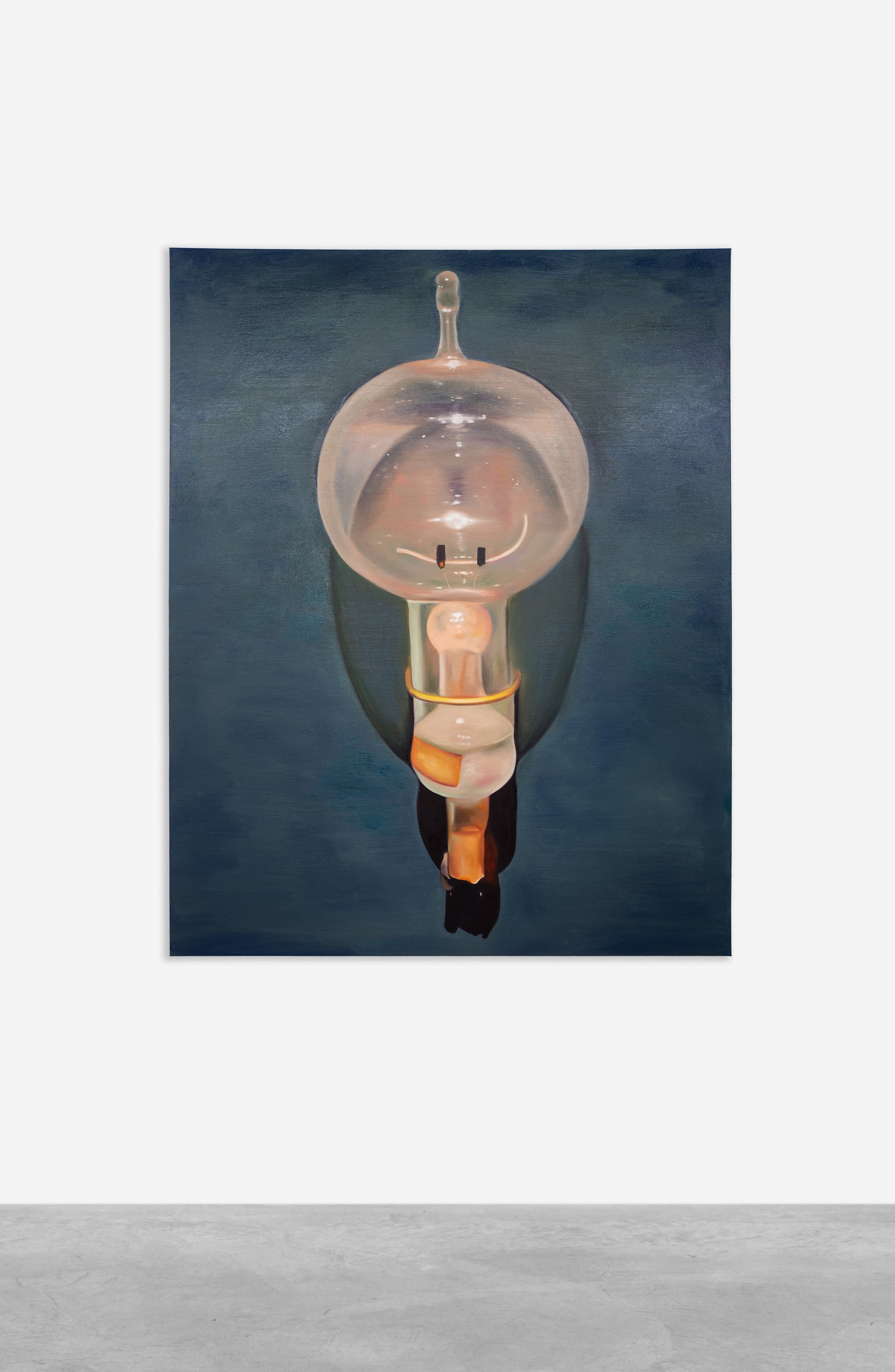
The painting is 152 by 122 centimeters, a vertical format that gives the bulb the proportions of a standing figure. At this scale, the glass envelope fills most of the canvas, and the filament inside it is large enough to show its structure: a thin, curved thread of carbon that arcs between two vertical supports, each one a thin line of dark grey descending from the glass seal at the top of the bulb to the base at the bottom. The filament itself is rendered in a warm amber-gold that glows against the cooler tones of the glass and the dark ground. The glass is not transparent. It is translucent, a thin shell of pale grey-blue that modulates between opacity and translucence depending on the thickness of the paint application. Where the glass curves toward the viewer, at the center of the bulb, it is at its most transparent, allowing the amber glow of the filament to radiate outward. Where the glass curves away, at the edges, it is at its most opaque, producing a rim of lighter grey that reads as the reflection of an external light source, or as the glass itself catching the ambient illumination of the room in which the painting hangs. The ambiguity is deliberate. The painting does not make clear whether the light in the bulb comes from the filament or from the viewer's world. The bulb glows, but the glow could be an emission or a reflection, and the painting refuses to settle the question.
The ground behind the bulb is a dark, near-black field of umber and lamp black, applied in thin, even layers that produce a smooth, almost airless surface against which the glass envelope floats as though suspended in a void. There is no context. No socket, no wire, no table, no laboratory, no Menlo Park. The bulb exists in the same condition that a portrait subject exists in when the background has been removed: alone, without context, defined entirely by its own form. The dark ground is not the darkness of a room. It is the darkness of a studio backdrop, the kind of neutral void that portrait photographers use to isolate the subject from any environmental distraction. Tan Mu has described the bulb as a "subject with presence, rather than merely a functional device." The dark ground makes this claim legible. It removes the bulb from the circuit that gives it power and places it in the frame that gives it attention. The bulb in Illuminate is not a component in an electrical system. It is a sitter in a portrait studio, and the portrait it is sitting for is a portrait of illumination itself.
Joseph Wright of Derby's A Philosopher Giving a Lecture on the Orrery (1766) is a painting of artificial light as a vehicle of enlightenment, both literal and intellectual. The composition shows a group of figures gathered around a mechanical model of the solar system, an orrery, lit by a single oil lamp concealed inside the central sphere. The lamp illuminates the faces of the viewers from below, casting dramatic shadows upward across their brows and cheeks, and creating a circle of light that corresponds to the circle of the orrery's brass arms. The children in the foreground lean forward with open mouths, their faces lit by the same source that lights the model of the sun. The philosopher, standing to the right with his hand extended in explanation, is in shadow, his face lit by the reflected glow of knowledge rather than by the lamp itself. Wright's painting is not a record of an actual lecture. It is a constructed scene, a staged demonstration of the principle that knowledge is a form of light, and that the lamp, the orrery, and the lecture are three expressions of the same Enlightenment conviction: that the universe is intelligible, that the human mind can comprehend it, and that the comprehension spreads outward from a single source like the rays of the sun.
Wright's painting and Tan Mu's share a central concern: how to represent artificial light as a subject in itself, not as a means of illuminating something else but as the thing that is being illuminated. Wright's lamp is not visible. It is hidden inside the orrery, and its presence is known only by its effects: the circle of light it casts on the surrounding faces, the shadows it throws upward, the warmth it imparts to the brass armillary. The light is the subject, but it is always mediated by the objects it falls on. Tan Mu's filament, by contrast, is not hidden. It is the central element of the composition, and its glow is not shown through its effects on surrounding faces but through the direct depiction of the amber-gold thread suspended inside the glass. Wright paints light by painting what it falls on. Tan Mu paints light by painting the thing that produces it. The difference is not trivial. Wright's approach assumes that light is a medium, a means of making things visible. Tan Mu's approach assumes that light is an event, a moment of emission that can be represented directly, without the intermediary of illuminated surfaces. The filament in Illuminate does not illuminate a room. It illuminates itself. It is the source and the subject at once, the thing that glows and the thing that is seen glowing, and this doubling is the painting's argument: that the moment when a manufactured object produces its own light is the moment when technology crosses a threshold into something that resembles, however distantly, the self-illumination of a living cell.
Tan Mu's Q&A for this work contains an unexpected comparison that opens the painting's deepest register. "While painting this piece," she says, "I became deeply absorbed in the moment when the filament emits light. That process unexpectedly reminded me of cell division, a subject I had explored in earlier works. Although the light bulb is entirely man-made, the way light emerges from within it evoked associations with the origins of life. I began thinking about the first single cell, round in form, dividing and multiplying." The comparison is not metaphorical. It is structural. The light bulb is a glass envelope containing a filament that, when heated, emits light. The cell is a membrane envelope containing organelles that, when metabolically active, produce energy in the form of ATP and emit a faint bioluminescent glow. Both are containers. Both produce light from within. Both are round. Both divide: the cell by mitosis, the filament by cracking under repeated heating and cooling, a process that eventually causes it to fail and, in failing, to produce a brief flash of light that is brighter than its sustained glow. The filament does not divide in the biological sense. But the visual analogy that Tan Mu draws is not about biological division. It is about the moment of emergence, the moment when something inside a container begins to produce its own light, its own energy, its own activity, and in doing so transforms from a passive object into an active system.
The physics of incandescence confirms this analogy at the molecular level. A carbon filament at operating temperature, roughly 2,200 degrees Celsius, is not simply hot. It is in a state of continuous thermal emission. The carbon atoms at the surface of the filament are vibrating with enough energy to release photons across the visible spectrum. These photons are not reflected from an external source. They are produced by the filament itself, from its own internal energy, generated by the resistance of the carbon to the flow of current. The filament is not a medium for light. It is a source of light. And the light it produces, the warm amber-gold that suffuses the interior of the glass envelope in Tan Mu's painting, is the visible evidence of a transformation that occurs entirely within the filament: electrical energy becomes thermal energy becomes radiant energy, and the radiant energy, in the form of visible photons, fills the glass envelope and, if the envelope were not there, would fill the room, the street, the city, the world. The filament in Illuminate is not a passive object being illuminated by an external source. It is an active system producing its own illumination from its own substance, and the painting makes this visible by rendering the glow as an internal property of the filament rather than as an external effect.
Dan Flavin's monument" for V. Tatlin (1964) is a fluorescent light tube, eight feet tall, mounted vertically on the wall of a gallery. The tube is a standard commercial fluorescent, the kind used in offices and hospitals, the kind that buzzes and flickers and casts a cold, even light over the surfaces around it. Flavin's gesture was to take this object, an object designed to be invisible, to disappear into the ceiling of a room and provide light without being seen, and to place it on a wall, at eye level, where it could not be ignored. The title dedicates the work to Vladimir Tatlin, the Russian Constructivist who designed the never-built Monument to the Third International, a spiraling tower of iron and glass that would have been the tallest structure in the world if it had been constructed. Flavin's monument is the opposite of Tatlin's in every material respect: where Tatlin proposed iron and glass, Flavin uses commercial lighting; where Tatlin designed a dynamic spiral, Flavin presents a static vertical; where Tatlin envisioned a building that would transform a city, Flavin offers a tube that illuminates a room. What they share is the conviction that industrial materials can be art, and that the art is not in the transformation of the material but in the recognition of what the material already is.
Flavin's fluorescent tube and Tan Mu's incandescent bulb share more than a medium. They share a genre: the portrait of a light source. Flavin's work is a portrait because it presents the fluorescent tube as a subject, not as a utility. The tube is not providing light for the gallery. The tube is the gallery's subject. The light it produces is not functional. It is aesthetic. It is what the work does, but it is also what the work is, and the difference between doing and being is the difference between a light fixture and a portrait of light. Tan Mu's Illuminate occupies the same genre, but with a crucial difference. Flavin's fluorescent tube is a readymade. It is an off-the-shelf object that Flavin purchased and installed without modification. The art is in the act of selection, not in the act of making. Tan Mu's light bulb is a painted object. It is not a readymade. It is a representation, made by hand, in oil paint, on linen, over the course of weeks or months, during which the artist studied the bulb's structure, mixed the colors that would represent the glass and the filament and the glow, and applied them in layers that produce the visual effect of a light source producing its own illumination from within. Flavin's tube is light. Tan Mu's bulb is a painting of light. Flavin eliminates the distance between the artwork and the illumination. Tan Mu preserves it, and in preserving it, she makes the light into a subject that can be looked at, thought about, and compared to other things that produce their own light from within, including cells.
Saul Appelbaum, writing in his 2025 essay "Dreaming in Public," describes Tan Mu's practice as one of "arbitration," the act of deciding, judging, and mediating between input and output. In Illuminate, the arbitration occurs at the threshold between the filament and the glass. The filament produces the light. The glass contains it. The painting renders the containment visible by showing the amber glow suffusing the glass envelope from within, as though the glass were a membrane holding a warm interior against a cold exterior. The membrane, in biological terms, is the lipid bilayer that separates the interior of a cell from the extracellular environment. It is semi-permeable: it lets some things in, lets some things out, and maintains the conditions under which the cell's internal processes can continue. The glass envelope of the light bulb performs the same function. It lets nothing in and nothing out, except the current that enters through the electrodes at the base and the light that exits through the glass. The vacuum inside the bulb is necessary because oxygen would cause the filament to burn up in seconds. The glass maintains the vacuum the way the membrane maintains the cytoplasm: by providing a barrier between the conditions the interior requires and the conditions the exterior provides.
The visual resonance between the light bulb and the cell is not a coincidence. Tan Mu has explicitly identified it, and she has identified it in structural terms, not metaphorical ones. The bulb is round. The cell is round. The bulb contains a filament that glows. The cell contains mitochondria that produce energy. The bulb is sealed. The cell is sealed. The bulb emits light. The cell, under certain conditions, emits light: bioluminescence, chemiluminescence, the faint glow of metabolic activity that is visible to specialized cameras if not to the naked eye. The painting does not illustrate this analogy. It performs it. The amber glow inside the glass envelope in Illuminate is rendered with the same warm, internal luminosity that Tan Mu uses in her paintings of embryos and cell divisions. The color is the same. The modulation is the same. The way the glow fills the container without spilling over the edge is the same. The painting treats the light bulb and the cell as instances of the same visual phenomenon: a round container producing light from within, a sealed system that generates its own energy, an object that, when activated, becomes indistinguishable from the light it produces.
Tan Mu has described the bulb's approach as "portrait-like," and the word is worth attending to. A portrait is not a documentation. It is a representation that claims to capture something essential about its subject. A portrait of a person does not simply record what the person looks like. It records what the person is like, what the person projects, what the person means to the viewer. A portrait of a light bulb does not simply record what a light bulb looks like. It records what a light bulb is like, what it projects, what it means. And what a light bulb means, in the context of this painting, is not merely illumination. It is emergence. It is the moment when a manufactured object begins to produce something, light, energy, activity, that it did not contain before it was switched on. Before the current flows, the filament is a thread of carbon. It is dark, inert, passive. When the current flows, the filament becomes a source. It emits photons. It glows. It transforms from an object into an event. This transformation is the painting's subject, and it is the same transformation that Tan Mu identifies in the cell: the moment when the container begins to produce its own light, its own energy, its own aliveness, the moment when the membrane and the mitochondria and the cytoplasm stop being a collection of chemicals and start being a cell, a single round object that divides and multiplies and, in dividing, becomes alive.
The dark ground of Illuminate, the near-black field of umber and lamp black against which the bulb floats, is not the darkness of a room. It is the darkness before the switch is thrown. It is the condition that the filament transforms. When Edison demonstrated the incandescent lamp at Menlo Park on New Year's Eve, 1879, the three thousand people who came to see it came because they had heard that a man had made a light that did not go out. They came in darkness, and they left in light, and the light they left in was not the light of a flame that could be blown out by wind or extinguished by rain or depleted by the last drop of oil in a lamp. It was the light of a current, sustained by a generator, controlled by a switch, produced by a filament inside a glass envelope that maintained its own vacuum and its own conditions for combustion. The light bulb did not merely replace the candle. It replaced the condition of darkness itself. Before the light bulb, darkness was the default. After the light bulb, darkness was a choice, a condition that could be reversed at will by the movement of a switch. Tan Mu's painting is a portrait of the object that made this reversal possible. It is a portrait of the filament that, when heated, emits light. And it is a portrait of the cell that, when metabolically active, emits energy. And it is a portrait of the moment when a manufactured object becomes indistinguishable from a living system, not because it is alive, but because it does what living systems do: it produces its own light from its own substance, in a sealed container, against a dark ground, and the light it produces is the evidence that something inside the container is working.