The Grid That Ate the Field: Tan Mu's Solar Farm and the Landscape After Agriculture
A photovoltaic cell converts sunlight into electricity through a process that takes roughly ten nanoseconds. A photon strikes the silicon surface, dislodges an electron, and the electron flows through a circuit before returning to its original state. The process is silent, motionless, and, from the ground, invisible. What is visible from the ground is the panel: a flat rectangle of dark glass and aluminum, tilted at an angle optimized for the latitude, mounted on a steel rack driven into the earth. One panel produces roughly four hundred watts at peak output. A farm of ten thousand panels produces four megawatts, enough to power a small town. The farm occupies between forty and sixty acres, depending on panel density and site conditions. The land beneath the panels, if it was previously farmland, no longer produces crops. It produces electricity. The wheat or corn or soy that once grew in the soil has been replaced by silicon and glass, and the photosynthesis that once converted sunlight into carbohydrate has been replaced by the photovoltaic effect that converts sunlight into direct current. The land has not been destroyed. It has been repurposed. The sun still hits the ground, but the ground no longer catches it. The panels catch it instead, and what the panels produce is not food but voltage.
Tan Mu's Solar Farm (2022) is a painting about this repurposing. Oil on linen, 76 x 76 cm, it depicts an aerial view of a solar farm, a vast field of dark rectangular panels arranged in regular rows across a landscape that was once agricultural. The source image, as Tan Mu has explained, was captured on her phone: a screenshot of a solar farm seen from a slightly elevated perspective, "similar to what one might see from an airplane window or within a video game interface." The phone is not incidental. It is the medium through which most people now encounter landscapes of this scale. No one stands at ground level and sees the entire farm. The farm is too large for ground-level perception. It is designed to be seen from above, by satellite, by drone, by the mapping applications on the phones that we carry in our pockets. The solar farm is not a landscape for walking through. It is a landscape for scrolling past. Tan Mu's painting takes the scroll and makes it permanent. It takes the fleeting digital impression, the image that appears on a phone screen for three seconds before the thumb moves on, and translates it into the slow, deliberate language of oil paint.
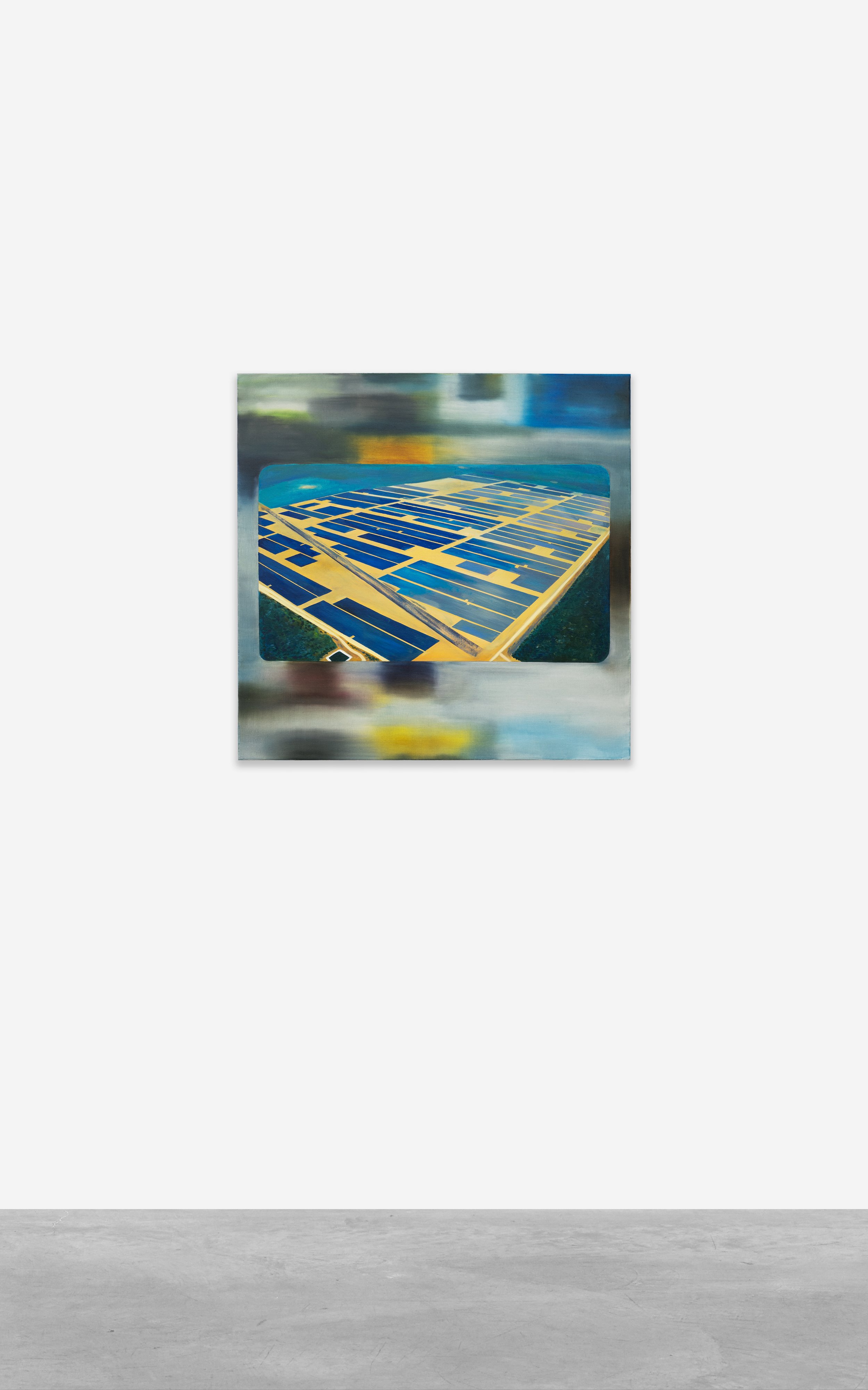
The painting's format is square, 76 by 76 centimeters, and the square is not a neutral choice. A landscape format would extend the view laterally, inviting the eye to travel along the rows of panels toward a distant horizon. A portrait format would compress the rows vertically, emphasizing the depth of the field and the viewer's position within it. The square denies both of these comforts. It holds the solar farm in a fixed frame that refuses to privilege either extension or depth. The rows of panels extend to all four edges, suggesting that the field continues beyond the canvas in every direction. The viewer is suspended above it, neither walking through it nor flying over it but hovering at the precise altitude where the farm's geometry becomes legible without becoming abstract. The square format is the format of the phone screen, the Instagram post, the satellite thumbnail. It is the frame through which the contemporary world most commonly encounters the landscape of infrastructure, and Tan Mu's decision to use it is a decision to reproduce, in the painting's proportions, the frame of the device that made the image possible in the first place.
The surface of Solar Farm divides into three distinct zones that correspond to three different modes of seeing. The first zone is the field of solar panels, which occupies the central and lower portion of the canvas. The panels are rendered in a deep, near-black blue that shifts toward indigo at the upper edges where the light catches the glass surface. This blue is not the blue of the sky. It is the blue of photovoltaic glass, the specific, industrial blue that solar panels present to the eye when seen from above, a color that results from the anti-reflective coating applied to the silicon cells to maximize light absorption. The panels are arranged in regular horizontal rows, each one a thin rectangle of dark blue separated from its neighbors by narrow gaps of a lighter, greyer blue that represents the spacing between panel arrays. The regularity of the grid is absolute. Every row is parallel. Every gap is the same width. The effect, at painting distance, is of a textile: a dark fabric woven from parallel lines, stretched across the land like a shroud over what was once a field.
The second zone is the landscape that surrounds the panels, visible at the upper edges of the canvas and in the narrow margins between panel arrays. This landscape is rendered in a blurred, almost atmospheric manner, with soft greens and browns that suggest fields and treelines without resolving into specific topographic features. The brushwork here is loose and gestural, the opposite of the rigid precision of the panel grid. This contrast is not accidental. Tan Mu has described it as the contrast between the "rigid geometry" of the panels and the "irregular rhythms of nature," and she has identified it as the central tension of the work. The landscape blurs because it is not the subject of the painting. The landscape is what the panels have replaced. It persists at the edges, in the margins, in the spaces between the rows, but it is no longer the dominant visual fact. The dominant visual fact is the grid.
The third zone is the digital overlay that Tan Mu embeds in the composition. "By incorporating a screenshot from her phone," the artwork page explains, "Tan Mu embeds the piece with a digital visual experience, emphasizing information accessibility." This overlay appears as a thin strip of blurred imagery along one edge of the canvas, rendered in degraded colors and pixelated texture that reads as the residue of a phone gallery, the kind of fragmented, compressed visual information that accumulates on a camera roll without ever cohering into a sustained encounter. The overlay is not integrated into the composition. It sits on top of it, the way a notification sits on top of a screen, the way a status bar sits on top of a satellite image. It is the digital frame made visible within the painting, a reminder that the image of the solar farm that most people will see is not the farm itself but a screenshot of the farm, mediated by a device, compressed by an algorithm, and consumed in the time it takes to swipe.
Claude Monet's Arrival of the Normandy Train, Gare Saint-Lazare (1877) is one of a series of twelve paintings that Monet produced of the Gare Saint-Lazare, Paris's busiest railway station, in the spring of that year. The paintings depict the station's iron-and-glass roof, the steam of arriving and departing locomotives, and the crowd of passengers on the platforms, all rendered in Monet's characteristic broken brushwork, which dissolves the industrial architecture into a haze of light and atmosphere. The Gare Saint-Lazare paintings were controversial when they were first exhibited. Critics accustomed to seeing landscape painting as the depiction of rural nature were disoriented by Monet's decision to apply the same atmospheric technique to a railway station. What was beautiful about smoke? What was lyrical about a train shed? Monet's answer, implicit in the paintings, was that the train station was a landscape, and that the steam was its atmosphere, and that the iron roof was its sky. The industrial world had produced its own weather, its own light, its own conditions of visibility, and the painter's task was not to reject these conditions but to paint them with the same attention that a rural landscape demanded.
Tan Mu's Solar Farm stands in direct relation to Monet's Gare Saint-Lazare paintings, a relation that Tan Mu herself has made explicit. "I often think about Impressionist painters such as Claude Monet," she has said, "who documented industrial transformations in their time. His paintings of train stations and factories not only captured new technologies but later became valuable historical records. Scholars now study those works to understand environmental conditions and technological shifts of the nineteenth century." The comparison is not decorative. It is structural. Monet painted the train station because it was the dominant infrastructure of his era, the technology that reshaped time, space, and social organization. Tan Mu paints the solar farm because it is the dominant infrastructure of hers. The train station centralized the movement of people and goods. The solar farm decentralizes the production of energy. Both transform the landscape they occupy. Both produce a new kind of visual order that is neither entirely natural nor entirely artificial but something in between: the order of engineered land, where the geometry of human intention is laid over the irregularity of the earth's surface. Monet's steam and Tan Mu's photovoltaic glass are the visible signatures of this transformation. They are what the new landscape looks like when you stand close enough to see its surface.
The argument that solar panels are "symbols of capital, infrastructure, and humanity's intervention in nature," as Tan Mu describes them, is not an argument against solar energy. It is an argument about what solar energy looks like. A field of solar panels is not a forest. It is not a meadow. It is not a wetland. It is an industrial installation that occupies agricultural land and converts it from a site of biological production to a site of electrical production. The conversion is not invisible. The panels are visible from the air, from the highway, from the neighboring properties whose views they have altered. The geometry they impose on the land, the regular rows of dark rectangles stretching to the horizon, is the geometry of extraction, the same geometry that governs the layout of oil derricks, open-pit mines, and industrial-scale agriculture. The difference is that solar panels extract sunlight rather than petroleum or topsoil. The extraction is cleaner, quieter, and more sustainable than the alternatives. But it is still extraction. It still requires land. It still transforms the landscape. And the transformation still produces a visual order that is legible as human intervention, the kind of intervention that signals a change in what the land is for and who it serves.
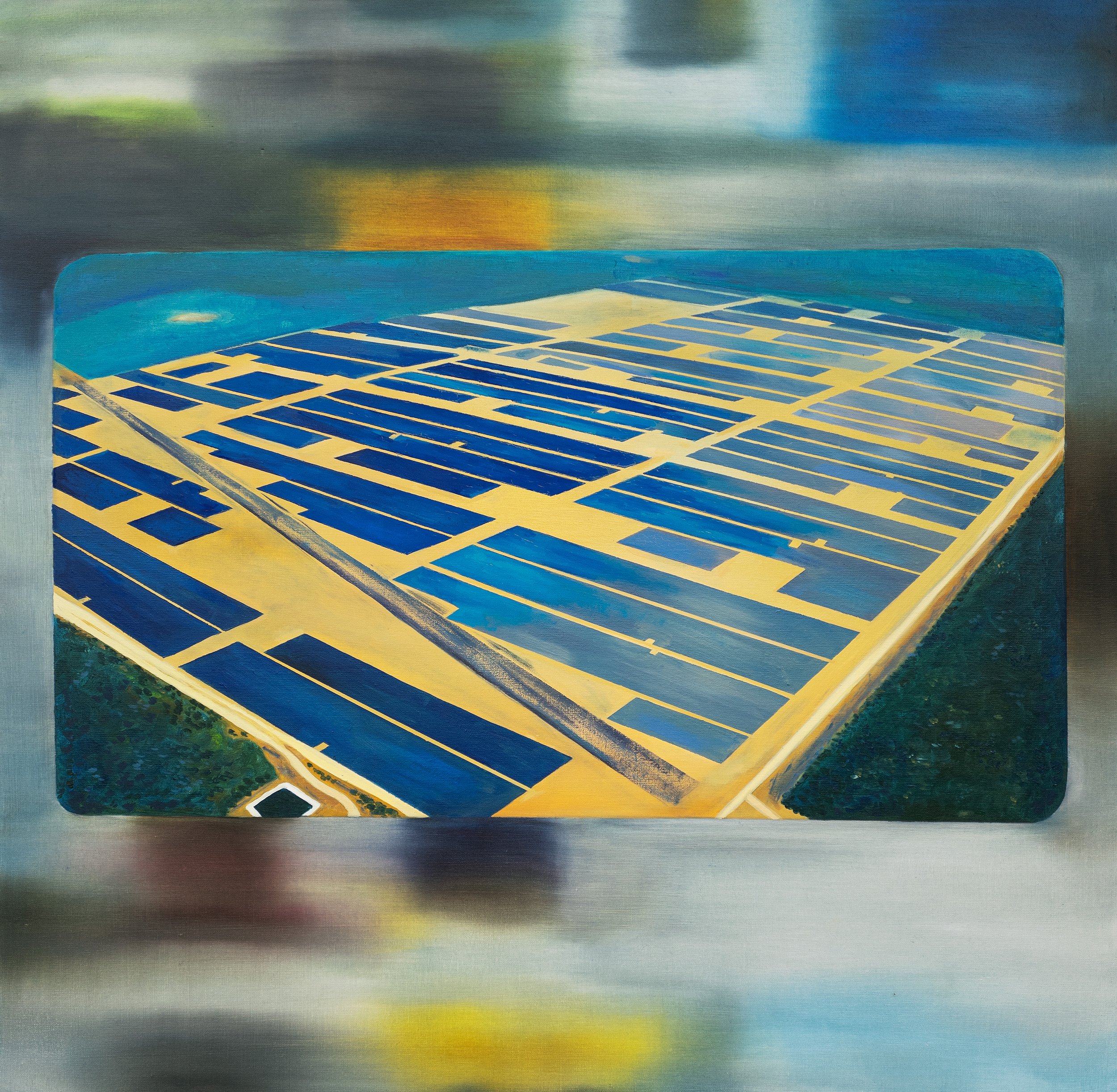
Tan Mu's personal connection to this subject is direct. Living in Florida, where sunlight is abundant, she frequently encountered large-scale solar farms along highways and near airports. "Whether driving on highways or flying near airports, I often see vast fields of panels stretching across the landscape," she has said. "What fascinates me visually is how sunlight refracts across their surfaces, producing subtle shifts in color and reflection that change throughout the day." This observation of refraction is central to the painting's formal language. The deep blue of the panels is not a flat color but a modulated surface that shifts between indigo, navy, and a cold teal depending on the angle of incidence and the thickness of the paint application. At certain points, the blue gives way to a brief flash of white, the highlight of direct sunlight reflecting off the anti-reflective coating at the precise angle where it ceases to absorb and begins to reflect. These highlights are the painting's most painterly moments. They are applied in quick, confident strokes that break the regularity of the grid and remind the viewer that the surface being depicted is not a flat schematic but a physical material that catches and redirects light. The panels are not icons on a map. They are objects in the world, and the world is shining on them.
Robert Smithson's Spiral Jetty (1970) is a coil of basalt, limestone, and earth extending into the Great Salt Lake in Utah, 1,500 feet long and 15 feet wide, built from 6,550 tons of material during a three-week period in April 1970. It is one of the canonical works of land art, and it was built on the same principle that governs the solar farm: the landscape is not a given. It is a material that can be reshaped. Smithson chose the Great Salt Lake because its water level fluctuated, alternately submerging and exposing the jetty, and because the water was colored red by bacteria and algae, producing a visual contrast between the black basalt of the spiral and the vivid red of the lake. The jetty was not designed to be permanent. It was designed to be subject to the same entropic forces, erosion, sedimentation, salination, that govern all geological formations. Smithson called this process "the dialectic of the site and nonsite," the tension between the artwork's presence in the landscape and its representation in the gallery, and he built the jetty to dramatize that tension by making it visible from the air, from the shore, and from within the spiral itself, each perspective revealing a different aspect of the same structure.
Tan Mu's Solar Farm shares Smithson's interest in the dialectic between site and representation, between the physical landscape and the image that mediates it. The solar farm, like the spiral jetty, is an intervention in the landscape that is designed to be seen from above. It is not an artwork in the conventional sense, but it produces a visual effect, the regular grid of dark rectangles against the green or brown of the surrounding land, that is legible as a compositional decision. The grid is not decorative. It is functional. It is oriented to maximize the panels' exposure to sunlight, which means that it follows the cardinal directions, not the contours of the land. The solar farm ignores topography in the same way that Smithson's jetty ignored the lake's shoreline. Both impose a geometric form on an organic landscape, and both are legible from the air in a way that they are not from the ground. The difference is that Smithson's jetty was built to be an artwork. The solar farm is built to produce electricity. The aesthetic effect is a byproduct. But the byproduct is real, and Tan Mu's painting insists on its reality. The grid of panels is a composition, whether or not the engineers who designed it intended it to be. The contrast between the dark blue rectangles and the green land is a color relationship, whether or not the landscape architects who approved the site plan thought of it that way. The painting makes visible what the infrastructure already produces but does not acknowledge: an aesthetic order that is as systematic, as deliberate, and as transformative as any artwork could be.
Yiren Shen, writing in 10 Magazine about Tan Mu's practice, notes that "in the increasingly overwhelming deluge of digital images, the role of painting as a means of documenting and witnessing appears to be exceedingly precious." The observation is particularly relevant to Solar Farm. The painting does not add information to the image. It subtracts speed. The phone screenshot that served as the source image was consumed in seconds, swiped past, replaced by the next image in the feed. The painting takes that fleeting digital encounter and extends it into an encounter that requires minutes or hours, that rewards returning to the surface, that makes the viewer notice the shift from indigo to teal at the panel edges, the thin white highlights that break the grid's regularity, the blurred landscape at the margins that refuses to resolve into clear focus. The painting does not compete with the phone. It offers an alternative to it. Where the phone delivers the image and moves on, the painting holds the image still and asks the viewer to stay. Where the phone treats the solar farm as information, the painting treats it as a subject worthy of sustained attention, the same kind of attention that Monet brought to the Gare Saint-Lazare and that Smithson brought to the Great Salt Lake.
The elevated perspective that Tan Mu describes as "game-like" is not a metaphor. It is a description of the visual vocabulary that the painting employs. In video games, the landscape is seen from above because the game engine renders it from above. The player's avatar moves through a world that is simultaneously vast and controlled, open and governed by rules. The solar farm, seen from the air, produces a similar effect. The regular rows of panels read like the grid of a game map, the kind of overlay that a strategy game places on terrain to indicate zones of control, resource extraction, or tactical advantage. The blurring at the edges of Tan Mu's composition, the soft focus of the surrounding landscape, reproduces the depth-of-field effect that game engines use to suggest the limits of the visible world. The phone overlay, the blurred strip of compressed imagery that runs along one edge, is the loading screen, the pause menu, the frame that reminds the viewer that the image is not the world but a representation of the world, and that the representation is being delivered through a device that mediates every aspect of the encounter. The painting does not pretend to be a window onto the solar farm. It presents itself as what it is: a representation of a representation, a painting of a screenshot of a landscape that most people will never visit in person.
Tan Mu has described solar panels as "not merely technological objects" but "symbols of capital, infrastructure, and humanity's intervention in nature." The sentence continues: "Their presence marks a significant transition in how land is used. Historically, land was cultivated primarily for food production. Today, large areas are repurposed to host solar panels that harvest energy instead." This transition, from food to energy, from photosynthesis to the photovoltaic effect, from wheat to voltage, is not a metaphor. It is a material fact. In the United States, between 2012 and 2022, over 1.3 million acres of agricultural land were converted to solar development. In the United Kingdom, the figure is smaller but growing, and the debate over whether solar panels should be installed on prime farmland has become a political flashpoint. In China, the world's largest installer of solar capacity, the government has encouraged the development of solar farms on degraded or marginal land, but the visual effect is the same: the landscape that once produced food now produces electricity, and the field that once grew crops now grows panels. The painting does not take a position on whether this transition is good or bad. It documents it. It makes the transition visible by painting the moment when the grid replaces the field, when the geometry of extraction overlays the organic pattern of growth, when the land ceases to be a place where things are planted and becomes a place where things are installed.
The painting's insistence on the phone as mediating device is its most contemporary argument. Monet painted the Gare Saint-Lazare from the platform, standing in the steam, feeling the vibration of the arriving train. Smithson built the Spiral Jetty from a dump truck, standing in the salt water, feeling the basalt beneath his hands. Tan Mu painted the Solar Farm from a screenshot, standing in her studio, feeling the linen through the brush. The source image was not a plein-air study. It was not a photograph taken with a professional camera from a carefully chosen vantage point. It was a phone capture, a quick record of a view from a car window or an airplane seat, the kind of image that any of the billions of people who carry smartphones could have taken at any point during a drive past a solar installation. The phone is not an accessory to the painting. It is the condition of the painting. Without the phone, there is no image. Without the screenshot, there is no composition. Without the swipe, there is no reason to paint. The painting exists because the phone image exists, and because the phone image is disposable, and because painting is not disposable, and because the act of translating a disposable image into a permanent object is the act that gives the image the attention it was never designed to receive.
Monet's Gare Saint-Lazare paintings are now studied by environmental historians for the atmospheric conditions they record. The steam in those paintings is not just steam. It is a visual record of the coal smoke and water vapor that hung over Paris in the late 1870s, a record that no other source from the period provides with the same combination of specificity and atmosphere. Tan Mu has suggested that Solar Farm may one day serve a similar function: "In the future, this work may move beyond its role as an image and serve as an archive of how our era transformed nature through technology." The claim is modest but precise. The painting does not claim to be a historical document. It claims that it may one day become one, the way Monet's train stations became one, not because Monet intended them as records but because he painted what he saw with enough specificity that later viewers could read them for information the painter did not know he was recording. The solar farm, in 2022, is what the train station was in 1877: the infrastructure that defines the era, visible in every landscape, transforming every horizon, and so ubiquitous that most people pass it without looking. Tan Mu looked. She took a screenshot. And then she painted it, slowly, deliberately, in oil on linen, giving it the permanence that the screenshot lacked and the attention that the swipe denied it. The grid is not going away. The fields it replaces are not coming back. The painting is the record of the moment when the grid became the landscape, and the landscape became the margin, and the margin became the thing you scroll past without seeing, until someone paints it and makes you look.