The Hand That Reached Across Ten Thousand Years: Tan Mu's Touch and the Mark That Outlasts the Body
In the canyon of the Río Pinturas, in the Patagonian province of Santa Cruz, Argentina, there is a cave whose walls are covered with hundreds of handprints. The cave is called Cueva de las Manos, the Cave of Hands, and the handprints were made over a period of approximately four thousand years, from roughly 7300 BCE to 3300 BCE, by hunter-gatherers who lived in the canyon and used the cave for shelter, ceremony, and the storage of food and tools. The technique for making the handprints was simple: the maker placed a hand against the rock wall and blew pigment, made from ground minerals mixed with water or saliva, through a tube made of bone or reed, creating a negative image of the hand in which the area around the hand was filled with color and the hand itself remained the color of the bare rock. The result is a silhouette, a negative, an absence in the shape of a presence. The hands vary in size. Some are large, belonging to adults. Others are small, belonging to children. A few are so small that they could only have been made by infants, held up to the wall by an adult who blew the pigment for them. The cave contains these handprints in such numbers and over such a span of time that they constitute one of the earliest and most sustained records of the human impulse to leave a mark, to say "I was here," to press a hand against a surface and create an image that records the exact shape and size of the hand that made it. The handprints are not art in the Western sense. They are not compositions. They are not narratives. They are records. They are the traces of hands that pressed against stone and left behind a shape that is still visible ten thousand years later.
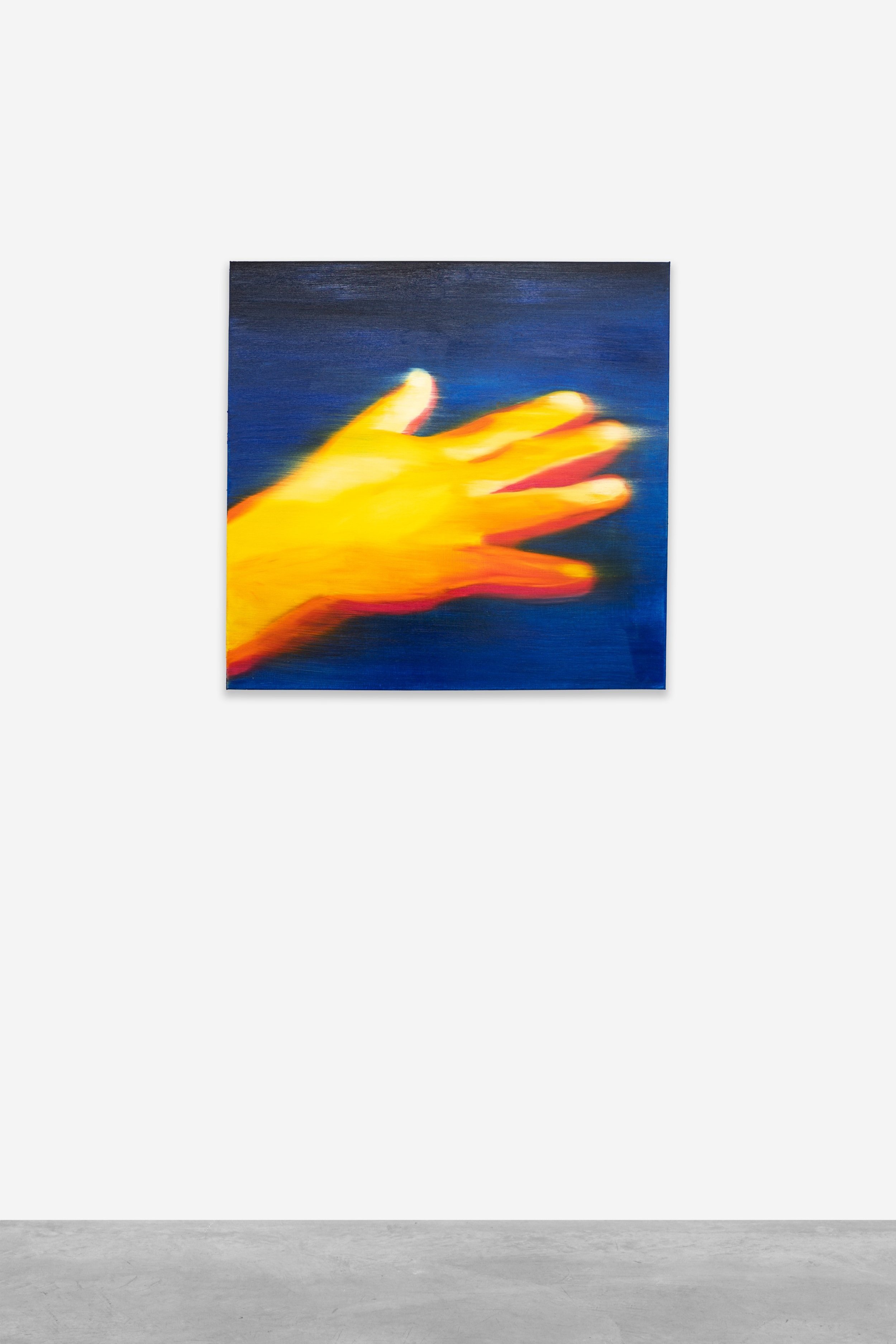
Tan Mu's Touch (2022) is a painting of a hand that also leaves a trace, but the trace it leaves is not pigment on stone. It is heat on a sensor. The painting is based on a thermographic image, a thermal photograph that records the infrared radiation emitted by a human hand and converts it into a color map in which warm areas appear in shades of yellow, orange, and red, and cool areas appear in shades of blue and violet. Oil on linen, 76 x 76 cm, it depicts a single hand rendered in the color palette of thermal imaging technology, floating against a deep blue background that represents the ambient temperature of the surrounding environment, the temperature of the air that the hand is not touching. The hand is open, palm facing the viewer, fingers slightly spread, in the same gesture that the ancient inhabitants of Cueva de las Manos pressed against the rock wall of the canyon ten thousand years ago. The difference is that the hand in Tan Mu's painting does not touch a surface. It hovers. It reaches. It extends toward the viewer without making contact, and the warmth it radiates is captured by a technology that records temperature without touch, that measures heat without proximity, that sees the body without feeling it.
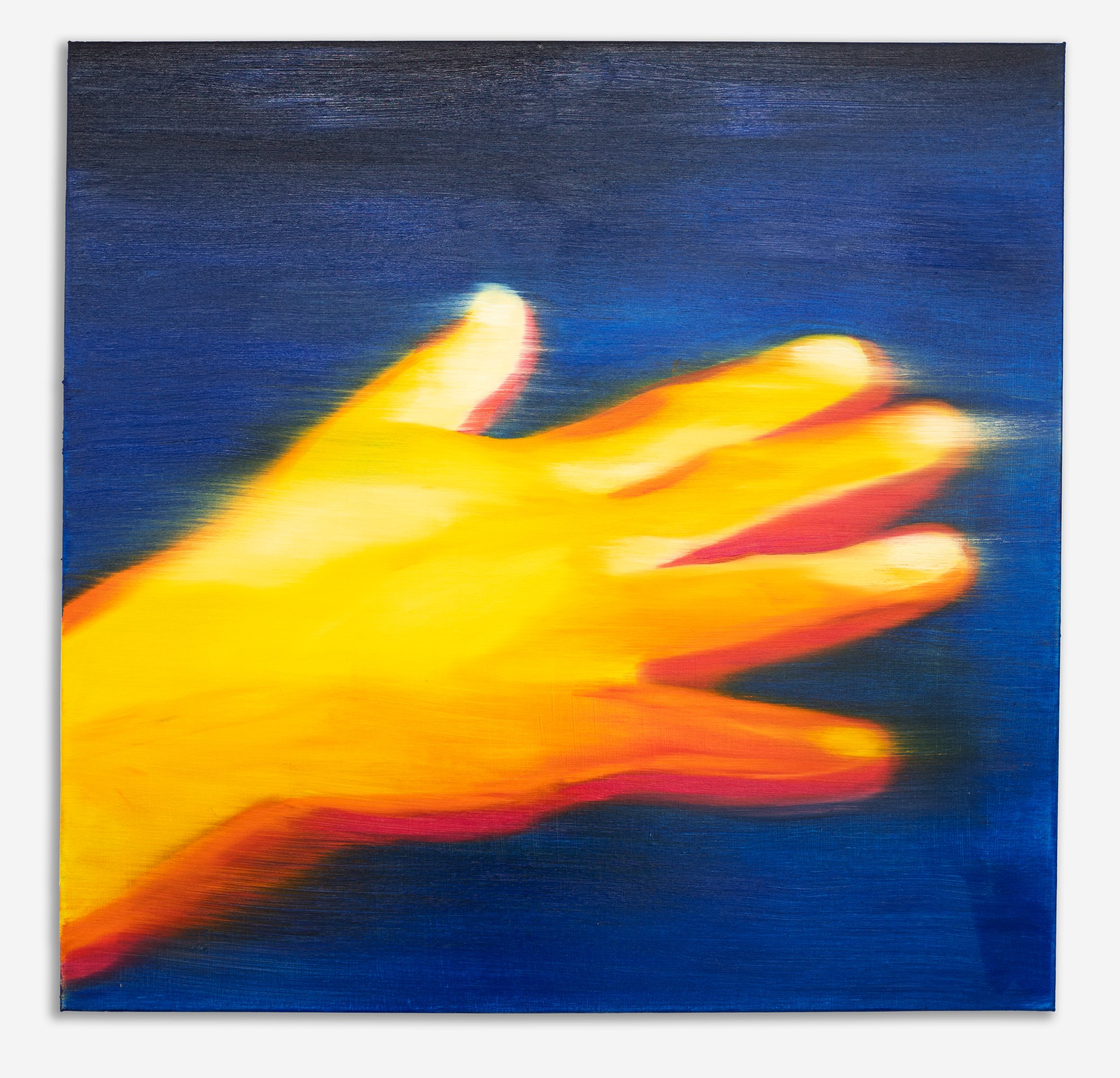
The painting is square, 76 by 76 centimeters, a format that centers the hand and gives it equal presence in all directions. The hand occupies the middle of the canvas, neither reaching toward the top nor sinking toward the bottom, neither pushing forward nor pulling back. It is suspended, held in a state of potential contact that never resolves into actual contact. The thermographic color palette assigns warm yellows and oranges to the palm and the fingertips, where the blood vessels are closest to the surface and the skin temperature is highest. The cooler blues and purples appear at the edges of the hand, where the blood vessels recede and the skin temperature drops toward the ambient temperature of the surrounding air. The background is a deep, saturated blue that reads as cold, as night, as the absence of the body's warmth. The contrast between the warm hand and the cold background is the painting's primary visual argument. The hand is warm. The air around it is not. The hand extends into the cold. The cold surrounds the hand. And the boundary between them, the precise edge where the warm colors of the fingers meet the cold colors of the background, is the boundary where touch would occur if the hand were reaching toward another hand, another body, another surface, instead of reaching toward nothing, which is what it is doing in this painting, which is a painting about the absence of touch, made during a pandemic in which touch was restricted, monitored, and in many contexts forbidden.
Tan Mu's description of the painting connects it explicitly to two sources: the thermographic image, captured through technology, and the handprints of Cueva de las Manos. "The handprints in the Cueva de las Manos are among the earliest traces of human presence," she writes. "Created through a stencil process, they record the physical act of placing a hand against a surface and leaving behind a negative image. These marks preserve a moment of touch across thousands of years." The connection between the cave handprint and the thermographic hand is not a metaphor. It is a structural comparison. Both are records of a hand made by a process that converts touch into image. The cave handprint converts touch into a negative silhouette of pigment. The thermographic hand converts the heat of the body into a color map of temperature variation. Both are images made without traditional painting or drawing. Both are generated by a process that lies outside the hand itself: the blowing of pigment in the cave, the sensing of infrared radiation in the camera. And both are records of presence that survive the departure of the body that made them. The handprint on the cave wall was made by a person who then walked away. The thermographic image was captured by a camera that then stored the file. The hand in both cases is no longer there. The trace remains.
The handprints of Cueva de las Manos are among the oldest known examples of stenciled negative imagery in human history. The technique, which archaeologists call "stencil painting" or "negative hand printing," involves placing a hand against a surface and applying pigment around it, either by blowing it through a tube, spattering it with a brush, or pressing a pigment-covered pad against the wall. The result is a positive image of the surrounding area and a negative image of the hand, the exact reverse of a fingerprint, which leaves a positive image of the ridges and a negative image of the valleys. The handprints at Cueva de las Manos are predominantly left hands, which suggests that the makers held the pigment tube in their right hands and placed their left hands against the wall. The predominance of left hands has been interpreted as evidence that the prints were made by a specific group or lineage within the broader community, though the interpretation remains speculative. What is not speculative is the persistence of the prints. The mineral pigments used, primarily iron oxides in red, orange, brown, and white, have adhered to the rock surface for over nine thousand years, protected from rain and wind by the overhang of the cave ceiling, and visible today in the same condition in which they were left, as though the hands had just withdrawn from the wall and the pigment had just dried. The prints are not art objects in the sense that we use the term in museums. They are something more fundamental. They are evidence that the human hand, placed against a surface, will leave a mark, and that the mark, once made, will persist for as long as the surface endures.
The structural connection between the cave handprint and Tan Mu's thermographic hand is the connection between two technologies of touch that produce opposite results. The cave handprint requires physical contact. The hand must touch the wall for the pigment to be applied around it. The thermographic image prohibits physical contact. The thermal camera records the heat of the body at a distance, without the camera touching the skin and without the body touching any surface. The cave handprint is the most tactile image ever made: it is the trace of a hand pressing against stone. The thermographic image is the most distanced image ever made: it is the record of a body's warmth captured by a sensor that never comes within meters of the skin. Tan Mu's painting holds both of these technologies in a single frame. The hand in Touch is rendered in the colors of thermal imaging, the technology of distance. The composition of the hand, open-palmed and facing the viewer, is the gesture of the cave handprint, the technology of contact. The painting does not choose between them. It presents them as the two ends of the same arc: the arc that begins with a hand pressing against a rock wall in Patagonia and ends with a sensor recording the infrared radiation of a hand that is not touching anything, in a world where touch has been replaced by data.
Albrecht Dürer's Study of Hands (c. 1508) is one of a series of preparatory drawings that Dürer made for his painted altarpieces and other compositions. The drawing, executed in pen and brown ink with grey wash on blue paper, shows a pair of hands in various positions: one open, palm facing outward; one curled, fingers touching the thumb; one reaching, fingers extended as though grasping an object that is not there. The hands are rendered with a precision that is anatomical in its attention to the structure of the knuckles, the tendons, and the veins, and devotional in its attention to the gesture of prayer and supplication that the positions imply. Dürer's hands are not generic. They are specific, individual, and alive. The veins bulge slightly under the skin. The knuckles are knobby. The fingernails are shaped and shaded with the same care that Dürer applied to the fingernails of Christ in his Passion engravings. The drawing is a study, not a finished work, but it contains more information about the human hand than most finished paintings contain about their entire subjects. It is a record of sustained looking, of the kind of attention that does not glance but dwells, that does not summarize but specifies, that does not generalize but particularizes. Dürer looked at these hands for a long time. The drawing is the evidence of that looking.
Tan Mu's Touch shares Dürer's conviction that the hand is worthy of sustained, particularized attention. But where Dürer's study renders the hand in the language of naturalism, with the full range of tonal variation that ink and wash can produce, Tan Mu renders the hand in the language of thermal imaging, with the reduced palette of yellows, oranges, reds, blues, and purples that the technology assigns to temperature gradients. Dürer's hand is a hand you could reach out and grasp. Tan Mu's hand is a hand you could measure. Dürer's hand is warm because it is made of flesh and blood. Tan Mu's hand is warm because the sensor says so, because the pixels that compose the thermographic image have been assigned colors according to a scale that maps temperature to hue, and the mapping has determined that the palm is yellow and the fingertips are orange and the edges of the hand are blue. The warmth in Dürer's drawing is inferred from the rendering of the skin. The warmth in Tan Mu's painting is declared by the technology that produced the source image. The technology does not feel the warmth. It records it. It converts it into data. It translates the most intimate of human sensations, the warmth of one body against another, into a color code that any infrared camera can read and any computer can store. This is the condition that the painting documents: a world in which the warmth of the human body has become information, and the information has replaced the warmth, and the hand that reaches toward another hand reaches through a medium that records its temperature without allowing it to touch what it reaches for.
Danni Shen, in her 2024 studio visit profile for Emergent Magazine, describes Tan Mu's paintings as works that "serve as a kind of witness to human socio-technological histories." The description applies to Touch with particular force. The painting witnesses a specific moment in human history, the pandemic of 2020-2022, when physical contact was restricted, body temperature became a marker of health and a criterion for access, and the thermographic camera became a symbol of the surveillance state that monitored the body's warmth from a distance. "Temperature became a central marker of health," Tan Mu writes in her Q&A, "and technologies such as thermal imaging and AI-based monitoring were widely deployed in public spaces. These tools reduced the body to data points, reinforcing a sense of distance and surveillance." The thermographic image of the hand in Touch is the product of these technologies. It is the kind of image that was produced by the infrared cameras mounted at the entrances of airports, office buildings, and schools during the pandemic, cameras that scanned every person who passed and recorded their skin temperature as a proxy for infection. The hand in the painting is the hand that was scanned. The warmth that the painting records is the warmth that was measured, quantified, and judged. The blue background is the background of the screen, the interface, the distance that the technology interposed between one body and another.
The soft edges of the hand in Touch are not an aesthetic choice. They are a feature of the thermographic medium. Thermal cameras do not produce sharp images. The resolution of the sensor, the diffraction of infrared radiation, and the interpolation algorithms that convert raw sensor data into color-mapped images all contribute to a slight blurring at the edges of warm objects, a halo of transitional color that surrounds the hand and dissipates gradually into the background temperature. Tan Mu reproduces this halo in paint, using thin, translucent layers of oil that blend the warm colors of the hand into the cool colors of the background without a hard boundary. The result is a hand that appears to be dissolving at its edges, fading into the surrounding cold, as though the warmth of the body is not strong enough to maintain its shape against the encroaching chill. The soft edges are the painting's visual metaphor for what the pandemic did to physical contact. It did not eliminate it entirely. It blurred it. It made it uncertain. It made it unclear where one body ended and the surrounding space began. The handshake became the elbow bump. The hug became the wave. The touch became the temperature reading. And the temperature reading became the only record of the body's warmth that the technology was willing to provide.
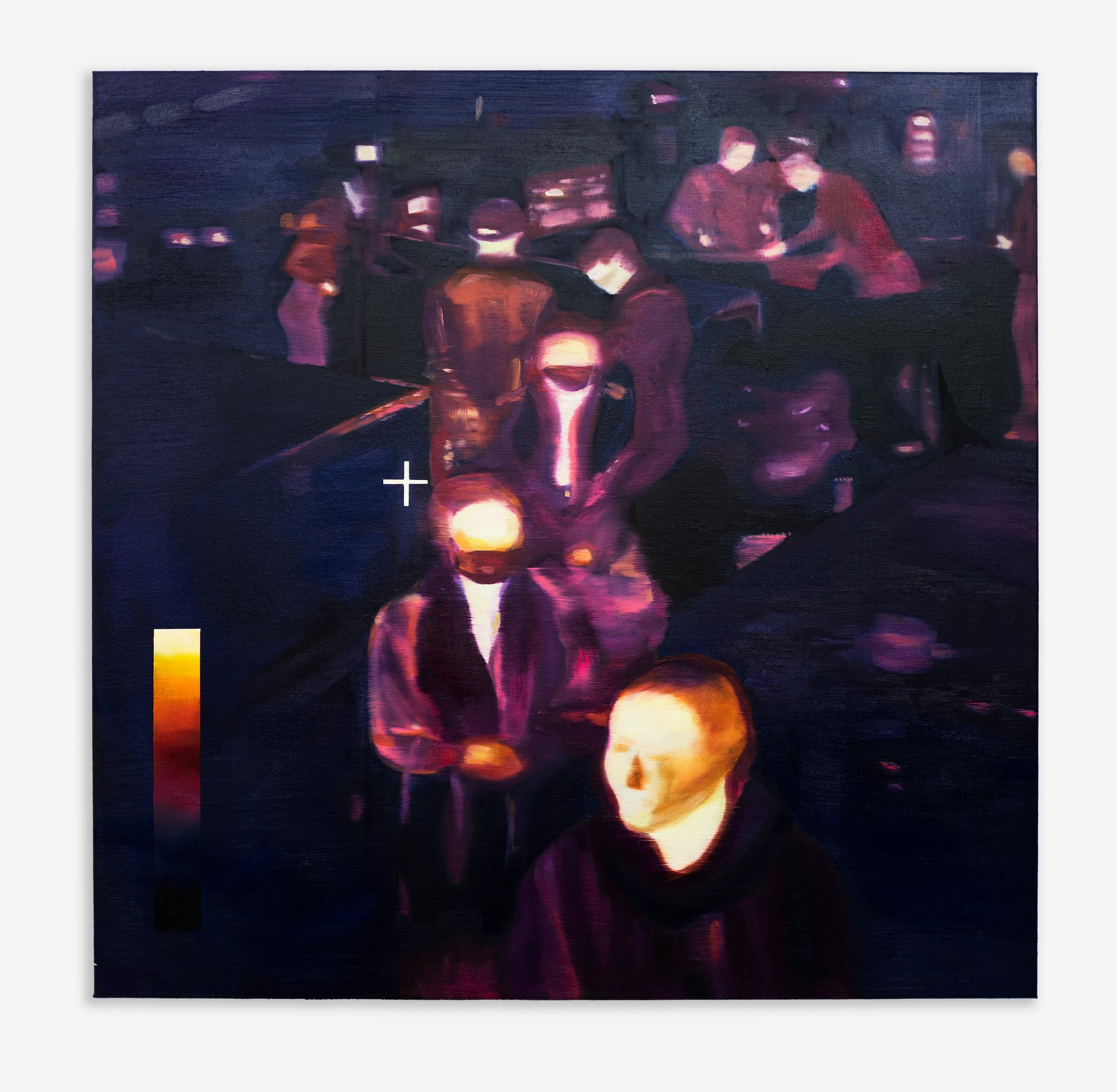
Tan Mu has described the pandemic as an experience in which "the pandemic felt like an enclosed space, almost like a cave," and she has drawn the parallel explicitly: "Like the handprints in the Cueva de las Manos, Touch serves as a record of a specific moment in human history, shaped by separation yet driven by the need for connection." The comparison is not decorative. It is structural. The cave was an enclosed space. The pandemic was an enclosed space. The handprints on the cave wall were records of presence made by people who were inside the cave together. The thermographic image of the hand is a record of presence made by a person who is being monitored from a distance. The cave handprint says: "I was here. I pressed my hand against this wall. My hand was warm. The wall was cold. The pigment marked the place where my hand met the stone." The thermographic hand says: "My hand is warm. The camera can see it. The camera does not need to touch me to know that I am warm. The camera does not need to be near me to record my temperature. The camera can measure my warmth from across the room, from across the building, from across the city, and it can store the measurement in a database that will outlast my body by as many years as the pigment on the cave wall has outlasted the hands that blew it." The two images are separated by ten thousand years and by the entire distance between touch and data. They are connected by the gesture of the open hand, reaching toward something that may or may not be there, leaving a trace that records the fact of reaching, if not the fact of contact, and persisting long after the hand that made the gesture has withdrawn, has cooled, has gone, has left behind only the shape of its reaching, pressed into pigment on stone or rendered in color on canvas, ten thousand years apart and one gesture the same.