The Stone That Fell Through Time: Tan Mu's Moldavite and the Object That Remembers Fifteen Million Years
Fifteen million years ago, a meteorite approximately 1.5 kilometers in diameter struck the Earth at a velocity of roughly 20 kilometers per second, creating a crater 24 kilometers wide in what is now the Nördlinger Ries in southern Germany. The impact released energy equivalent to approximately 1.8 million Hiroshima bombs. The temperature at the point of impact exceeded 20,000 degrees Celsius, converting the local sandstone, granite, and sedimentary rock into a superheated plasma of vaporized silica and rock that was ejected upward through the atmosphere in a plume of molten material. As this material rose, it cooled, and as it cooled, it solidified into droplets of glass that rained back down across a strewn field extending from southern Germany through the Czech Republic to the outskirts of Vienna. These droplets, called tektites, are not meteorites. They are terrestrial rock that was melted by a meteorite impact, launched into the upper atmosphere, and returned to the surface as natural glass. The Czech variant, known as Moldavite after the Vltava river (Moldau in German) near which the majority of specimens are found, is distinguished from other tektites by its green color, which ranges from pale yellow-green to deep forest green depending on the iron content, and by its surface texture, which is covered in sculptural pits, grooves, and ridges that formed during the solidification process as the molten glass was shaped by atmospheric friction and rapid cooling. Every piece of Moldavite on Earth was created in the same instant, by the same impact, fifteen million years ago. Every piece is a fragment of the same event. Every piece is a time capsule that preserves, in its chemical composition and its surface texture, a record of the moment when a rock from space collided with the planet and the planet's surface responded by turning itself to glass.
Tan Mu's Moldavite (2020) is a painting of one such piece. Oil on linen, 36 x 28 cm, it depicts a single Moldavite tektite from the artist's personal collection, rendered against a dark ground that absorbs all surrounding context and presents the stone as a self-contained object, floating in a void that could be deep space, deep time, or the dark interior of a mineral collector's cabinet. The painting is small. It is the smallest work in Tan Mu's entire catalogue. At 36 by 28 centimeters, it is roughly the size of a sheet of A4 paper turned on its side, or the size of a human hand held at arm's length. This scale is not incidental. Moldavite is a small stone. Most specimens fit in the palm of a hand. The painting matches the stone's dimensions, or close enough to make the viewer aware that they are looking at an object that could be held, turned over, examined in the light, and placed back on a shelf. The painting does not enlarge the stone. It does not monumentalize it. It presents it at approximately the size it actually is, and it presents it alone, without context, without scale indicators, without a hand to provide reference. The dark ground is not a backdrop. It is an absence. It is the absence of everything that is not the stone: no landscape, no horizon, no atmosphere, no time. The stone exists in the painting the way it exists in the hand of the person who holds it: as an object that is sufficient unto itself, an object that does not need explanation because its surface texture is the explanation.
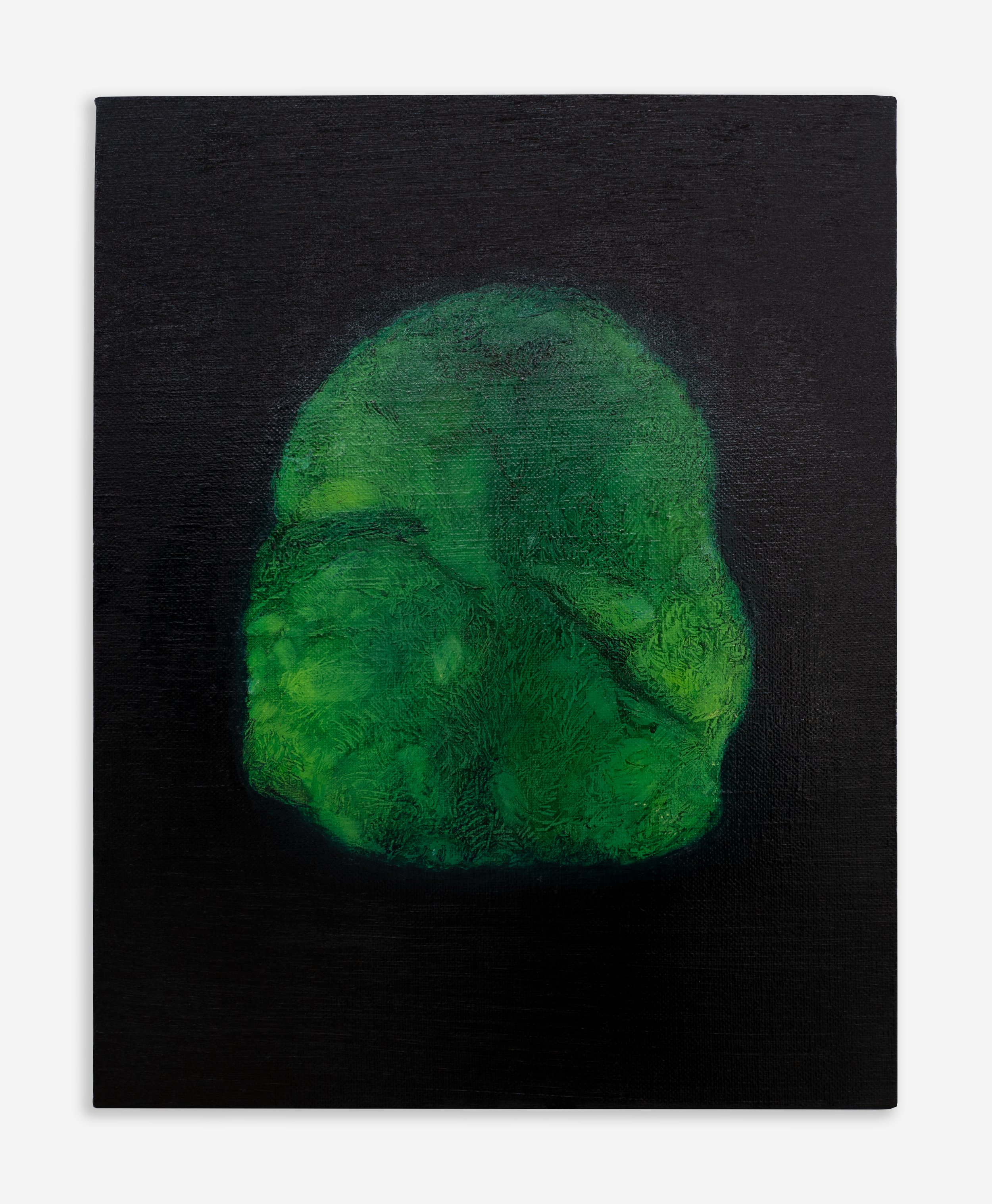
The surface of the stone in the painting is a dense field of pale green, olive, and translucent yellow-green, modulated by the sculptural texture of the tektite's natural surface. Moldavite is not smooth. It is not a polished gemstone. It is a natural glass that solidified while still in flight through the atmosphere, and its surface records the aerodynamic forces that shaped it during that flight. The pits are called "regmaglypts," and they were formed by the ablation of molten material from the surface of the tektite as it decelerated through the atmosphere. The ridges are the remnants of flow lines, created by the movement of viscous glass under aerodynamic pressure. The grooves are the traces of air currents that sculpted the surface during the seconds or minutes of atmospheric transit. Tan Mu renders these features with a precision that rewards close viewing. At arm's length, the surface resolves into individual marks: a raised ridge of lighter green where the glass flowed over a concavity, a pit of darker green where material was ablated away, a vein of nearly transparent yellow-green where the glass thinned enough to transmit light. The texture is not painted as texture. It is painted as form. Each pit, each ridge, each groove is a separate mark of paint, applied with a small brush to a surface that is itself a representation of a surface, and the accumulation of these marks produces an effect that is simultaneously painterly and geological, an effect that could only have been achieved by a painter who studied the stone at close range, understood the physical processes that created its surface, and then found a way to translate those processes into the language of oil paint.
The dark ground is rendered in a mixture of lamp black and burnt umber, applied in thin, even layers that produce a surface of absolute darkness against which the green of the Moldavite floats as though suspended in the void of space. Tan Mu has described this painting as "one of my earliest experiments with using a dark background and a close-up perspective." The experiment was productive. The dark ground eliminates all distraction. It removes the stone from any geological context, any landscape, any human hand, any display case, and presents it as what it is: a fragment of a cosmic event, a piece of glass that was once rock that was once sandstone that was once a seabed that was once the floor of a continent, all of which was converted, in an instant, by the impact of a rock from space, into the green glass that now sits in the center of a painting in an artist's studio, having traveled fifteen million years to arrive at this particular surface at this particular moment. The dark ground is not an aesthetic choice. It is a temporal choice. It removes the stone from human time and places it in geological time, where the only relevant scale is millions of years and the only relevant event is the impact that created it.
Walter De Maria's The Lightning Field (1977) is a grid of 400 stainless steel poles, each approximately 6.27 meters tall, planted in a one-mile by one-kilometer rectangular array in the high desert of western New Mexico. The poles are polished to a mirror finish, and they are designed to attract lightning during the summer thunderstorm season, though lightning strikes the field only a few times per year and the work is rarely seen in its fully activated state. Most visitors experience The Lightning Field as a grid of thin vertical lines stretching across the desert floor, reflecting the sky during the day and disappearing into the darkness at night, producing an experience of vast, empty space punctuated by the regular geometry of the poles. De Maria insisted that the work be experienced in person, that visitors spend at least 24 hours at the site, and that photographs could not convey the scale and the solitude of the encounter. The work's title refers to lightning, but its real subject is time. The poles are permanent. The desert is ancient. The lightning is instantaneous. The work holds all three temporalities simultaneously: the instant of the strike, the duration of the visit, the geological epoch of the desert. The Lightning Field is not about lightning. It is about the relationship between the instantaneous and the eternal, between the flash that lasts a fraction of a second and the landscape that has been there for millions of years.
Tan Mu's Moldavite shares De Maria's concern with deep time, but it approaches the subject from the opposite direction. De Maria placed a permanent installation in a landscape that is itself millions of years old, and he invited visitors to experience the relationship between the temporary flash of lightning and the ancient permanence of the desert. Tan Mu placed a single small stone, fifteen million years old, against a dark void, and she invites the viewer to experience the relationship between the stone's immense age and the brief moment of looking. De Maria's work is large, remote, and requires pilgrimage. Tan Mu's painting is small, portable, and can be encountered in any gallery. But both works are asking the same question: what happens to human perception when it confronts an object that exists on a timescale that dwarfs human existence? De Maria answers by making the viewer stand in the desert and wait for lightning. Tan Mu answers by making the viewer stand in front of a painting and look at a stone. The answer, in both cases, is a form of temporal disorientation: the recognition that the object in front of you has existed for so long and through so many transformations that your own lifetime is, by comparison, an instant, a flash, a moment of attention that the stone does not notice and does not require.
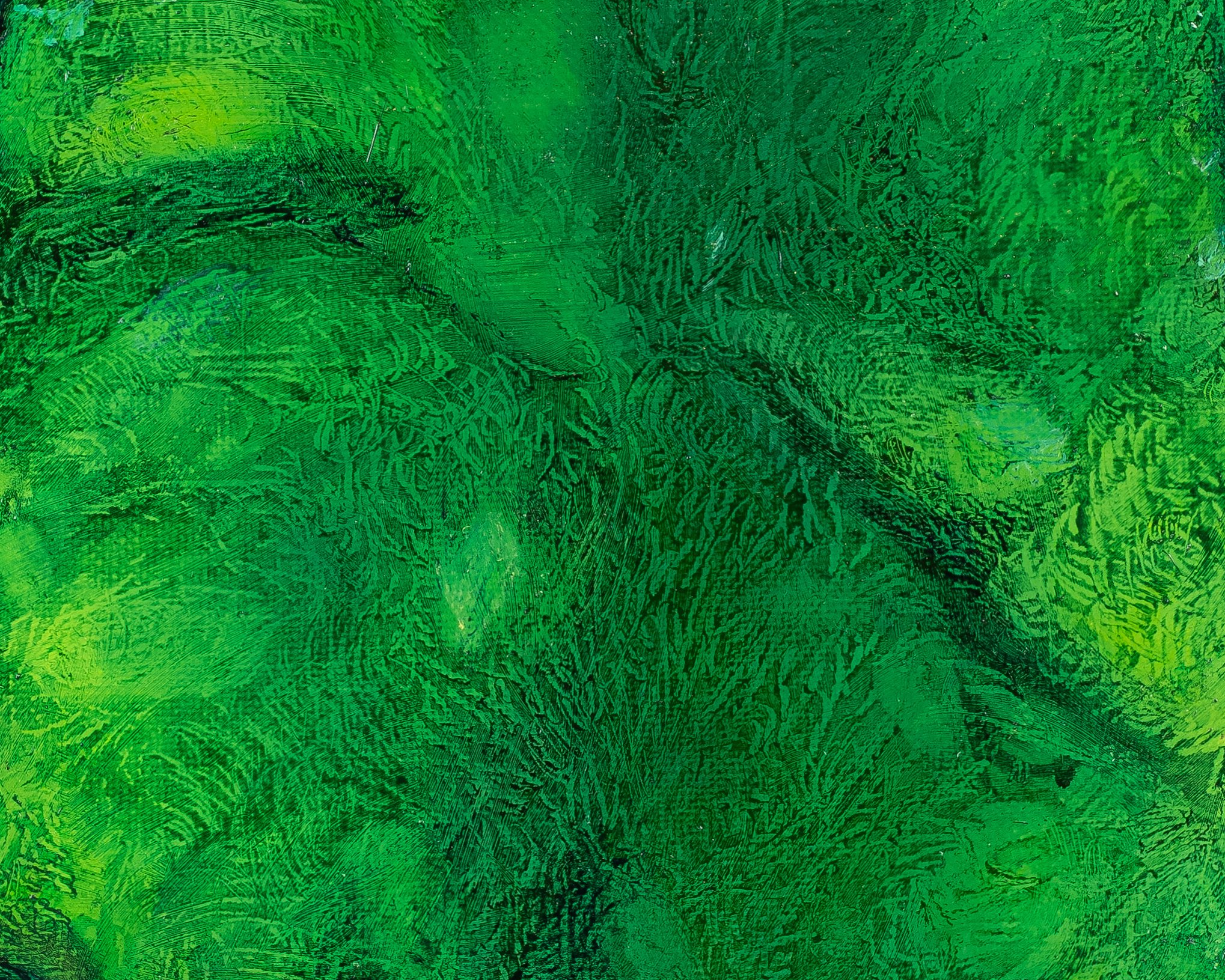
Moldavite is classified as a tektite, from the Greek word "tektos," meaning "molten." Tektites are not meteorites. They are not fragments of the impacting body. They are fragments of the Earth's surface that were melted by the impact, launched into the atmosphere, and returned as natural glass. The chemical composition of Moldavite is distinct from other tektites because it was formed from a specific mixture of local rocks, primarily the sandstone and shale of the Upper Freshwater Molasse formation that underlay the impact site. The green color comes from iron oxide in the source material, and the specific shade varies from specimen to specimen depending on the local concentration of iron. The surface texture, the regmaglypts and flow lines, are the record of the tektite's passage through the atmosphere, a passage that lasted between seconds and minutes but left permanent marks on the glass surface. These marks are not decorative. They are forensic. They are the physical record of an event that no human witnessed and no instrument recorded, preserved in a material that was itself created by the event. To hold a piece of Moldavite is to hold a record of the Nördlinger Ries impact. To look at its surface is to read the aerodynamic forces that shaped it during its brief flight through the atmosphere fifteen million years ago. The stone does not merely come from the past. It is the past, materialized in the present, available for inspection by anyone with the patience to look closely enough.
Tan Mu's personal connection to this stone is direct. "This work depicts a Czech meteorite known as Moldavite, which comes from my personal collection," she states in the Q&A for this work. "I have always been interested in collecting stones, and Moldavite in particular deeply fascinated me. It was the first Czech meteorite I acquired, which gives it personal significance." The phrase "personal significance" is doing specific work. Moldavite is not a subject that Tan Mu encountered in a textbook or a database. It is a stone she holds in her hand. It is a physical object that she purchased, transported, stored, and returned to repeatedly over the course of painting it. The relationship between the artist and the stone is not the relationship between a researcher and a specimen. It is the relationship between a collector and a cherished object, the kind of relationship that involves picking the stone up, turning it in the light, feeling its weight and its texture, and placing it back on the shelf with the awareness that it will still be there tomorrow, and the day after, and the year after that, because it has been there for fifteen million years already and it is not going anywhere. The painting is not a documentation of the stone. It is a record of the experience of holding it, examining it, and recognizing, in its surface, the record of an event that predates not only the artist but the species to which the artist belongs.
Anish Kapoor's Void Field (1989) consists of sixteen rough-hewn sandstone blocks, each approximately 30 centimeters square, arranged in a four-by-four grid on the gallery floor. Each block has a circular hole carved into its top surface, and inside each hole, the interior is painted in Kapoor's signature deep blue-black pigment, a color so dark that it appears to absorb light rather than reflect it. The holes are not openings. They are voids. They do not lead anywhere. They are cavities in solid stone that appear, because of the pigment and the depth of the carving, to recede into infinite darkness, as though each block contained a bottomless hole that descended through the floor and into the earth below. Kapoor has described the void as "a non-space, a non-object," a place where the eye goes in and does not come back. The work's power lies in this reversal: the stone is solid, heavy, and present, but the void inside it is empty, lightless, and seemingly infinite. The solid and the empty coexist in the same object, and the viewer's perception oscillates between the two, unable to settle on either the presence of the stone or the absence of the hole.
Tan Mu's Moldavite and Kapoor's Void Field share a compositional logic: a solid object presented against or containing a field of absolute darkness. In Kapoor's work, the darkness is inside the stone. In Tan Mu's, the darkness is outside it. In both cases, the darkness functions as a temporal marker. It is not merely the absence of light. It is the absence of human time, the absence of context, the absence of the present moment. Against the darkness, the object stands as a remnant of deep time, a fragment of a past that existed long before the present and will exist long after it. Kapoor's void descends into geological depth. Tan Mu's darkness extends into cosmic depth. Both produce the same effect: the object, whether a block of sandstone or a piece of Moldavite, is stripped of its contemporary context and placed in a space where the only relevant dimension is time, and the time is not human time but geological or cosmic time, a time so vast that the object's presence in the frame becomes an act of survival, a persistence, a refusal to disappear into the darkness that surrounds it. The green of Tan Mu's Moldavite against the black of the ground is the same green that the stone would display if it were held up against the night sky: the color of terrestrial glass, made from terrestrial rock, by a cosmic impact, floating in a darkness that is not the darkness of a gallery wall but the darkness of the time that produced it.
Nick Koenigsknecht, writing about Tan Mu's practice in his 2025 BEK Forum catalog essay, observes that her paintings "transform data cables into gestural constellations that oscillate between calculation and intuition." The observation applies to Moldavite as well, though the transformation here is not from data cable to constellation but from geological specimen to painted surface. The calculation is in the observation: the precise rendering of each regmaglypt, each flow line, each pit, each ridge, translated from the surface of the stone to the surface of the canvas with an accuracy that could only come from sustained, close-range study. The intuition is in the color: the modulation of green into olive into translucent yellow, the thinning of the paint where the glass would transmit light, the thickening where the glass would block it, the judgment calls that every painter must make about where to emphasize and where to suggest, where to describe and where to evoke. The stone is the data. The painting is the constellation. And the darkness that surrounds it is the space in which the constellation becomes visible, the void against which the green glows, the absence of time that makes the presence of the stone so urgently, so undeniably, so permanently there.
Tan Mu has said that Moldavite "carries a timespan of approximately fifteen million years" and that holding it made her reflect on "how it has endured through vast geological and cosmic processes, placing human history, technological progress, and social conflict into a much smaller perspective." The word "smaller" is the key. The stone does not make human history insignificant. It makes it smaller. The difference matters. Insignificance implies that human concerns do not matter. Smallness implies that they matter, but that they occupy a smaller portion of the temporal scale than we typically assume. The stone's fifteen million years do not erase the hundred thousand years of Homo sapiens. They contextualize them. They place them on a timeline that extends far beyond the boundaries of individual or collective memory, and they show, with the authority of a physical object that can be held in the hand, that the timeline exists, that deep time is not an abstraction but a material reality, and that the present moment, however urgent it feels, is a thin layer on top of a geological and cosmic history that is, by any measure, the dominant fact of the planet we live on. The painting makes this visible by removing everything except the stone and the darkness. The stone is the fact. The darkness is the time. And the fact, floating in the time, is the image that remains when all human concerns have been stripped away and all that is left is a piece of green glass that was once part of a continent, and that was launched into the sky by a rock from space, and that fell back to earth, and that lay in a field for fifteen million years, and that was picked up by a woman who looked at it, and painted it, and placed it against a dark ground, and left it there for the next viewer to find, and hold, and recognize, as the fragment of an event that happened before there were hands to hold it, and that will still be here, in its green and glassy permanence, long after the hands that hold it have turned to dust.