The Instant Stretched Across Seven Days: Tan Mu’s TRINITY TESTING and the Vibration After the Blast
At 5:29 a.m. on July 16, 1945, in the Jornada del Muerto desert of southern New Mexico, a device codenamed Gadget produced the first nuclear detonation in human history. The flash was visible from more than two hundred miles away. The shockwave broke windows in homes up to one hundred and twenty miles from ground zero. The resulting fireball rose to a height of thirty-five thousand feet, and the mushroom cloud that formed above it reached the stratosphere within seconds. The entire event, from the initial flash to the stabilization of the column, occupied less time than it takes to inhale. And yet this fraction of a second redirected the trajectory of the species that produced it. Every nuclear weapon that has ever existed, every arms treaty, every doctrine of mutually assured destruction, every protest movement and every geopolitical calculation that has included the phrase "nuclear option" traces its origin to those few seconds in the New Mexico desert. Tan Mu's TRINITY TESTING (2020) does not depict the aftermath. It does not depict the politics or the fallout or the decades of deterrence theory that followed. It depicts the instant itself, the precise moment when energy escapes containment, and it does so seven times, across seven small panels, each one a separate frame extracted from the continuous violence of a detonation that the eye cannot process in real time.
TRINITY TESTING is oil on linen in seven parts, each measuring 28 x 36 cm (11 x 14 in), with an overall dimension of 28 x 252 cm (11 x 98 in) when the panels are displayed together. The format is essential. These are not seven variations on a single image. They are seven sequential moments drawn from the same archival footage of nuclear tests, each one capturing a different phase of the explosion's expansion. The first panel shows the initial burst, a concentrated sphere of white light surrounded by a halo of radiating energy. The second and third panels show the fireball as it expands and begins to lift, its lower edge pulling upward as the thermal updraft creates the stalk that will become the mushroom column. The fourth and fifth panels show the fireball at its maximum lateral extension, the moment when the blast wave has done its damage and the cloud is beginning to rise vertically. The sixth and seventh panels show the mushroom cloud in its mature form, the column rising and the cap flattening into the anvil shape that photographs of nuclear tests have made iconic. Each panel is rendered in a restricted palette of whites, greys, and pale yellows against a dark ground, the monochrome palette that Tan Mu has described as a way of stripping away "the familiarity of the visible world" so that "what we think we understand begins to operate within a different system." The mushroom cloud in this palette is no longer an image of destruction. It is a visual expression of vibrational frequency, a shape that the eye reads as energy rather than as catastrophe.
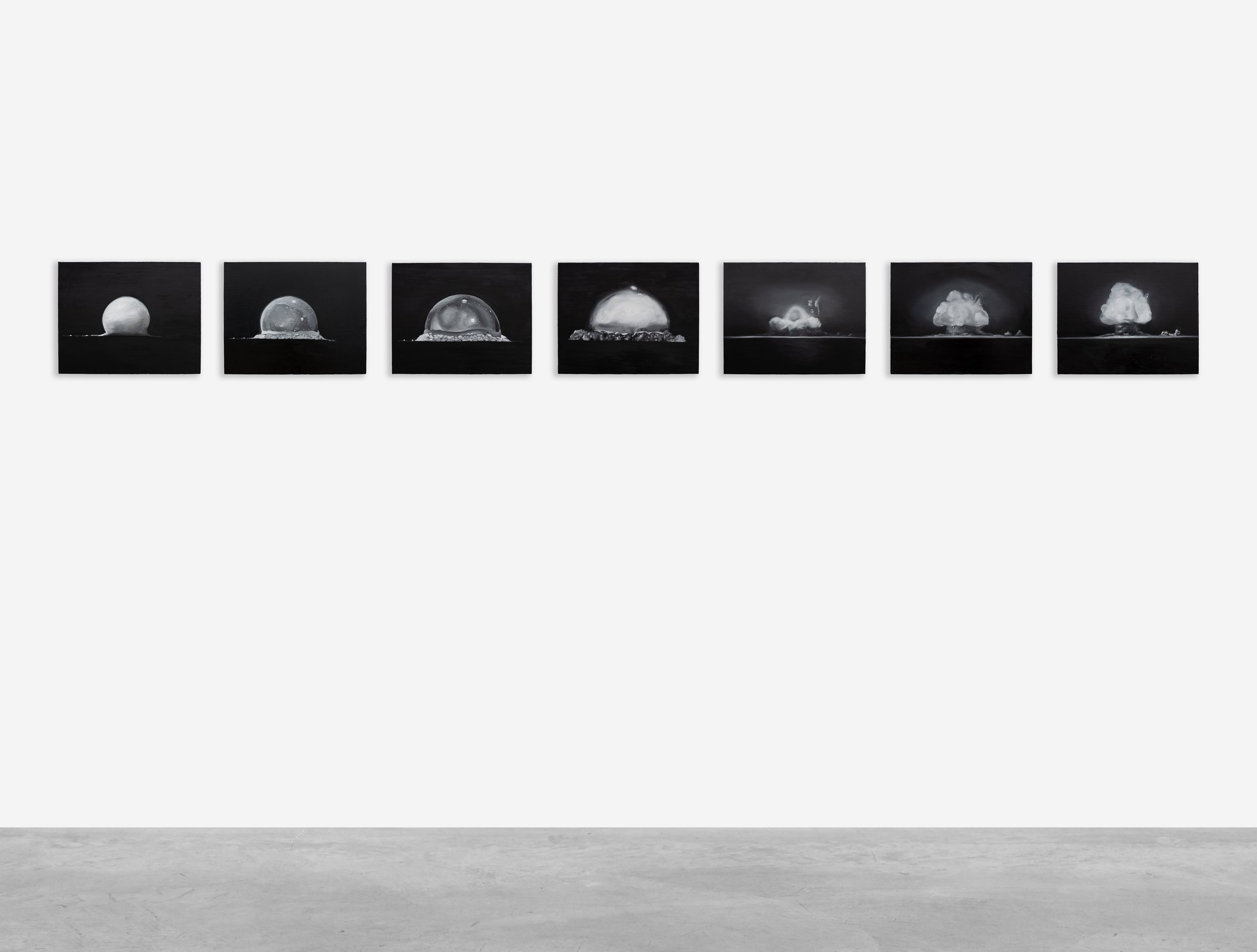
The surface of each panel enacts the same tension that the subject describes: between the instantaneous and the sustained, between the event that destroys and the hand that records. The white light at the center of the initial burst in the first panel is not a single stroke of white paint. It is built from successive applications of pale yellow, cream, and white over a ground of dark grey or black, and the layering produces a luminosity that a single flat application could not achieve. The edges of the fireball in the second and third panels dissolve into the dark background not through blending but through a progressive thinning of the paint layer, so that the linen weave becomes visible at the perimeter and the explosion appears to be literally dissolving into the fabric that holds it. This is a material analogy for the process the painting depicts: the blast dissipates, the energy spreads, the concentrated light of the initial flash gives way to the expanding column and the dispersing cap. Tan Mu has described painting each panel in a single day, working for roughly ten hours with full concentration, and the surface reflects that intensity. There is no hedging in these panels, no areas where the brush hesitates. Each mark is committed, and the speed of the brushwork in the expanding cloud forms contrasts with the careful layering in the central fireball, producing a visual tempo that shifts from the sustained to the explosive within the space of a single panel.
Francis Bacon's Three Studies for Figures at the Base of a Crucifixion (1944) was first exhibited in April 1945, three months before the Trinity test. The coincidence of dates is not incidental to the comparison. Bacon's triptych was created during the same historical moment that produced nuclear weapons, and it shares with TRINITY TESTING a structural logic that the serial format enforces. A triptych is not three paintings. It is one painting divided into three parts, and the division itself creates a temporal sequence. The viewer reads from left to right, and the panels enter consciousness in succession, even though they exist simultaneously on the wall. Bacon understood this. The three figures in his triptych are not three separate creatures. They are three phases of a single contortion, three moments extracted from a continuous spasm of anguish that the body cannot sustain for more than an instant. The triptych format allows Bacon to hold that instant open, to stretch a fraction of a second of bodily extremity into three distinct views that the viewer must process in sequence. The horror of the painting is not in any single panel. It is in the cumulative effect of seeing the same anguish from three angles, which produces the sensation that the event is ongoing, that it has duration, that it has not yet ended.
Tan Mu's seven-panel sequence works by the same logic, but where Bacon stretches a moment of bodily anguish, Tan Mu stretches a moment of physical release. The nuclear detonation in each panel of TRINITY TESTING occupies a fraction of a second of actual time. The seven panels together, when read left to right, convert that fraction into a duration that the viewer can walk along, examine, and absorb. The serial format does not illustrate the explosion. It decompresses it. It takes an event that is too fast for the eye to parse and distributes its phases across seven separate surfaces, forcing the viewer to experience each phase as a discrete moment rather than as a component of a single overwhelming flash. Bacon's triptych holds open the instant of suffering. Tan Mu's heptaptych holds open the instant of detonation. Both use seriality as a tool against the ephemerality of the extreme moment. Both refuse to let the viewer look away by insisting that the event is not a single image but a sequence, and that the sequence has not yet concluded.
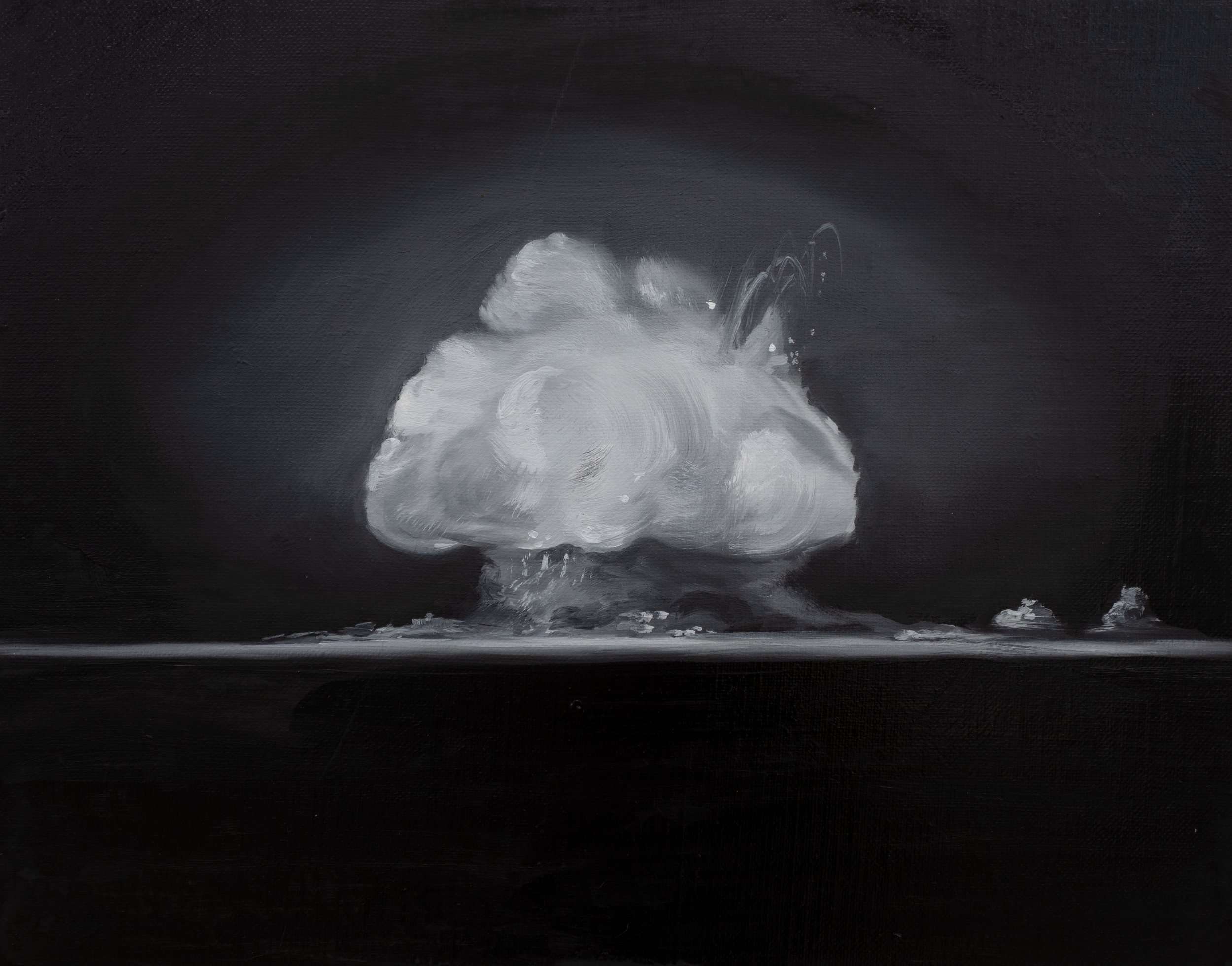
The decision to render these explosions in monochrome is not aesthetic. It is epistemological. Tan Mu has explained that removing color "helps strip away the familiarity of the visible world," and that when images are rendered in black and white, "familiar environments become strange, and what we think we understand begins to operate within a different system." The mushroom cloud is among the most photographed phenomena of the twentieth century. It has been reproduced in newspapers, documentaries, protest posters, and science textbooks. It carries a specific color signature: the orange fireball, the grey column, the white cap. When these colors are removed, the cloud ceases to be a document of a specific historical event and becomes a visual expression of energy in expansion. The grey and white forms that remain after color has been subtracted look less like an explosion and more like an oscillation, a vibration pattern rendered visible. Tan Mu has described her fascination with "oscillation and vibration," noting that historical accounts of nuclear explosions describe "not only their visual impact but also the powerful vibrational energy they generate." The shockwave that radiates outward from a nuclear detonation is not only a pressure wave. It is a vibrational event that transmits energy through every medium it encounters: air, water, rock, the bodies of anyone within range. The monochrome palette converts the mushroom cloud from an image of destruction into an image of frequency, a snapshot of energy crossing a threshold from one state to another.
The physics of that threshold is worth pausing over. A nuclear detonation begins with the compression of fissile material, either uranium-235 or plutonium-239, to a density that permits a self-sustaining chain reaction. In the Trinity test, the device used plutonium-239 and was triggered by implosion: conventional explosives arranged in a spherical pattern around the plutonium core detonated simultaneously, compressing the core to approximately twice its normal density. At that density, neutrons from an initiator at the center struck plutonium nuclei, which split, releasing additional neutrons and a quantity of energy described by Einstein's equation relating mass and energy. The reaction proceeded through roughly eighty generations in fractions of a microsecond before the expanding core blew itself apart. By the time the energy had expanded to the point where it was visible as a fireball, roughly one millisecond had elapsed. The fireball reached its maximum diameter in approximately one second. The mushroom cloud formed over the next several seconds as the hot gases rose and the surrounding air was drawn upward by the thermal updraft. The entire sequence that Tan Mu distributes across seven panels, from the initial flash to the mature cloud, occupies between three and ten seconds of real time. A single painting could not capture this duration. It would have to choose a single moment, and the choice would eliminate the expansion that is the event's defining characteristic. The serial format solves this problem by converting temporal sequence into spatial sequence. The viewer walks along the wall and experiences the detonation as a narrative, one panel at a time, and the duration that was too brief to perceive becomes a duration that can be studied at length.
Yiren Shen, in her conversation with Tan Mu for 10 Magazine, describes the ocean at Curacao, where a dive site was located beside a submarine cable entry point and a massive oil rig. She notes that Tan Mu "swam beneath one of its pillars," and that "we often think of these structures as artificial monstrosities, yet below the surface, they become marine habitats, like giant castles for sea life." The observation is precise and it extends to TRINITY TESTING by analogy. The nuclear explosion is understood as an artificial monstrosity, a human-made catastrophe of unprecedented scale. But Tan Mu's treatment of the blast in monochrome, as vibration rather than destruction, asks the viewer to consider what happens when the monstrosity is suspended, when the event is frozen and examined without the emotional overlay of catastrophe. Below the surface of the mushroom cloud, below the destruction and the politics, there is a physical process: energy converting from one form to another, matter reaching temperatures that replicate the interior of a star, a vibrational wave propagating outward through every available medium. Shen also draws a connection between Tan Mu's Signal paintings and John Cage's Concert for Piano and Orchestra, where "the conductor's alternating arms moving like clock hands and the musicians playing from boxes on two tiers" created a composition defined not by melody but by the distribution of sound in space. This observation illuminates TRINITY TESTING from a different angle. The seven panels are not seven separate explosions. They are seven frequencies of the same vibrational event, seven readings of the same shockwave at different moments in its expansion, the way a conductor's gestures distribute the same musical material across different registers of the orchestra. Tan Mu does not sentimentalize this process. She does not ask the viewer to find beauty in nuclear detonation. She asks the viewer to see what is actually happening in the fraction of a second before judgment intervenes. The monochrome strips away the familiar color coding of destruction and replaces it with something that looks like a waveform, a frequency pattern, an oscillation. The question the painting poses is not whether the blast is beautiful. The question is whether the blast, when seen as vibration rather than as catastrophe, reveals something about the nature of energy that the catastrophic framing obscures.
Tan Mu has described the experience of painting TRINITY TESTING as a form of temporal manipulation. She spent roughly ten days on the seven panels, working for about ten hours each day. "Each painting represents a fragment of time, transformed into a visual record," she has said. "It felt as though I was stretching time, entering that brief instant and examining its impact from within." This description is not metaphorical. The painting process literally stretched the instant. An event that occupied between three and ten seconds of real time was decompressed into approximately seventy hours of working time. The ratio is approximately 1 to 25,000. For every second of detonation, Tan Mu spent roughly seven hours of painting. This is not an illustration of the explosion. It is a temporal translation that operates at a scale almost impossible to grasp. The layering of oil paint on linen becomes a record of sustained attention applied to an event that could not be sustained by any human eye. The paint does not depict the blast. It holds the blast open, the way a high-speed camera holds open a millisecond, except that the camera does it mechanically and the painting does it through the cumulative pressure of human attention. The seven panels are not seven moments of detonation. They are seventy hours of looking at seven moments of detonation, and the paint on each linen surface carries the duration of that looking as a physical fact. The thickness of the paint in the central fireball, the thinness of the paint at the cloud's dissolving edges, the transition from committed mark to fading veil: all of these material decisions are records of time spent, and the time spent is the subject of the work as much as the explosion itself.
TRINITY TESTING is, at its structural level, an argument about time and attention. The serial format insists that the detonation is not a single image but a sequence, and that the sequence has implications that only duration can reveal. The monochrome palette insists that the mushroom cloud is not a symbol but a physical event, and that its visual properties change when the color of catastrophe is removed. The scale of each panel, 28 x 36 cm, small enough to hold in two hands, insists that the largest event in human history can be approached at the scale of the body, the scale of the studio, the scale of a single day's work. And the seventy hours of painting that went into the ten seconds of detonation insist that the relationship between an event and its representation is not one of documentation but of translation, and that the translation takes as long as it takes. The blast occurred in seconds. The painting took ten days. The translation is complete when the paint says it is complete, and the paint says it is complete when the instant has been held open long enough for its vibration to become visible. Seven small panels, seventy hours of looking, ten seconds of detonation. The ratio is the argument.