The Curtain That Will Not Rise: Tan Mu’s Stage and the Time Hidden Behind It
The image began as a black-and-white film photograph. Tan Mu took it roughly a decade before she painted it, in a theater she has not named, at a moment she has not dated. She later turned the photograph into a print, and then, years after that, into a painting. Three mediums, three iterations, each one a translation of the same curtain into a different material register. The print preserved the tonal range of the film negative. The painting preserved the print and replaced its flatness with texture, its mechanical reproduction with the slow accumulation of oil on linen. With each translation, the curtain became less a document of a particular theater and more an object accumulating time. The painting that finally emerged from this process, Stage (2021), is not a picture of a curtain. It is a record of how long an artist can look at a single image before the image reveals what it has been hiding.
Stage is oil on linen, 61 x 45.7 cm (24 x 18 in), a vertical format that emphasizes the curtain's full drop from an unseen proscenium to the stage floor. The curtain fills nearly the entire canvas. It is a heavy, draped fabric, painted in deep burgundy and black with passages of warmer red where the folds catch light from an unseen source above and to the left. The fabric is thick, almost viscous in the way it hangs, and the folds are rendered with the kind of close attention that produces weight: each fold casts a shadow on the one below it, and the shadows are not black but a cool, desaturated purple that reads as the natural shadow of red cloth under warm illumination. There is no visible stage, no audience, no proscenium arch. The curtain occupies the entire visual field, and its bottom edge terminates just above the lower edge of the canvas, leaving a narrow band of dark floor that suggests depth without revealing what lies behind. At the center of the composition, where two panels of the curtain meet, a narrow vertical gap reveals a sliver of darkness behind, a hint of the space the curtain conceals. This gap is the painting's hinge. Everything on this side of the curtain is present, material, painted with fullness. Everything on the other side is absence.
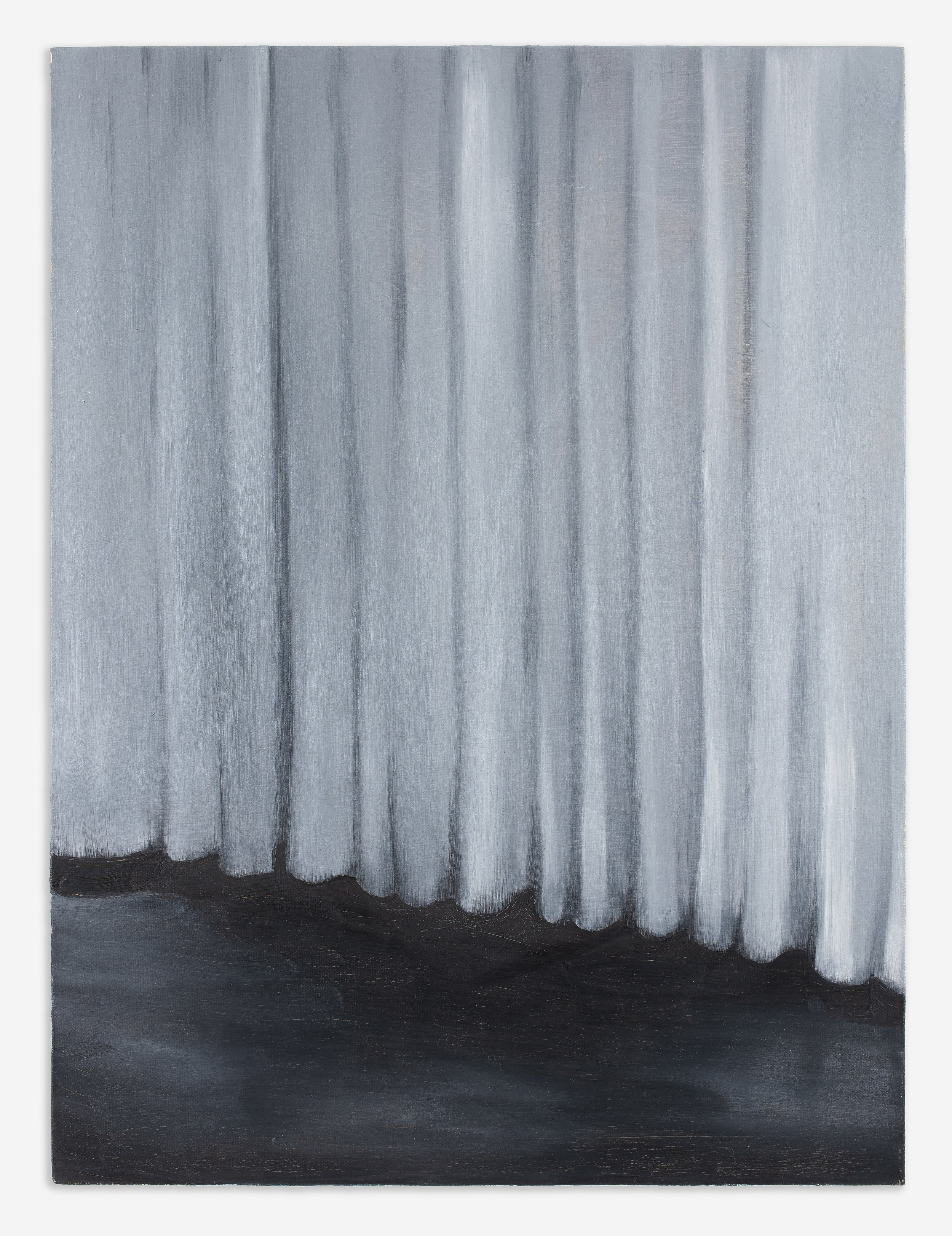
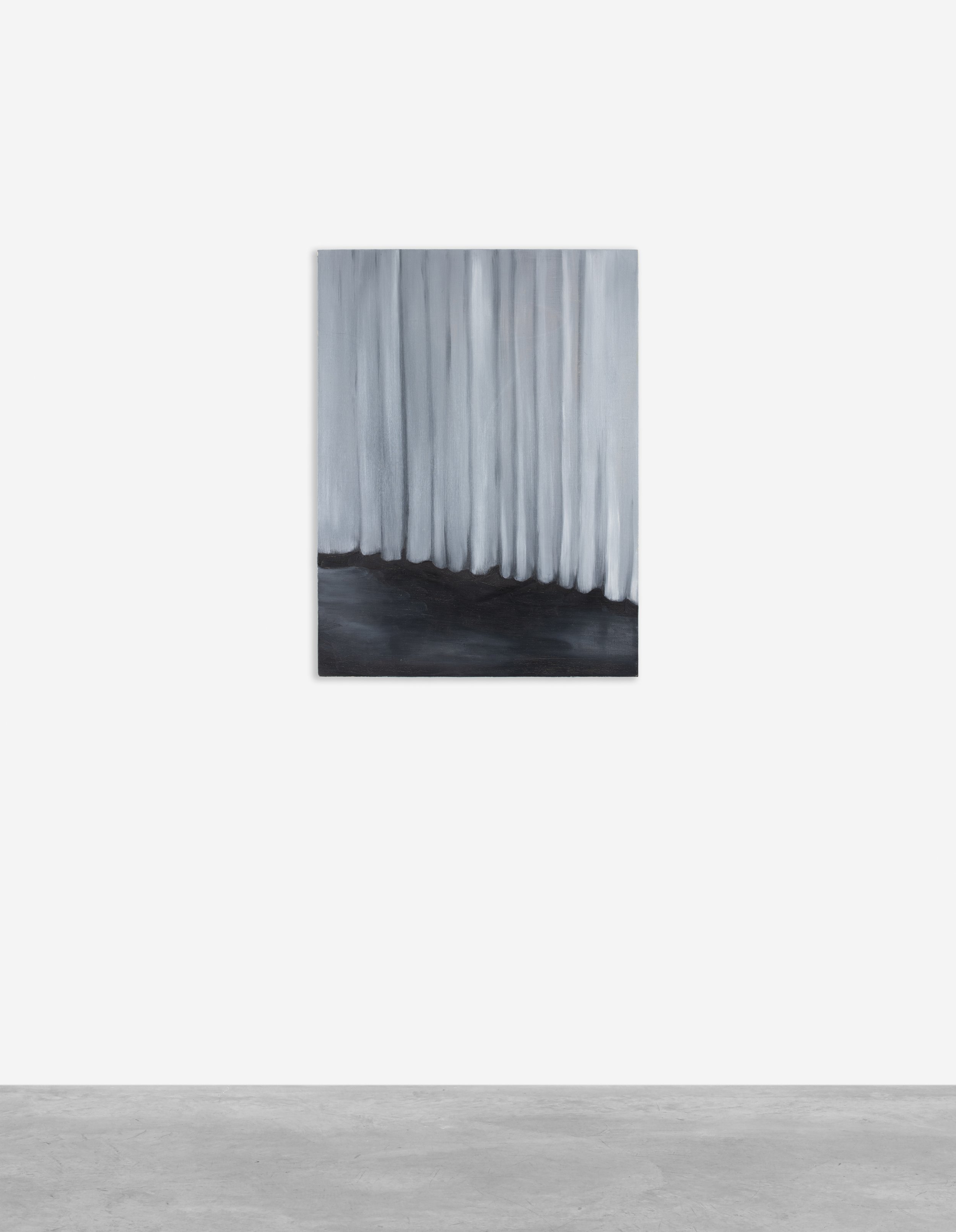
The surface of Stage rewards the kind of sustained looking that its subject, a theater curtain, itself demands from an audience before a performance begins. The linen weave is visible in the darker passages along the curtain's edges, where thin paint allows the ground to breathe through. In the center, where the burgundy deepens toward black, the paint has been built up in successive glazes, each one slightly warmer than the one beneath it, so that the darkest areas carry a faint ember of red that emerges only after the eye has adjusted. The folds are not described with contour lines. They are modeled by value alone, with the transitions between light and shadow occurring across surfaces that curve gently, the way real velvet or heavy wool would curve under its own weight. Tan Mu has described how she concealed a clepsydra, an hourglass-shaped water clock, within the curtain's folds. It can only be perceived from a certain angle, she has said, "much like time itself, which is invisible yet constantly present." The painting does not announce this hidden form. It waits for the viewer to find it, the way a stage waits for its audience to notice the set before the lights go down. This is not a puzzle painting in the manner of Holbein's anamorphic skull. The clepsydra is integrated so fully into the curtain's drapery that finding it becomes a secondary act of attention, a reward for looking long enough that the drapery stops being drapery and starts being time.
Rene Magritte's The Human Condition (1933) shows an easel placed in front of a window. On the easel stands a canvas that depicts the landscape beyond the window with such precision that the painting appears to complete the view, filling in the portion of the hillside that the easel itself obscures. The conceit is that the painting on the easel is indistinguishable from the landscape it covers. Magritte has removed the boundary between representation and the thing represented, or rather he has made that boundary the entire subject of the work. The viewer cannot tell where the window ends and the painting begins. The curtain in this painting, a red drape on the left side of the canvas, is the only element that refuses the illusion. It hangs in front of both the window and the easel, reminding the viewer that what they are looking at is a constructed scene, a staging of the problem of representation itself.
Tan Mu's Stage inverts Magritte's structure while preserving its central insight. Where Magritte places a painted landscape inside a real landscape and makes them continuous, Tan Mu places a curtain in front of an absence and makes that absence continuous with the painted surface. There is nothing behind the curtain in Stage except the dark gap between its two panels, and that gap reveals nothing. It is not a landscape waiting to be unveiled. It is not a performance about to begin. It is the simple, irreducible fact of concealment: something is behind the curtain, and the curtain will not rise to show what it is. The painting holds the viewer in the moment before revelation, the interval when the house lights have dimmed and the audience sits in expectant darkness, and it refuses to resolve that interval into the event that would follow. Magritte's curtain marks the boundary between the painted world and the real one. Tan Mu's curtain marks the boundary between two kinds of time: the time of the performance, which has a beginning, a middle, and an end, and the time of waiting, which has none.
The theater curtain has functioned as a threshold between two states of consciousness for as long as theaters have existed. In Greek drama, the curtain was not yet a curtain but a stage building, the skene, which served as a backdrop and a hiding place for actors between entrances. In Elizabethan theater, the discovery space behind the hangings allowed characters to be revealed rather than to enter. In the proscenium theaters that became standard in Europe after the seventeenth century, the curtain descended between acts and rose to signal their beginning, creating a rhythm of concealment and revelation that structured the audience's experience of narrative time. The French tragedians of the seventeenth century formalized this rhythm to an extraordinary degree. Racine's prefaces specify the precise moment when the curtain should rise and fall, treating the curtain as a compositional element as important as any line of verse. The curtain became the temporal architecture of the performance, dividing continuous time into the segments that narrative requires. The Drottningholm Palace Theatre in Sweden, preserved since 1766 with its original stage machinery intact, still operates a painted curtain that descends between scenes, and the descent of that curtain is as much a part of the drama as anything that happens in front of it. The curtain does not simply hide the stage. It produces the expectation of revelation. It manufactures suspense by creating a boundary between what the audience can see and what they know they are about to see. Without the curtain, the actors would be visible as they arrange themselves. The magic of the performance depends on the moment when the boundary is removed and the hidden becomes visible. The curtain, in other words, is the mechanism that converts time into narrative. Before the curtain rises, time is undifferentiated. After it rises, time has a shape. Tan Mu has described the theatrical curtain as "both a physical barrier separating the stage from the audience and a conceptual threshold between the real world and a fictional narrative." Her painting withholds the moment of crossing. The curtain stays closed, and time remains undifferentiated. The clepsydra hidden in the folds reinforces this. The water clock measures time without shaping it into narrative. It simply passes, the way time passes in a theater before the performance begins, or the way it passes in a life that has not yet arrived at its decisive event.
Li Yizhuo, in her catalog essay for the BEK Forum exhibition in Vienna, describes the experience of watching John Cage's Concert for Piano and Orchestra performed at the Musikverein, where "the conductor's alternating arms moving like clock hands and the musicians playing from boxes on two tiers left me mesmerized." The image of the conductor's arms moving like clock hands is precise: a figure marking time through gesture, the way a clepsydra marks time through water. Li Yizhuo draws a direct connection between this experience and the Signal series, where "each composition of lines and dots full of tension and anticipation" functions like a graphic score, a notation system that awaits interpretation. Her observation applies to Stage as well, though the score here is not a network of cables but a single curtain that conceals an unknown performance. The painting is full of the same tension and anticipation that Li Yizhuo identifies in the concert hall. The curtain is about to rise. The conductor's arms are raised. The clock is running. But the moment of resolution never arrives. The painting suspends the viewer in the interval before the event, and it is this suspension, this held breath, that gives the work its force.
Li Yizhuo's observation also illuminates the structural role of the hidden clepsydra. A water clock does not measure time by marking beginnings and endings the way a theatrical curtain does. It measures time by the steady flow of water from one chamber to another, a continuous process that has no narrative arc. By concealing a clepsydra within the drapery of a theatrical curtain, Tan Mu creates a tension between two temporal systems: the narrative time of the theater, which operates by concealment and revelation, and the continuous time of the water clock, which operates by accumulation and flow. The clepsydra is one of the oldest timekeeping devices in human history. The Egyptians used water clocks as early as 1500 BCE, and the Greeks refined them into precision instruments capable of measuring the duration of speeches in court. The water clock does not require sunlight, which made it useful for measuring time at night or indoors, in precisely the kind of enclosed, darkened space where a theater curtain hangs. Tan Mu's decision to hide a clepsydra rather than a mechanical clock or a digital timer is deliberate. The water clock shares something with painting: it measures duration through a physical medium that flows at a rate determined by gravity and the shape of its container. It is an analog instrument in a digital age, and its presence behind the curtain connects the painting to a pre-mechanical understanding of time as something that flows rather than something that ticks. The curtain divides time into before and after. The clepsydra tells the viewer that time was already flowing before the curtain existed and will continue flowing after it has fallen. The painting holds both systems in the same visual field, and the tension between them is what gives the burgundy surface its depth. The curtain is not merely a surface. It is a membrane between two orders of time, and the clepsydra is the instrument that measures the time on the other side of that membrane, the time that continues whether or not anyone is watching.
The process by which Stage came into being is itself a meditation on translation and time. Tan Mu has described the work's origin: a black-and-white film photograph, taken about a decade before the painting, also titled Stage. She later transformed that image into a print and eventually into an oil painting. Each medium imposed its own conditions. The photograph captured the curtain in the tonal range of black-and-white film, with the grain and contrast inherent to the chemical process. The print flattened that tonal range into a reproducible matrix, a set of marks designed to be multiplied. The painting reintroduced color, texture, and the thickness of oil on linen, adding information that the photograph and the print could not hold. Tan Mu has described printmaking as "an art form centered on process, layering, and repetition," linked historically to "the evolution of communication" from woodblock to digital media, each development marking "a shift not only in artistic practice but also in how information was disseminated." The journey from photograph to print to painting is not merely a change of materials. It is a progression through increasingly intentional forms of mediation, each one adding a layer of human decision between the original scene and the final image. The photograph captures what the lens saw. The print translates that capture into a reproducible code. The painting translates the code back into a unique object that carries the memory of both previous iterations in its surface. Tan Mu has said that "moving the image across different mediums allowed me to revisit it from multiple perspectives and uncover layers of meaning that were not immediately visible before." This is not a casual statement about workflow. It is a description of how time accumulates in an image. The photograph is a moment. The print is that moment multiplied. The painting is that moment plus the years of looking that transformed it from a document into a meditation. The clepsydra hidden in the folds is not only a symbol of time's passage. It is the record of the time the artist spent translating the image from one medium to another, each translation adding a layer of duration to the surface. The curtain in the painting is not the curtain in the photograph. It is the curtain plus the decade of attention that has been folded into its drapery.
The hidden clepsydra also connects Stage to a pattern that runs through Tan Mu's entire body of work: the embedding of invisible systems within visible surfaces. The submarine cable paintings bury their subject under thousands of meters of ocean, visible only as colored lines and access points on a dark ground. The MRI paintings show the interior of the brain, a structure that no eye can see without technological mediation. The Quantum Computer paintings depict the exterior of a cryostat, a machine whose essential activity, the quantum behavior of superconducting qubits, occurs at a scale and temperature that no human perception can register. In each case, the painting shows the container and asks the viewer to understand what the container holds. Stage works the same way. The curtain is the container. The clepsydra is what it holds. The difference is that the clepsydra is not a technological system but a temporal one, and its concealment is not the result of physical scale or electromagnetic shielding but of the deliberate choice to hide time inside fabric. This choice transforms the painting from a depiction of a curtain into an argument about what curtains do: they conceal, they mark thresholds, and they impose a temporal structure on the experience of looking. The clepsydra makes that structure explicit without making it visible, which is precisely what a curtain does to the performance it conceals.
Stage occupies a distinctive position within Tan Mu's practice. Most of her paintings depict systems that operate at scales far beyond the body: submarine cable networks spanning oceans, quantum processors operating at near absolute zero, MRI machines rendering the brain's interior visible. Stage depicts a system that operates at the scale of a room: a curtain, a stage, an audience, and the time that passes between them. It is the most domestic of her subjects, the one closest to ordinary human experience, and yet it enacts the same structural logic that animates the larger works. The submarine cable paintings depict networks that transmit information across invisible channels. The MRI paintings depict technologies that make the invisible interior of the body visible. Stage depicts a curtain that conceals an unknown space and a water clock that measures the time that passes in that concealment. In every case, the painting is not about the thing itself but about the boundary that separates the visible from the invisible, the known from the unknown, the present from the future. The photograph that began the process was a document of a particular curtain in a particular theater. The print multiplied that document into a reproducible image. The painting, the final iteration, transformed the document into something that no longer needs the theater it came from. It has become a curtain that exists only on canvas, a curtain that will never rise, behind which time flows without narrative, measured by a clock that only the patient viewer will find. The stage remains empty. The performance has not begun, and the curtain is the performance.