The Brain Outside the Skull: Tan Mu’s Memory and the Building That Remembers for Us
When Tan Mu surfaced from a freedive, her vision faded to blankness. The blackout was brief, a few seconds at most, but in those seconds she could not access her own memories. When consciousness returned, she described the experience as her mind rebooting, as though the self were a machine that had been powered down and restarted. She spent the following month in her studio asking a question that most people never need to ask explicitly: Who am I? The question was not philosophical. It was neurological. A temporary interruption in oxygen supply had demonstrated, in the most direct way possible, that identity is not a fixed essence but a function of memory, and that memory is not a permanent archive but a fragile biological process that can be suspended and restarted like a computer recovering from a crash. The painting that emerged from this experience, Memory (2019), is a triptych that depicts not the content of memory but its architecture, not what we remember but where memory goes when we entrust it to systems larger than ourselves.
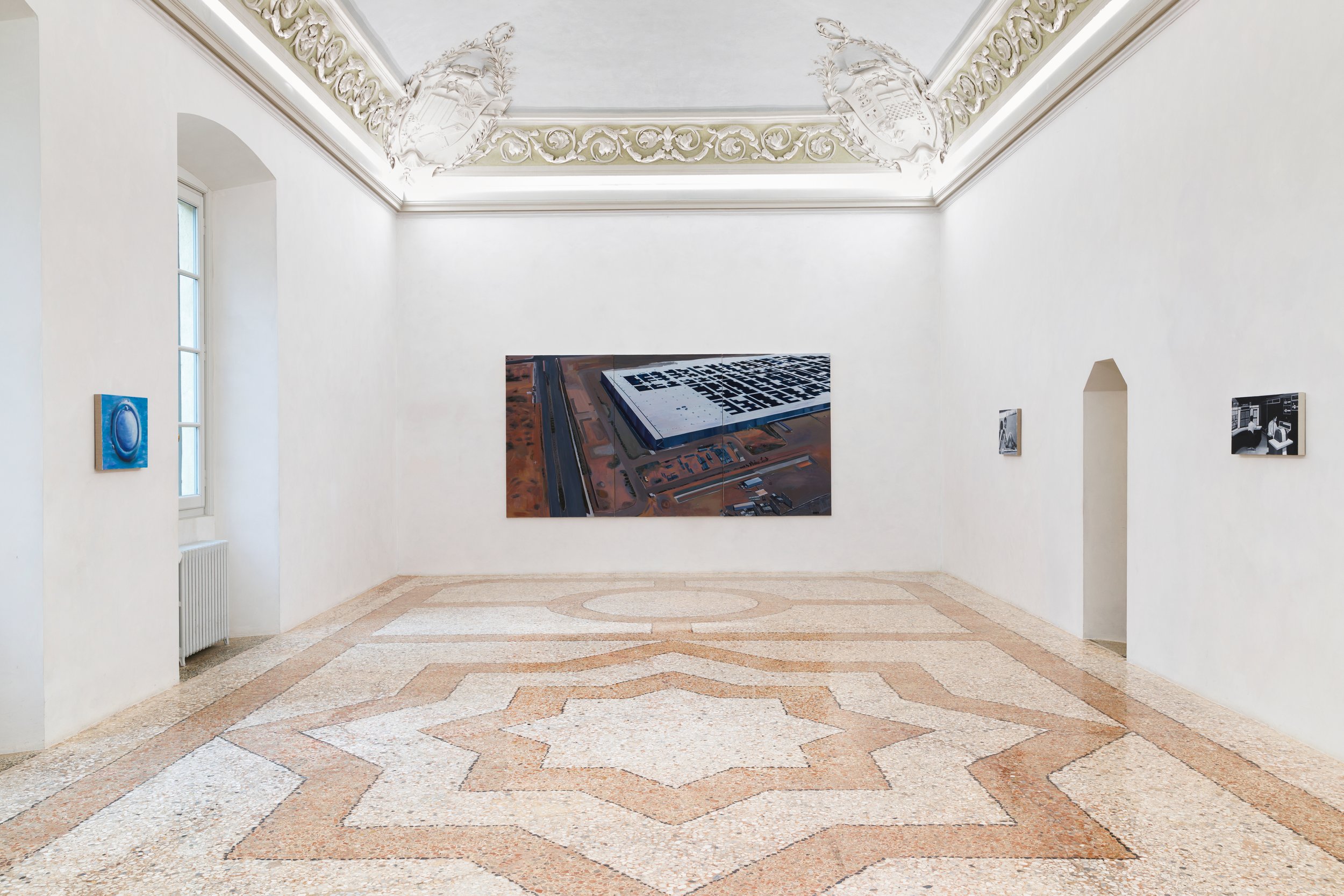
Memory is oil on linen in three parts, each panel measuring 183 x 122 cm (72 x 48 in), with an overall dimension of 183 x 366 cm (72 x 144 in). The scale is significant. Each panel is large enough to stand in front of, and the three panels together create a horizontal expanse that the eye must travel across, reading left to right the way it would read a sentence or a data stream. The left panel shows a field of small, irregular marks distributed across a dark ground, marks that could be stars, could be data points, could be neural connections, could be any of the distributed nodes that appear throughout Tan Mu's practice. The center panel shows a more structured composition: rows of illuminated rectangles arranged in a grid, each one a warm point of light against a cooler dark ground, the unmistakable visual signature of a data center seen from the front, its server racks glowing with the amber and blue indicator lights of active processing. The right panel returns to the field of distributed marks, but these marks are denser and more interconnected than those in the left panel, as though the network has thickened, the connections have multiplied, and the system has grown more complex between the first panel and the last. The progression from left to right enacts the painting's argument: from dispersed and isolated points to an organized grid and then back to dispersed points that are now connected, as though memory has moved from a state of fragmentation through a state of organization and into a state of reconstituted complexity.
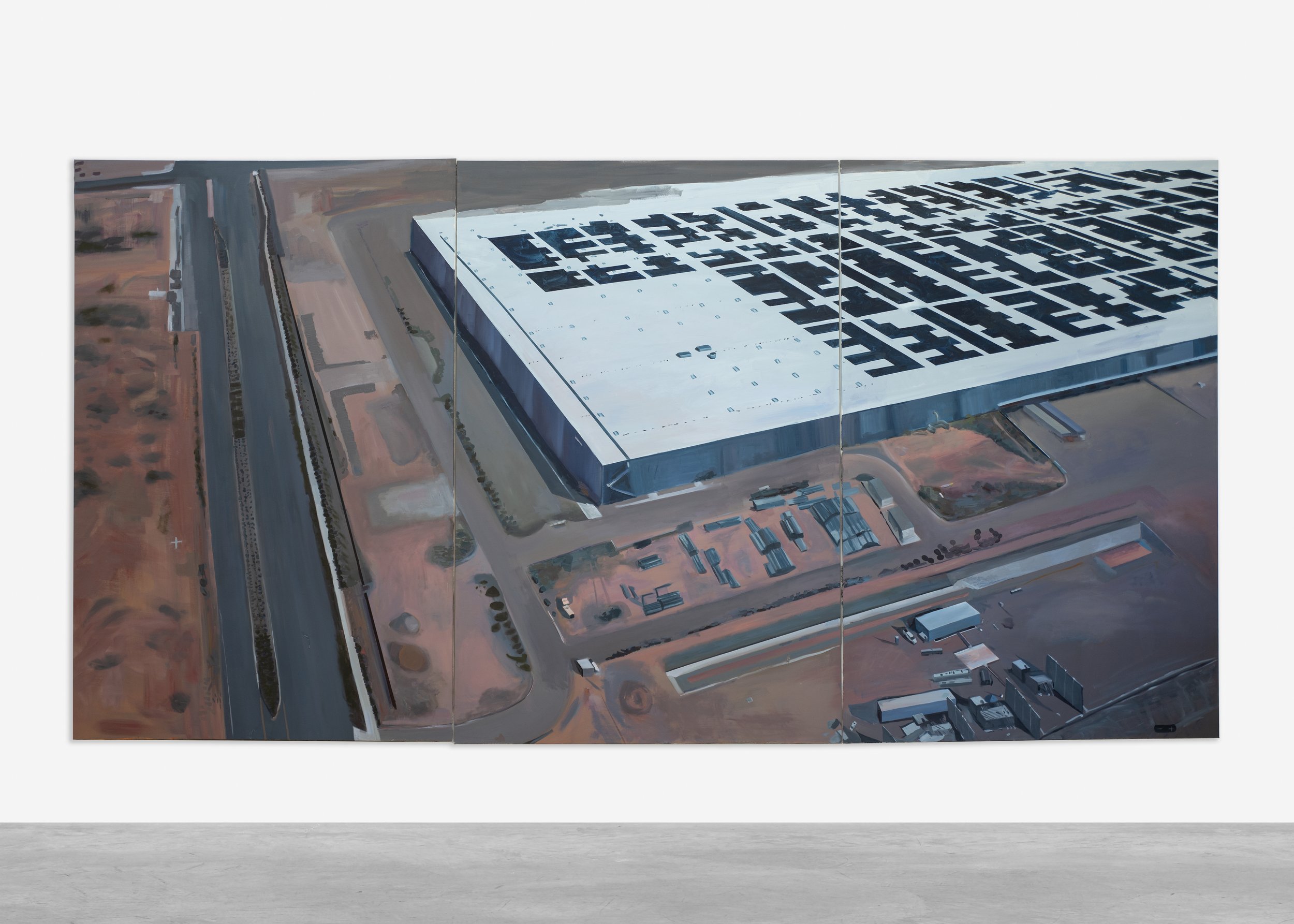
The surface of each panel in Memory is built on the same principle that governs Tan Mu's Signal paintings: the access points, the small marks that represent nodes in a network, are rendered in thick, wax-heavy oil paint that sits above the surrounding surface, creating a physical protrusion that catches gallery light and makes each point a tangible object rather than a mere mark on a flat ground. In the left panel, these points are sparse and isolated, separated by wide expanses of dark paint that suggest the empty spaces between unconnected neurons or between data points that have not yet been linked by a network. The ground in this panel is a deep blue-black, applied in thin layers that allow the linen weave to show through in places, giving the dark areas a warmth and texture that pure black would lack. In the center panel, the ground shifts to a denser, more opaque black that absorbs light rather than reflecting it, creating the visual effect of a server room seen in near-darkness, where the only illumination comes from the indicator lights on the machines. The right panel returns to the warmer ground of the left, but the marks are now connected by lines of varying thickness that suggest both neural pathways and fiber-optic cables. The progression from sparse to dense to interconnected is not only compositional. It is material. The paint thins where the network is still forming and thickens where the connections have been established, as though the painting's surface is itself a carrier that becomes more substantial as more information passes through it.
Thomas Struth's museum photographs, particularly his Musee du Louvre 4 (1989), depict crowds of visitors standing before paintings in the galleries of the world's great museums. The paintings are visible on the walls, but the subject of the photograph is not the paintings. It is the act of looking at paintings, the collective ritual of gathering in a dedicated space to engage with objects that hold the memory of a culture. Struth's museums are memory institutions in the most literal sense: buildings designed to preserve and display the artifacts that a civilization has decided are worth keeping. The museum organizes memory. It selects, catalogues, restores, and presents, and in doing so it makes decisions about what is remembered and what is forgotten. The crowd in a Struth photograph is not merely an audience. It is a congregation of individuals who have come to a specific building to access a specific kind of memory, the kind that is stored in pigment and canvas and bronze, and their presence in the photograph is evidence that the institution is functioning as intended: people are coming to it to remember. The museum, in Struth's hands, is not a neutral container. It is an active agent in the construction of cultural memory, deciding through its selections and its arrangements what the public will see and therefore what the public will know. The architecture of the museum, with its galleries, its lighting, its circulation paths, and its benches for contemplation, is designed to facilitate the encounter between the viewer and the object. Every element of the museum experience, from the climate control that preserves the paintings to the labels that provide context, exists to make memory accessible to the living.
Tan Mu's Memory proposes a different kind of memory institution. The data center, which occupies the center panel of the triptych, is also a building designed to preserve and store, but what it preserves is not pigment on canvas. It is digital information: photographs, emails, financial records, social media posts, location data, search histories, the ceaseless outpouring of human activity that is now encoded in binary and stored in rows of servers stacked in climate-controlled rooms. The data center does not curate. It does not select. It stores everything, or as close to everything as its capacity allows, and it makes that stored information available on demand through networks that operate at speeds no museum can match. The museum preserves the artifacts that a culture has deemed significant. The data center preserves the artifacts that a culture has produced, significant or not. Struth's museum photographs ask the viewer to consider what it means to look at paintings together in a room. Tan Mu's Memory asks the viewer to consider what it means to store the totality of human output in a building that no one visits, a building that has no galleries and no crowds, only rows of humming machines that remember on our behalf.
The parallel between biological and technological memory that Memory enacts is not metaphorical. Tan Mu has described how her personal experience of memory loss, the blackout after the freedive, led directly to the painting's creation. "In my studio, I spent a month pondering, 'Who am I?' Unable to access personal memories, I turned to carriers of memory, creating works like Memory (2019)." The phrase "carriers of memory" is precise. A carrier is not a metaphor for memory. It is a substrate that holds memory, the way a hard drive holds data or a synapse holds a neural trace. When Tan Mu's oxygen-deprived brain temporarily suspended access to her memories, she did not conclude that memory is unreliable, although it is. She concluded that memory requires a carrier, and that when one carrier fails, another can be found. The data center is the carrier she found. Its rows of illuminated servers are the externalization of a function that her brain performs internally, and the triptych format allows her to place these two modes of memory, the biological and the technological, in the same visual field, side by side, without privileging one over the other. The left panel is the brain before the network. The center panel is the network. The right panel is the brain after the network, reconstituted through the externalized memory that the center provides.
The data center as a building type is younger than most of the people who use it. The first facility that could be called a data center in the modern sense was built by IBM in 1946, but the term itself did not enter common usage until the 1990s, when the expansion of the internet created a demand for centralized computing infrastructure that could house servers, storage systems, and networking equipment in climate-controlled environments. By 2019, when Tan Mu painted Memory, data centers had become one of the largest building types on the planet by energy consumption, and their visual signature, rows of illuminated servers in dark, climate-controlled rooms, had become as recognizable as the visual signatures of earlier memory institutions: the reading room of the library, the gallery wall of the museum, the vault of the archive. The data center differs from all of these predecessors in one crucial respect: it is not designed to be visited. The museum invites the public. The data center excludes it. The servers hum in rooms where no one but maintenance personnel ever go, and the memory they hold is accessed remotely, through cables and wireless signals, at speeds that make the physical visit unnecessary. This is the building at the center of Tan Mu's triptych: a memory institution with no public, an archive with no reading room, a library where the books are read by machines rather than by human eyes. It remembers on our behalf, and we never enter it.
The structural parallel between neural memory and data center memory runs deeper than analogy. When a memory is formed in the human brain, it passes through a process called consolidation, in which the hippocampus temporarily holds the memory before transferring it to the neocortex for long-term storage. This transfer happens primarily during sleep, when the brain replays the day's experiences in compressed form, strengthening the synaptic connections that encode each memory so that it can be retrieved without relying on the hippocampus. When consolidation fails, as it can during oxygen deprivation, trauma, or the onset of degenerative conditions, the memory either never reaches the neocortex or reaches it in a degraded form, and the result is the kind of gap that Tan Mu experienced after the freediving blackout: a period of personal history that simply is not there, as though a file had been deleted before it could be backed up. The data center performs the same function by different means. Data that exists only on a local device is like a memory held in the hippocampus: vulnerable to loss if the device fails. When that data is synced to a server in a data center, it undergoes a technological version of consolidation: it is copied, indexed, and distributed across multiple storage systems so that it can be retrieved even if the original device is destroyed. The data center does not replace the brain. It extends the brain's storage capacity and provides a redundancy that the brain alone cannot offer. The triptych format of Memory makes this structural parallel visible. The left panel is the unconsolidated memory, fragile and fragmented. The center panel is the consolidation mechanism, the external system that receives, stores, and indexes. The right panel is the reconsolidated memory, richer and more interconnected than the original because it has passed through the external system and emerged with new connections that the isolated brain could not have made on its own.
Nick Koenigsknecht, writing in his essay "Alone, Together / Locals, Everywhere" for the BEK Forum catalog, observed that Tan Mu's technological paintings "function more as self portraits, rather than depictions of external, scientific milestones." The observation is acute and it applies to Memory with particular force. The data center in the center panel is not a depiction of an external object. It is a self-portrait of a mind that has experienced the failure of its own memory and has rebuilt itself by turning to an external carrier. The rows of glowing servers are not servers. They are the neural pathways that Tan Mu's brain could not access during the blackout, reconstructed in paint on a surface that can hold them permanently. The triptych format enacts the structure of the experience: before the crash, during the rebuild, after the reconnection. The left panel is the fragmented self. The center panel is the external memory that makes the self possible. The right panel is the self reconstituted through the carrier. Koenigsknecht's insight that the technological paintings are self-portraits, not depictions, resolves a question that Memory poses but does not explicitly answer: why is the painting called Memory when it shows a data center? It is called Memory because the data center is the site where Tan Mu's memory was rebuilt. It is not a painting about a building. It is a painting about what happens when the building becomes the brain.
Tan Mu has described the concept of "the fabric of memory" as the central framework of this body of work, a concept that "examines how technology reshapes the ways we preserve, distort, and recall memory." The word "fabric" is chosen with care. A fabric is woven from individual threads into a connected whole. It is not a container that holds memory. It is the structure that memory takes when biological and technological carriers are interwoven. The left panel of Memory shows threads that have not yet been connected. The center panel shows the loom, the data center, the mechanical structure that makes connection possible. The right panel shows the fabric after it has been woven, the network of interconnected points that is denser and more complex than the isolated dots of the first panel. This is the trajectory of the triptych: from fragmentation through structure to reconstituted complexity, and the data center is the mechanism that makes the final state possible. The fabric metaphor also explains why the painting refuses to privilege one mode of memory over the other. The brain and the data center are both carriers. They are both subject to corruption, loss, and failure. "Data can be lost or corrupted, just as human memory can fade, distort, or fragment over time due to trauma or the passage of years." Tan Mu has stated this equivalence explicitly, and the triptych's structure embodies it: the left panel is as much a depiction of failed technological memory as it is of failed biological memory, and the right panel is as much a depiction of biological reconnection as it is of data retrieval. The fabric is not woven from one kind of thread. It is woven from both, and the painting's achievement is to make the two kinds of thread visually indistinguishable. The dots in the left panel could be neurons or data points. The grid in the center could be synapses or servers. The network in the right panel could be a neural pathway or a fiber-optic cable. The viewer cannot tell the difference, and the inability to tell the difference is the painting's argument: there is no difference, or rather, the difference is not what matters. What matters is the connection.
The scale of Memory, 183 x 366 cm overall, places the viewer in a specific relationship to the painting. The three panels are large enough that the viewer must walk along them to see the whole, and walking along them reproduces the left-to-right trajectory that the composition describes. This is not a painting that can be taken in at a glance. It demands duration, and the duration it demands is the same duration that the act of remembering requires. Memory is not instantaneous. It unfolds across time, one fragment leading to the next, one connection triggering another, until a self reconstitutes itself from the dispersed material of its own past. The triptych format, which has its origins in altarpieces designed to be read in sequence from left to right, provides the structural model for this temporal unfolding. The viewer walks from the fragmented left panel through the organized center to the reconstituted right panel, and the walk is the act of remembering. The data center at the center is not merely the mechanical intermediary between fragmentation and reconnection. It is the altar at which the memory is stored, the institution that makes the reconnection possible. And the triptych itself, three large panels of oil on linen, is the carrier that Tan Mu built when the carrier inside her skull failed. She could not access her memories, so she painted a building that could.