The White Cube That Closed: Tan Mu’s Isolation and the Exhibition Hall That Became a Hospital
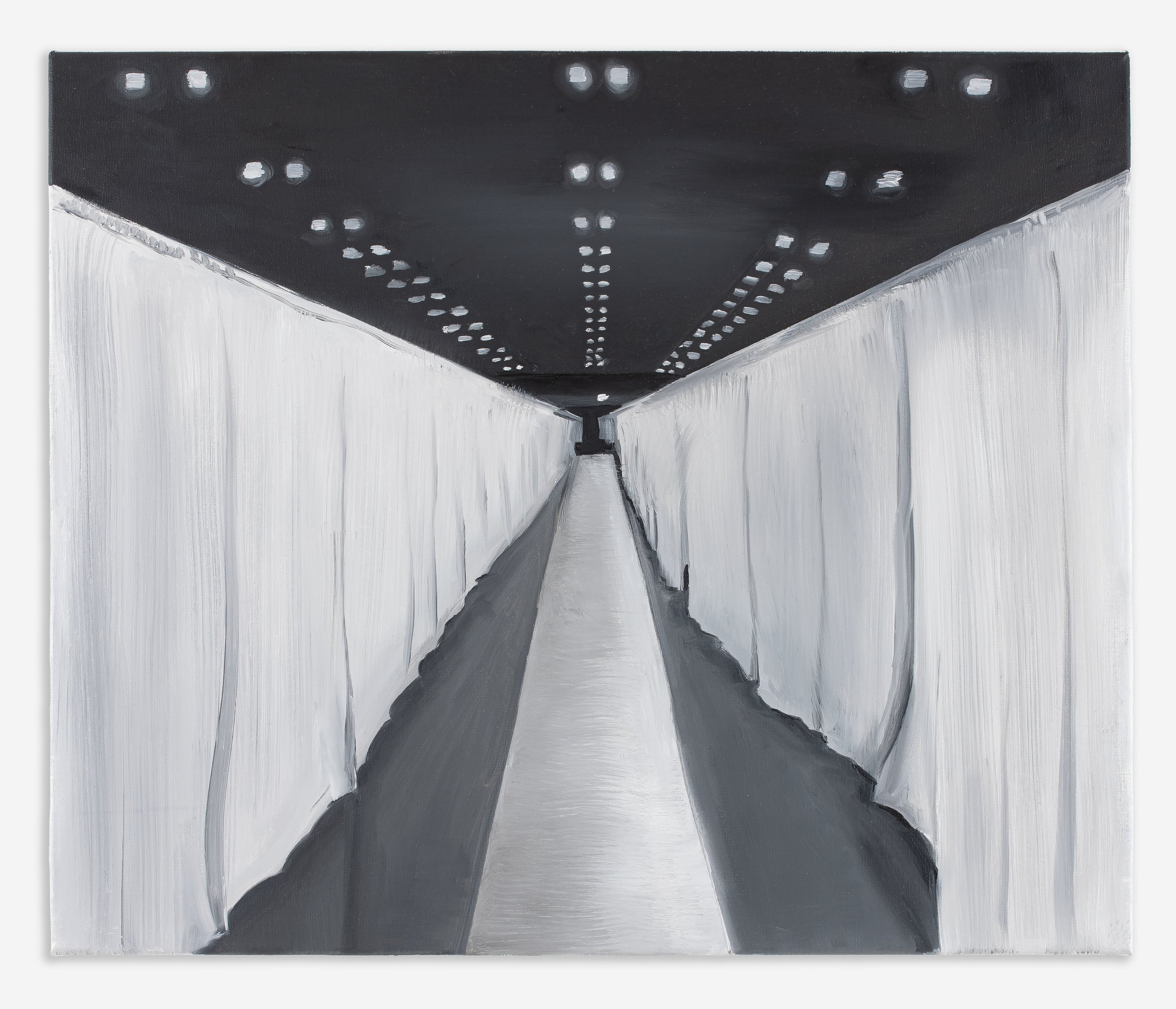
In March 2020, the Jacob K. Javits Convention Center on the west side of Manhattan, a glass-walled exhibition hall of 840,000 square feet that had hosted the International Auto Show, the Armory Show, the Functional Fabric Fair, and the Cannabis World Congress and Business Expo, was converted into a temporary field hospital in response to the surging COVID-19 pandemic. The transformation took six days. Army National Guard units installed interior partitions, laid flooring over the concrete, and erected a network of white curtains that divided the vast open floor into individual patient bays, each one separated from its neighbors by the same material that had previously been used to delineate trade show booths. Within a week, the building that had been designed to gather thousands of people into a single space for commerce, art, and entertainment was reorganized around the principle of keeping people apart. Tan Mu witnessed this transformation from her studio in downtown Manhattan. She had exhibited at the Javits Center herself. The building she knew as a space of public assembly, where crowds moved freely between booths and galleries, became a space of enforced separation, where each person occupied a discrete unit defined by white fabric walls. Isolation (2020) is the painting that records this reversal.
Isolation is oil on linen, 51 x 61 cm (20 x 24 in), a horizontal format that suits its subject: a wide interior space receding toward a central vanishing point. The composition is divided into two halves by a corridor that runs from the foreground to a distant vanishing point at the center of the image. On either side of this corridor, white curtains hang in vertical folds, creating a series of enclosed bays that recede in perspective toward the back of the hall. The curtains are painted in shades of white and pale grey, with the folds catching an overhead light source that is never depicted but is suggested by the gradation from bright at the top of each panel to shadowed in the folds. The floor is rendered in a cool grey that darkens toward the edges of the canvas, suggesting the vast concrete expanse of the Javits Center floor under fluorescent lighting. The corridor itself is the darkest passage in the painting, a narrow band of near-black that contracts as it recedes, drawing the eye toward a point that is almost but not quite a true vanishing point. The black at the end of the corridor is not an absence of detail. It is an accumulation of distance, the way a long interior corridor appears to darken as it recedes from the viewer because less light reaches its farthest reaches. The overall palette is monochrome: blacks, whites, greys, with no color to relieve the austerity. This is not a choice of style. It is a choice of subject. The Javits Center, in its hospital configuration, was a monochrome space. The curtains were white. The floor was grey. The light was fluorescent. The people, if there were any visible, would have been in medical gowns, also white. Tan Mu painted what she saw, and what she saw was a building that had been drained of the color of its former life.
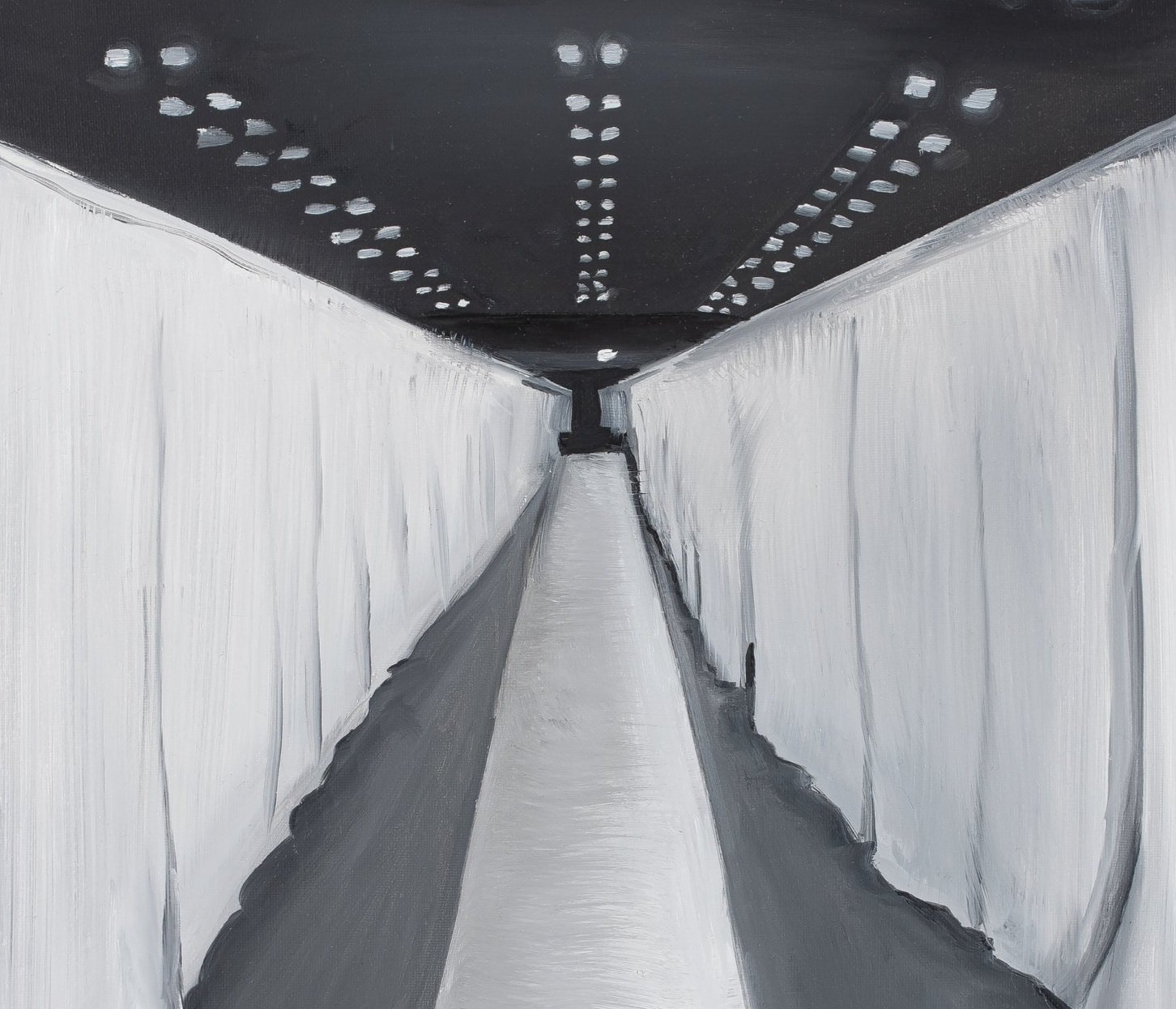
The surface of Isolation is notable for the contrast between the corridor and the curtains. The corridor is painted thinly, with the linen weave visible beneath a transparent wash of black and dark grey that allows the texture of the fabric to function as the texture of a concrete floor seen at a distance. The curtains are painted more thickly, with individual folds built up through overlapping strokes of white and pale grey that create a ridged, almost tactile surface. This difference in paint handling is not accidental. The corridor is the space of passage, the route through which medical staff and equipment would have moved. It is the space of function, and its thin, functional paint application mirrors the speed and efficiency with which the corridor was constructed. The curtains are the space of habitation, the partitions behind which patients would have lay, and their thicker, more deliberated paint application mirrors the care and time that went into rendering the fabric's weight and drape. At the intersection of corridor and curtain, where the white panels meet the dark passage, Tan Mu has allowed the paint to thin to a single layer, so that the boundary between the two spaces is marked not by a hard line but by a transition in paint density that echoes the way light bleeds from a bright room into a dark hallway. The vanishing point at the center of the composition is not a dot but a convergence, the place where two lines of perspective, two walls of curtains, and the floor and ceiling of the corridor all meet at a point that is too far away to resolve into detail. The painting asks the eye to travel toward that point and then refuses to deliver a destination.
Gordon Matta-Clark's Splitting (1974) involved cutting a suburban house in Englewood, New Jersey, down its center, bisecting the roof, the walls, and the floors, and then removing a thin slice of material from the cut so that light could pass through the gap. The result was a house that no longer functioned as a house but that revealed, through its destruction, the interior structure that had previously been invisible: the wall cavities, the joists, the lath and plaster, the layers of construction that a house conceals behind its finished surfaces. Matta-Clark called these works "anarchitecture," a term that described both his method of cutting into existing structures and his critique of the architectural conventions that produced them. The cut in Splitting did not merely damage the house. It transformed it from a container of domestic life into a lens through which the viewer could see the mechanisms of containment. The house became transparent in the exact place where it had been most solid, and the transparency was not gentle. It was a wound that exposed the interior to weather, to light, and to the gaze of anyone standing outside. Matta-Clark documented the work in photographs and film, and then the house was demolished. The cut survived only in documentation, which meant that the experience of walking through the bisected house, looking up through the gap in the roof at the sky, existed only as a trace, a set of images that pointed toward a physical experience that could no longer be had.
Tan Mu's Isolation performs a related operation in reverse. Where Matta-Clark cut open a domestic structure to reveal its interior, Tan Mu documents a public structure that has been closed. The Javits Center, in its exhibition configuration, was the opposite of a house: a space defined by openness, by the free movement of large crowds through a single undivided hall. Its glass walls and high ceilings were designed to make the interior visible from the outside and to make the outside visible from the inside. The building's architecture was an architecture of transparency and gathering. When it was converted into a hospital, that transparency was replaced by a grid of white curtains that divided the open floor into enclosed units. The building was not cut open. It was partitioned. The principle of its design, which was to bring people together, was replaced by the principle of keeping people apart. Tan Mu's painting records this reversal with the same forensic precision that Matta-Clark brought to his cuts. The corridor that runs through the center of the composition is the wound that reveals the interior, but the wound here is not an opening. It is a passage between two walls of partition, and the partitions are what define the space. The building has not been opened. It has been subdivided, and the subdivision has turned an architecture of assembly into an architecture of isolation.
The Javits Center was not the only exhibition hall converted to medical use during the pandemic. The ExCel Centre in London, the IFEMA fairground in Madrid, the RDS in Dublin, the Makuhari Messe convention hall outside Tokyo: all over the world, the same type of building, the large, flat-floored, column-free exhibition hall, proved to be the ideal structure for rapid conversion into a temporary medical facility. The reason was simple. Exhibition halls are designed for maximum flexibility. They have no fixed seating, no permanent interior walls, and floor loads rated for heavy equipment. They can be configured and reconfigured within days to suit any purpose, from auto shows to art fairs to, in a crisis, hospital wards. This flexibility, which is their commercial virtue, became their civic utility. But the speed and ease of the conversion also revealed something unsettling about these buildings: they are so generic, so devoid of specific character, that they can be repurposed for the opposite of their intended function without any structural modification at all. The same floor that hosted the International Auto Show could host rows of hospital beds because neither use required any permanent alteration to the building itself. The architecture of the exhibition hall is, at its core, an architecture of interchangeability. It is designed to be anything, which means it is designed to be nothing in particular. Tan Mu's painting captures this neutrality with ruthless clarity. The white curtains, the grey floor, the fluorescent light: none of these belong specifically to a hospital or to a trade show. They belong to the condition of the generic interior, the space that can become anything because it is already nothing.
Danni Shen, in her studio visit with Tan Mu for Emergent Magazine, observed that the paintings "serve as a kind of witness to human socio-technological histories," documenting "the trajectory and continuum of bodily and mediated presence through human technical developments." Shen also noted Tan Mu's description of her process of sourcing images, which "often involves a relatively lengthy cycle" beginning with a current event that leads "to the exploration of that event within a particular clue," a process she describes as "a retrospective journey." This observation acquires a specific resonance in Isolation. The Javits Center is a socio-technological structure: a building designed to facilitate the commercial exchange of goods and ideas, equipped with the electrical, HVAC, and telecommunications infrastructure required to support large-scale public events. When that infrastructure was repurposed for medical use, the technical systems that served exhibition booths, the power drops for display lighting, the data ports for live streaming, the air handling for crowded spaces, were the same systems that could be redirected to support ventilators, patient monitors, and negative-pressure isolation rooms. The building's technical infrastructure did not change. Only the use changed. Shen's phrase "the trajectory and continuum of bodily and mediated presence" describes exactly what the Javits Center enacted in March 2020: the same infrastructure that had mediated the presence of bodies at trade shows was repurposed to mediate the presence of bodies in medical distress. The trajectory was continuous. The building never stopped mediating. It merely switched from mediating commerce to mediating care, and the white curtains that divided the floor into bays were the physical evidence of that switch, the partitions that converted a space of gathering into a space of isolation without altering the building's essential structure at all.
Tan Mu's decision to render this scene in monochrome is not merely a matter of documentary fidelity, although the Javits Center in its hospital configuration was, as she has noted, essentially a monochrome space. The absence of color serves the same function it serves in her nuclear test paintings and her early works like No Signal (2019) and Off (2019): it strips the image of the particularities that would tie it to a specific moment and allows it to operate as a structural condition rather than a documentary record. The Javits Center, rendered in color, would be recognizable as a specific building in a specific city during a specific crisis. Rendered in monochrome, it becomes any large interior that has been subdivided into units of isolation. The white curtains could be hospital partitions, trade show dividers, office cubicle walls, or the partitions of a refugee processing center. The corridor could be a hospital hallway, a convention center aisle, a prison corridor, or the central passage of any large institutional space organized around the logic of division and flow. By removing color, Tan Mu removes the specific and retains the structural. The painting is no longer about the Javits Center. It is about the white cube itself, and about the ease with which a space designed for gathering can be repurposed for separation.
The vanishing point at the center of the composition is the painting's most potent formal device. In Renaissance perspective, the vanishing point is the place where the viewer's eye is supposed to rest, the destination toward which all lines of sight converge. It creates the illusion of depth and draws the viewer into the painted space. In Isolation, the vanishing point performs the opposite function. It draws the eye toward a destination that cannot be reached. The corridor narrows as it recedes, and the darkness at its end is not a place where something is waiting to be seen. It is a place where vision fails, where the light no longer reaches, where the space itself becomes too distant and too compressed to resolve into detail. The viewer is drawn into the painting and then refused at the point of maximum depth. This is the spatial equivalent of the isolation the painting depicts. The corridor promises a destination and then withholds it. The white curtains promise community, the way exhibition booths promise gathering, and then they enclose instead. The architecture of the exhibition hall promises openness and then partitions itself into cells. The painting holds the viewer in the space between the promise and its reversal, and the vanishing point is where the reversal becomes explicit: the space that was designed to be traversed is now a space that leads nowhere.
Tan Mu has noted that after the pandemic, she returned to the Javits Center to participate in the Armory Show. "Returning to that space felt like a continuation of my artistic investigation," she has said. "The building itself had accumulated layers of history, and my work became a way of recording the transformations it had undergone." This return to the site after its transformation is significant. It means that Isolation is not a painting made in the heat of crisis but a painting made in the aftermath of a crisis that the building still carries in its walls. The Javits Center is the same building it was before March 2020. The white curtains are gone. The floor has been cleaned. The exhibition schedule has resumed. But the memory of what the building became, and the speed with which it became it, is now part of its architectural identity. A building that can be converted from an auto show to a hospital in six days is a building whose function was always provisional, whose openness was always conditional, and whose white walls were always capable of serving as partitions between people as easily as they served as backdrops for products. Isolation records the moment when that provisionality became visible, when the white cube revealed that it had always been a container waiting to be filled with whatever the city required, and that what the city required, in March 2020, was separation.