The Page That Foretold the Machine: Tan Mu’s The Note G and the Woman Who Saw Beyond Calculation
In the summer of 1843, a twenty-seven-year-old woman named Ada Byron King, Countess of Lovelace, sat at a desk in her London home and wrote a series of annotations to a paper by the Italian military engineer Luigi Federico Menabrea. The paper was a description of Charles Babbage's Analytical Engine, a proposed mechanical computer that had not yet been built and would never be built in Babbage's lifetime. Lovelace's annotations, which she called Notes A through G, were longer than the paper they accompanied, and Note G, the final and longest, contained what is now recognized as the first published algorithm intended to be carried out by a machine. The algorithm calculated Bernoulli numbers using the Engine's hypothetical operations. It was not a formula. It was a sequence of steps, a procedure, a set of instructions that a machine could follow without human intervention. In the same note, Lovelace made an observation that extended far beyond the calculation at hand: she proposed that the Engine could manipulate not only numbers but any symbol, and that it might one day compose music, produce graphics, and perform tasks that had nothing to do with arithmetic. She saw, in 1843, what the rest of the world would not see for more than a century: that computation is not a subset of mathematics but a generative act capable of producing works that belong to no existing category.
The Note G (2022) is oil on linen, 76 x 122 cm (30 x 48 in), a horizontal format that mirrors the proportions of an open book or a manuscript page. Against a black ground that fills the entire canvas, a single sheet of paper is depicted at a slight angle, its edges soft and its surface covered with lines of text and mathematical notation that have been deliberately blurred to the point of illegibility. The page glows against the black ground with an internal light, as though it were a luminous document floating in darkness. The text is rendered in pale gold and white tones that suggest aged paper and faded ink, but the blurring removes any possibility of reading the specific equations or algorithmic steps that Lovelace wrote. The page is legible as a page, legible as a document, legible as an artifact of intellectual labor, but its contents have been withheld. The black ground is not merely a background. It is Tan Mu's established visual language for depicting objects that carry significance beyond their material presence, a language she has used consistently across the Signal paintings, the Quantum Computer paintings, and the Data Architectures series. Here, the black serves an additional function: it isolates the page from any context, any library, any archive, and forces the viewer to confront it as an object stripped of its surroundings, a single sheet of paper that contains an idea that changed the world.
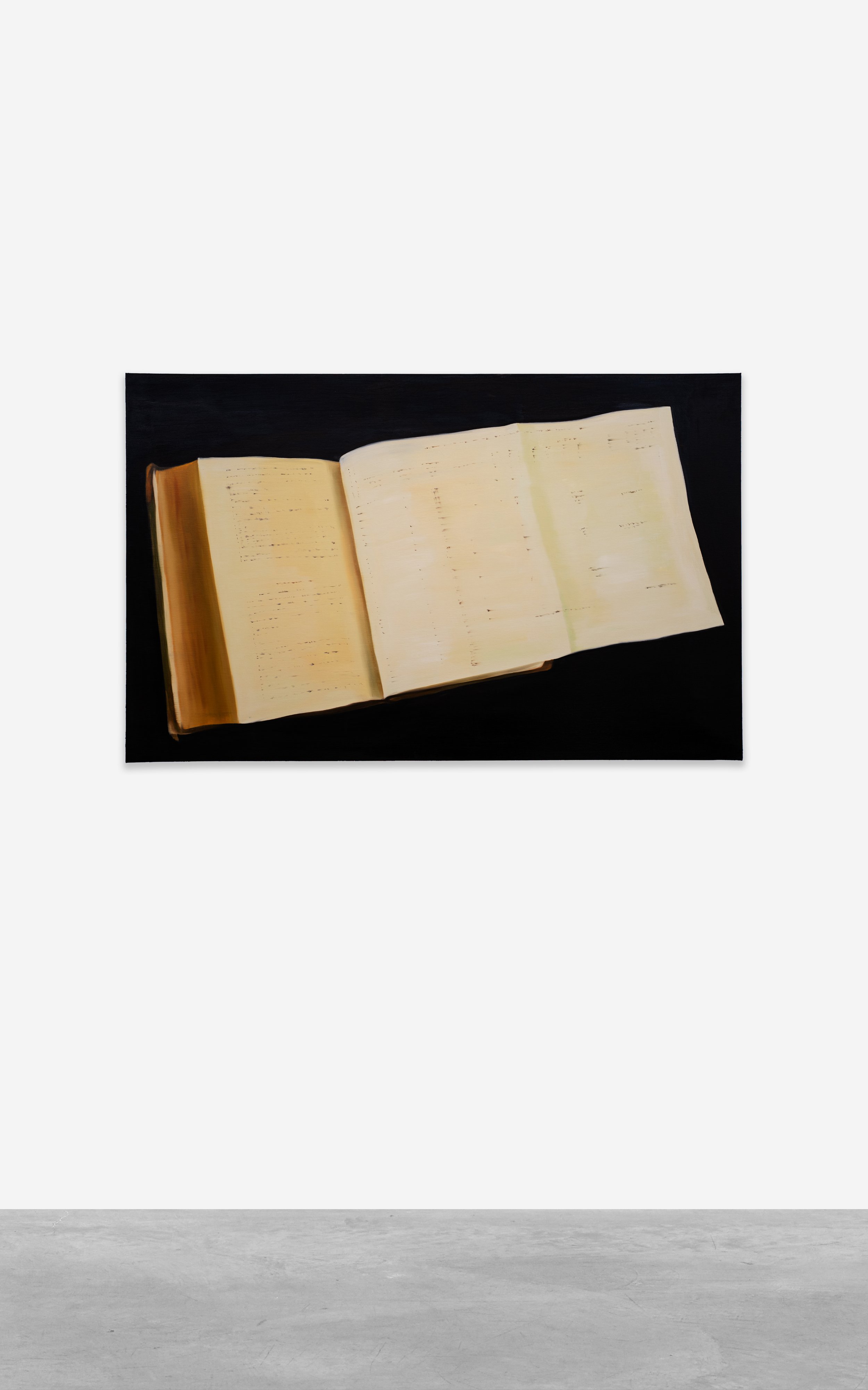
The surface of The Note G enacts the same tension between legibility and erasure that the painting's subject describes. The lines of text and notation are painted in thin, semi-transparent layers of pale yellow, ochre, and white over a ground of warm cream that represents the paper itself. This ground has been applied with enough opacity to read as paper but with enough thinness to allow the black beneath to show through at the edges, creating a luminous halo effect where the page meets the void. The blurring of the text is not uniform. In some areas, individual characters are nearly legible, their strokes distinguishable as marks even if their meaning has been dissolved. In other areas, the text has been reduced to horizontal bands of pale color that read as lines of writing without being readable as writing. This graduated approach to legibility, some passages clearer, others almost entirely dissolved, produces a visual analogue for the process of historical erasure that Tan Mu has described. The contributions of women to the history of computing have not been entirely destroyed. They have been rendered indistinct, blurred at the edges, reduced to a presence that can be sensed but not fully deciphered. The paint handling reinforces this reading. Where the text is most blurred, the brushstrokes are broad and horizontal, as though the writing had been smeared by a hand dragged across the page. Where the text is most legible, the brushstrokes are finer, more controlled, as though the writing were trying to reassert itself against the forces that would render it invisible.
Cy Twombly's blackboard paintings, particularly the series produced in 1966 and 1967, consist of canvases covered with loops, scribbles, and lines of cursive writing rendered in white oil or wax crayon on dark grey or black grounds. The effect is that of a classroom blackboard that has been written on and partially erased, with traces of earlier lessons still visible beneath the most recent marks. Twombly was not painting actual blackboards. He was painting the experience of thinking on a surface that accepts and retains marks while also allowing them to be erased, a surface that records the process of thought in all its revisions, cancellations, and false starts. The blackboard is the medium of provisional knowledge, the place where ideas are worked out and then wiped away, and the palimpsest of marks and erasures that Twombly creates on the canvas surface is a record of intellectual activity that no single, clean version of the thought could represent. The writing in these paintings is never fully legible. It loops and curves and trails off, and the viewer can sense the presence of words and numbers without being able to read them, as though the language of thought were visible but the content of that thought remained private.
Tan Mu's blurring of Note G operates in the same visual register but with a different structural logic. Where Twombly's blackboard paintings present a surface that has been written on and then partially erased by the thinker herself, a record of the process of working through an idea, Tan Mu's painting presents a surface whose text has been blurred not by the author but by history. Lovelace did not erase her own note. The blurring in The Note G is not the blurring of revision. It is the blurring of neglect, the gradual indistinctness that overtakes documents whose significance has been underappreciated or actively marginalized. Twombly's blackboards are palimpsests of thought in progress. Tan Mu's page is a palimpsest of thought in recession, a document whose visibility is being slowly withdrawn by the same cultural forces that failed to recognize its author's contribution for more than a century after her death. The painting does not restore the text to legibility. It preserves the text in its current state of partial erasure, and in doing so it makes the erasure itself visible as a historical fact rather than as an accident of time. This distinction between the erasure of revision and the erasure of neglect is what separates The Note G from every other painting of a written document in the history of art. When Twombly erases a line on his blackboard, he is performing the act of thinking: trying, failing, correcting, trying again. When Tan Mu blurs the text on Lovelace's page, she is performing the act of forgetting: the cultural process by which a contribution that was available in print for a century was never read, never cited, never recognized as the founding document of a discipline that did not yet exist. The blurring is not the artist's gesture. It is history's gesture, and the painting records it as such.
Ada Lovelace died on November 27, 1852, at the age of thirty-six, from uterine cancer. She had published her Notes three times: once in Taylor's Scientific Memoirs in 1843, and twice more in subsequent editions. After her death, her work was largely forgotten for more than a century. It was not until the 1950s, when the field of computer science began to coalesce around the invention of electronic computing, that Lovelace's Notes were rediscovered and her contribution to the history of programming was recognized. The algorithm in Note G is now understood to be the first published description of a step-by-step procedure designed to be executed by a machine, and Lovelace's observation that the Engine could operate on symbols other than numbers is recognized as one of the founding insights of computer science. The Bernoulli numbers algorithm that Lovelace devised was not a trivial exercise. It required the Engine to perform a sequence of operations including multiplication, division, and subtraction in a specific order, with intermediate results stored in the machine's variable columns and then retrieved for subsequent calculations. The algorithm also included conditional branching, the ability to redirect the machine's operations based on the sign of a calculated result, which is one of the fundamental operations of modern programming. This was not a calculation that a human could not perform. It was a calculation that a human could perform but that a machine could perform according to a set of instructions without human intervention, and the distinction between these two modes of calculation is the distinction between arithmetic and programming. But the century of neglect between her death and her rediscovery is not a gap in the historical record. It is the record itself. It is the period during which her contribution was available in print but unread, in which her algorithm existed on the page but was not recognized as an algorithm, in which her insight about symbolic computation was present in the text but invisible to the discipline it would eventually create. Tan Mu was thirty-six when she painted The Note G, the same age at which Lovelace died. This coincidence, which Tan Mu has described as making Lovelace's story feel "even more immediate and personal," is not a biographical footnote. It is the engine of the painting's emotional charge. The artist and the mathematician are the same age, and the artist is painting the mathematician's page at the moment when both of their lives could have ended, one in 1852 and the other in 2022, with the same thirty-six years of work behind them and the same uncertainty ahead.
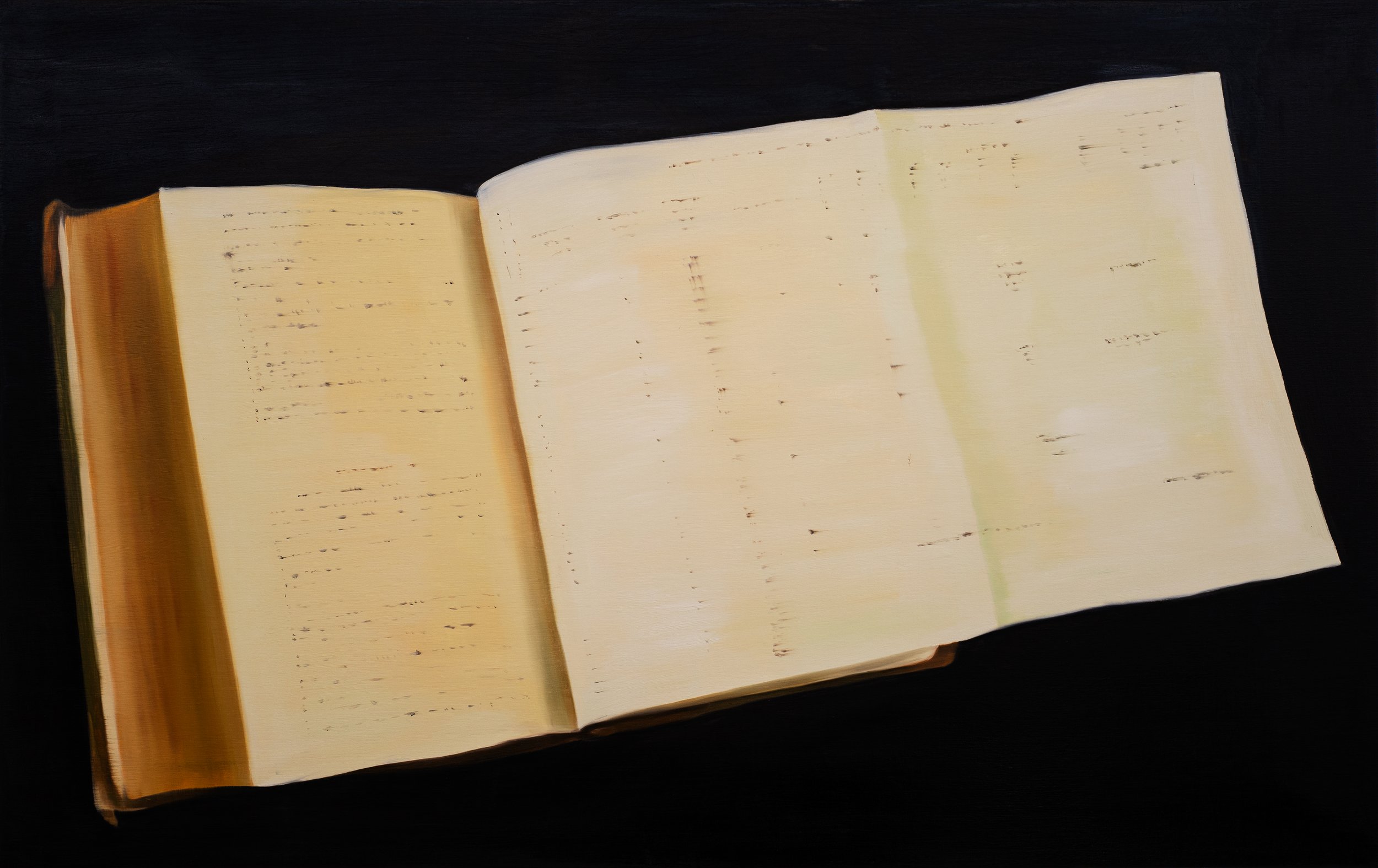
Nick Koenigsknecht, writing in the BEK Forum catalog about Tan Mu's technological paintings, observed that they "function more as self portraits, rather than depictions of external, scientific milestones." The observation is particularly resonant for The Note G. The page that floats against the black ground is not a depiction of Lovelace's Note G. It is a self-portrait of an artist who recognizes her own situation in the mathematician's: a woman working in a field dominated by men, producing work that is in danger of being erased by the same cultural forces that erased Lovelace's contributions for a century, and choosing to paint the erasure itself rather than to restore what has been erased. Koenigsknecht's insight that the technological paintings are self-portraits explains why The Note G does not attempt to reproduce Lovelace's algorithm in legible form. A restoration would imply that the erasure can be undone, that the century of neglect can be reversed by painting the text clearly. Tan Mu's decision to blur the text instead is an acknowledgment that the erasure has happened and that it is now part of the document's history. The blurring is not a mistake. It is a condition, and the painting preserves that condition with the same care that it preserves the remaining traces of the text. Koenigsknecht also noted that Tan Mu's work is "not a direct alignment between system and representation, but the act of arbitration," and The Note G is an act of arbitration in its purest form: the artist has decided what to show and what to withhold, and the decision to withhold the specific content of the algorithm while preserving its visual presence as a written document is the most consequential act of arbitration in her entire body of work.
Lovelace's proposal that the Analytical Engine could operate on symbols other than numbers, that it might compose music or produce graphics, is the insight that separates her from Babbage and places her in the lineage that leads directly to the digital present. Babbage conceived the Engine as a calculating machine. Lovelace conceived it as a general-purpose symbol manipulator. The distinction is not trivial. A calculating machine performs arithmetic. A symbol manipulator performs any operation that can be described as a sequence of steps, which is to say, any operation that can be described as an algorithm. Every word processor, every image editor, every music synthesizer, every video game, every social media platform, and every large language model that exists today operates on this principle. They are all, in Lovelace's terms, engines that manipulate symbols according to algorithms, and the fact that they manipulate symbols rather than numbers does not change their fundamental nature. It extends it. Lovelace wrote that the Engine "might act upon other things besides number, the engine might compose elaborate and scientific pieces of music of any degree of complexity or extent," and this sentence, buried in Note G among the Bernoulli calculations, contains the seed of every creative application of computing that has followed. Tan Mu's own practice, which uses algorithmic processes to generate images and then translates those images into oil paint on linen, is itself a fulfillment of Lovelace's prophecy: a machine that manipulates symbols producing visual output that a human artist then interprets and extends. The Note G does not depict this fulfillment. It depicts the moment before the fulfillment, the moment when the prophecy was written down but not yet recognized, the moment when the page that contained the future of computing was still just a page of annotations attached to a translation of a paper about a machine that had not yet been built.
Tan Mu has described her practice as operating "in the space between representation and abstraction," and The Note G occupies that space with a precision that matches its subject. The page is representational: it is clearly a page, clearly a document, clearly covered in writing. But the blurring of its contents pushes it toward abstraction, toward a condition where the page signifies documentness rather than any specific document, and the writing signifies writingness rather than any specific text. This movement between representation and abstraction is not a stylistic choice. It is the structural logic of the painting's argument. Lovelace's Note G occupies the same space in the history of ideas. It is clearly a document. It is clearly covered in writing. But the significance of that writing, the fact that it contains the first algorithm and the first proposal that computation could be a creative act, was not clearly legible for more than a hundred years. It was visible as a document but invisible as a milestone. The painting holds both conditions at once: the page is there, and the text is not. The insight is present, and it is blurred. The woman who wrote it was thirty-six years old, the same age as the woman who painted it, and both of them are working in a space where their contributions are legible as contributions but not yet fully legible in their significance. The Note G is a painting about an idea that was ahead of its time and a woman whose recognition came after her time, and it holds both of those conditions in the same image, on the same page, against the same black ground, where the text is still trying to be read.