The Box That Moves the World: Tan Mu’s Containers and the Memory Carried in Steel
Tan Mu's maternal great-grandfather was a maritime trader during the Republican era who spent much of his life traveling between China and Korea, carrying goods across the Yellow Sea on routes that predated the standardized shipping container by decades. During World War II, his journeys were interrupted, and he was forced to remain in Korea, where he became part of the overseas Chinese community before eventually returning to China. His story, which Tan Mu has described as shaping her family's identity and instilling in her "a sensitivity to movement, displacement, and cultural exchange," is not a footnote to Containers (2021). It is the painting's point of origin. The multicolored steel boxes stacked on the back of a truck on a New Jersey highway are not abstract symbols of global trade. They are the descendants of the cargo that her great-grandfather carried across the same sea, standardized now into uniform rectangles, but carrying the same weight of connection and displacement that his voyages carried three generations ago. The painting is about what the container carries, and what the container is: a steel box that moves goods across oceans, and a vessel that carries memory across generations.
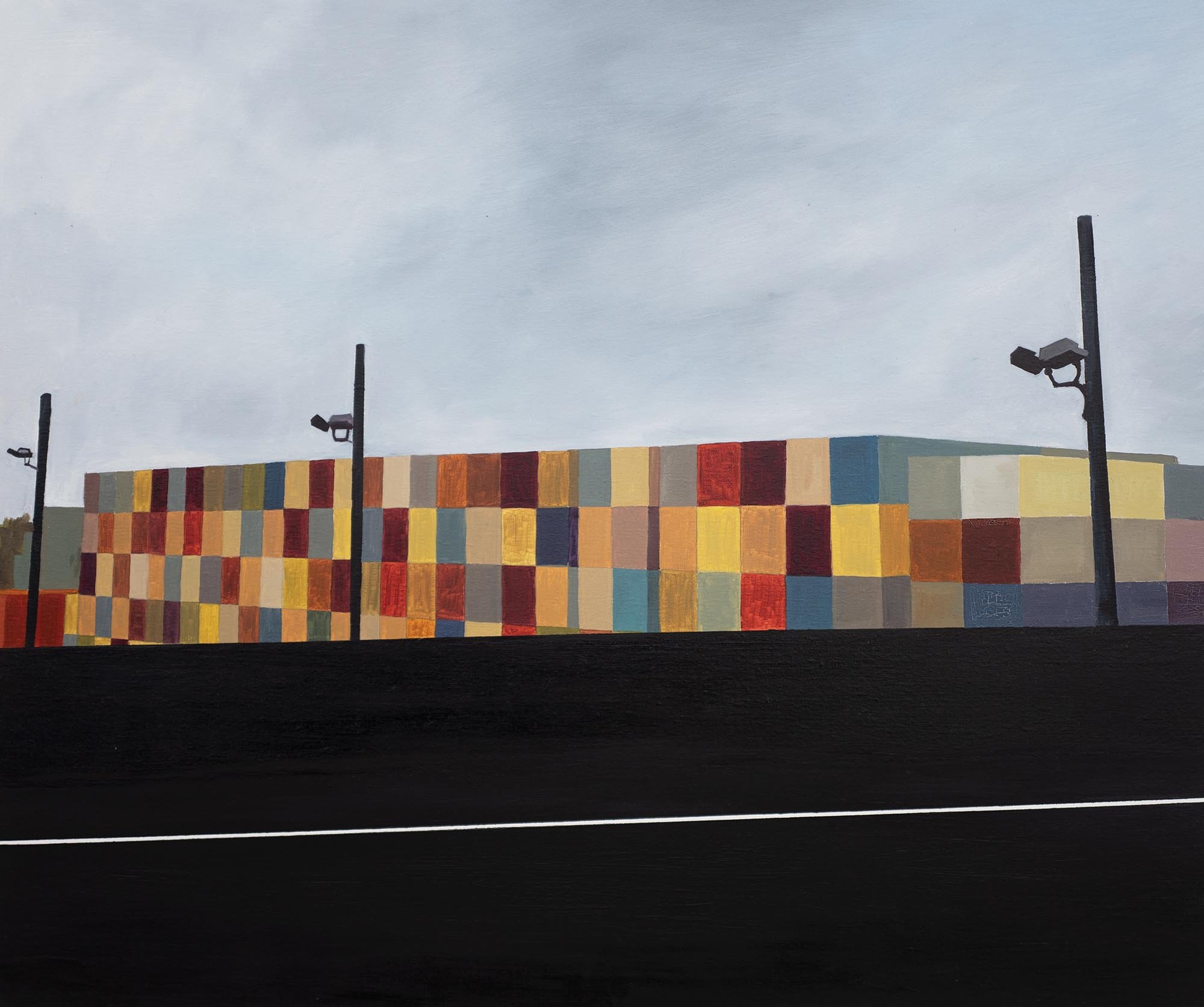
Containers is oil on linen, 76 x 91 cm (30 x 36 in), a horizontal format that suits its subject: a wide view of a highway with stacked shipping containers visible on a truck bed in the foreground and additional containers receding along the road. The composition is anchored by the highway, which cuts across the lower third of the canvas as a broad grey band of asphalt marked by painted lane lines. Above the road, the sky occupies the upper two-thirds of the painting, a field of muted blue-grey that lightens toward the horizon where it meets a strip of pale yellow, the last glow of a day that is either ending or beginning. The containers themselves are rendered as simplified rectangular blocks of saturated color: a deep red, a maritime blue, a dark green, a muted orange, and a weathered teal that suggests exposure to salt air and ocean crossings. Tan Mu has described reducing the containers to "simplified rectangular blocks of color" as a deliberate choice, "shifting attention away from individual objects and toward their collective meaning." The individual markings, logos, and registration numbers that would identify each container as belonging to a specific shipping line have been omitted. What remains is color and shape, the universal visual language of global logistics rendered with the directness of a child's building blocks.
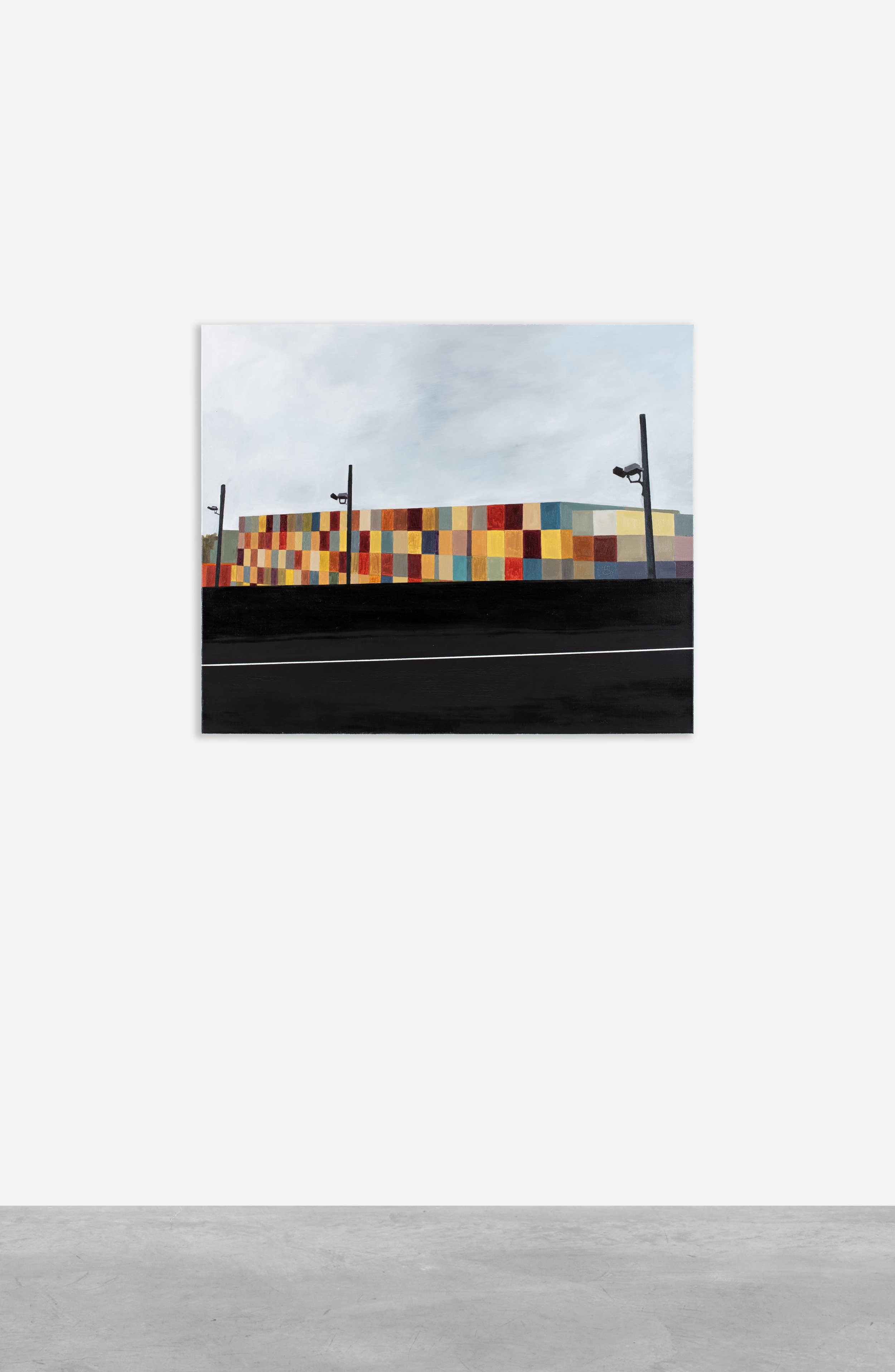
The surface of Containers reflects the dual nature of its subject: the mechanical and the personal coexisting in the same paint film. The highway in the foreground is rendered in a flat, even application of grey that covers the linen weave completely, producing the smooth, featureless surface of an actual road seen from a moving vehicle. The containers, by contrast, are built up in thicker layers of oil paint, each block of color a small relief of impasto that sits slightly above the surrounding surface, the same technique Tan Mu uses for the access points in her Signal paintings. This is not an accident of technique. The access points in the Signal series are nodes in a network, raised above the dark ground so that they catch light and announce themselves as points of connection. The containers in Containers serve the same function. They are the visible nodes of a global logistics network, the points where goods, information, and memory converge before being redistributed to their next destination. The sky above the containers is painted in thin, transparent washes that allow the linen weave to show through, producing a luminosity that contrasts with the opacity of the containers below. This difference in paint handling divides the canvas into two zones: the zone of human activity, where the road and the containers are solid, opaque, and material, and the zone of atmosphere, where the sky is translucent, atmospheric, and diffuse. The painting places its subject at the boundary between these two zones, at the point where the steel box meets the open air, where the manufactured object meets the natural world it traverses.
Allan Sekula's Fish Story (1995) is a photographic and textual project that documents the maritime spaces through which global trade moves: ports, container ships, dockworkers' unions, and the waterfront economies that sustain and are sustained by the circulation of goods. Sekula spent seven years photographing harbors and shipping lanes in Europe, Asia, and the Americas, producing a body of work that treats the sea not as a romantic wilderness but as a workspace, a site of labor and exchange whose visibility has been systematically erased by the same logistics systems that depend on it. The shipping container is the central actor in this erasure. Before standardization, cargo was loaded and unloaded by hand, and the dock was a place where the specific character of each shipment was visible: tea in one hold, cotton in another, machinery in a third. The container, which was invented by Malcolm McLean in 1956 and standardized by the International Organization for Standardization in 1968, made it possible to seal the contents of each shipment inside a uniform steel box that could be transferred from ship to truck to train without ever being opened. The contents became invisible. The dockworker could no longer see what he was handling. The port became a site of standardized transfer rather than specific knowledge, and the sea became a blank space across which identical boxes moved in identical patterns.
Tan Mu's Containers participates in the same inquiry that Sekula initiated, but from a different vantage point. Where Sekula documented the dock and the ship, the places where containers are loaded and unloaded, Tan Mu documents the highway, the place where the container passes through the landscape between its points of origin and destination. The highway is the seam that connects the port to the inland warehouse, and it is the space where the container, sealed and anonymous, becomes visible to ordinary people who are not dockworkers or logistics professionals. A driver on a New Jersey highway does not see what is inside the containers on the truck ahead. She sees only color: red, blue, green, orange, teal. The contents are hidden, the provenance is unknown, and the destination is irrelevant to the act of driving past. This is the condition that Sekula identified as the defining feature of containerized trade: the contents are invisible, and the labor that produced them and the labor that will consume them is equally invisible. Tan Mu renders this condition with pictorial clarity. The containers are blocks of color, nothing more, and their reduction to color blocks is not an aesthetic simplification. It is an accurate representation of what the container looks like to the world it passes through: a rectangle of color whose contents are sealed, whose origin is obscured, and whose destination is somewhere beyond the horizon.
The standardization of the shipping container in the late 1950s and early 1960s transformed global trade with a speed and thoroughness that few other inventions have matched. Before the container, cargo was loaded and unloaded by hand, a process known as break-bulk shipping that required armies of longshoremen and weeks of turnaround time in each port. After the container, a ship could be unloaded and reloaded in hours rather than days, and the cost of shipping a ton of cargo dropped by more than ninety percent. The container did not merely make shipping cheaper. It made it possible for manufacturing to be offshored to countries where labor was inexpensive and for the resulting goods to be sold in countries where labor was not. It made the global supply chain possible, and it made the global supply chain invisible, because once goods were sealed inside a steel box, nobody needed to know what was inside until the box arrived at its destination. The port of Yantai, where Tan Mu grew up watching containers move in and out of the harbor, was one of the first Chinese ports to benefit from this transformation. In the decades following China's economic reforms of the late 1970s, Yantai expanded from a regional fishing harbor into a major container port handling millions of twenty-foot equivalent units per year. The cranes and container stacks that dominated the harbor when Tan Mu was a child were not relics of a bygone era. They were the infrastructure of the system that had made her great-grandfather's trading routes obsolete and then, in a different form, had recreated them at a scale he could not have imagined.
The painting was created during the COVID-19 pandemic, and its subject matter is inseparable from the supply chain crisis that the pandemic produced. Tan Mu has described how the crisis made visible what had previously been invisible: the global network of shipping routes, port facilities, and logistics operations that moves goods from factories to consumers. When the network functioned smoothly, nobody thought about it. When it broke down, when ships queued outside ports for weeks, when containers piled up in the wrong places, when semiconductor shortages halted automobile production and grocery shelves went empty, the network became the story. The pandemic revealed the container not as a neutral piece of industrial equipment but as a critical node in a system whose failure could halt global manufacturing. The chip shortage that began in 2020 and continued through 2022 was caused in part by containers full of semiconductors sitting on ships that could not be unloaded because port workers were sick or locked down. The same steel boxes that carried televisions and running shoes also carried the components that powered the devices on which the world had come to depend for work, communication, and information during the lockdowns. The container, in other words, was not merely a carrier of goods. It was a carrier of the infrastructure on which modern life depended, and when it stopped moving, everything stopped.
Saul Appelbaum, in his 2025 essay on Tan Mu's Signal series, introduced the concept of "arbitration" to describe the process by which an artist mediates between a system and its representation. The artist, Appelbaum argues, is not a passive recorder of what the system looks like. She is an active arbiter who decides what to keep, what to transform, and what to discard as the signal passes through her hands. The term comes from the Latin arbitratio, meaning judgment or decision, and it names the specific operation that distinguishes artistic representation from documentary recording. A photograph of a shipping container on a highway documents what the container looks like. A painting of a shipping container as a block of color arbitrates between the container's visual presence and its function within the logistics system, keeping the color and the shape and discarding the brand name, the registration number, and the port of origin. This is not an act of simplification. It is an act of judgment about what aspects of the system are essential to its representation and what aspects are incidental. The color is essential because it is how the container appears to the casual observer. The shape is essential because it is the universal form that all containers share regardless of their contents. The brand name is incidental because it tells the viewer nothing about the system's structure. Tan Mu's arbitration, in Appelbaum's terms, strips the container of its surface specificity and preserves its systemic identity. The painting is not about Maersk or COSCO or any other shipping line. It is about the container as a node in a network, and the network is what the painting represents.
Tan Mu's own description of the painting's origin connects the global network to her personal history with a directness that the painting itself does not make explicit but that informs every decision on the canvas. "Growing up in Yantai, a major port city, I was naturally exposed to cargo transport and container logistics, partly because of my parents' professions," she has said. "Images of ships being loaded and containers moving in and out of the harbor became part of my childhood visual memory." The Yantai harbor, located on the northeastern coast of Shandong province, has been a trading port since the Qing dynasty and was one of the first Chinese ports opened to foreign trade after the Treaty of Chefoo in 1876. Its waterfront is dominated by the same cranes, container stacks, and cargo ships that define every major port in the world, and the sight of multicolored containers moving in and out of the harbor was, for Tan Mu, a visual constant of childhood, as familiar as the sea itself. Yantai's economy was built on trade, first in peanuts and silk, later in wine and fruit, and most recently in manufactured goods destined for export. The containers that rolled through the harbor when Tan Mu was a child carried the products of Shandong's factories to markets in Europe, North America, and Southeast Asia, and they carried back the raw materials and consumer goods that the region's growing middle class demanded. The harbor was not a backdrop. It was the engine of the city's prosperity, and the containers were its most visible product. When Tan Mu later used maritime shipping to transport her own artworks across borders, she became not only an observer of global trade but a participant in it. "This painting emerged directly from that lived experience," she has said, and the specificity of the claim is important. The painting is not about containers in general. It is about the containers that she has seen, first in Yantai harbor and later on the New Jersey highway where she took the photograph that became the painting's source. The great-grandfather who carried goods between China and Korea, the childhood harbor in Yantai, the shipping company that transports her work, the New Jersey highway: these are not abstract references to globalization. They are specific coordinates in a personal geography that the painting transforms into a visual argument about what containers carry and what they conceal.
Containers occupies a position within Tan Mu's practice that connects it to both the Signal series and the Memory paintings. The submarine cables in the Signal paintings carry information. The data centers in Memory carry digital records. The containers in Containers carry physical goods. All three are nodes in networks that span oceans, and all three are rendered with the same raised impasto technique that makes each node a physical presence on the canvas. The difference is that the submarine cable and the data center are invisible to most people most of the time. They operate beneath the ocean floor or behind locked doors. The container, by contrast, is visible. It travels on the back of a truck on a public highway. It passes through landscapes that anyone can see. And yet its contents are as invisible as the data flowing through a fiber-optic cable. The container is the visible node of an invisible network, the point at which the system that moves the world's goods becomes momentarily apparent to the driver on the highway before disappearing again into the logistics stream. The great-grandfather who carried goods between China and Korea did not travel in containers. He traveled in the hold of a ship, alongside his cargo, and he knew what he was carrying because he had loaded it himself. The container eliminated that knowledge. It sealed the cargo and the person into separate spaces, and in doing so it sealed away the memory of what was being carried and by whom. Tan Mu's painting opens that seal, not by showing what is inside the container, but by showing what the container carries on the outside: color, shape, and the accumulated weight of three generations of movement across the same sea.