The Surface That Disappears: Tan Mu’s 4K and the Green That Erases Itself
The green arrives before you understand what it is. Not the green of grass or leaves or emerald, but a green that belongs to no natural surface: the saturated, slightly blue-shifted chroma key green that television production studios use to make backgrounds disappear. This is the green of erasure, a color chosen precisely because it exists nowhere in human skin tones and rarely in the natural world, making it an ideal sacrificial layer, a surface designed from its inception to be replaced by something else. Tan Mu's 4K (2022) fills its modest canvas, oil on linen, 41 by 51 centimeters, with this green, and in doing so creates a paradox that the painting holds in tension from first glance to last: the most visible color in the composition is the one whose entire purpose is to become invisible.
The painting positions the viewer inside a camera's recording frame. Along the top edge, thin white numerals and icons indicate the status of a digital viewfinder: a timecode running, a battery level, format information. In the upper left corner, a small red dot pulses with the word "REC" beside it, the universal indicator that an image is actively being captured. The painting does not show someone looking at a screen. It places you behind the screen, looking out through the camera's own optics at a green field that fills the entire frame. There is no scene beyond the green. There is no actor, no weather, no landscape. The chroma key has swallowed everything, or rather, it has not yet been replaced by anything. The screen is recording, but it is recording nothing, or it is recording the condition of being ready to record anything. The green field is not a background. It is a waiting room.
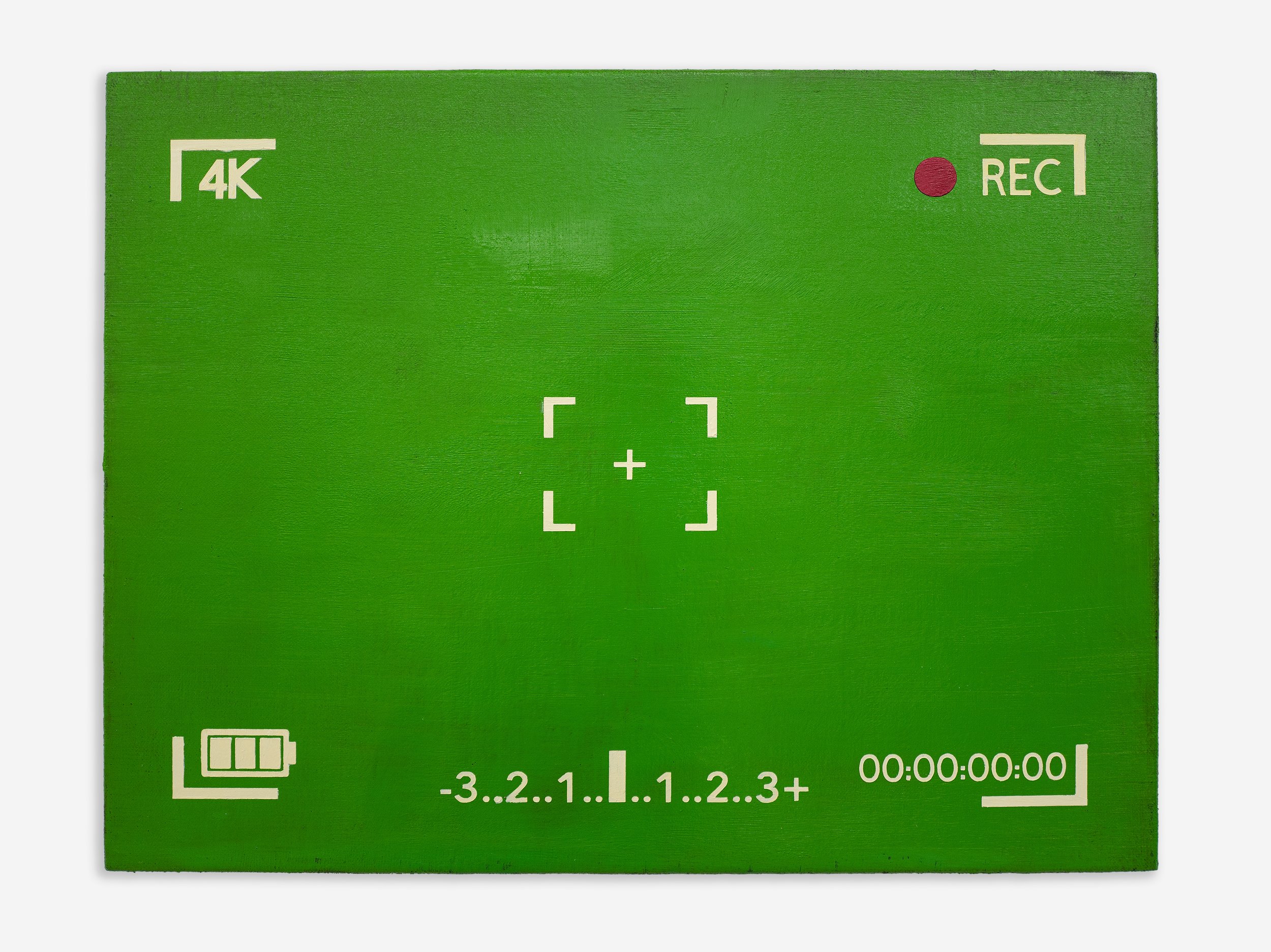
The dimensions of the painting, 41 by 51 centimeters, are intimate. This is not a screen that dominates a wall. It is a screen held at arm's length, the size of a laptop display or a large tablet, the scale at which recording devices have become personal accessories rather than studio equipment. The painting's size matches the scale of the technology it depicts. A larger canvas would have turned the green into an environment, an immersive field. At 41 by 51 centimeters, the green remains a surface, a rectangular plane with edges, a thing you can hold in your hands or set on a desk. The intimacy of the format is part of the argument. This is not the green screen of a Hollywood soundstage. This is the green screen of a phone camera or a laptop webcam, the kind of chroma key that anyone with a ring light and a YouTube account can deploy from a bedroom. The technology of erasure has been democratized, and the painting's modest dimensions register this shift.
Tan Mu built the surface in layers. Over a dark base coat, she applied multiple layers of green oil paint, using horizontal brushstrokes that sweep across the linen from left to right. These strokes are not uniform. They vary in width, pressure, and opacity, creating wave-like bands that recall the scan lines of early cathode-ray tube displays. Where a scan line on a CRT monitor was an artifact of the electron gun drawing the image one horizontal line at a time, the brushstrokes in 4K are artifacts of the painter's hand moving across the canvas in the same directional rhythm, left to right, top to bottom, replicating the machine's logic through bodily repetition. The paint builds to a slight impasto where the strokes overlap, creating a surface texture that catches light differently at each band. In reproduction, the painting reads as a flat green field. In person, the surface breathes, each scan line a ridge that the eye can follow across the canvas like a groove in vinyl.
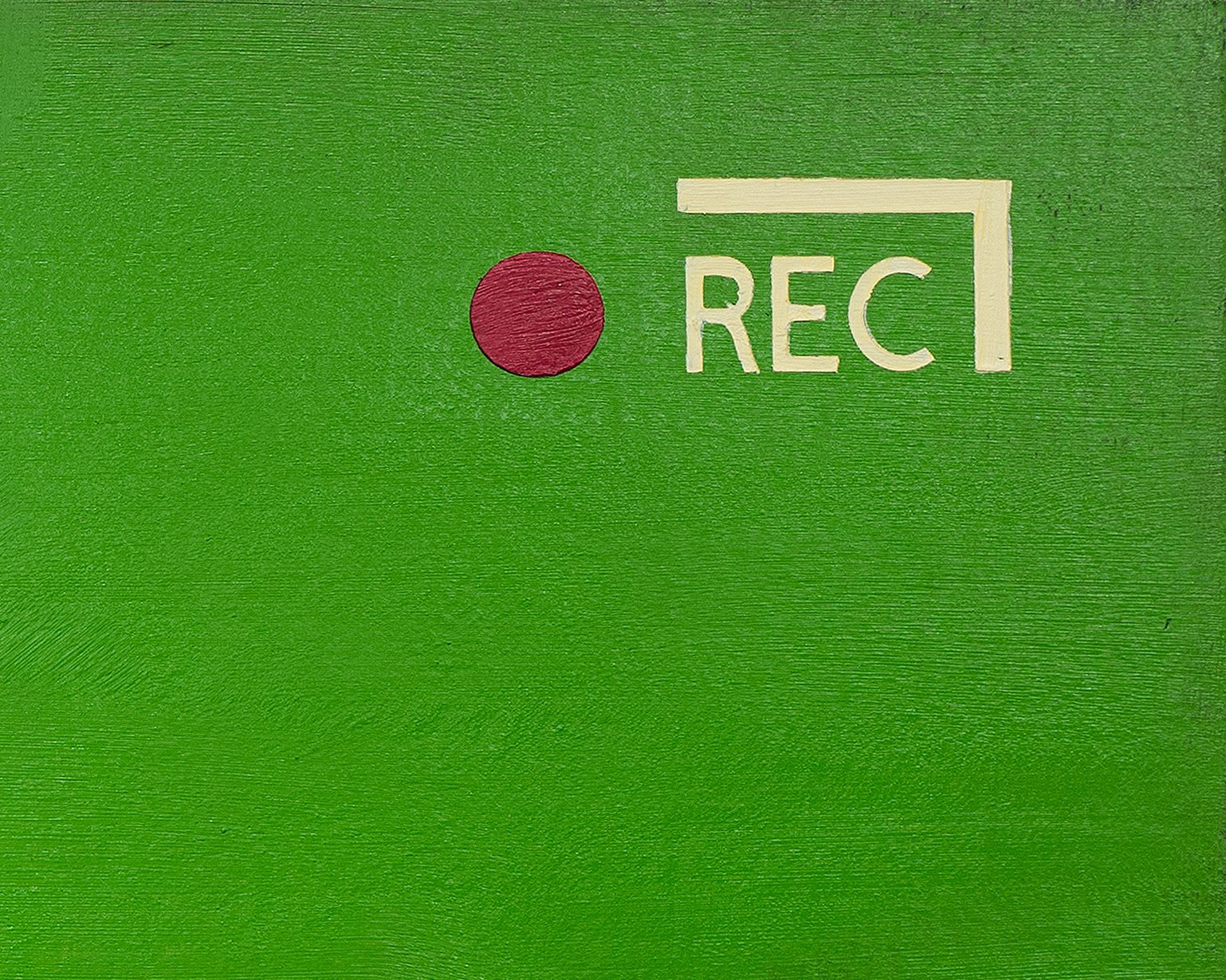
The scan-line effect connects 4K directly to Tan Mu's Play (2022), another painting from the same year that depicts a television screen showing a paused video game. In her interview for the Atlas of Seeing, Tan Mu describes the relationship: "The process of creating this painting is closely related to my work Play, which also explores screen-based visual language. I was particularly interested in recreating the scan-line effect associated with early television and video displays. To achieve this, I applied multiple layers of green oil paint over a dark base, allowing the surface to build up density and texture." The technique is the same in both works, but the implications diverge. Play shows a screen with an image on it, a game interface frozen mid-action. 4K shows a screen with no image at all, only the green that precedes all images. Play is about what the screen displays. 4K is about what the screen is made of before it displays anything. The substrate, the precondition, the surface that must disappear before anything else can appear.

In 1963, Sigmar Polke began making paintings that used the raster dot, the halftone screen through which newspaper photographs were reproduced, as their primary visual language. Works like Liebespaar (Lovers, 1965-66) and the later raster paintings of the early 1970s translated the Benday dot grid of commercial printing into oil on canvas, making the mechanical reproduction process itself into the subject of painting. Polke's dots are not representations of newspaper photographs. They are representations of the process through which newspaper photographs are made visible. The raster is not the image. It is the condition under which the image appears. Polke understood that by painting the raster, he was not painting a picture of something. He was painting the mechanism that makes pictures possible.
Tan Mu's 4K does for chroma key green what Polke did for the halftone dot. The green field is not a picture of a green screen. It is a painting of the condition under which all contemporary pictures are made. Every weather broadcast, every Zoom background, every TikTok special effect, every Hollywood composite shot passes through a stage where the image sits on top of a surface that is designed to disappear. The green is the invisible architecture of virtually all visual media, the color that is everywhere in production and nowhere in the final product. Polke made the raster visible by refusing to complete the reproduction process. Tan Mu makes the chroma key visible by refusing to replace it with a background image. Both artists arrest the production process at the point where the mediating technology is most exposed, most itself, before it becomes transparent in service of the final image. The green field in 4K is the moment before the magic trick, the moment when the mechanism is still visible, still green, still erasable, still waiting to be overwritten by whatever scene the director or the algorithm or the user decides to place on top of it.
Chroma key compositing was developed in the 1940s and 1950s as a method for combining foreground and background images in film and television production. The technique works by selecting a specific color in the foreground image, typically a shade of green or blue that does not occur in human skin tones, and making that color transparent so that a second image can be inserted in its place. The green is not part of the final picture. It is a placeholder, a region of the image that is designated for removal. When the compositing process is complete, the green disappears entirely, replaced by whatever background the production team has chosen: a weather map, a distant galaxy, a newsroom. The viewer never sees the green. They see only the composite result. The green exists only in the production pipeline, visible to the camera operator and the editor but invisible to the audience. It is the most functional color in the media production chain, and it is defined by its own obsolescence. Its purpose is to cease to exist. The title 4K refers to the resolution standard that produces an image approximately 4,000 pixels wide, delivering a level of clarity so extreme that the human eye can no longer distinguish individual pixels at typical viewing distances. Ultra-high-definition video was standardized by the International Telecommunication Union in 2012 as Rec. 2020, specifying a frame size of 3,840 by 2,160 pixels for consumer displays and 4,096 by 2,160 for digital cinema. The standard was designed to eliminate the visible artifacts of earlier formats: the jagged edges on diagonal lines, the softness of interlaced scanning, the faint flicker of refresh rates too low for the eye to register as steady. In a 4K image, the grain of skin, the weave of fabric, the individual leaves on a distant tree all resolve with a precision that approaches the threshold of optical perception. The recording indicator in Tan Mu's painting claims this standard for a surface that contains nothing to resolve. The 4K designation promises maximum definition for a field of uniform green. Every pixel is dedicated to rendering the same color, the same flat expanse, with the same crystalline precision. The resolution serves the erasure. The sharper the image, the more thoroughly the green declares its intention to disappear.
Tan Mu's painting holds this color in suspension. The green fills the frame because it has not yet been replaced, and the red recording dot in the upper left corner confirms that the camera is already running, already capturing this green field as though it were content worth recording. The paradox of 4K is that the recording indicator treats the chroma key surface as a legitimate image. The camera does not know that the green is meant to disappear. It records the green with the same fidelity it would record a landscape or a face. In this moment, the green is the image, not the absence of one. The painting extends this logic. By rendering the chroma key in oil on linen, Tan Mu gives the erasable surface a permanence it was never designed to have. The green that should have been replaced by a weather map or a news anchor now sits on a linen support, behind varnish, in a frame, in a gallery, in a painting that will outlast every television broadcast it was designed to serve. The placeholder has become the monument.
The red recording dot carries a secondary charge that Tan Mu articulates explicitly. In her interview, she describes it as a symbol that "usually indicates that a camera is actively recording, which carries an implicit psychological weight. It suggests surveillance, documentation, and the awareness of being seen." She notes that "when it appears inside the frame, the viewer may feel as though they are being observed rather than simply observing." The red dot is small. It occupies perhaps one percent of the canvas area. But it reverses the entire dynamic of the painting. Without it, the green field is a passive surface, a blank waiting to be filled. With it, the surface becomes an active apparatus. The camera is running. The viewer is being recorded. The person looking at the painting is no longer an observer standing outside the image. They are a subject positioned inside the camera's field of view, which is to say inside the green, inside the chroma key, inside the surface that is designed to vanish. The painting does not merely depict a screen. It installs the viewer within the screen's logic.
Hito Steyerl's video installation "How Not to Be Seen: A Fucking Didactic Educational .MOV" (2013) addresses the chroma key directly. In one section of the work, a figure stands against a green screen, and the narrator explains that "to become invisible in the age of images is to not exist." The green surface in Steyerl's installation is both the tool of erasure and the condition of visibility. A person standing against a green screen can be composited into any background, transported to any location, inserted into any narrative. They become maximally visible and maximally replaceable at the same time. The green makes them visible by making them transportable, and it makes them invisible by making their original context, the actual room they were standing in, disappear. Steyerl's work is a political analysis of this double condition, but the formal observation is precise: chroma key green is a color that exists in a state of permanent potential erasure. It is always about to be replaced. It is always on the verge of not being there.
Tan Mu's painting occupies this same state of permanent potential erasure, but it does so through paint rather than video. The material difference matters. A digital green screen can be replaced in seconds. A painted green screen cannot be replaced at all. The oil paint has dried. The linen is stretched. The varnish will protect the surface for decades. The painting has taken the most ephemeral surface in contemporary media production, a color that exists only to be deleted, and fixed it in the most durable medium available. This is not an accident of subject matter. It is an argument about permanence and impermanence, about what we choose to preserve and what we allow to disappear. The green that was meant to vanish has been made to stay. The placeholder has been given the weight of a final image. And the final image, if there ever was one, the background that the green was supposed to support, has been denied the chance to appear at all. The painting refuses the compositing process. It stops at the green and stays there.
Danni Shen, writing about Tan Mu's practice in Emergent Magazine, observed that the works "serve as a kind of witness to human socio-technological histories." The phrasing is careful. A witness does not merely document. A witness testifies. A witness is present at the event and carries the memory of it forward. In 4K, the witness is the painting itself, a painted surface that testifies to the existence of a color that is designed not to be seen. The painting stands in for every green screen that was ever struck, every background that was ever composited, every weather map that was ever overlaid on the shoulders of a meteorologist who was standing in front of a blank green wall, gesturing at clouds that existed only as data. The green remembers what the final broadcast has already forgotten.
Tan Mu has described the green screen as "not an image in itself, but a transitional surface that enables images to move between different visual systems." The word "transitional" is the key. The green screen is a threshold, a membrane, a door that opens in one direction only. Images pass through it on their way to becoming something else, but the green itself never arrives. It stays at the threshold, performing its function of erasure over and over, each time vanishing so that another image can take its place. By painting this threshold and refusing to let the green vanish, Tan Mu holds the transitional moment open. The viewer stands at the threshold with the green, in the moment before the image arrives, in the moment when the recording indicator blinks and the surface is still visible and the camera is still running and nothing has been replaced yet. This is the moment that 4K preserves. Not the image that eventually appears on the screen. Not the background that replaces the green. But the green itself, the surface that disappears, the color that was never meant to be looked at, now fixed in oil on linen and looking back at you with the full weight of a recording indicator that says: I see you, too.