The Stars Beneath the Surface: Tan Mu’s Signal: Submarine Network 07 and the Routes That Remember
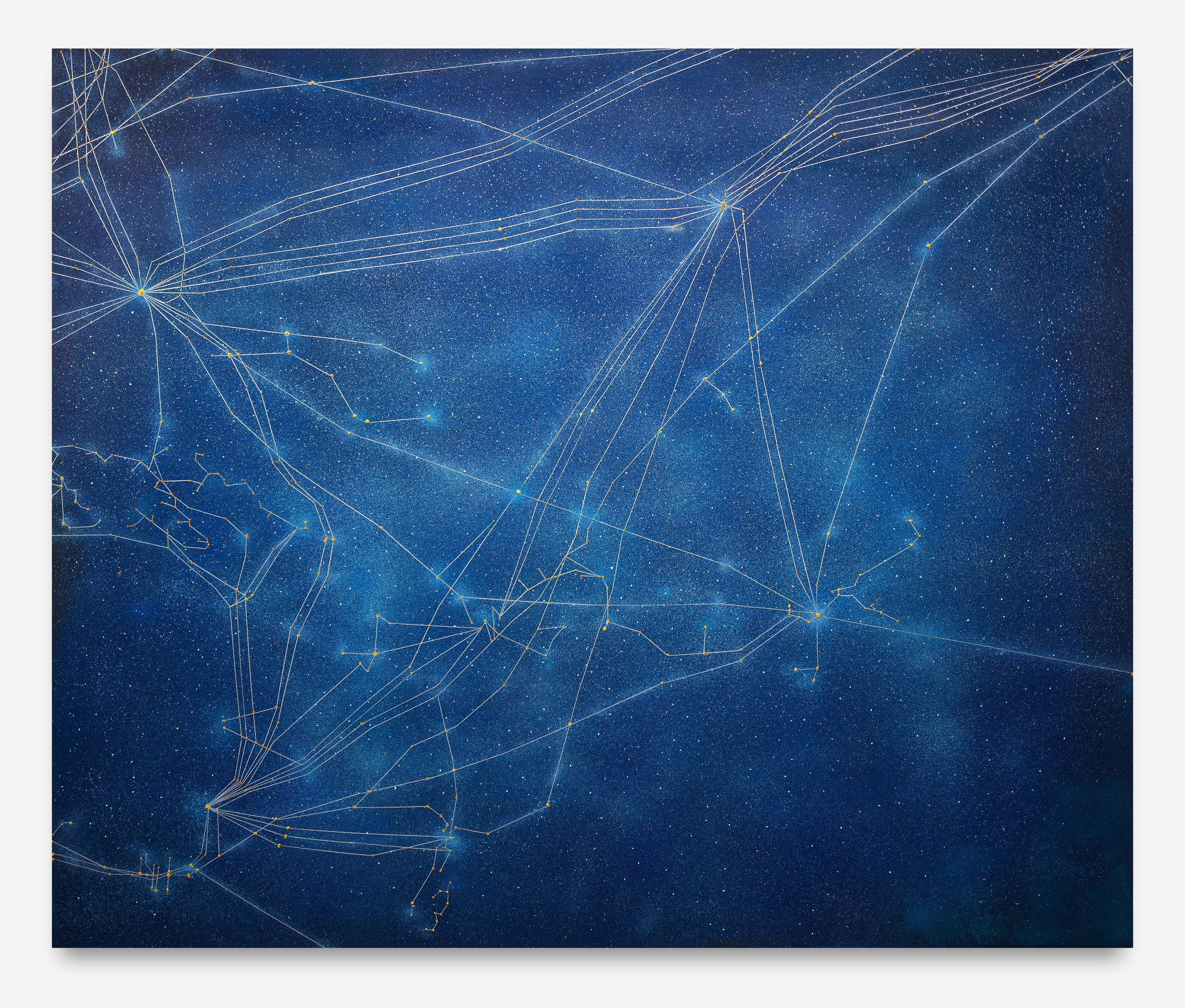
A dot appears at the lower left of the canvas, then another, then a line drawn between them. From across the room, the composition reads as a constellation chart: points of light scattered across a dark field, connected by filaments so thin they seem to hold the points in tension rather than draw them together. Step closer and the dots thicken, some rising from the linen in small wax-heavy relief, each one a landing point where a fiber-optic cable reaches an island or a coastal city. The filaments are not stars; they are submarine cables, carrying nearly all of the world's internet traffic across the floor of the Pacific Ocean. The constellation is not a constellation. It is infrastructure. Tan Mu's Signal: Submarine Network 07 (2025) takes as its subject the vast web of undersea cables stretching from Australia's eastern coast toward New Zealand, Papua New Guinea, French Polynesia, and the scattered atolls of the South Pacific. The painting measures 152.5 x 183 cm, oil and acrylic on linen, and it presents this hidden network as both a technical cartography and something older: a map of routes that people have been tracing across this same ocean for three thousand years.
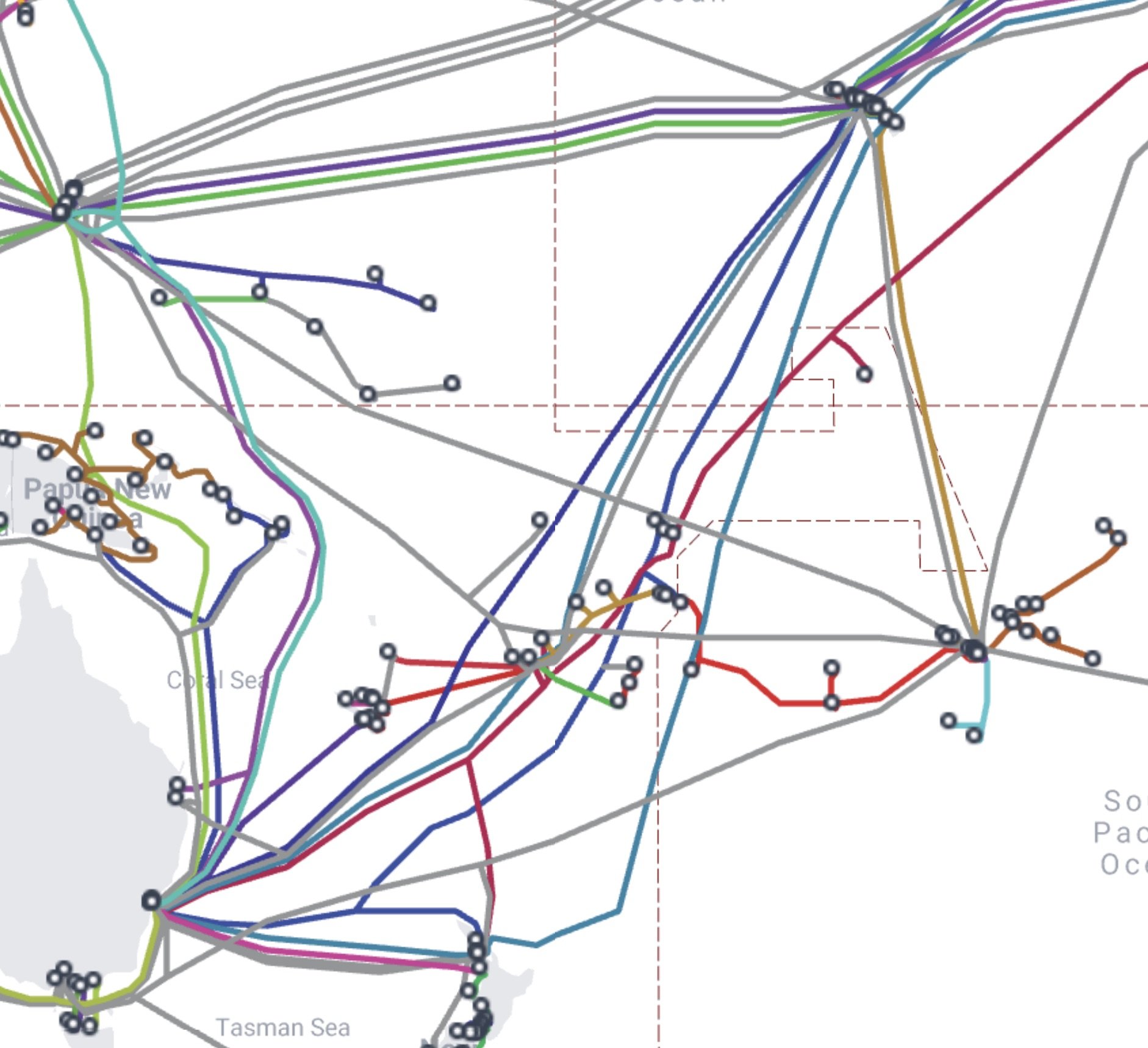
The South Pacific is the largest blank space on any submarine cable map. Where the Atlantic and the Mediterranean coil with overlapping lines, the Pacific south of the equator opens into vast reaches where no cable runs at all. Australia sits at the lower edge of the painting like a landmass that generates connections outward, a hub radiating lines toward the islands and toward the continental networks of Asia beyond the frame. The cable routes to New Zealand and Papua New Guinea are relatively dense, clustering along Australia's eastern seaboard. But as the lines extend toward French Polynesia and the smaller island nations of the Pacific, they thin. The dots become stepping stones, each one a crucial transit point linking Australia with the Americas and with Asia. In the painting, these nodes appear as points of concentrated light against the dark linen ground, and the composition makes visible what satellite maps of the same region reveal: that connectivity in the Pacific is not uniform. It follows the old patterns of settlement, trade, and navigation, concentrating where people have long gathered and dissipating where the ocean is too vast and too empty to justify the cost of a cable.
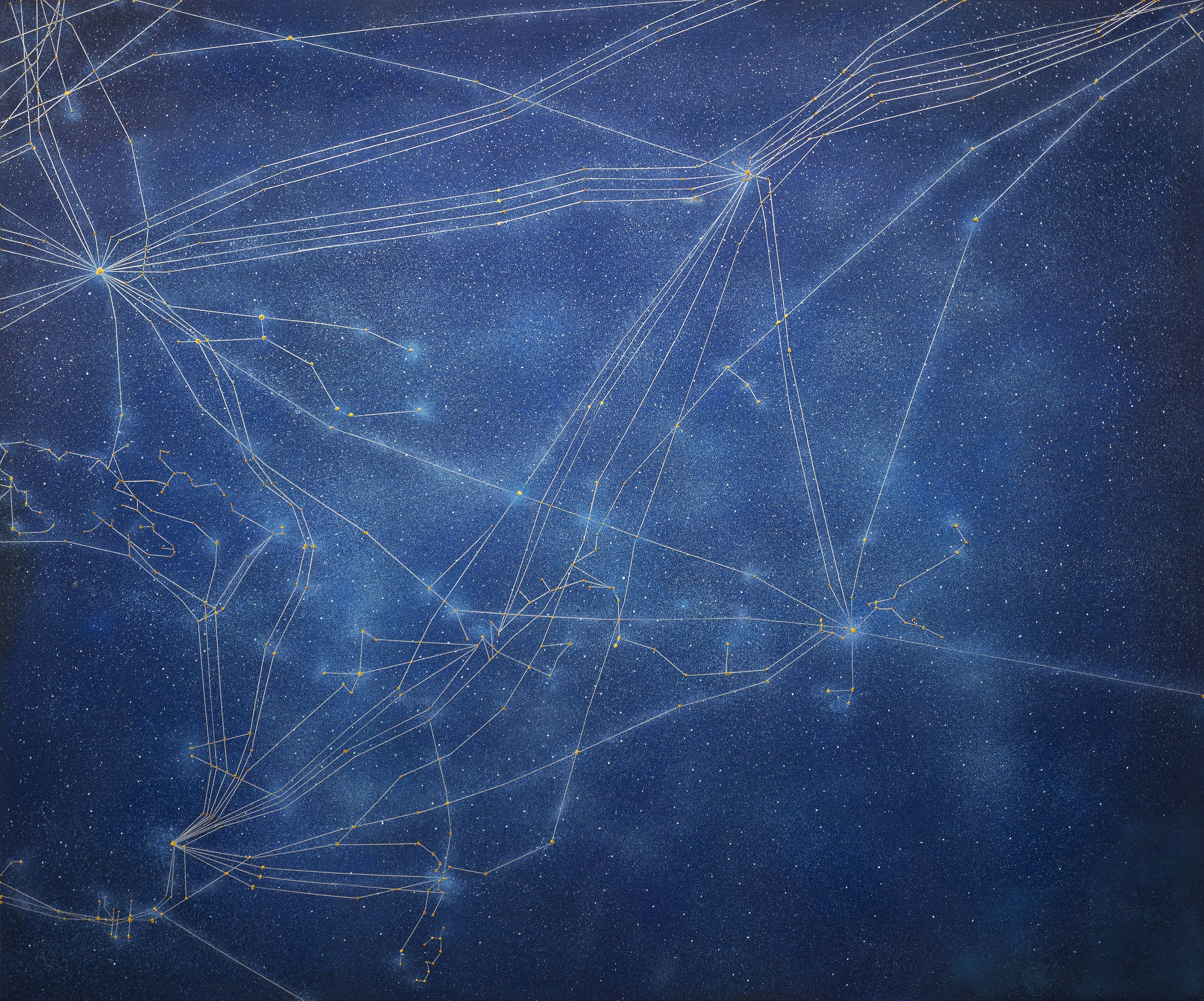
The linen itself does cartographic work. At 152.5 x 183 cm, the painting is wide enough that the horizontal format suggests a panoramic view, the proportions of a nautical chart laid flat. The weave of the linen shows through in the darker passages of the sea, where thin washes of acrylic leave the fabric visible as a faint grid. That grid, the warp and weft of the material support, becomes a surrogate for the bathymetric contour lines that Tan Mu's grandfather once drew as a marine engineer. The sea in this painting is not an empty field. It has texture and structure, a ground that was measured and plotted long before any cable was laid across it. The cable lines themselves are rendered in a pale, cool gray that distinguishes them from the warmer white of the landing points. The lines do not fill the canvas. They trace specific routes, hugging coastlines where the water is shallow enough for a cable to be laid and serviced, then striking out across open ocean in long arcs that connect island to island. Where two cables run parallel, the painting shows them as separate filaments, each one an independent system carrying its own traffic, each one a line of connection that can be severed by a single anchor drag or a single volcanic eruption on the seafloor.
At close range, the landing points reveal their material history. Tan Mu builds these nodes with thick, wax-heavy oil paint, applying it in successive layers until each dot rises slightly above the surface of the canvas. In reflected light, these raised points catch and hold illumination, becoming small beacons. The technique is specific to the Signal series. In her interview with Yiren Shen for 10 Magazine, Tan Mu describes the process: the underpainting is laid down spontaneously, and then, when painting specific areas, she overlays another layer to reflect the underwater terrain before mapping the cable routes. "The access points are built up with thick, wax-heavy oil paint, resembling the soldered connections of electronic circuits. Each connection point has a raised texture." The description is precise and it is also a conceptual claim. These are not simply dots on a map. They are material accumulations, small reliefs that echo the physical reality of a cable landing station, a concrete structure on a coastline where fiber-optic strands emerge from the ocean floor and enter a building filled with equipment that converts light pulses into data. The painting makes these points tangible in a way that a submarine cable map on a computer screen cannot.
The Norwegian painter Peder Balke (1804-1887) spent his career painting the outer margins of known geography. His views of the North Cape, the northernmost point of continental Europe, are compositions in which sea, sky, and rock merge into a single luminous field. In North Cape by Moonlight (c. 1860s, National Museum, Oslo), Balke renders the Arctic coastline as a sliver of dark land beneath a moon that lights the clouds from within, while the sea reflects the sky in a continuous wash of silvery gray. The horizon is barely distinguishable. The painting is small, barely 30 centimeters across, yet it contains an immensity that refuses to resolve into foreground, middle ground, and distance. Balke was painting places that most Europeans would never visit, the edges of the continent where the known world gave way to elemental forces. His compositions strip away anecdotal detail and leave only the geometry of a coast, a cliff, a lighthouse, a lone ship reduced to a vertical mark against a luminous void.
Tan Mu's Signal: Submarine Network 07 occupies a comparable position, but with a crucial inversion. Balke painted the boundary where human presence thinned to nothing. Tan Mu paints the boundary where human presence, invisible from the surface, is concentrated into a network of extraordinary density. The South Pacific in her composition is not empty. It is threaded with lines that carry the entire weight of contemporary communication across that vast floor. Where Balke saw the edge of the world as a place where representation itself had to thin out, Tan Mu reveals that the same apparent emptiness conceals an infrastructure of almost incomprehensible complexity. Both painters work at the margin, but Tan Mu's margin is one where the visible emptiness of the ocean conceals the densest architecture of connection on the planet. The dots and lines that appear to float in the dark field of her canvas are not decorative. They are a record of specific cables at specific landing points, and their thinning in the South Pacific follows the same logic that governs all infrastructure: density follows population, and population follows the old routes, the ones people have been traveling for millennia.
The submarine cables that cross the South Pacific do not float freely. They rest on the ocean floor at depths that exceed four kilometers in places. They are sheathed in layers of copper, polyethylene, and steel wire armoring, and they are laid by specialized ships that pay out cable from massive spools at a rate of roughly 200 kilometers per day. The total length of submarine cable currently in service worldwide exceeds 1.4 million kilometers. That figure is difficult to comprehend in the abstract, and one of the things Tan Mu's painting does is make it visible. The cables that reach from Sydney to Auckland, from Port Moresby to Honiara, from Suva to Nuku'alofa, are not interchangeable threads. Each one has a name, a commissioning date, a consortium of owners, and a design capacity measured in terabits per second. The Southern Cross Cable, which links Australia to New Zealand and onward to the United States, became operational in 2000. The PPC-1 cable, connecting Papua New Guinea to Australia, entered service in 2009. The Hawaiki cable, stretching from Australia and New Zealand to the west coast of the United States, was completed in 2018. These are the specific lines that Tan Mu's composition renders in pale gray against the dark linen, and each one is a piece of engineered infrastructure that exists because a consortium of telecommunications companies decided that the volume of data traffic between those points justified the enormous capital expenditure of laying a cable across thousands of kilometers of ocean floor.
The painting's subject, however, is not merely the technical fact of these cables. As Tan Mu states on her artwork page for Signal: Submarine Network 07, the nodes and lines in the painting act as "stepping stones" in the cable layout, "serving as crucial transit points linking Australia with the Americas and Asia," and she notes that "in a region once known for celestial navigation and canoe voyages, these ancestral pathways of movement are now quietly mirrored by fiber-optic threads deep beneath the sea." The cables follow the routes that Polynesian navigators first traced using the stars, ocean swells, and the flight patterns of birds. The Austronesian expansion across the Pacific, beginning roughly 3,000 years ago, was the longest maritime migration in human history. Navigators set out from what is now Taiwan and traveled south and east across thousands of kilometers of open ocean, settling islands across a region spanning from Madagascar to Easter Island. They used no instruments. They read the position of stars, the direction of swells refracting around distant landmasses, the color of water above shallow reefs, and the behavior of seabirds returning to land at dusk. The routes that cables now follow were not chosen arbitrarily. They follow population density, and population density in the Pacific follows the old navigational routes, the ones that the first voyagers opened and that their descendants have been traveling ever since.
Li Yizhuo, in her catalog essay "Constellations" written for the BEK Forum exhibition in Vienna, observes that almost every visitor's first impression of the Signal series is of constellations of stars. The pattern of dots and lines against a dark field triggers a perceptual reflex that reaches for the familiar: the night sky. But Li Yizhuo redirects this reading. The constellation "points away from subject or telos toward a telecommunication system." The dots are not stars. They are landing points. The lines are not the imaginary connectors of zodiac mythology. They are fiber-optic cables carrying packets of data at the speed of light. And yet the formal similarity between the two systems of connection, celestial and submarine, is not a coincidence to be dismissed. It is the point where Tan Mu's painting begins its most ambitious work. Li Yizhuo extends the musical analogy further. She describes attending a performance of John Cage's Concert for Piano and Orchestra at the Musikverein in Vienna, where "the conductor's alternating arms moving like clock hands and the musicians playing from boxes on two tiers left me mesmerized." The experience reframed the Signal series for her. "Each composition of lines and dots full of tension and anticipation." The cables, read as notation, assign register, pitch, timbre, and duration to each configuration of cities and systems. The painting becomes a score that can be performed.
This reading opens a structural parallel with the work of the Swiss healer and artist Emma Kunz (1892-1963), whose radial drawings on graph paper, created between 1938 and 1950, were never intended as art. Kunz made her drawings using a pendulum, laying out geometric patterns that she believed carried diagnostic and therapeutic information. The drawings function simultaneously as functional instruments and aesthetic objects. Their radiating lines, concentric forms, and precise geometries could be read as energy maps, as therapeutic tools, or as compositions that sit within the history of abstract drawing. Kunz herself never distinguished between these readings. The drawings were what they were: records of invisible forces made visible through the medium of graphite on paper. When Kunz's work was shown at the Serpentine Gallery in London in 2019, the exhibition catalog noted that her drawings "oscillate between the diagnostic and the prophetic." They are not merely decorative, and they are not merely functional. They occupy a space where the two categories dissolve into each other.
Tan Mu's Signal series occupies a comparable position. The paintings are not abstract compositions that happen to resemble cable maps. They are cable maps, accurate enough that a telecommunications engineer could identify specific routes and landing points from the pattern of dots and lines on the canvas. At the same time, they are compositions that evoke constellations, musical notation, neural networks, and the radial geometries of Kunz's pendulum drawings. The question is not whether the painting is a map or an abstraction. It is both, and the structural reason it can be both is that the underlying subject, a system of invisible connections that shapes every aspect of daily life without ever becoming visible, demands a form that can hold these contradictory readings simultaneously. Kunz's drawings work because the pendulum traced forces that could not be seen directly. Tan Mu's paintings work because the cables that carry virtually all intercontinental data traffic are equally invisible. Both artists make hidden structures legible through a visual language that refuses to collapse into either the purely technical or the purely aesthetic.
Tan Mu's own relationship to the ocean gives this particular painting a personal dimension that the others in the series share but that Signal 07 articulates with particular force. She grew up in Yantai, a coastal city in Shandong province, where her mother was a professional windsurfer on China's first national team and her paternal grandfather was a marine engineer who worked on harbor design and land reclamation. She began freediving in 2019, and the experience of neutral buoyancy, that suspended state where the surface above mirrors a sky and the depths below open into infinite blue, structures the visual vocabulary of the entire Signal series. As she told Yiren Shen: "The underwater world resembles outer space, a dreamlike realm where the boundaries of reality fade away." The South Pacific, the specific region that Signal 07 maps, is the ocean where this mirroring is most complete. The Pacific is vast enough that the line between sea and sky, seen from a small boat or from below the surface, becomes a single continuous field. The cable routes that cross it, visible only as thin lines on a nautical chart, are the contemporary version of the star paths that Polynesian navigators followed for thousands of years. The painting makes both systems visible at once: the ancient and the contemporary, the celestial and the submarine, the route read in stars and the route laid in glass.
Tan Mu describes the relationship between internal and external systems explicitly. "I often think of submarine cables as the veins of the planet, similar to meridian lines in traditional medicine, circulating energy and information through a living body. This idea connects directly to my earlier work on the brain and memory. Internal systems such as neurons and synapses transmit thought and emotion within the body, while external systems like cables and data centers extend that process outward into the world. Together, they form a larger body that connects individuals across space and time." The painting's composition enacts this connection. The dots that mark landing points in Australia, New Zealand, and the islands of the South Pacific are rendered in the same material language as the dots that mark synaptic connections in Tan Mu's earlier paintings of neurons and brain tissue. The formal vocabulary does not change. The scale does. What was microscopic becomes planetary. What was internal becomes external. What was biological becomes technological. And what was technological, the painting insists, is also biological. The cables are veins. The landing points are nodes. The ocean floor is a membrane through which information passes, just as information passes through the synaptic cleft, and just as light passes through the ocean surface when a freediver looks up from below.
The synthesis that Signal: Submarine Network 07 achieves is not a metaphor. It is a formal argument made in paint and linen. The painting does not say that cables are like stars or that networks are like nervous systems. It presents both systems in the same visual language, on the same surface, at the same scale, and lets the viewer discover that the old navigational routes and the new fiber-optic routes trace the same lines across the same ocean for the same reason: because people need to connect, and because the ocean, for all its vastness, has always been crossed by those who understood that the distances between islands could be measured, memorized, and traversed. Peder Balke painted the North Cape as a place where the world thinned into elemental light. Tan Mu paints the South Pacific as a place where the apparent thinness of connection conceals an architecture of extraordinary density. The dots on her canvas are not stars. They are not nerve endings. They are landing stations where cables emerge from the sea floor, and the fact that they look like both of those other things is not an accident of form. It is a discovery about structure. The routes that carry data between continents follow the routes that carried people between islands, and both sets of routes were laid by hands that understood that the ocean is not an empty space but a surface that connects everything it touches, as long as you know how to read it. The painting leaves the viewer with that double vision: the network beneath the water and the constellation above it, two maps of the same darkness, each one made by people who refused to believe that distance was the same as separation.