The Drop That Stayed: Tan Mu’s The Splash of a Drop and the Hand That Caught What the Lens Could Not
When a water droplet strikes a flat surface, it does not simply splash. It performs a sequence of events so rapid that the human eye cannot parse them individually. First the drop deforms on contact, spreading into a thin disc. Then the rim of this disc rises in a crown of tiny jets, each one thinner than a needle, lifting droplets into the air in a geometry so precise it resembles the vaulting of a miniature cathedral. This crown collapses inward, and the center of the disc rebounds upward in a vertical column, a thin stalk of water that rises and then falls back, sending out secondary ripples that expand outward in concentric rings. The entire sequence, from impact to calm, takes roughly forty milliseconds. In 1895, the English physicist Arthur Mason Worthington published a book called A Study of Splashes, in which he attempted to document this process using high-speed photography and hand-drawn illustration. His frontispiece showed three photographs of a milk splash, but the technology of the era could not capture the finer stages of the descent. For the rest of the sequence, Worthington relied on drawings, made by observing the splash repeatedly under controlled conditions and then reconstructing from memory what the camera could not yet record. The hand completed what the lens left unfinished.
Tan Mu's The Splash of a Drop 1 (2022) takes Worthington's study as its direct source. Oil on linen, in six panels, each panel measuring 28 x 36 cm (11 x 14 in), with an overall dimension of 28 x 216 cm (11 x 84 in), the work presents six stages of a water droplet's impact and dissolution across a horizontal sequence. The format is cinematic. The six panels read like film frames, each one capturing a different moment in the splash's evolution, from the initial contact through the crown formation to the final rebound. The overall span of 216 centimeters means that the six panels extend across a viewing distance that requires the eye to travel from left to right, following the temporal sequence as it unfolds across the wall. The paintings cannot be taken in simultaneously. They must be read in order, like a strip of film or a row of negatives pulled from a developing tray. The horizontal format insists on duration. It converts a fraction of a second into the time it takes to walk past six canvases.
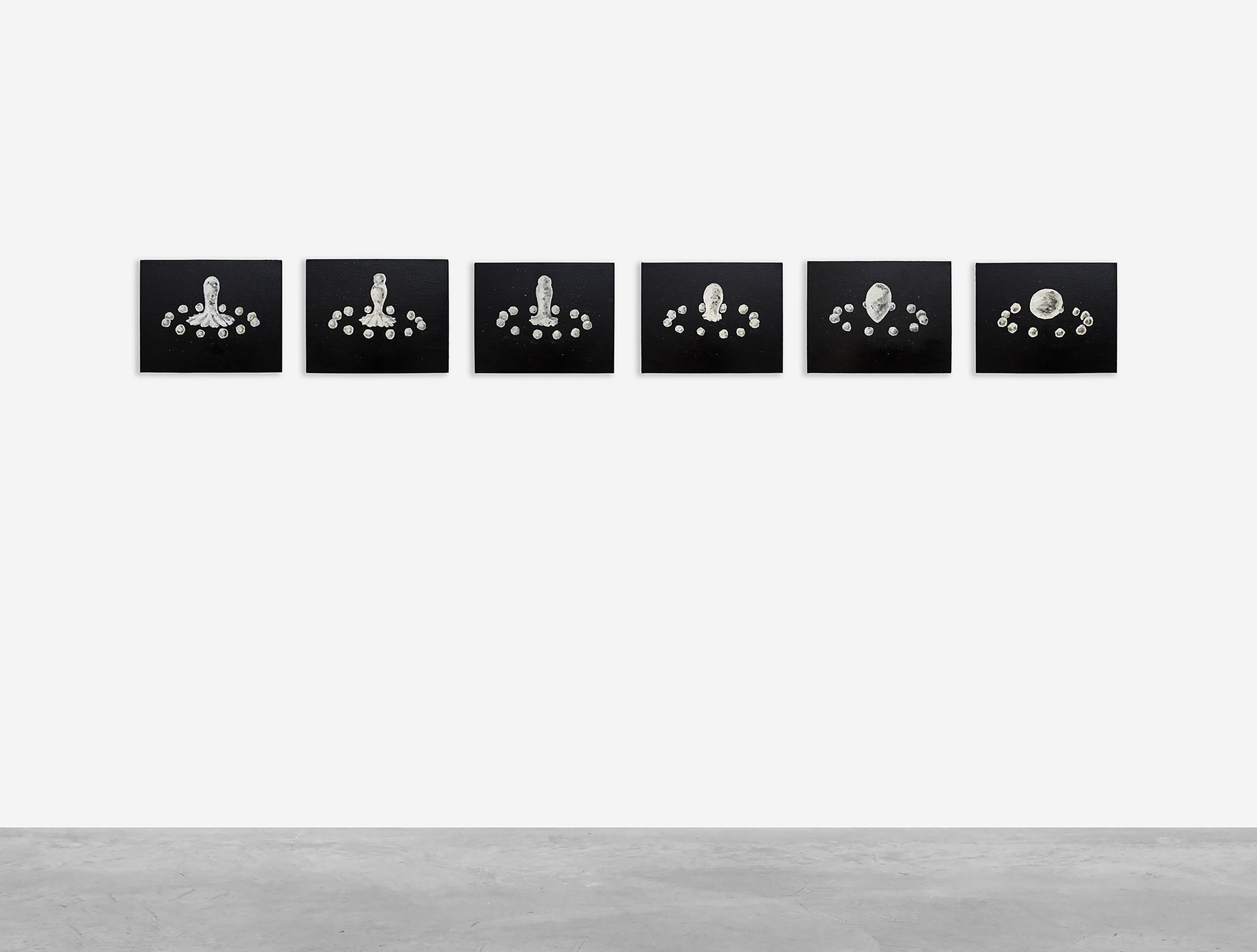
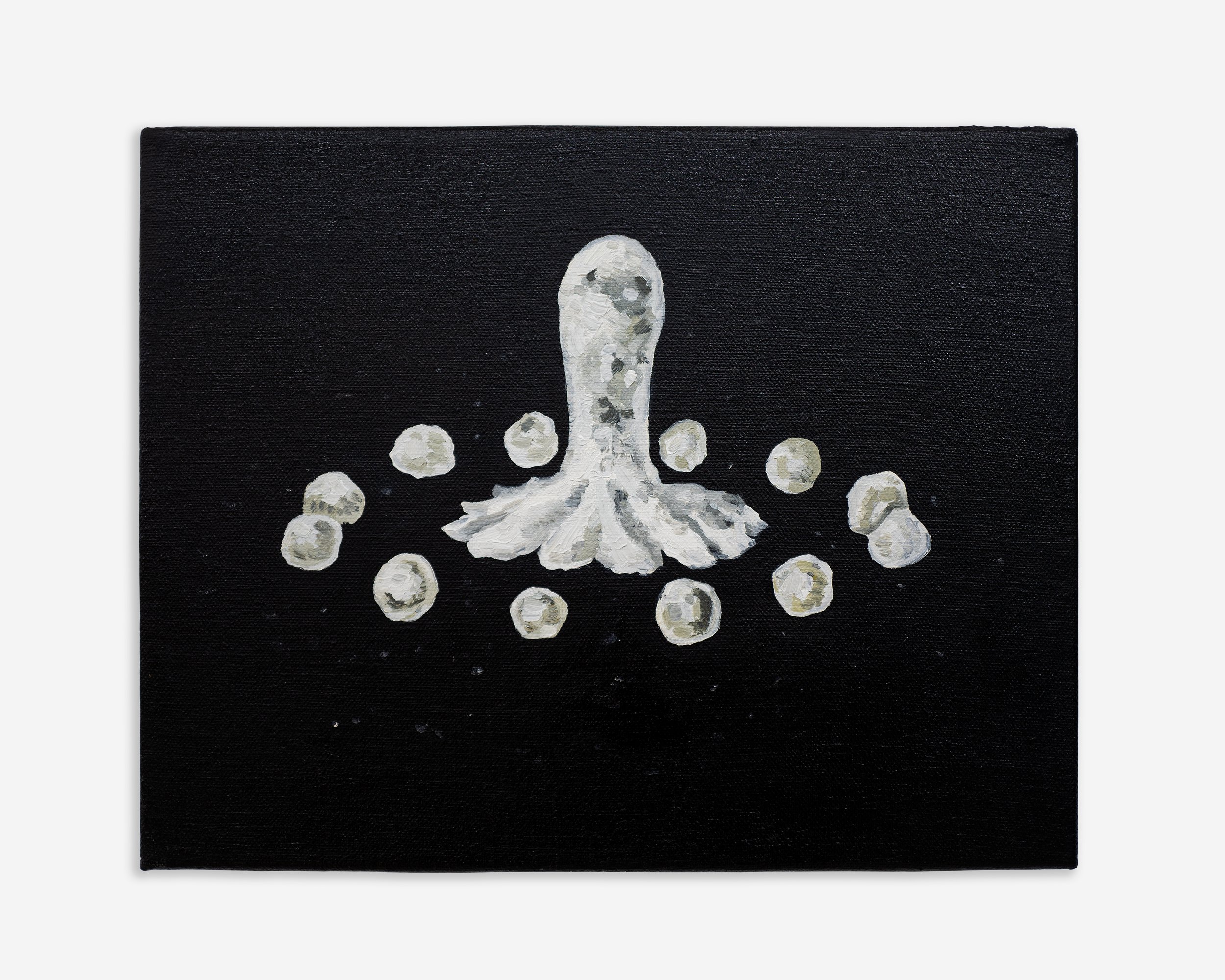
Each panel is painted in a restrained palette of pale blues, grays, and whites against a dark ground. The droplet itself appears as a small, bright form at or near the center of each panel, surrounded by the radiating geometry of the splash. In the first panel, the drop makes contact with the surface, a single luminous point of compression where the sphere of water meets the plane below it. In the second, the disc has formed and the rim is beginning to rise. By the third and fourth panels, the crown is at its full extension, thin jets of water curving outward in symmetrical arcs, each one rendered with a precision that recalls the engraving traditions of scientific illustration. In the fifth, the crown has collapsed and the central column is rising. In the sixth, the column has fallen and the surface is settling into concentric ripples that radiate outward in diminishing waves. The dark ground in each panel serves the same function as the black backdrop Worthington used in his laboratory: it isolates the splash from all visual context, reducing the event to its pure geometry. Water against darkness. Form against void. The sequence could be a series of astronomical photographs of a stellar event, a nova expanding and contracting across six frames, were it not for the unmistakable physics of liquid that identifies it as something terrestrial, something small, something that happens every time it rains on a puddle.
The paint handling in these panels carries the weight of a deliberate paradox. Tan Mu has rendered the fastest event in fluid dynamics, a splash that resolves in less than a tenth of a second, using a medium that requires hours of patient layering. The water in each panel is built from thin, translucent glazes over a dark underpainting, with brighter highlights applied in thicker strokes where the light catches the rim of the crown or the peak of the rebound. The effect is luminous and almost photographic from a distance, but close inspection reveals the individual gestures that construct each form. This is not the smooth, airbrushed surface of a digital rendering. It is a hand-painted approximation of an event that the hand can never witness in real time. The brushstroke that defines the rim of the splash crown in panel three took longer to execute than the entire splash it depicts. The painting is slower than its subject by a factor of roughly one million. This temporal discrepancy is not an accident of medium. It is the argument of the work.
Eadweard Muybridge's motion studies of the 1870s and 1880s established the grammar that Tan Mu's six-panel sequence inherits. In 1872, the former governor of California, Leland Stanford, commissioned Muybridge to determine whether a horse ever lifts all four hooves off the ground simultaneously during a gallop. Muybridge arranged a row of cameras along a racetrack, each triggered by a thread that the horse would break as it passed, producing a sequence of still images that, when viewed in succession, decomposed the gallop into discrete instants. The resulting series, first published as cabinet cards and later as collotype plates in the landmark volume Animal Locomotion (1887), contained 781 plates of humans and animals in motion, each plate presenting multiple phases of a single action arranged in a grid. Muybridge's invention of sequential photography did not merely document motion. It created a new way of seeing, one that parsed continuous movement into a series of frozen states and required the viewer to reassemble the sequence in time. The grammar of the strip, the row of frames read left to right, became the default format for representing duration in still images, and it remains the format that Tan Mu's six-panel work adopts.
Muybridge's horse studies solved a specific question: does the horse's hoof leave the ground? The answer, visible only in the sequential photographs, was yes, but only for a fraction of a second, and only when the legs were gathered under the body rather than extended. The photographs revealed something that no amount of direct observation could confirm, because the human eye cannot parse events that occur in less than a tenth of a second. Muybridge's cameras extended perception into temporal regimes that the unaided body could not reach. Tan Mu's splash sequence inherits this logic. Worthington's 1895 study posed a comparable question: what happens in the forty milliseconds after a drop hits a surface? The answer required a technology that could freeze time at intervals shorter than human perception could resolve. Worthington used photography where it was available and drawing where it was not. Tan Mu uses painting, which cannot freeze time at all, to re-record the same sequence that Worthington first documented. The gesture is not nostalgic. It is a claim about what the hand can do that the lens cannot.
Arthur Mason Worthington was a fellow of the Royal Society and the principal of the Royal Naval College at Greenwich. His study of splashes, conducted over two decades beginning in the 1870s, was one of the earliest sustained investigations of fluid dynamics using high-speed photography. Worthington built a dark room in his laboratory where he could control the lighting and the angle of the camera with precision. He used an electric spark to illuminate the splash for a fraction of a millisecond, freezing the motion at a specific stage. He then photographed the splash at successively later moments by varying the timing of the spark relative to the drop's release. The result was a series of photographs that showed the splash at different points in its evolution, each image a separate experiment, each experiment requiring the drop to be released, the spark to be fired, and the plate to be exposed, all in perfect synchronization. The technical difficulty was immense. Worthington estimated that each successful photograph required dozens of failed attempts, and the frontispiece of his 1895 book shows only three such images: the crown at its maximum extension, the rim beginning to collapse, and the central column rising. For the remaining stages, where even his electric spark apparatus could not resolve the motion with sufficient clarity, he provided hand-drawn illustrations based on his repeated observations of the phenomenon. The physics of the splash that Worthington labored to capture is itself a study in emergent geometry. When a spherical droplet of water strikes a flat surface at terminal velocity, the kinetic energy of the falling drop must be redistributed instantaneously. The water cannot compress, so it moves outward in the only direction available: laterally, along the plane of the surface. The disc that forms on contact is a consequence of this lateral redistribution. The rim rises because the outer edge of the spreading disc decelerates while the inner mass continues to push outward, forcing the excess liquid upward into jets. These jets fragment into droplets when the surface tension of the water can no longer hold them together against the force of the momentum pushing them outward. The resulting crown, with its symmetrical arch of tiny spines, is not a decorative accident. It is the mathematically predictable consequence of the Rayleigh-Taylor instability, the same physical principle that governs the shape of mushroom clouds and the ripples on the surface of a pond. The rebound column that rises from the center of the disc after the crown collapses is called the Worthington jet, named after the man who first documented it systematically. The fact that the most recognizable feature of a splash bears his name is a measure of how thoroughly his study defined the field. Every fluid dynamics textbook that describes the crown, the jet, and the capillary waves that follow still uses the terminology that Worthington established in his 1895 publication.
The fact that Worthington's study relied on hand-drawn illustrations for the stages that photography could not capture is the historical hinge on which Tan Mu's painting turns. The 1895 book already contained a hybrid record: photographic where the technology permitted, hand-drawn where it did not. The hand was not an afterthought. It was the technology of last resort, the instrument that filled the gaps in the camera's temporal resolution. When Tan Mu paints all six stages in oil, she is not replacing the photographs with paintings. She is returning the entire sequence to the medium that Worthington himself used when the camera fell short. The painting does not dispute the authority of the photograph. It occupies the space that the photograph left empty. In her interview for the Atlas of Seeing, Tan Mu describes the relationship explicitly: "Although the frontispiece includes photographs of splashing milk drops, the photographic technology of that era was not yet capable of recording every micro detail with complete precision. The author repeatedly conducted the same experiment, carefully observing and documenting each stage by hand. I am deeply fascinated by this phenomenon because it is both fleeting and endlessly repeatable."
Harold Edgerton's stroboscopic photographs of milk drops, produced at MIT in the 1930s and refined through the 1950s, solved the technical problem that Worthington could not. Edgerton's Milk Drop Coronet (1957) captured the splash at the precise instant when the rim of the crown lifted into its symmetrical jets, each droplet frozen in mid-air against a black background, the geometry of the splash so perfect that it appeared to be a mathematical ideal rather than a physical event. The image became one of the most reproduced photographs of the twentieth century. It hung in science classrooms and art galleries with equal authority, admired by physicists for its precision and by artists for its formal beauty. Edgerton's contribution was not aesthetic. It was technological. His stroboscopic flash could fire for durations as short as a millionth of a second, exposing the film for a temporal interval that Worthington's spark apparatus could not approach. Where Worthington had to observe the splash repeatedly and reconstruct the missing stages from memory, Edgerton could photograph the event directly, capturing every stage with identical technical precision. The hand-drawn illustrations in Worthington's book became obsolete. The camera had caught up with the splash.
Yet Tan Mu's painting does not reference Edgerton. It references Worthington. This is a deliberate choice. By going back to the moment when photography was still incomplete, when the camera needed the hand to fill in what it could not see, Tan Mu positions painting not as a competitor to photography but as a complement to it. Her six panels do not claim to be more accurate than a photograph. They claim something more specific: that painting can re-record a photographic sequence and, in the re-recording, introduce qualities that the photograph cannot contain. Time, for one. Each panel took hours to paint. The total labor of the six-panel sequence represents days of sustained attention to an event that lasted forty milliseconds. The painting compresses that duration into a single viewing, but it also expands it, asking the viewer to spend time with an event that the original observer could barely perceive. The body of the painter, the movement of the hand, the accumulated layers of translucent glaze, these are not merely aesthetic choices. They are a form of attention that the camera cannot provide. The camera freezes. The painter dwells.
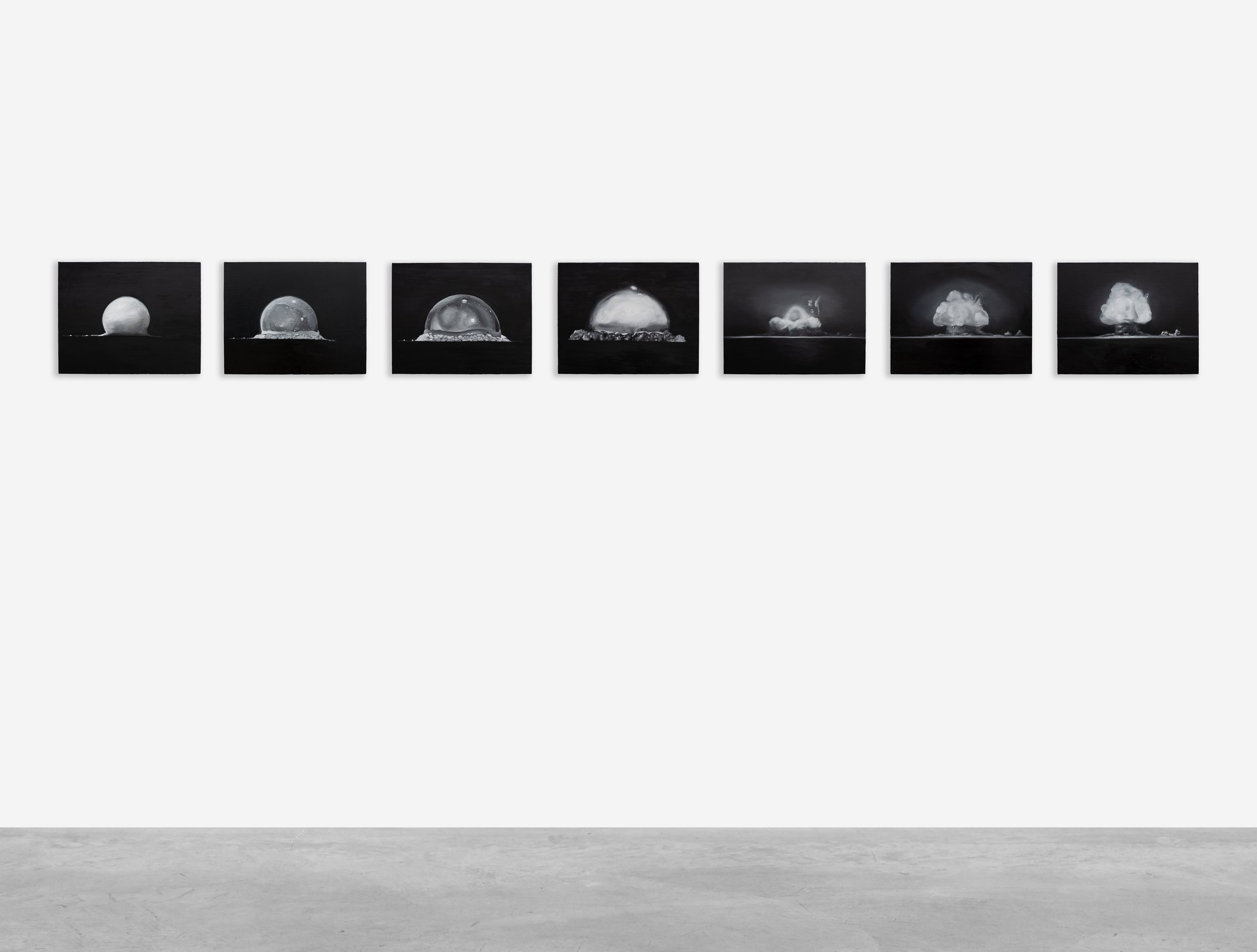
Li Yizhuo, reviewing the DAWN exhibition at Peres Projects in Berlin, noted that "two series of paintings, The Splash of a Drop (2022) and Trinity Testing (2020), of radically different topics, bear striking resemblance in their form, palette, and sequence." The observation is precise. Trinity Testing, also in six panels, also 28 x 36 cm each, also oil on linen, also arranged as a horizontal sequence, depicts the successive stages of a nuclear explosion rather than the stages of a water splash. The formal similarity is not coincidental. Both works use the same six-panel format, the same dark ground, the same progression from a central bright form to radiating geometry to dissipation. Both works take an event that unfolds in a fraction of a second and slow it down to the speed of looking. But the subjects could not be more different. One is the smallest possible splash, a droplet of water no larger than a pea hitting a flat surface. The other is the largest possible explosion, a nuclear fireball that vaporizes everything within its radius. The paintings look alike because the structure of rapid transformation, the sequence from impact through expansion to dissipation, is the same whether the event is measured in milliliters or in kilotons. Tan Mu has discovered that the formal grammar of the splash and the formal grammar of the explosion share a common syntax. Both begin with a point of contact. Both expand outward in symmetrical geometries. Both dissipate into concentric rings. The scale changes by orders of magnitude. The shape does not.
Tan Mu's own description of her process confirms the documentary intention. "Through painting, I revisited and re-recorded these photographic moments," she says. The word "re-recorded" is careful and precise. She does not say she recreated or reimagined the splash. She re-recorded it, using a different instrument. The analogy is musical. A performance can be recorded on a wax cylinder, on magnetic tape, on a digital file, and each recording captures a different set of information about the same event. The wax cylinder preserves the timbre but not the dynamic range. The tape preserves the dynamics but adds hiss. The digital file preserves the data perfectly but lacks the warmth that listeners attribute to analog media. Tan Mu's six oil paintings are a recording of the splash in the medium of paint. They preserve information that the photograph does not carry: the time it took to make them, the sequence of decisions that built each form, the thickness of the paint where the light strikes the rim of the crown, the thinness of the glaze where the surface settles into ripples. These are not decorative effects. They are data points in a different recording format. The hand records what the lens leaves out, and what the lens leaves out is duration itself, the time that a human being spent looking at an event that lasts forty milliseconds and deciding, panel by panel, stroke by stroke, how to make it stay.