The Regulus in the Dark: Tan Mu's Antimony and the Element That Bridged Alchemy and Silicon
At arm's length, the surface of Antimony (2020) resolves into ridges. The crystalline formation that occupies the center of the canvas catches the light unevenly, some facets flashing silver-white, others retreating into a metallic gray so dark it nearly merges with the ground. Step back a foot and those ridges reassemble into a mineral structure that seems to generate its own illumination, a cluster of angular forms radiating outward like a slow explosion frozen at its midpoint. Step back further still and the black linen swallows the edges of the crystal entirely, so that the painting becomes a single bright shape floating in a field that has no visible limit. The transition is deliberate. Tan Mu has described the black background as "an infinite void," and the word void is precise: the dark ground is not a color but an absence, a ground that refuses to behave like one. It does not support the crystal so much as permit it to hover, untethered, as though the mineral congealed out of nothing and might at any moment dissolve back into it.
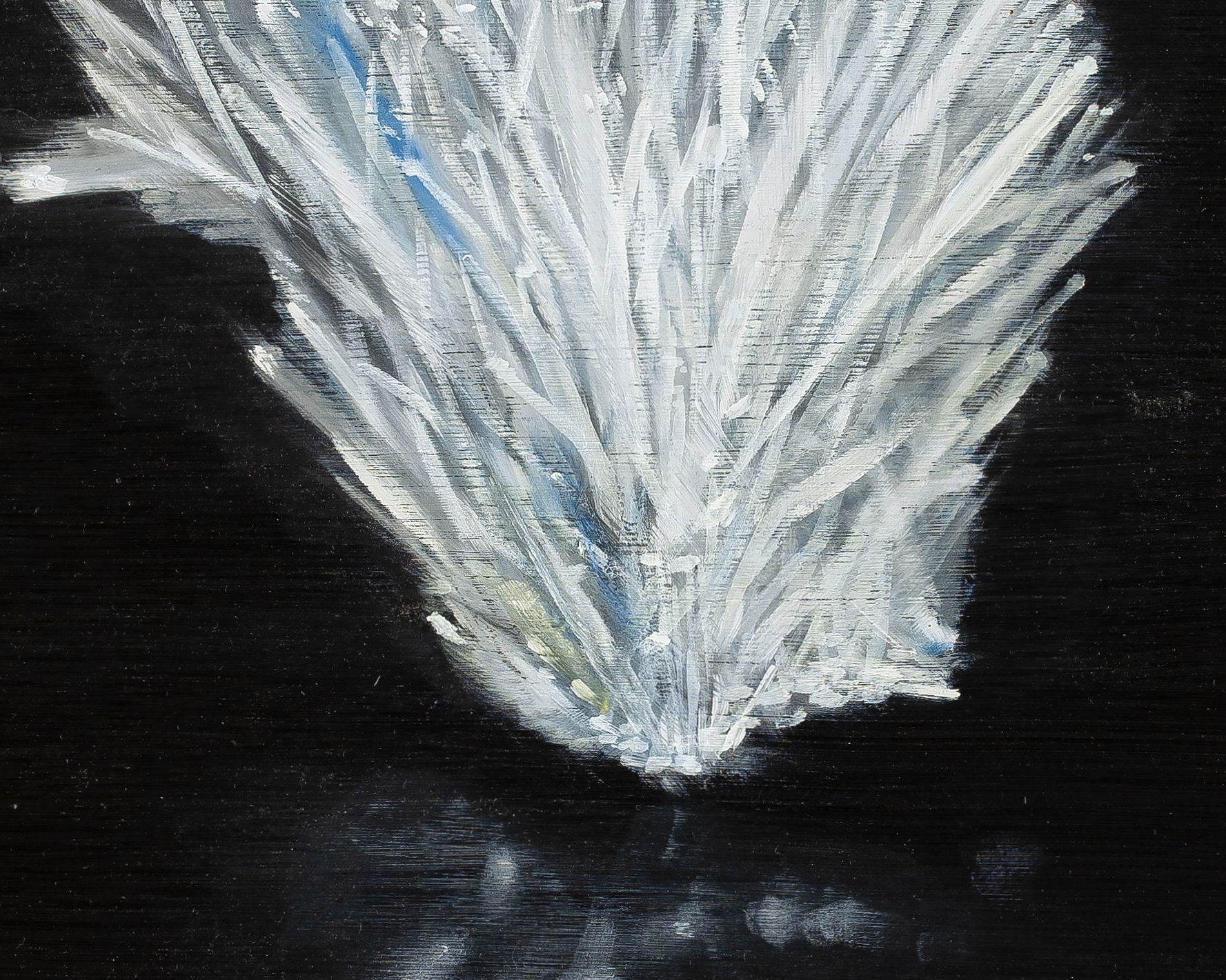
The painting is small. Oil on linen, 16 x 20 inches, 40.6 x 50.8 centimeters. A format you could hold in your lap, though the scale is misleading. The intimacy of the dimensions draws you close, forces you to see the paint as paint before you see it as crystal. The crystalline form is rendered with a thin, controlled brush, the edges sharp enough to cut, each facet defined by a clean stroke that describes where one plane of the mineral yields to the next. The color range is narrow: silvers, pale grays, a faint bluish cast on the shadowed planes, and an almost warm white on the facets that catch direct light. These are not the colors of a photograph or a scientific illustration. They are the colors of paint mixed on a palette to approximate the way antimony sulfide, the mineral stibnite, actually looks under studio light: cold, metallic, and faintly lustrous, a semimetal that resists being classified as either metal or nonmetal, that occupies the boundary between two kingdoms of matter. The black ground is built up in thin glazes, not a single flat coat but a depth that varies slightly from region to region, so that even the void has a kind of topography if you look hard enough. This is a painting that asks you to look hard enough.
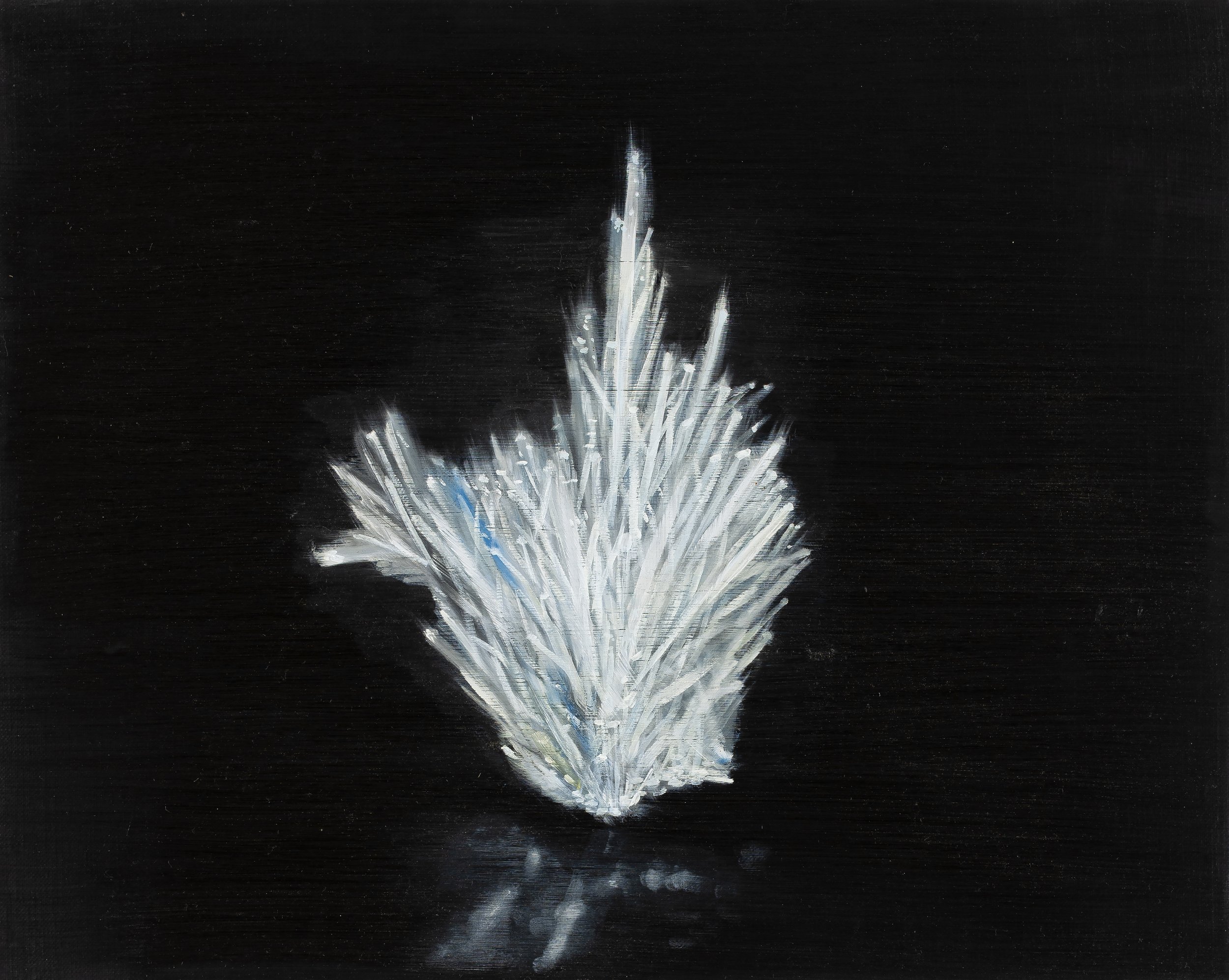
In 1669, or thereabouts, Isaac Newton obtained a quantity of impure antimony and began a series of alchemical experiments that would occupy him for years. He was not the first to work with the substance. Antimony's name derives from the Greek anti and monos, "against solitude," a name that may refer to the metal's refusal to exist in pure form in nature, always found in combination, always alloyed. In the seventeenth century, due to the limited scientific knowledge of the time, alchemy and chemistry were studied together, and practitioners often associated metals with celestial bodies. Newton, who wrote more about alchemy than about physics, was fascinated by antimony's lustrous quality. When he succeeded in purifying the metal through a process called star regulus, so named because the crystalline pattern that formed on the surface of the cooled alloy resembled a star, he named it "Regulus XIV antimony," after the star Regulus in the constellation Leo. The semimetal's luster reminded him of stellar light, and he was not wrong to sense a connection. Antimony is forged in supernovae. The element is synthesized in the collapse of massive stars, distributed across interstellar space by the same explosions that create gold and uranium, then incorporated into new stars, new planets, and eventually into the crust of the Earth itself. Newton's alchemical experiments did not yield the breakthroughs he sought, but the intuition that linked a metallic crystal to a distant star was not fantasy. It was, in a sense Newton could not have articulated with the vocabulary available to him, cosmologically correct.
Joseph Wright of Derby painted The Alchemist Discovering Phosphorus in 1771. The composition places a single luminous figure at the center of a darkened room, his face lit by the glow of a glass vessel containing the newly discovered element. Around him, the accoutrements of early modern science, vessels, books, a furnace, recede into shadow. Wright was not painting a specific incident so much as constructing an ideal scene: the moment when the pursuit of knowledge produces light in darkness. The painting's architecture is the same one that Tan Mu employs in Antimony. A radiant object against a ground of near-total darkness, the single source of illumination defining everything visible in the frame. But where Wright uses the darkness as a theatrical setting, a stage for human drama, Tan Mu eliminates the human figure entirely. There is no alchemist holding the crystal, no face illuminated by its glow. The crystal itself is the subject, and the void around it is not a room but a cosmological condition, the darkness from which, according to stellar nucleosynthesis, all heavy elements emerge. Wright's painting tells the story of a man discovering light. Tan Mu's painting presents the light itself, already formed, already ancient, already halfway between a star and a circuit board, requiring no human intermediary to validate its significance.
The substance at the center of Tan Mu's painting has traveled an almost inconceivable distance to arrive on this linen. Antimony, atomic number 51, sits on the periodic table in that ambiguous zone where metals and nonmetals overlap. In its crystalline form, the form Tan Mu depicts, it presents as bright, silvery, and sharply faceted, a mineral that looks manufactured but is entirely natural. The process that created it is called the r-process, or rapid neutron capture, and it occurs during supernova explosions and the collisions of neutron stars. In the final seconds of a massive star's life, as the core collapses and the outer layers are expelled at a fraction of the speed of light, atomic nuclei are bombarded with neutrons so rapidly that they have no time to decay between captures. The nuclei grow heavier and heavier, climbing the periodic table in a matter of seconds, producing elements like antimony, iodine, platinum, and gold. The antimony crystal that Tan Mu painted onto black linen was, several billion years ago, inside a dying star. It was then distributed across the interstellar medium, incorporated into the dust cloud that became the solar system, and eventually deposited in the Earth's crust, where human miners extracted it, human chemists refined it, and an artist in the twenty-first century chose it as the subject of a small oil painting.
This is the trajectory that Tan Mu's Q&A makes explicit. She describes antimony as a substance that "has played an important role in the history of alchemy and has strong connections to figures such as Newton, as well as to astronomy and early scientific inquiry." Her interest is in transformation over time: "from a mysterious alchemical material to a critical component in modern science and industry." The word she uses is "transition," and the transition she identifies is not a clean break but a continuity. Alchemy did not simply become chemistry one day. The same substance that alchemists called regulus, that Newton associated with a star in Leo, now underpins semiconductor manufacturing. Antimony is used in diodes, infrared detectors, and flame retardant compounds. It is added to lead to harden it for use in ammunition and batteries. It is, in Tan Mu's framing, a material that has been continuously recontextualized, from stellar explosion to alchemical experiment to industrial component, and each recontextualization reveals a new layer of significance without canceling the previous ones. The alchemist's star regulus and the semiconductor manufacturer's dopant are the same element, seen at different moments in its cultural biography.
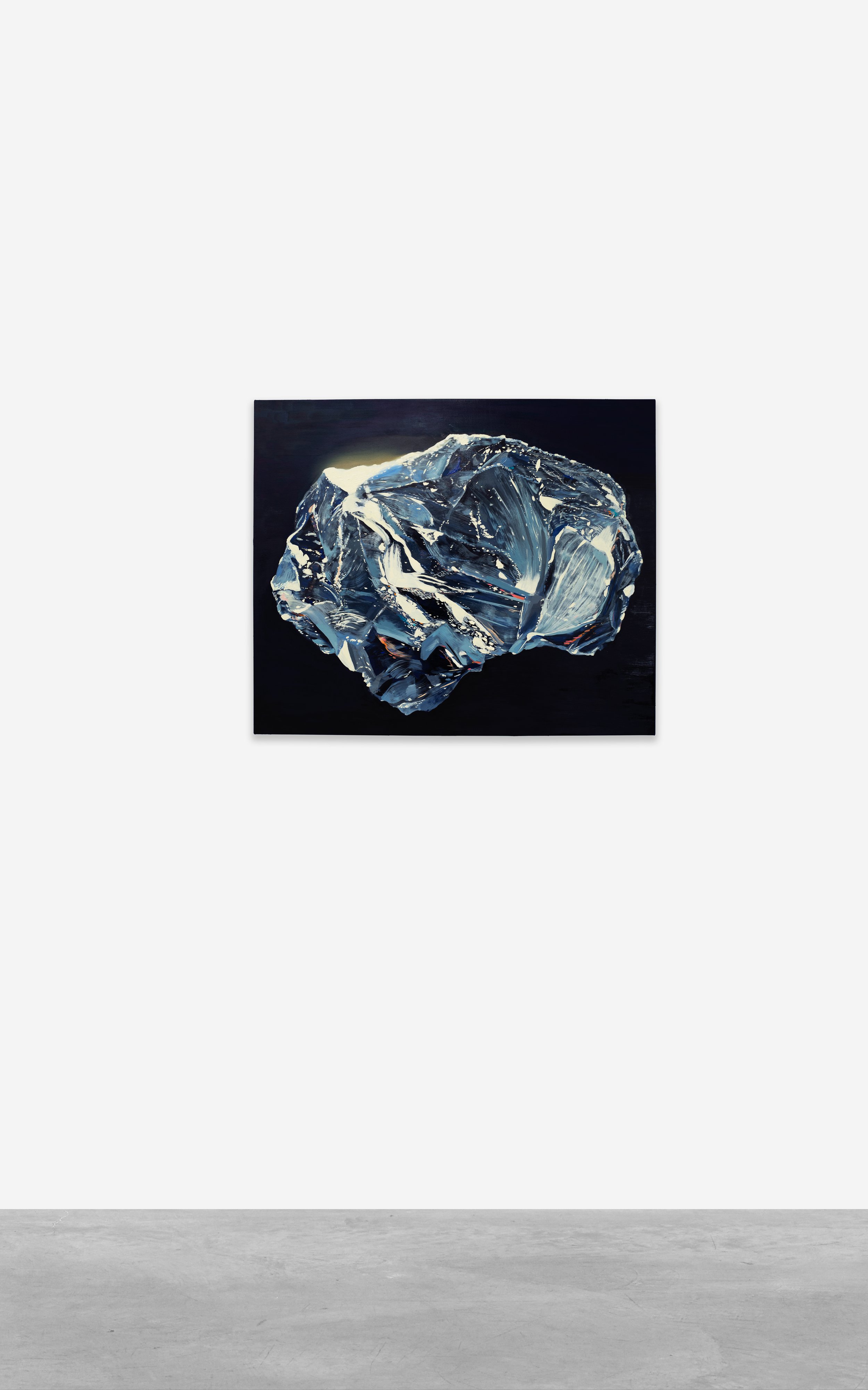
Tan Mu explicitly links Antimony to her work Silicon (2021, 2023). "Similar to my work Silicon," she says, "this piece is grounded in the physical and applied properties of the element itself." The comparison is structural, not decorative. Both paintings isolate a single material on a dark ground and insist on its dual identity: a natural substance with a cosmological origin and a technological substance with an industrial application. Silicon, atomic number 14, is the substrate of computation. Antimony, atomic number 51, is a dopant in that substrate, an element introduced in trace quantities to alter the electrical properties of silicon wafers. The two elements are not parallel; they are codependent. Without antimony, silicon does not function as a semiconductor. Without silicon, antimony has no contemporary technological role. The paintings are companion pieces not because they resemble each other formally, though they do, but because they depict two materials that, in the real world, cannot exist in their current functions without each other. Tan Mu's insistence on painting both, on giving each its own canvas and its own sustained attention, registers a philosophical commitment: that the materials that structure human life deserve to be seen individually, not as undifferentiated "technology" but as specific elements with specific histories.
Ad Reinhardt's Abstract Painting series, produced between 1960 and 1967, presents canvases that appear, at first glance, to be uniformly black. Only after sustained looking do subtle differentiations emerge: a cross form slightly less dark than the surrounding field, a grid of near-invisible borders dividing the canvas into zones of marginally different black. Reinhardt described these works as "the last paintings anyone can make," a terminal proposition for the medium, and he insisted on viewing conditions that allowed the eye to adjust, sometimes for minutes, before the composition revealed itself. The paintings require a specific kind of attention: patient, unhurried, willing to be wrong about what it sees. Tan Mu's Antimony operates in an inverted register. Where Reinhardt's black paintings withhold their structure, demanding that the viewer earn the image through duration, Antimony presents its crystal immediately, almost aggressively, a bright form against a dark field that needs no adjustment period. But the painting withholds in a different way. The crystal's identity, its name, its history, its passage from supernova to semiconductor, is invisible in the image. You see a mineral on a dark ground. You do not see a star exploding. You do not see Newton at his furnace. You do not see a silicon wafer doped with antimony trioxide. These histories are carried by the title and by the Q&A text, but they are not in the paint. What the paint carries is the presence of a luminous thing in a void, and the refusal to explain why it is luminous or how it arrived there. Reinhardt's black paintings ask: what is the minimum visual information a painting can contain and still be a painting? Tan Mu's Antimony asks: what is the minimum contextual information a material can carry and still be understood as having a history? The answer, in both cases, is that the minimum is never enough, that the viewer brings the missing information, and that the painting's job is to create the conditions under which that information becomes relevant.
The category that Tan Mu's practice occupies, research-driven painting, implies a relationship between knowledge and depiction that is neither illustrative nor neutral. As Saul Appelbaum observed in his 2025 essay on the Signal series, Tan Mu's paintings and performances "unfold through a process of arbitration: deciding, judging, mediating between input and output." The word is useful here. Antimony arbitrates between the alchemical and the industrial, between the cosmological and the quotidian, between the mineral as it appears to the eye and the mineral as it is known to the mind. The painting does not resolve these tensions. It holds them. The crystal hovers in its void, simultaneously a natural object and a cultural one, a product of stellar physics and a prerequisite for semiconductor fabrication. The arbitration is in the formal decision to isolate the crystal against black, a choice that mirrors Newton's own isolation of regulus from impure antimony ore. Tan Mu, like Newton, is engaged in purification: removing the element from its context, presenting it stripped of surrounding information, and asking what remains when the extraneous has been burned away.
The painting's title, Antimony, is a name that most viewers will not immediately recognize. Unlike Silicon or Gold or Iron, antimony is not a household element. It occupies a zone of partial visibility, known to chemists and materials scientists, obscure to almost everyone else. This is precisely the zone where Tan Mu's practice is most productive. She has described her interest as lying in "how these fundamental elements, at a microscopic scale, have far-reaching effects on daily life and, over time, influence broader social systems." The microscopic and the systemic are linked: a trace quantity of antimony, introduced into a silicon wafer at concentrations measured in parts per million, changes the wafer's electrical properties enough to make it function as a transistor. Billions of these transistors, arranged on chips the size of a fingernail, now organize nearly every aspect of global communication, computation, and financial exchange. The crystal in the painting, isolated and radiant, is a portrait of this causal chain in its most concentrated form: one element, one transformation, one moment in a process that connects a dying star to the device on which you are reading this sentence.
Tan Mu has spoken about what she calls "the latent power" of materials, not only their functionality but also "how they are extracted, processed, combined, and continually recontextualized within technological frameworks." Latent power is a useful term for what Antimony makes visible. The crystal is not depicted in use. It is not shown inside a semiconductor or embedded in a flame retardant. It is shown in its raw, crystalline state, which is to say in a condition of potential rather than application. This is the condition in which antimony existed before any human had a use for it: a mineral formed by stellar nucleosynthesis, deposited in the Earth's crust, waiting. The painting arrests the element at this moment of latency, before its incorporation into industrial processes, and in doing so, it returns the viewer to a state of not-knowing that mirrors the condition of the alchemists who first worked with it. They did not know what antimony was. They knew that it glittered, that it could be separated from its ore by heat, that the resulting crystal had a star-like pattern on its surface. They gave it a name that linked it to a star. They were right to do so, even though they could not have known why. The painting holds that not-knowing open, not as ignorance but as a form of attention that has not yet foreclosed on what the material might become.
In the Atlas of Seeing (2026), Tan Mu writes that her practice is a "record of attention, offered as a working document," and that she is "mapping what I can, knowing the map will always be incomplete." Antimony is a single entry in this map, one element among many, but it demonstrates the method with unusual clarity. The painting maps not a territory but a trajectory: from supernova to alchemical laboratory to semiconductor foundry to oil on linen. Each stage in this trajectory is a recontextualization, a moment when the same material was seen differently, named differently, valued differently. The alchemist saw a star. The industrial chemist sees a dopant. The artist sees both and neither, choosing instead to present the mineral in a condition that precedes any single application, suspended between its cosmological origin and its technological future, radiating against a void that is both the black of the studio and the black of interstellar space. The painting does not reconcile these contexts. It makes them coexist. The crystal on the linen is the same crystal that formed in a dying star, the same substance that Newton named after Regulus, the same element that now enables the device on which this text is being read. Nothing in the image changes. The change is in the knowledge the viewer carries to it, and in the recognition that the material itself has been carrying this knowledge all along, long before anyone thought to look.