Seven Detonations in Ten Days: Tan Mu's Trinity Testing and the Second That Split the World
One painting per day, for seven consecutive days, roughly ten hours of work on each. Tan Mu has described the making of Trinity Testing (2020) with a precision that mirrors the subject itself: a controlled sequence, a measured expenditure of energy, a fixed duration allocated to an unrepeatable event. Each of the seven canvases captures a single frame from the archival footage of American nuclear tests, a mushroom cloud at a different stage of its formation, frozen at the instant when immense energy restructures the air around it. The format is small, 28 x 36 cm each, 11 x 14 inches, and the seven panels read together span 28 x 252 cm, 11 x 98 inches, a horizontal sequence of detonations that the eye travels across like a strip of film or a row of test results. The artist's account of the process carries its own quiet charge: "Each day felt like the birth of something new, almost as if I were conducting an experiment with time." The verb is unexpected. Not painting, not depicting, not documenting. Conducting. The word belongs to a laboratory, not a studio, and it locates the act of painting within a tradition of controlled repetition that the subject matter, nuclear weapons testing, shares with scientific experiment itself.
The seven panels of Trinity Testing are painted in oil on linen, each one a monochrome rendering of a mushroom cloud at a distinct moment of its expansion. The palette is narrow: whites, grays, and blacks that shift across the sequence from the searing white of the initial fireball to the dispersed, almost translucent grays of the cloud's later stages. In the earliest panels, the explosion is a column of light erupting upward from a dark ground, the column's edges sharp and defined, the paint applied with a controlled density that gives the form a sculptural weight. In the later panels, the cloud has begun to spread and thin, the edges softening into the atmosphere, the paint itself becoming more translucent, allowing the linen weave to show through in places. This is not a failure of technique but an enactment of the subject's physics: the explosion begins as a concentrated mass and ends as dispersed energy, and the paint's behavior, from opaque to translucent, from defined edge to soft dissipation, follows the same trajectory. The black ground that underlies each panel is not uniform. It varies slightly in depth, sometimes dense and velvety, sometimes allowing a faint warmth to surface, and this variation gives the sequence a subtle rhythm that prevents the seven panels from reading as mechanical reproductions of a single idea. Each ground is a different void, and each cloud fills it differently.
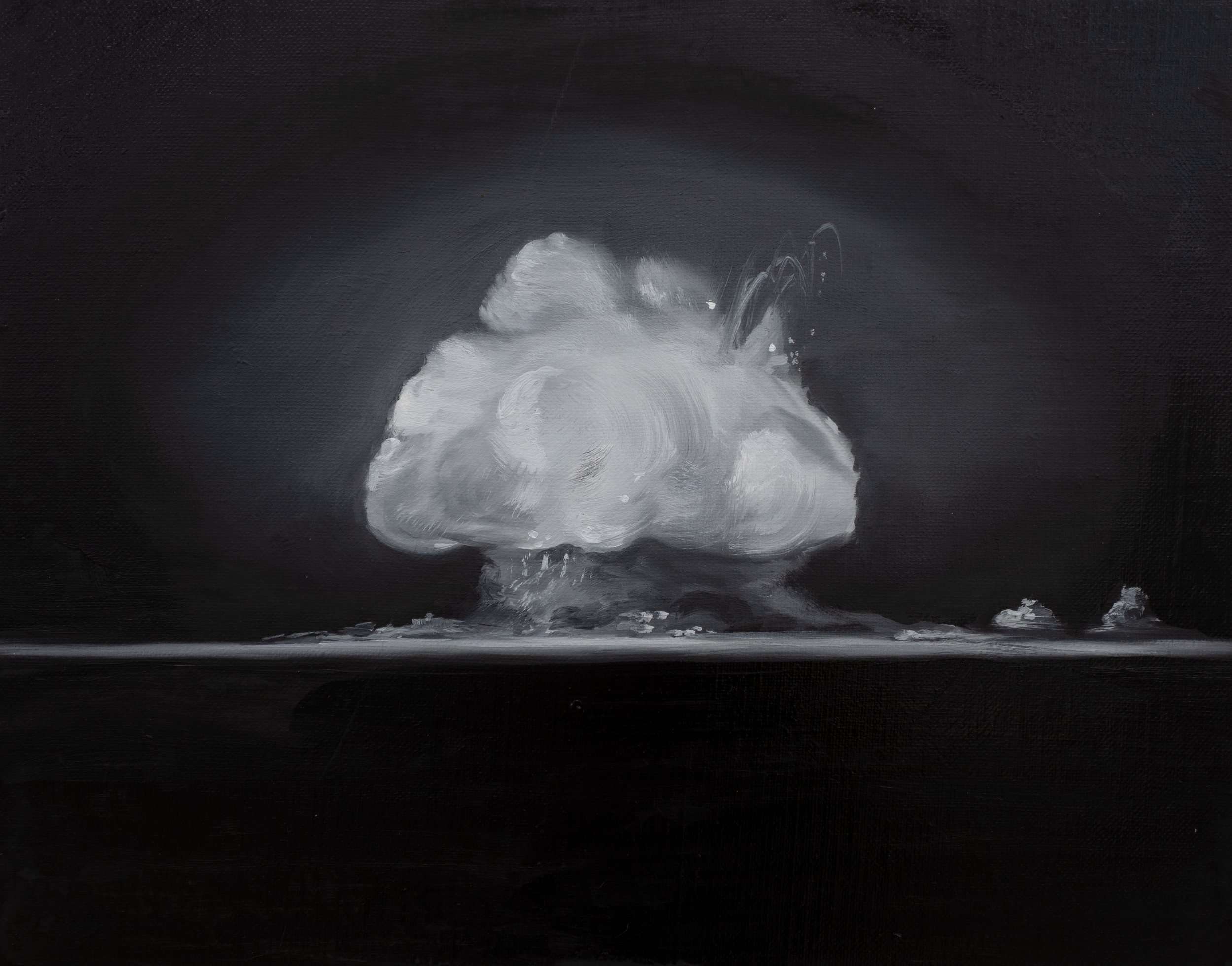
Barnett Newman completed Onement I in 1948, three years after the Trinity test detonated the world's first nuclear device in the New Mexico desert. The painting is modest in scale, a vertical zip of cadmium orange bisecting a field of dark cadmium red, and it is conventionally dated as the moment when Newman found his mature language. The zip is not a line drawn on a surface. It is a vertical event that divides the field into two zones of color that exist in a state of mutual dependence and mutual tension. Newman spent the war years in a state of what he called "silence," unable to paint, convinced that the scale of destruction visited upon the world by nuclear weapons had rendered previous artistic languages inadequate. When he returned to painting, the form he arrived at, the zip, was an assertion of presence against void, a single vertical gesture that establishes a relationship between two expanses of color that would otherwise remain undifferentiated. The structural parallel to Trinity Testing is exact. Tan Mu's mushroom clouds are vertical events that emerge from and define a dark ground. Without the cloud, the ground is a monochrome field. Without the ground, the cloud has no context, no scale, no sense of the emptiness from which it erupts. The relationship is the same one that Newman discovered in 1948: the mark and the field define each other, and neither has meaning in isolation. Newman said of his work that it was about "the self" in the atomic age, and he meant this literally: the zip as a figure asserting its existence against the void, as a person might assert their existence against the annihilation that nuclear weapons made conceptually possible. Tan Mu's clouds carry a related existential weight, but they approach the question from the opposite direction. Where Newman paints the assertion of presence, Tan Mu paints the assertion of energy. The cloud is not a figure standing against a ground. It is energy released into a void, and the void is what remains after the energy has passed.
Newman made his most explicit statement about the atomic age in the titles and structure of his Stations of the Cross series (1958 to 1966), fourteen paintings subtitled "Lema Sabachthani," meaning "Why have you forsaken me," which he interpreted not as Christ's lament but as the cry of humanity in the face of nuclear annihilation. The stations are sparse, almost empty canvases, their zips thin and isolated against vast white fields. The scale is large, but the gesture is small, a single line traversing an immense emptiness. Newman insisted that the series was not about the Passion but about the human capacity to ask the unanswerable question in the face of total destruction. Tan Mu's Trinity Testing occupies the same territory from a different vantage. Where Newman's stations are devotional in form, sequential and processional, Tan Mu's seven panels are documentary in form, sequential and evidential. Newman asks why. Tan Mu shows what. The difference is generational, philosophical, and methodological. Newman, working in the immediate aftermath of the war, when the bomb was still a raw wound in the American psyche, responds with a kind of sacred abstraction, stripping the canvas to its minimal components in the same way that the bomb stripped Hiroshima to its minimal components: ash, shadow, void. Tan Mu, working three quarters of a century later, when nuclear testing is historical footage rather than lived experience, responds by painting the archival image directly, by rendering the mushroom cloud in oil with the same attentive materiality she brings to submarine cables and quantum computers. The sacred and the documentary are not opposites. They are two ways of refusing to look away.
The subject of Trinity Testing is the Trinity test itself, conducted at 5:29 a.m. on July 16, 1945, in the Jornada del Muerto desert in New Mexico. The device detonated was a plutonium implosion weapon, the same design that would be dropped on Nagasaki twenty-four days later. The test was named by J. Robert Oppenheimer, who borrowed the term from John Donne's Holy Sonnet XIV: "Batter my heart, three-person'd God." The name was meant to evoke the complexity of the undertaking, the convergence of multiple forces and disciplines, but its theological resonance proved inescapable. The detonation released energy equivalent to approximately 20 kilotons of TNT, vaporized the steel tower from which the device was suspended, fused the desert sand into a greenish glass now called trinitite, and produced a mushroom cloud that rose to an altitude of over 12,000 meters. The light of the explosion was visible from over 250 miles away. Witnesses described the colors of the fireball cycling through white, yellow, orange, and red before settling into the now-familiar mushroom shape. Oppenheimer, watching from a bunker 10,000 yards away, later recalled a line from the Bhagavad Gita: "Now I am become Death, the destroyer of worlds." Tan Mu's seven panels are not illustrations of this single event. They draw from multiple archival photographs of American nuclear tests, the Trinity test among them, to construct a sequence that captures the morphology of a nuclear explosion from its earliest burst through the full formation and dispersal of the mushroom cloud. Each panel isolates a fraction of a second. Together, they constitute a visual grammar of detonation.
Tan Mu has spoken about the monochrome palette in terms of vibration. "Removing color helps strip away the familiarity of the visible world," she says. "When images are rendered in black and white, familiar environments become strange, and what we think we understand begins to operate within a different system." The mushroom cloud, stripped of the lurid oranges and reds of the original photographs, "no longer functions solely as an image of explosion but becomes a visual expression of vibrational frequency." This is a precise and unusual claim. The standard reading of monochrome nuclear imagery treats it as documentation: black and white because the archival sources are black and white, because the newsreels and military photographs that recorded these events were made in black and white, and the painter, working from these sources, simply inherits the palette. Tan Mu rejects this inheritance as the sole explanation. Her monochrome is a choice, and the choice converts the image from document to diagram, from a picture of something that happened to a map of the forces that made it happen. Vibration, in this reading, is not a metaphor. Nuclear explosions generate shockwaves that propagate through the atmosphere at speeds exceeding the speed of sound. These shockwaves carry information: about the yield of the device, the composition of the atmosphere, the distance from the detonation point. The mushroom cloud is the visible portion of this vibrational event, the part that can be seen, but it is not the whole event. The whole event extends outward as sound, as heat, as electromagnetic radiation, as seismic disturbance, as radioactive fallout, and as the political and ethical shockwaves that reshaped international relations for the next eighty years. By rendering the cloud in black and white, Tan Mu redirects attention from the spectacle of color to the structure of force, from what the explosion looked like to what it did.
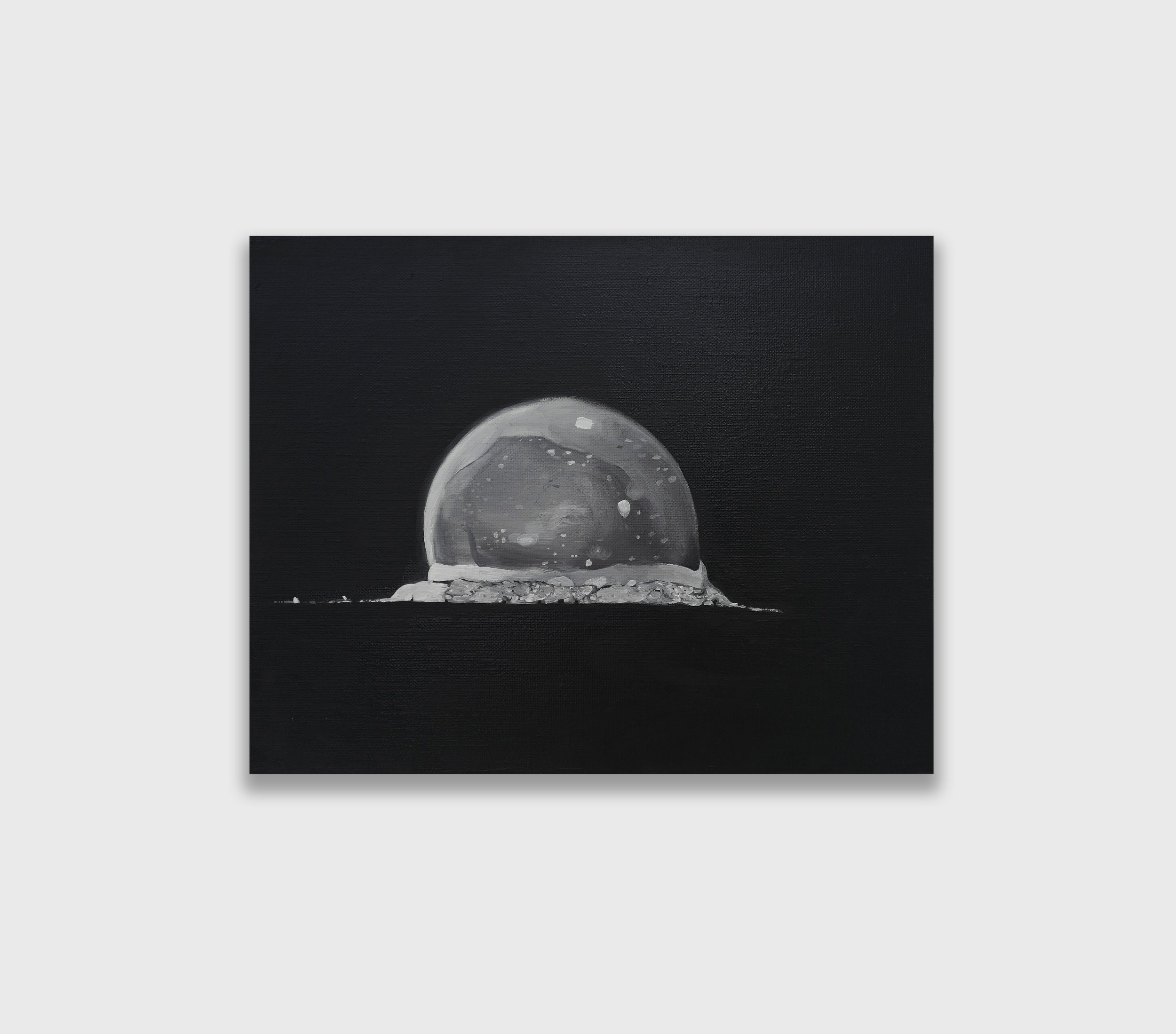
Li Yizhuo, in her 2022 essay "The Widening Gyre," observed that Tan Mu's Trinity Testing and The Splash of a Drop, two series of radically different subjects, "bear striking resemblance in their form, palette, and sequence." The observation is not incidental. It identifies a structural principle at work in Tan Mu's practice that operates independently of subject matter. A nuclear detonation and a milk drop coronet are events of incommensurable scale, one releasing energy sufficient to destroy a city, the other dissipating energy barely sufficient to ripple a saucer. Yet both are captured at the instant of their maximum formal definition, the moment when expanding force meets surrounding medium and produces a shape that is at once chaotic and highly ordered. Li Yizhuo's comparison makes explicit what the paintings already assert: that Tan Mu's practice is organized around the morphology of energy release, not around the moral or historical significance of the event that releases it. This is not a denial of significance. It is a reorganization of attention. The paintings ask the viewer to see the nuclear explosion and the milk drop as instances of the same physical process, and to understand that the process has a shape that can be studied, repeated, and painted, regardless of whether the energy being released is measured in kilotons or in ergs. The comparison also clarifies why the seven panels of Trinity Testing work as a sequence rather than as independent images. Each panel is a frame from a continuous process, and the process is the real subject. The sequence is not a narrative. It is a decomposition of a single event into its constituent stages, the way a high-speed camera decomposes a bullet's flight into frames that the eye cannot register in real time.
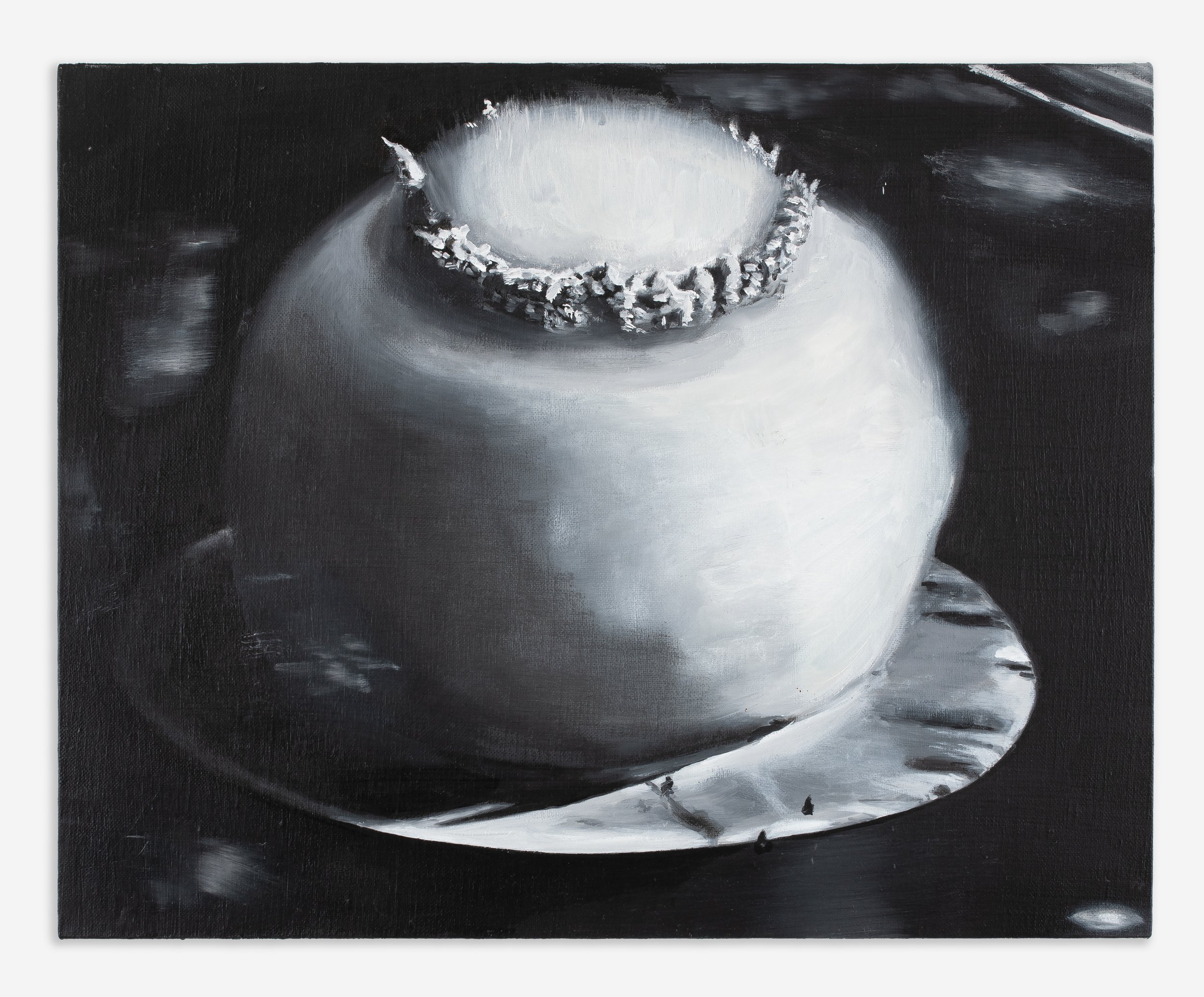
The tension between control and loss of control is built into Trinity Testing at every level, and Tan Mu has addressed it directly. "The carefully controlled size of the canvas stands in quiet contrast to the uncontrollable nature of the energy being depicted," she says. "I approach the mushroom cloud as if it were a calm and precise object, yet the behavior of the paint itself introduces unpredictability and instability." The 11 x 14 inch format is the smallest she regularly uses, and it imposes a discipline that mirrors the discipline of the nuclear test itself. Each test was a controlled experiment: the device placed on a tower or dropped from an aircraft, the instrumentation arrayed at measured distances, the observers stationed in bunkers with darkened viewing ports. The test was designed to be observed, measured, and recorded. It was, in this sense, a kind of scientific painting, an event staged to be seen. But the energy released by the device exceeded the capacity of any instrument to fully measure it, and the consequences of that energy, political, environmental, ethical, exceeded the capacity of any framework to contain it. Tan Mu's small canvases reproduce this structure. They are carefully composed, precisely painted, and deliberately sequenced. But the paint on each panel, in its transitions from opaque to translucent, from sharp edge to soft dispersal, enacts the same release of energy that the image depicts. The medium behaves as the subject behaves. Control produces the conditions for its own loss, and the loss is visible in the paint.
The format of Trinity Testing, seven small panels arranged in a horizontal row, places it within a tradition of serial painting that includes Monet's Grainstacks, Ryman's Classico series, and, most relevantly for this work, Gerhard Richter's 18 October 1977, a series of fifteen paintings based on photographs of the Baader-Meinhof group. Richter's series shares with Trinity Testing a commitment to the found photographic image as source material, a monochrome or near-monochrome palette that distances the viewer from the image's original emotional register, and a serial structure that fragments a single narrative into a sequence of visual events. But where Richter blurs his source photographs, converting the journalistic image into a kind of memory screen, Tan Mu sharpens hers, rendering each stage of the mushroom cloud with a clarity that approaches the clinical. The difference is significant. Richter's blur is an act of mourning, a refusal to let the image remain legible, a way of saying that the events of October 1977 are too painful to be seen clearly. Tan Mu's clarity is an act of attention, a refusal to let the image dissolve into abstraction, a way of saying that the events of July 1945 are too important to be blurred. The mushroom cloud must be seen clearly, not because it is beautiful, but because its clarity is the condition for understanding its consequences. The seven panels do not aestheticize destruction. They document it with the precision that destruction itself demands, and they insist, through their serial structure, that a single image is insufficient. One mushroom cloud is a spectacle. Seven mushroom clouds, each at a different stage, is an analysis.
Tan Mu has described her working process for Trinity Testing as a form of time dilation. "By slowing this moment down through painting, I disrupt linear time. The layering of paint extends that decisive second infinitely, allowing the complex texture of energy transformation to unfold." The statement is more than metaphor. A nuclear detonation proceeds through stages that occupy fractions of a second: the initial flash, the fireball formation, the rise of the column, the condensation of the mushroom cap, the beginning of dispersal. These stages happen faster than the human eye can register them. The archival photographs that Tan Mu works from were made by high-speed cameras capable of thousands of frames per second, cameras that could decompose an event too fast for human perception into a sequence of still images that could be studied at leisure. Painting these images extends the process further. Each panel required roughly ten hours of work. An event that lasted less than a minute is stretched across more than seventy hours of labor. The ratio of depicted time to working time is roughly one to one hundred thousand. This is not a representation of the explosion. It is a temporal inversion, a reversal of the explosion's own speed that converts a fraction of a second into a duration that can be inhabited, studied, and felt. The painting does not capture the explosion. It decelerates it to a pace at which a human body can register what happened.
In the Atlas of Seeing (2026), Tan Mu writes that her practice is "a record of attention, offered as a working document," and that she is "mapping what I can, knowing the map will always be incomplete." Trinity Testing is a map of a detonation. It is not the detonation itself, and it does not pretend to be. It is a sequence of seven still frames that, taken together, approximate the morphology of an event that exceeded every instrument designed to measure it, including the instrument of painting. The map is incomplete by definition. Seven frames cannot capture the full trajectory of a mushroom cloud any more than seven photographs could capture the full extent of the bomb's consequences, which extend from the sand fused into trinitite in the New Mexico desert to the ongoing debate over nuclear deterrence and disarmament. But incompleteness is not failure. It is the condition of every attempt to represent something that exceeds representation, and Tan Mu's acknowledgment of this condition, in the smallness of the format, in the serial structure that refuses the single definitive image, in the paint's own admission of instability, is what gives Trinity Testing its particular gravity. The seven panels do not pretend to contain the explosion. They contain what remains when the explosion has been slowed down, looked at closely, and rendered with the attention that the event itself, in its speed and violence, made impossible. What remains is not the explosion. It is the record of a person standing in a studio, painting one frame per day, for ten days, conducting an experiment with time that the original experimenters could never have imagined: not how to release the energy, but how to live in the aftermath of having released it.