The Grid That Harvests Light: Tan Mu's Solar Farm and the Landscape That Learned to Produce
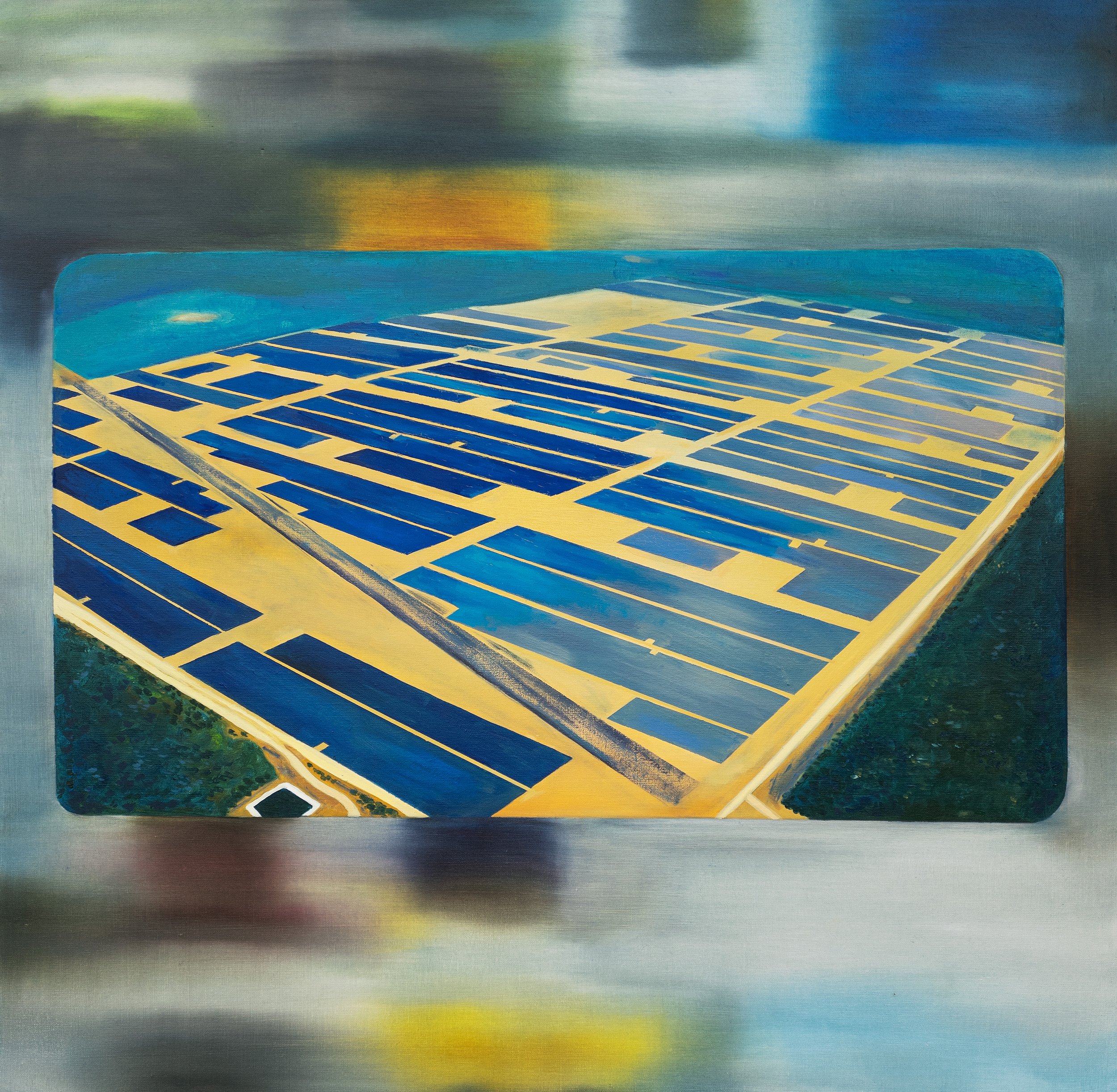
In 2022, the United States hosted over 2,500 utility-scale solar farms, occupying more than 200,000 acres of former agricultural land. Florida, where Tan Mu lives and works, ranked third among states for installed solar capacity. Driving the highways between Miami and the interior, or looking down from the window of an aircraft approaching Fort Lauderdale, the fields of photovoltaic panels are difficult to miss: geometric arrays of dark rectangles laid across flat terrain, their surfaces catching and returning the sunlight in color shifts that change with every passing cloud. Tan Mu has described encountering these arrays repeatedly, observing "how sunlight refracts across their surfaces, producing subtle shifts in color and reflection that change throughout the day," and the observation is itself a kind of painting in reverse: the panels are already doing what paint will later do, catching light and holding it, converting it from something passing and ambient into something captured and directed. Solar Farm (2022) is a painting about this conversion, not only the conversion of sunlight into electricity but the conversion of farmland into energy infrastructure, of aerial view into digital screenshot, and of digital screenshot into oil on linen. Each conversion leaves a residue. The residue in the painting is the blurred photo gallery that drifts behind the solar panels like a half-remembered landscape, the evidence that the image arrived on the artist's phone before it arrived on her canvas.
Solar Farm is oil on linen, 76 x 76 cm, 30 x 30 inches, a square format that reinforces the geometric regularity of the subject. The composition is divided into two zones. The upper and central portion of the canvas is occupied by the solar farm itself: rows of panels arranged in a grid that recedes slightly toward a low horizon line, each panel rendered as a dark rectangle with edges that catch the light in pale blue and silver. The panels are painted with a precision that gives them the character of an architectural rendering, each one a discrete unit in a larger system, each row parallel to the ones above and below it, each rectangle separated from its neighbors by thin lines that read simultaneously as gaps between panels and as the grid lines of a technical drawing. The colors of the panels shift across the surface, from deep navy to a lighter steel blue to a near-white where the light strikes at a direct angle, and these shifts are not decorative. They are the record of sunlight hitting the panels at different angles at different times of day, a compressed chronology of the day's changing light compressed into a single surface. Below and behind the solar farm, occupying the lower third of the canvas, a blurred and indistinct landscape drifts like a dissolving photograph. This is the photo gallery from Tan Mu's phone, rendered in soft focus, its details smudged and its colors desaturated, so that the images it contains, which appear to be additional screenshots of the same farm taken at different times, read as memories or afterimages rather than as present observations. The contrast between the sharp geometry of the panels and the dissolved blur of the photo gallery is the painting's central visual tension, and it enacts in material terms the condition that Tan Mu describes: the contemporary viewer perceives the world through layers of mediation, and the solar farm arrives on the canvas already filtered through a phone screen.
Claude Monet's La Gare Saint-Lazare series, painted in 1877, records the arrival of steam locomotion in the Parisian landscape with a specificity that has since become an indispensable historical document. The series comprises several canvases showing the train station from different angles and at different times of day, the locomotives arriving and departing under canopies of iron and glass, their steam rising in columns and clouds that Monet renders with the same attentiveness he brings to the foliage in his garden scenes at Giverny. The steam is not a byproduct. It is the subject, or at least half of it. The other half is the iron architecture that contains it, the engineered structure of columns, trusses, and glass roofs that transforms the station into a machine for processing trains and passengers. Monet painted these works at a moment when the French railway network was reshaping the geography of daily life, compressing distances, standardizing time across the nation, and creating a new kind of urban space: the station, where nature, in the form of steam and smoke, was produced by industrial activity rather than arriving from outside it. The paintings were not commissioned by the railway company. Monet sought the subject himself, persuading the station authorities to delay trains and hold them in position so that he could capture the steam at its most dramatic. He was not documenting the station. He was painting it, which is a different activity, one that involves selecting, compressing, and translating a visual experience into the terms of oil paint.
Tan Mu has cited Monet's train stations explicitly, noting that his paintings "not only captured new technologies but later became valuable historical records," and that scholars now study them "to understand environmental conditions and technological shifts of the nineteenth century." The reference is precise and productive. Monet painted steam engines at the moment when they were reshaping the landscape of Paris. Tan Mu paints solar panels at the moment when they are reshaping the landscape of Florida, and of the world. Both artists chose to depict a technology that was in the process of converting one form of energy into another, steam engines converting coal into motion, solar panels converting sunlight into electricity, and both chose to depict the visible evidence of that conversion, steam clouds and reflected light, rather than the invisible process itself. The parallel extends to the medium. Monet's steam is rendered in brushstrokes that dissolve the boundary between the natural and the industrial. The steam rising from the locomotives is visually continuous with the clouds in the sky behind the station, so that the viewer cannot always tell where the exhaust ends and the atmosphere begins. Tan Mu's reflected light is rendered in brushstrokes that dissolve the boundary between the technological and the photographic. The blue and silver highlights on the panel surfaces are visually continuous with the blurred images in the phone gallery, so that the viewer cannot always tell where the solar farm ends and the digital image of the solar farm begins. In both cases, the painting makes visible a condition that the technology itself produces: the interpenetration of the natural and the engineered, the atmosphere and the exhaust, the landscape and the screenshot.
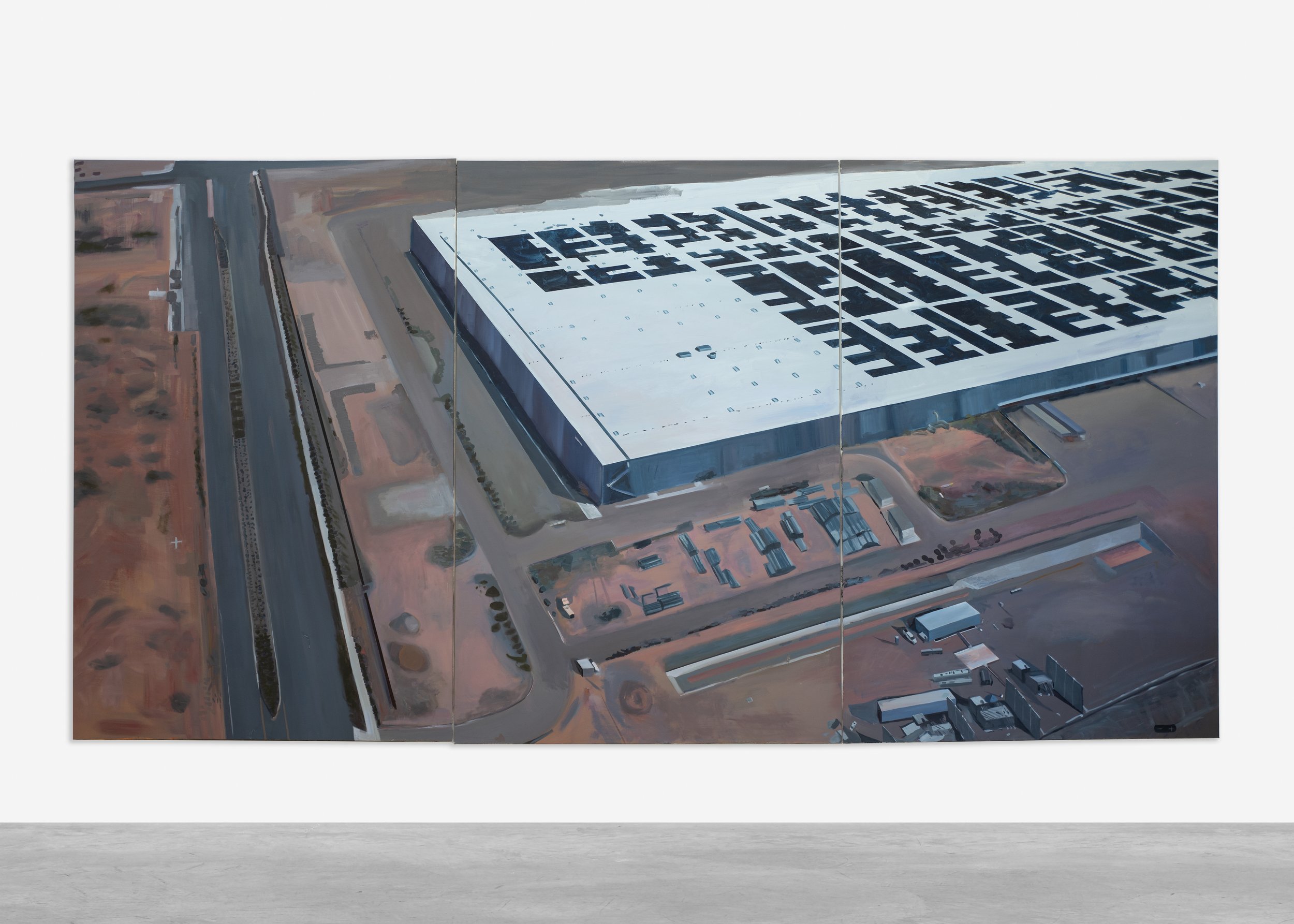
Tan Mu describes solar panels as "not merely technological objects" but "symbols of capital, infrastructure, and humanity's intervention in nature." The formulation locates the panels at the intersection of three systems that are rarely considered together: the financial, the material, and the ecological. A utility-scale solar farm is a capital investment that occupies agricultural land, replaces one form of harvest, the harvest of crops, with another, the harvest of photons, and in doing so, transforms the landscape from a biological system organized around the seasonal cycle of planting and reaping into an engineered system organized around the daily cycle of sunlight and shadow. The transformation is not subtle. A field of solar panels is not a field of wheat. The wheat grows, changes color, bends in the wind, is harvested, and leaves stubble that decays back into the soil. The solar panels are fixed, geometric, reflective, and silent. They do not grow. They convert. They take the light that once fell on whatever grew in that field, grass, soybeans, citrus groves, and they redirect it into an electrical grid that carries it away to be consumed at a distance, in homes and offices and data centers that the panels themselves cannot see. Tan Mu's decision to paint this subject in oil, a medium whose history is inseparable from the representation of landscape, is a statement about where solar farms belong in the trajectory of Western painting. They belong where the train stations belonged in 1877: at the center of the visual culture's attempt to come to terms with a technology that is remaking the landscape faster than the culture can develop a vocabulary for it.
The elevated perspective of Solar Farm is one of the painting's most deliberate choices. Tan Mu has described it as "similar to what one might see from an airplane window or within a video game interface," and the comparison is exact. The viewpoint is not a god's-eye view. It is a passenger's view, the view of someone sitting in a window seat at 30,000 feet, looking down at a landscape that has been flattened by altitude into a pattern of rectangles and lines, or the view of someone holding a phone, scrolling through satellite images of the same terrain at a zoom level that makes the individual panels legible. Both perspectives are mediated. The airplane window frames and distorts. The phone screen compresses and pixelates. Tan Mu's painting acknowledges both mediations by incorporating them into the composition itself: the sharp, grid-like rendering of the panels corresponds to the phone screenshot, while the soft, dissolved landscape beneath corresponds to the ambient blur of images in a photo gallery, the stream of visual information that passes behind the focused image like sediment beneath a river. The painting is not a view from above. It is a view through a screen from above, and the distinction is the difference between seeing a solar farm and seeing a photograph of a solar farm, a difference that the painting refuses to collapse because it makes both the farm and the screen visible at once.
Charles Sheeler's American Landscape (1930) presents an industrial landscape, the Ford Motor Company's River Rouge plant in Dearborn, Michigan, as a composition of such geometric clarity that it reads initially as an abstraction. The smokestacks are verticals. The railroad tracks are horizontals. The water of the Rouge River is a horizontal band of silver. The factory buildings are rectilinear masses arranged with the precision of a Mondrian. There are no workers visible. There is no smoke. The plant is depicted as a still, clean, luminous object, a machine for production that produces nothing in the frame except light and geometry. Sheeler made the painting from his own photographs of the plant, and the photographic origin is legible in the painting's clarity, its sharp edges, its elimination of everything that does not serve the composition's structural logic. The painting is not a lie. The River Rouge plant existed, and it looked something like this from certain angles. But it is a selection, a framing, a decision to show the plant as a formal system rather than as a site of labor, noise, and emissions. The selection is the meaning.
Tan Mu's Solar Farm shares with Sheeler's painting this quality of geometric clarity imposed on industrial subject matter. The panels are arranged in rows and columns that read as a grid, the same grid that Sheeler found in the smokestacks and rail lines of the Rouge plant. Both paintings render the engineered landscape as a visual system of lines and rectangles, and both derive this system from a photographic source that has already flattened the three-dimensional world into a two-dimensional image. The difference is that Tan Mu includes the photographic source in the painting itself. Where Sheeler's photographs remain behind the canvas, invisible but structurally determining, Tan Mu's phone screenshots occupy the lower portion of the composition, visible as blurred afterimages that remind the viewer that the solar farm was seen through a screen before it was seen through a painting. This inclusion is not a confession of mediation. It is an argument about the conditions of contemporary seeing. The solar farm is not visible without mediation. It is too large, too flat, and too regular to be seen clearly from ground level. It requires altitude, and altitude now means an airplane window or a satellite image, both of which arrive on a screen. The painting does not pretend otherwise. It incorporates the screen into its visual logic, making the mediation part of the subject rather than an embarrassment to be hidden.
Yiren Shen, writing in the 2025 essay "Constellations of Care," observed that in Tan Mu's practice, "the painting is never behind the technology. It is alongside it, in the same temporal frame, responding to the same conditions of production and perception." The observation is precise in relation to Solar Farm. The painting does not look back at the solar farm from a position of historical distance. It occupies the same present as the phone screenshot it incorporates. It is a painting made in 2022 about a subject that exists in 2022, and it incorporates the specific mode of seeing, the phone camera, the screenshot, the photo gallery, that characterizes visual experience in 2022. This is what distinguishes Tan Mu's approach from Sheeler's. Sheeler's American Landscape presents the factory as a timeless formal arrangement, an industrial sublime that could exist in any decade. Tan Mu's Solar Farm presents the solar farm as a subject that is inseparable from the way it was seen, and the way it was seen is through a phone. The painting's temporal frame includes the device that captured the image, and this inclusion makes it impossible to separate the technology from the perception. The solar farm and the phone screen are not two things. They are the same thing, seen at different stages of its mediation.
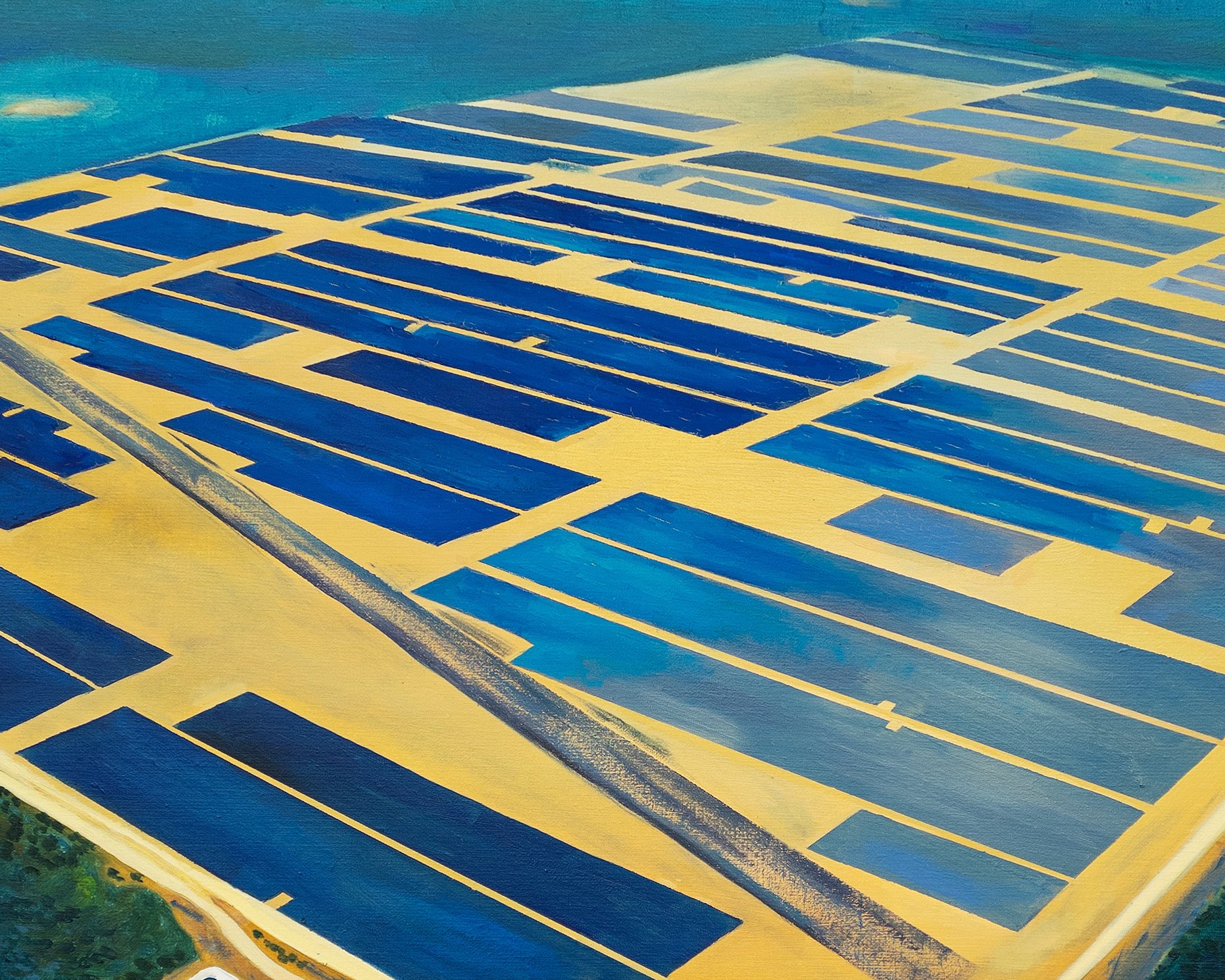
The square format of Solar Farm, 76 x 76 cm, reinforces the painting's structural logic. A rectangle suggests a landscape, with a horizon line dividing the composition into upper and lower zones. A square suggests a screen, a monitor, a viewing device. The square is the format of the phone, the format of the Instagram post, the format of the screenshot that Tan Mu used as her source image. By choosing a square canvas, she makes the painting's proportions correspond to the proportions of the device through which the image was originally seen, and this correspondence is not decorative. It is structural. It tells the viewer that the painting is not a window onto the solar farm. It is a screen that displays an image of the solar farm, and the image has already been processed, cropped, and framed by the device that captured it. The painting acknowledges this condition and refuses to transcend it. The blurred photo gallery in the lower portion is not a background. It is the substratum, the layer of visual information that exists beneath the focused image on any phone screen, the scroll of images that preceded and will follow the one that was selected, cropped, and painted.
Tan Mu has said that works like Solar Farm "may one day function as archaeological records of our current energy infrastructure," and the word "archaeological" carries more weight than its casual use suggests. Archaeology is the study of material remains to understand the cultures that produced them. It assumes that the remains are partial, that what survives is not what was most important but what was most durable, and that the archaeologist's task is to reconstruct a way of life from fragments that were not designed to communicate anything about that way of life to future observers. A painting of a solar farm is not a fragment. It is a deliberate construction, made by an artist who chose the subject, chose the composition, chose the palette, and chose to include the phone screenshot as a visible layer of the image. It is an archaeological record that was designed to be one, which makes it something else entirely: a document that is aware of its own status as a document, a record that knows it will be read in the future and has calibrated its content accordingly. This self-awareness does not diminish the painting's documentary value. It enhances it. A solar farm photographed by a satellite in 2022 will tell future archaeologists what the farm looked like. A painting of a solar farm that includes the phone screen through which the artist saw the farm will tell them how it was seen, and the difference between looking and seeing is the difference between data and knowledge. The painting holds both. It is a grid that harvests light, and it is a painting that knows it is a grid that harvests light, and it is the knowledge of the harvesting, not the harvesting itself, that makes it a work of art rather than an instrument of energy production. The solar panels will outlast the phone that photographed them, and the painting will outlast them both. What will remain, when the panels have been replaced by whatever technology succeeds them, is the record of a moment when a person looked down from an airplane window, saw a field of dark rectangles converting sunlight into electricity, and decided that this was something worth painting.