The Posture of Distance: Tan Mu's Yoga Isolation and the Geometry of Together Apart
On June 21, 2020, the summer solstice, residents of Toronto gathered for an outdoor yoga session. Photographs from the event show rows of practitioners on mats laid out on grass, each mat separated from its neighbor by a precisely measured interval of empty space, each figure performing the same postures in the same sequence, each facing the same direction, each enclosed in a perimeter of distance that the pandemic had made mandatory. The arrangement was at once communal and solitary: a collective ritual conducted in isolation, a gathering of people who were not allowed to gather in any sense that predated March of that year. Tan Mu saw the photograph, recognized in its geometry a visual expression of the condition she had been living with since the lockdown began, and translated it into Yoga Isolation (2022), a painting that renders the scene in monochrome and, in doing so, reveals a structure that the original photograph, with its green grass and blue sky and colorful yoga wear, could partially conceal. Remove the color, and what remains is a pattern: bodies arranged in rows, separated by measured intervals, performing synchronized movements in parallel, a choreography of distance that looks, from above or from across a gallery, like a circuit board, a grid, a data set, or any of the other organized systems of separated units that populate Tan Mu's practice.
Yoga Isolation is oil on linen, 91 x 102 cm, 36 x 40 inches, a format that is nearly square but not quite, the slight verticality giving the composition an upward pull that corresponds to the upright postures of the yoga practitioners. The painting is monochrome: blacks, whites, and grays, with a tonal range that shifts from the near-black of the ground beneath the figures to the pale gray of the sky above them, and from the darker grays of the figures' clothing and hair to the lighter tones of their exposed skin. The source photograph, which was in color, has been stripped of hue, and the effect is not merely documentary. The monochrome palette removes the scene from the specific afternoon in June and relocates it in a time that could be any time: a twilight zone between the particular and the archetypal, between a specific event in Toronto and a condition that was being experienced simultaneously in every city on earth. The figures are rendered with a controlled precision that renders each posture distinct. Arms extend, backs arch, legs extend into poses that a viewer familiar with yoga can identify: downward dog, cobra, warrior. The spacing between the figures is exact, each mat occupying its own rectangular zone, the gaps between them as deliberate as the figures themselves. This spacing is not an accident of composition. It is the subject. The distance between the bodies is the distance that the pandemic required, two meters, six feet, the length of a yoga mat plus an arm's reach, the space that turned every public gathering into a pattern of separated units.
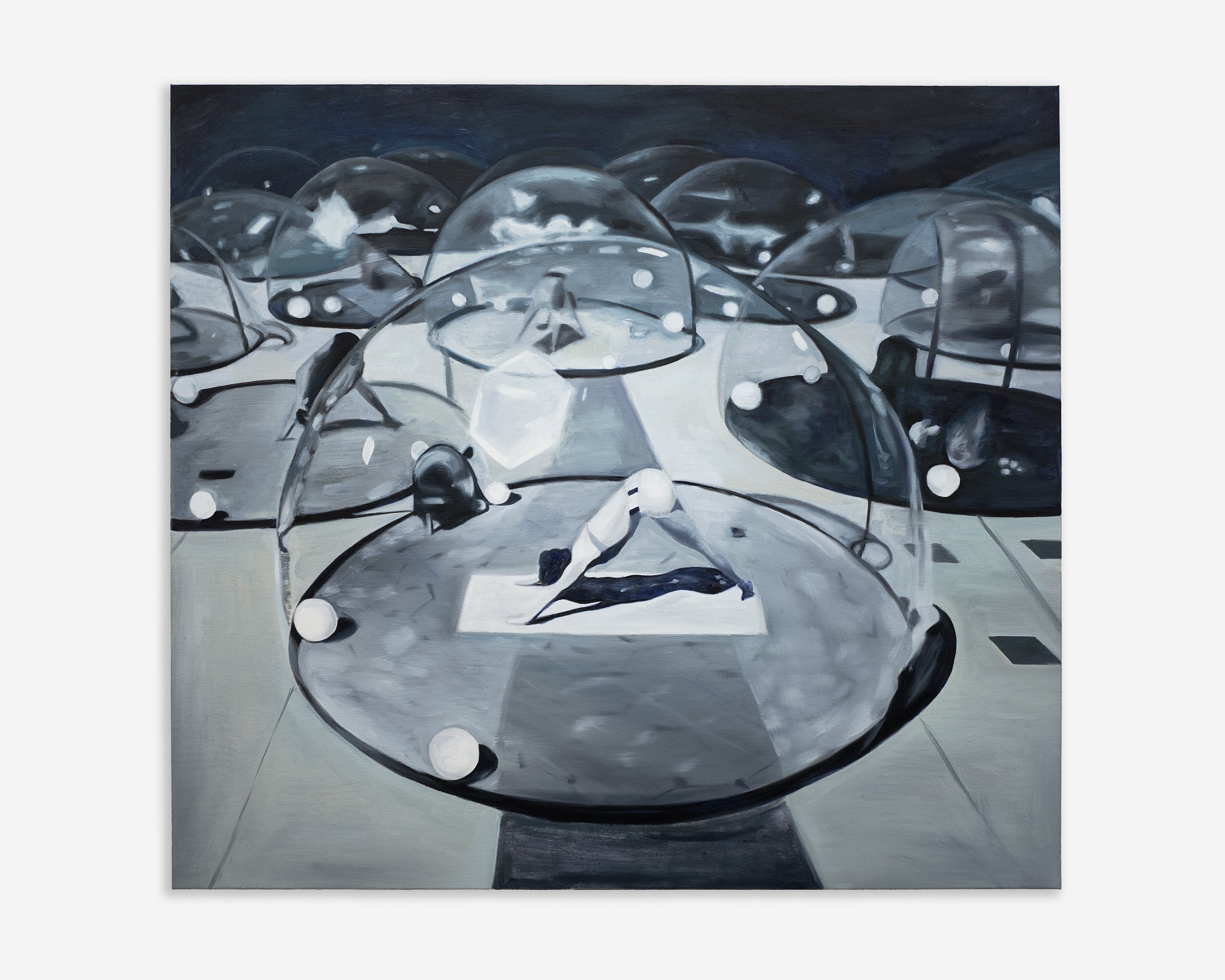
The choice to render the scene in black and white is not a neutral decision. Tan Mu has described monochrome as a way to "strip the image down to its essential structure and emotional core," and in Yoga Isolation, the structure that emerges when color is removed is the structure of spacing itself. Without the visual distraction of green grass and blue sky, the eye reads the composition as what it is: a grid of bodies, each in its own cell, each performing the same routine, each separated from its neighbors by a strip of empty ground that functions as a wall. The monochrome also evokes what Tan Mu calls "an otherworldly and suspended atmosphere, as if the scene exists outside of ordinary time," and this suspension is precisely what the pandemic produced. The lockdown was a period in which time seemed to stop, in which ordinary activities continued but under conditions that made them feel foreign, ritualistic, observed. Yoga, a practice rooted in mindfulness and presence, became under these conditions an enactment of the present moment's strangeness: the body is here, doing what it has always done, but the context has shifted so radically that the familiar postures acquire an uncanny quality, as though the practitioners are performing a ritual whose original meaning has been suspended and replaced by a new one that no one has yet named.
Edward Hopper's Nighthawks (1942) is the most familiar American painting of urban loneliness, and its familiarity can make it difficult to see how radical its formal structure is. Four figures occupy an all-night diner: three customers and one server. The diner's plate glass windows offer an unobstructed view of the interior, brightly lit from within, against a dark street where no other sign of life is visible. The customers sit along the counter, each in a separate zone: the couple touching at one end, the solitary man with his back to the window at the other, the server standing between them in a role that is functional rather than social. No one is speaking. The geometry of the composition separates each figure into its own space even as it places them within a shared enclosure. The counter, the stools, the wall behind the server, the windows that frame the scene like a display case: all of these elements organize the figures into a pattern of co-presence without connection, a pattern that Hopper repeats across his career, from the office at night where a woman stands in another room while a man works at a desk, to the theater where a single figure sits alone in the audience while the spotlight illuminates an empty stage. In every case, the architecture of the space enforces separation. The figures are together, but the space between them is not bridgeable. They are in the same room, but they are not in the same world.
Tan Mu's Yoga Isolation shares this structure and inverts its terms. Where Hopper's figures are isolated within a built environment that Hopper designed to produce loneliness, Tan Mu's figures are isolated within a natural environment that the pandemic has repurposed as a space of regulated distance. The park, the grass, the open air: these are not the materials of isolation. They are the materials of leisure, of community, of the kind of casual gathering that urban parks were designed to support. The pandemic converted them into something else, a landscape of measured intervals where the distance between bodies became the primary visual fact, more visible than the bodies themselves. The monochrome rendering makes this conversion legible. Without color, the grass and the sky become neutral fields, and the figures stand out against them not as people enjoying a summer evening but as units in a spatial arrangement, data points on a coordinate plane. The emotional register shifts from loneliness, which implies a subject who feels the absence of connection, to something more structural: a condition in which connection has been redefined as proximity within prescribed limits. The practitioners are not lonely. They are together, in the specific way that the pandemic required: at a distance, in parallel, synchronized but separate.
The source photograph was taken on June 21, 2020, the date of the summer solstice, which is also International Yoga Day. The coincidence of dates is not incidental to the painting's meaning. The solstice is the longest day of the year, a moment when the earth's axial tilt produces maximum illumination. International Yoga Day was established by the United Nations in 2014, following a proposal by Indian Prime Minister Narendra Modi, who described yoga as "an invaluable gift of India's ancient tradition" that "embodies unity of mind and body, thought and action, restraint and fulfillment." The painting captures a specific afternoon when a tradition of unity was practiced under conditions that made unity impossible in any physical sense. The practitioners were following a discipline whose foundational philosophy emphasizes the dissolution of the boundary between self and other, between individual consciousness and universal consciousness, at a moment when the boundary between self and other was being enforced by public health regulations as a matter of life and death. Tan Mu has described yoga in this context as "a paradoxical symbol. The practice remains communal in spirit, yet it is performed in isolation, with each individual contained within a clearly defined personal space." The paradox is the subject of the painting, and the monochrome palette is its visual corollary. The removal of color removes the last trace of the day's specificity: the green of the grass, the blue of the sky, the warm tones of the practitioners' skin. What remains is the geometry of a ritual performed under conditions that negated its original purpose, a discipline of connection practiced in a regime of separation.
Nick Koenigsknecht, writing in his 2025 catalog essay "Alone, Together / Locals, Everywhere" for the BEK Forum exhibition in Vienna, observed that the experience of the pandemic was one of simultaneous connection and isolation, a condition in which "the boundary between performer and audience dissolves" even as the physical distance between bodies is enforced. His formulation, "alone, together," is the phrase that Yoga Isolation renders visible. The painting shows what the phrase names: people who are in the same place, doing the same thing, at the same time, without being able to touch or approach or share the same air without risk. Koenigsknecht's essay was written to accompany an exhibition that included a performance in which audience members held a single strand of blue yarn connecting them to the musicians, a literal thread that made physical connection out of shared attention. The thread was both a metaphor for the submarine cables that carry data across oceans, the subject of Tan Mu's Signal series, and a literal embodiment of the condition that the pandemic had produced: people connected by the thinnest of threads, maintaining contact through channels that did not require physical proximity. Yoga Isolation represents the same condition from a different angle. The thread is gone. The connection exists only in the parallel performance of the same movements, the synchronized breath of practitioners who are too far apart to hear each other exhale. The connection is visual, gestural, and structural, not physical. It exists in the pattern, not in the touch.
Tan Mu has spoken about her pandemic experience in terms that illuminate the painting's emotional register without reducing it to autobiography. "During the pandemic, I experienced a deep sense of isolation and a disruption of everyday rhythms, much like many others around the world," she says. "Daily life became fragmented, and human connection was suddenly mediated by distance and restriction." The word "fragmented" is precise. It does not mean destroyed or ended. It means broken into pieces that retain their shape but no longer form a continuous whole. A fragmented rhythm is still a rhythm. It still has a beat, but the beat is irregular, interrupted, subject to gaps that were not there before. The practitioners in Yoga Isolation are performing a fragmented ritual. The asanas follow each other in sequence, the breath follows its prescribed rhythm, the body moves through its accustomed positions. But the ritual that once took place in a room full of people breathing together, adjusting their postures in response to the teacher's voice and the collective energy of the group, now takes place on separate mats on a lawn, each practitioner enclosed in a bubble of measured space, breathing air that no one else has just exhaled. The fragmentation is not in the practice itself, which remains whole, but in the conditions under which it is performed, which are broken by the requirement of distance.
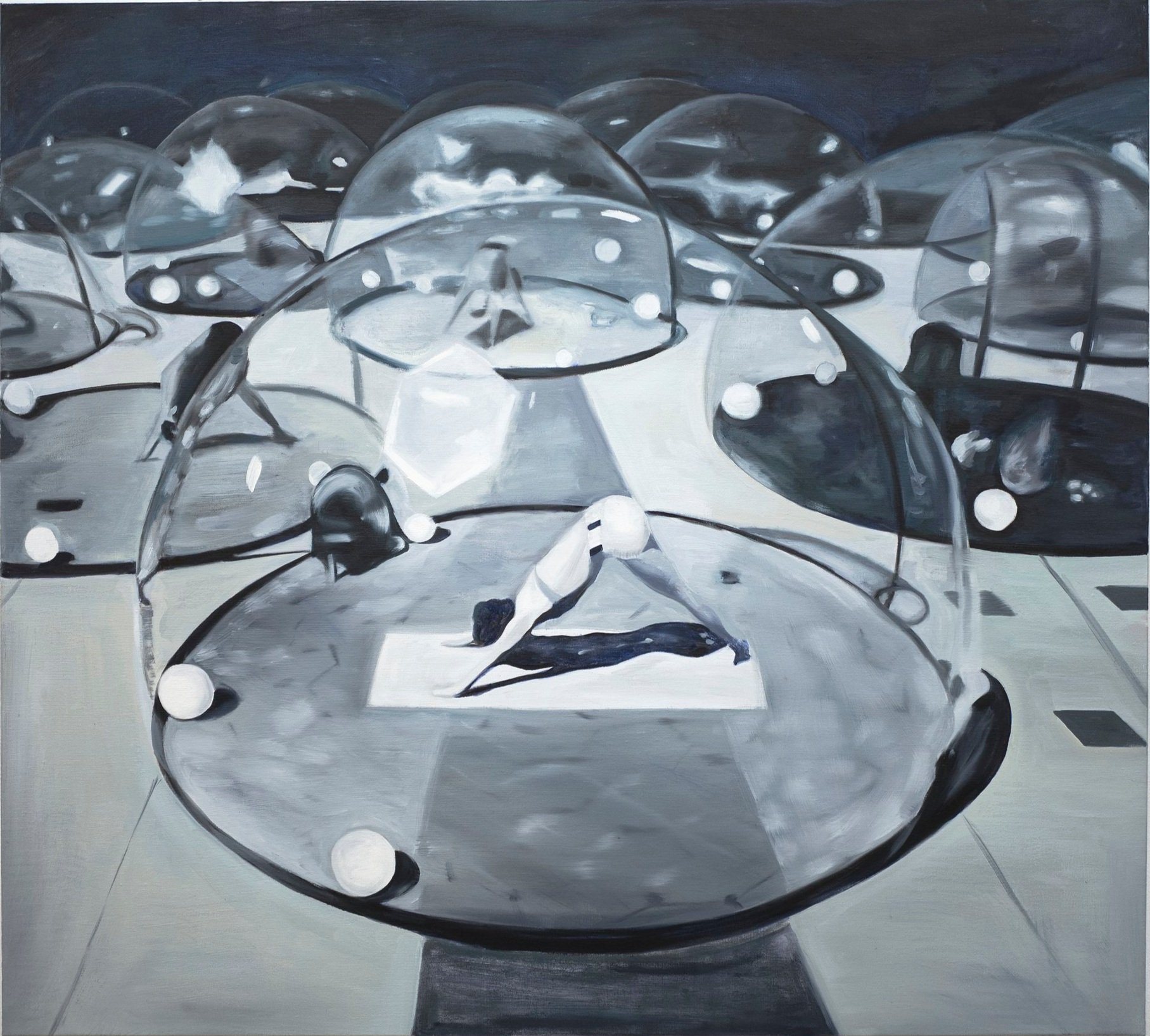
The monochrome palette places Yoga Isolation within a specific trajectory in Tan Mu's practice. She has identified three categories of monochrome work in her output. In works related to space and technology, such as Peek (2021) and DEC's PDP-10 (2021), "black and white reflects the technical and historical origins of the imagery." In works drawn from historical events, like Bikini Atoll (2020) and Trinity Testing (2020), "monochrome reinforces their documentary gravity." In works addressing isolation and disconnection, including Yoga Isolation, Isolation (2020), and Torus (2020, 2021), "the absence of color intensifies emotional distance and stillness" and "creates an atmosphere reminiscent of vintage science fiction or archival records." Yoga Isolation belongs to this third category, and the reference to science fiction is not decorative. The monochrome figures on the lawn, each in their designated zone, each performing synchronized movements without physical contact, look like inhabitants of a speculative world in which human proximity has been regulated by an external authority, which is, of course, exactly what they were. The pandemic made the present feel like science fiction, and Tan Mu's palette choice registers this feeling by producing an image that could be a still from a film about a society in which human beings are kept at prescribed distances from each other, a film that the viewer recognizes with a start as a documentary of the recent past.
Andreas Gursky's 99 Cent II Diptychon (2001) presents a supermarket aisle rendered at monumental scale, its shelves stacked with identical products arranged in grid formation, its shoppers reduced by distance and compression to elements in a pattern. The photograph's power lies in the tension between the individual and the aggregate: every person in the frame is visible as a distinct body with specific clothing and posture, but the overall composition swallows these distinctions into a visual field organized by the geometry of commerce. Gursky's image has been read as a critique of consumerism, and it is that, but it is also a study in what happens to human figures when they are arranged in a grid defined by an external logic, in this case the logic of retail shelving, in Tan Mu's case the logic of pandemic distancing. The two images share a structural insight: that the arrangement of bodies in space is never neutral, that it always encodes a set of rules, whether those rules are the market's demand for maximum product density or the health authority's mandate for minimum interpersonal distance. Gursky's shoppers and Tan Mu's yoga practitioners are both engaged in ordinary activities, shopping and exercising, that have been reorganized by an external system into a visual pattern that makes the system itself visible. The difference is that Gursky's system is permanent and commercial, while Tan Mu's is temporary and medical, but the visual grammar is the same: bodies in rows, separated by intervals, each performing the same action within the bounds of an invisible architecture.
The painting's format, 91 x 102 cm, is large enough to encompass multiple figures while remaining intimate enough to read as a personal scene rather than a panoramic landscape. The near-square proportions give the composition a stability that reinforces the regularity of the spacing. There is no dominant figure, no focal point that draws the eye away from the pattern. The practitioners are distributed across the canvas in a way that emphasizes their equivalence: each figure is a variation on the same shape, each mat is a variation on the same rectangle, each gap is a variation on the same distance. This equivalence is the painting's most uncomfortable observation, because it suggests that the pandemic did not merely impose distance on existing social structures but produced a new kind of social form in which the differences between individuals, their age, their flexibility, their skill level, become secondary to the fact of their separation. In the monochrome rendering, every figure is reduced to the same tonal range, the same contrast with the ground, the same relationship to the space around them. The painting does not erase individuality. It makes individuality irrelevant to the structure that governs the scene. The structure is the subject. The individual bodies are its contents.
In the Atlas of Seeing (2026), Tan Mu writes that her practice is organized around "different registers of the same question: how structure becomes experience." Yoga Isolation is a painting about a structure that became experience for every person on earth between March 2020 and whenever the distancing requirements were lifted in their particular jurisdiction. The structure was the mandated distance between bodies. The experience was the paradox of being together and apart at the same time, of performing a communal ritual in solitary confinement, of breathing in a space where the air had to be treated as a potential vector of transmission. The painting records this paradox with the same attentive precision that Tan Mu brings to submarine cables and quantum computers, not because yoga and pandemics belong to the same category as infrastructure and computation, but because the structure of regulated distance is itself a form of infrastructure, a set of rules governing the arrangement of bodies in space, no less designed and no less consequential than the rules governing the arrangement of data in a fiber-optic cable. The practitioners on the lawn are not just doing yoga. They are enacting a protocol, a prescribed set of behaviors that governs how human beings can occupy shared space under conditions of risk. The protocol is the structure. The yoga is the experience. The painting holds both in the same frame, and the monochrome palette, by removing the distractions of a summer afternoon, makes the frame visible.