The Dark Source of Unending Creation: Tan Mu's Powehi and the Image That Was Assembled
Eight telescopes, positioned across six locations on the surface of the Earth, from the South Pole to the high desert of Chile, from the volcanoes of Hawaii to the mountains of Spain, all pointed at the same patch of sky on the same nights in April 2017. They were not photographing a black hole. Black holes cannot be photographed. They emit no light, reflect no signal, return no information about what lies beyond their event horizons. What the telescopes were doing was collecting radio waves emitted by superheated gas in the accretion disk surrounding the black hole at the center of the Messier 87 galaxy, a supermassive object with a mass 6.5 billion times that of the Sun, located 55 million light years from Earth. The data they collected, roughly five petabytes of it, was too large to transmit over the internet. It was recorded on half a ton of hard drives and flown by plane to the Haystack Observatory at MIT and the Max Planck Institute for Radio Astronomy in Bonn, where it was processed by a custom algorithm called CLEAN and synthesized into a single image. The image was released to the public on April 10, 2019. It showed a bright ring of orange light surrounding a dark circle: the shadow of the event horizon, the boundary beyond which nothing, not even light, can escape. The black hole was named Powehi, a Hawaiian word meaning "embellished dark source of unending creation," drawn from the Kumulipo, a Hawaiian creation chant. The name was chosen by Larry Kimura, a Hawaiian language professor, and it located the black hole within a cosmological tradition that understood darkness not as absence but as generative, not as void but as source. Tan Mu's painting Powehi (2022) takes this image, this assembled, synthesized, algorithmically processed image of an object that cannot be seen, and renders it in oil on linen, a medium that has been making invisible things visible for six hundred years.
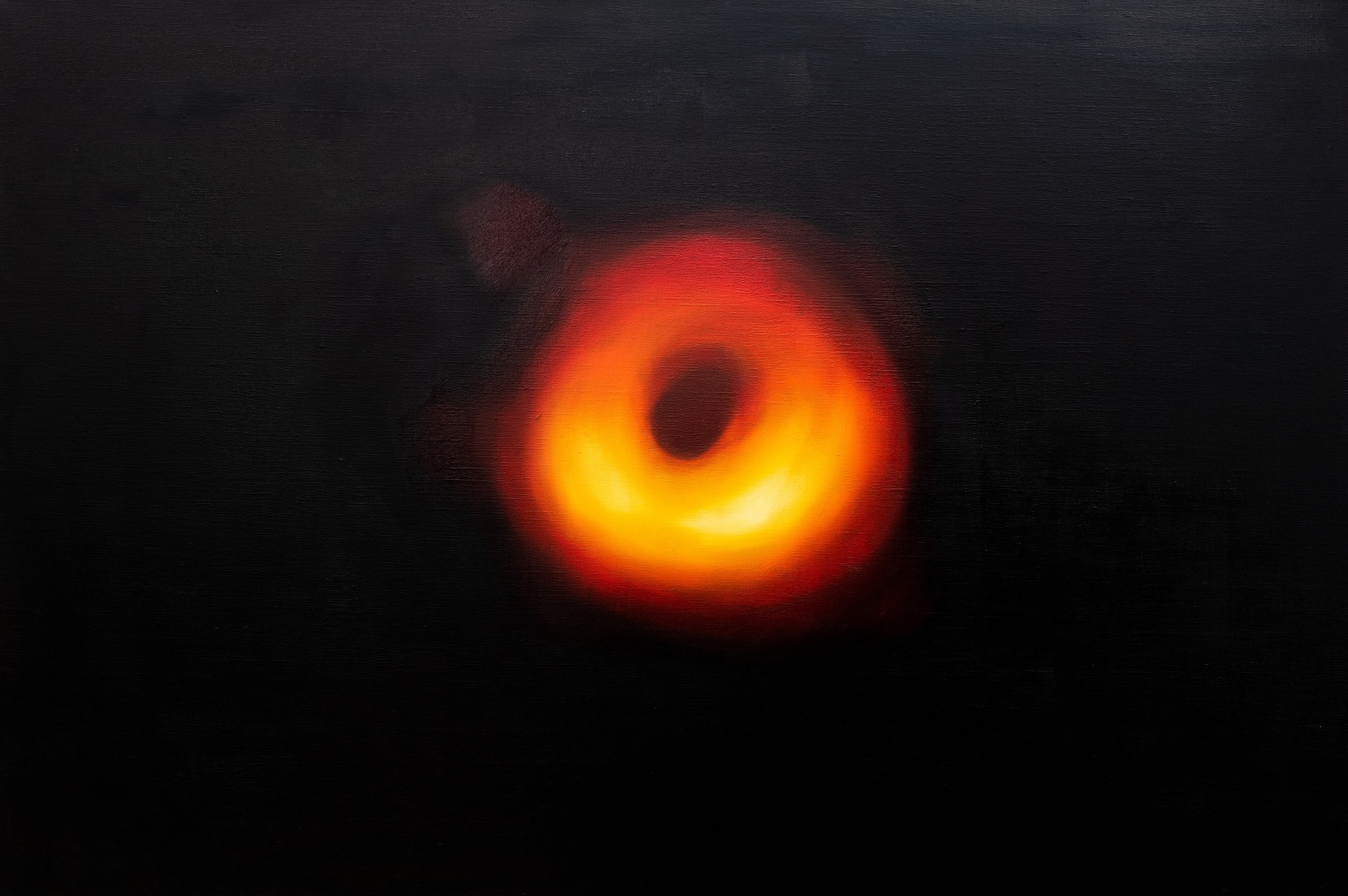
Powehi is oil on linen, 61 x 91 cm, 24 x 36 inches, a horizontal format that accommodates the ring shape of the accretion disk and the dark void at its center. The composition is centered on the black hole itself: a circular void of deep, near-absolute black surrounded by a ring of luminous orange and gold that fades at its outer edge into the dark ground of the painting. The accretion disk is not a uniform band of color. It is built from concentric layers of paint that shift in hue and intensity, from a hot, bright orange at the inner edge, closest to the event horizon, through amber and gold tones that cool as they move outward, to a thin fringe of pale yellow that dissolves into the black ground. The texture of the ring varies across its circumference. In some areas, the paint is dense and opaque, laid down in visible strokes that give the surface a sculptural weight. In others, it thins to a translucent wash that allows the dark linen to show through, as though the light itself is being pulled apart by the gravitational field it circulates. The black ground is not flat. It modulates in depth and warmth across the surface, sometimes dense and velvety, sometimes allowing a faint warmth to surface from beneath, as though the void itself is not entirely empty but contains some residual heat, some trace of the light it has absorbed. This is a painting that takes seriously the proposition that a black hole is not nothing. It is a gravitational field so intense that it bends space-time, and the paint on this canvas, in its modulations and its depth, is a material analogue of that bending.
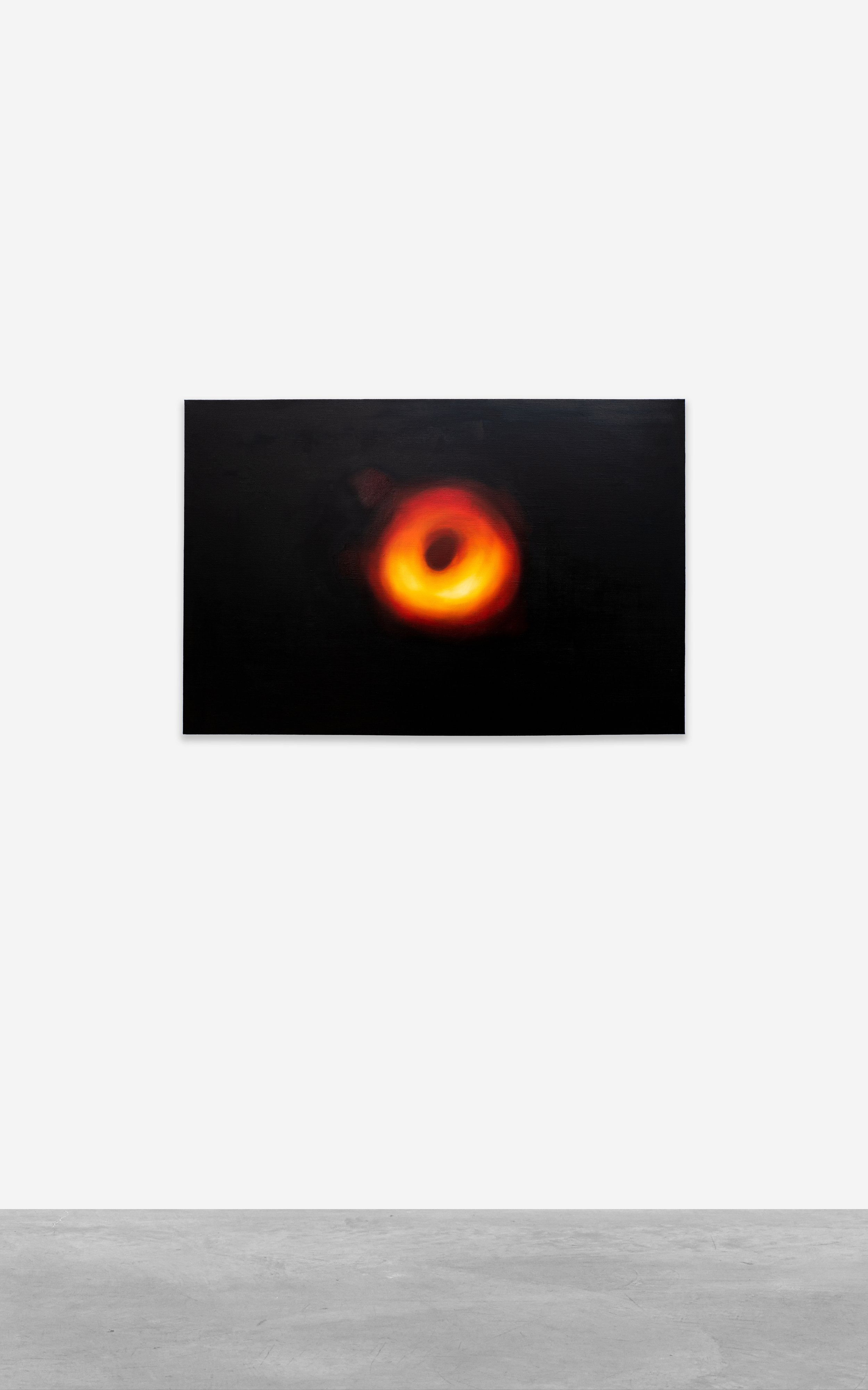
Tan Mu has described the black background as creating "an objectified space, similar to how phenomena are isolated and examined in research," and as carrying "a symbolic weight" that "suggests the unknown, the infinite, and the limits of human knowledge." The black ground in Powehi serves both functions simultaneously. As an objectified space, it isolates the ring of light from any context that might anchor it to a specific location, a specific telescope, a specific moment in time. The painting does not show the Event Horizon Telescope array or the scientists who operated it. It does not show the five petabytes of data or the custom algorithms that processed them. It shows the result, the bright ring around a dark void, and it places that result against a ground that is as close as paint can get to the condition of space itself: dark, infinite in implication, and empty of everything except the phenomenon under observation. As a symbolic space, the black ground functions as the unknown that the phenomenon implies. The ring of light is visible because of what it surrounds. The void at the center is what the ring is about. The painting's meaning is not contained in the light. It is contained in the relationship between the light and the dark, between what can be seen and what cannot, between the data that the telescopes collected and the singularity that no telescope will ever see.
Kazimir Malevich's Black Circle (1915, reconstructed 1923) presents a perfect circle of black paint against a white ground. It is one of the fundamental forms of Suprematism, the movement Malevich founded in 1915 with the declaration that the "supremacy of pure artistic feeling" had replaced the representation of objects as the purpose of visual art. The black circle in Malevich's painting is not a symbol. It is not a representation of the sun eclipsed, or a hole in a surface, or a planetary body seen from a distance. It is a form, a shape, a geometric element placed on a field for the purpose of demonstrating that pure geometric form can generate feeling without reference to the natural world. Malevich wrote that the black square, the black circle, and the black cross were the "zero point" of painting, the forms from which all subsequent Suprematist compositions would be built. They were not the end of painting but its beginning, the ground zero from which a new visual language would emerge. The structural parallel to Powehi is precise and productive. Both paintings present a circular form on a dark ground. Both locate the viewer's attention at the boundary between the form and the ground, the edge where one gives way to the other. Both use the circle as a form that is at once geometric and cosmic, at once a shape drawn on a surface and a reference to something that exceeds the surface. But the inversions are instructive. Malevich's circle is black on white. Tan Mu's is light on black. Malevich's ground is the blank canvas, the void from which form emerges. Tan Mu's ground is the black hole, the void that absorbs all form. Malevich's circle is the beginning, the zero point from which new compositions will arise. Tan Mu's ring is the evidence, the trace of what the void has failed to swallow.
The difference between beginning and evidence is the difference between Suprematism and what Tan Mu is doing here. Malevich's black circle is a declaration. It says: form begins here. Tan Mu's bright ring is a trace. It says: something happened here, and this is what remains visible after the happening. The bright ring of the accretion disk is not form emerging from void. It is light falling into void and failing to reach the center. It is the debris of a gravitational catastrophe, the last gasp of matter being torn apart before it disappears beyond the event horizon. The painting does not present this as a metaphor. It presents it as a physical fact, rendered in oil paint, that the light around a black hole is the light that the black hole has not yet consumed, and that the boundary between the light and the dark is the boundary between what can be known and what cannot. Malevich's circle sits on the canvas like a stamp, a declaration of presence. Tan Mu's ring circulates around the canvas like the gas around a singularity, a declaration of absence. The black hole is not present in the painting. It is the absence at the center of the painting, and the ring of light is there to mark that absence, to make it visible, to give it a circumference if not a content.
The Event Horizon Telescope Collaboration, the international consortium of over 200 scientists that produced the first image of Powehi, did not photograph a black hole. They synthesized one. The telescopes that formed the array, the Atacama Large Millimeter Array in Chile, the Submillimeter Array and the James Clerk Maxwell Telescope in Hawaii, the South Pole Telescope, the IRAM 30-meter telescope in Spain, the Large Millimeter Telescope in Mexico, the Submillimeter Telescope in Arizona, and the NOEMA array in the French Alps, collected radio wave data at a wavelength of 1.3 millimeters. Each telescope recorded the signal from the same region of sky over the same nights, and the data from all eight sites was combined using a technique called very-long-baseline interferometry, which treats the Earth itself as a single telescope with a dish the size of the planet. The angular resolution achieved was 20 microarcseconds, sufficient to resolve an orange on the surface of the Moon as seen from Earth. The resulting data set was too large to transmit electronically. It was physically shipped on hard drives to two processing centers, the Haystack Observatory and the Max Planck Institute, where four teams working independently produced the first image of the black hole's shadow using different algorithms. When the four teams compared their results, the images matched. The bright ring around a dark center was not an artifact of a single algorithm or a single processing pipeline. It was a feature of the data itself, and the data was a feature of the physical universe, and the physical universe had, for the first time, been made to yield an image of something that by definition emits no image.
Tan Mu has described the process of black hole imaging as analogous to printmaking, "where fragmented information is gradually consolidated into a complete image." The comparison is exact. In intaglio printmaking, the image is built by incising lines into a plate, inking the plate, and pressing it onto paper. The image on the plate is the negative of the image on the print. The print is a synthesis, an assembly, a translation from one medium into another. The EHT's image of Powehi is a print. The telescopes collected fragments of radio wave data, the algorithms consolidated those fragments into a complete image, and the image was released to the world on April 10, 2019, as a bright ring around a dark center. The ring is the accretion disk. The dark center is the shadow cast by the event horizon on the light behind it. The image is not a photograph. It is a synthesis. It is a print. And Tan Mu's painting is a print of a print, a rendering in oil of a rendering in data, a translation of a translation, each step adding its own layer of interpretation while remaining faithful to the phenomenon that initiated the chain. The painting is not more or less "real" than the EHT image. It occupies a different position in the chain of mediations that begins with the radio waves arriving at the telescopes and ends with the oil paint on the canvas, and its position allows it to make visible something that the EHT image cannot: the texture of the mediation itself, the hand that made the mark, the brush that carried the paint, the body that stood in a studio and decided, stroke by stroke, how bright to make the ring and how deep to make the void.
Saul Appelbaum, writing in his 2025 essay "Dreaming in Public," introduced the concept of "arbitration" to describe Tan Mu's process. Arbitration, in Appelbaum's framing, is the act of "deciding, judging, mediating between input and output," and he locates it in the space between the data that arrives at the telescope and the image that appears on the canvas. The space is not empty. It is filled with decisions: about color, about scale, about how much of the accretion disk to render in hot orange and how much to let fade toward the edges, about whether the black ground should be absolute or modulated, about whether the void should be flat or deep. Each of these decisions is an arbitration between the scientific data and the painted image, between what the telescopes recorded and what the viewer will see, and each arbitration introduces a degree of uncertainty that Appelbaum identifies as the condition shared by science and art. The EHT's image of Powehi involves its own arbitrations: the choice of color mapping, the choice of algorithm, the choice of which wavelengths to emphasize and which to suppress. These are not arbitrary. They are informed by scientific reasoning. But they are also interpretive, and the interpretive element is what Tan Mu's painting makes visible. The painting does not conceal the hand that made it. The brushstrokes are visible, the paint layers are distinguishable, and the surface bears the marks of the body that produced it. This is the arbitration that painting can make explicit and that data processing typically conceals: the fact that every image of an invisible phenomenon is a decision about how to make it visible, and that the decision is never neutral.
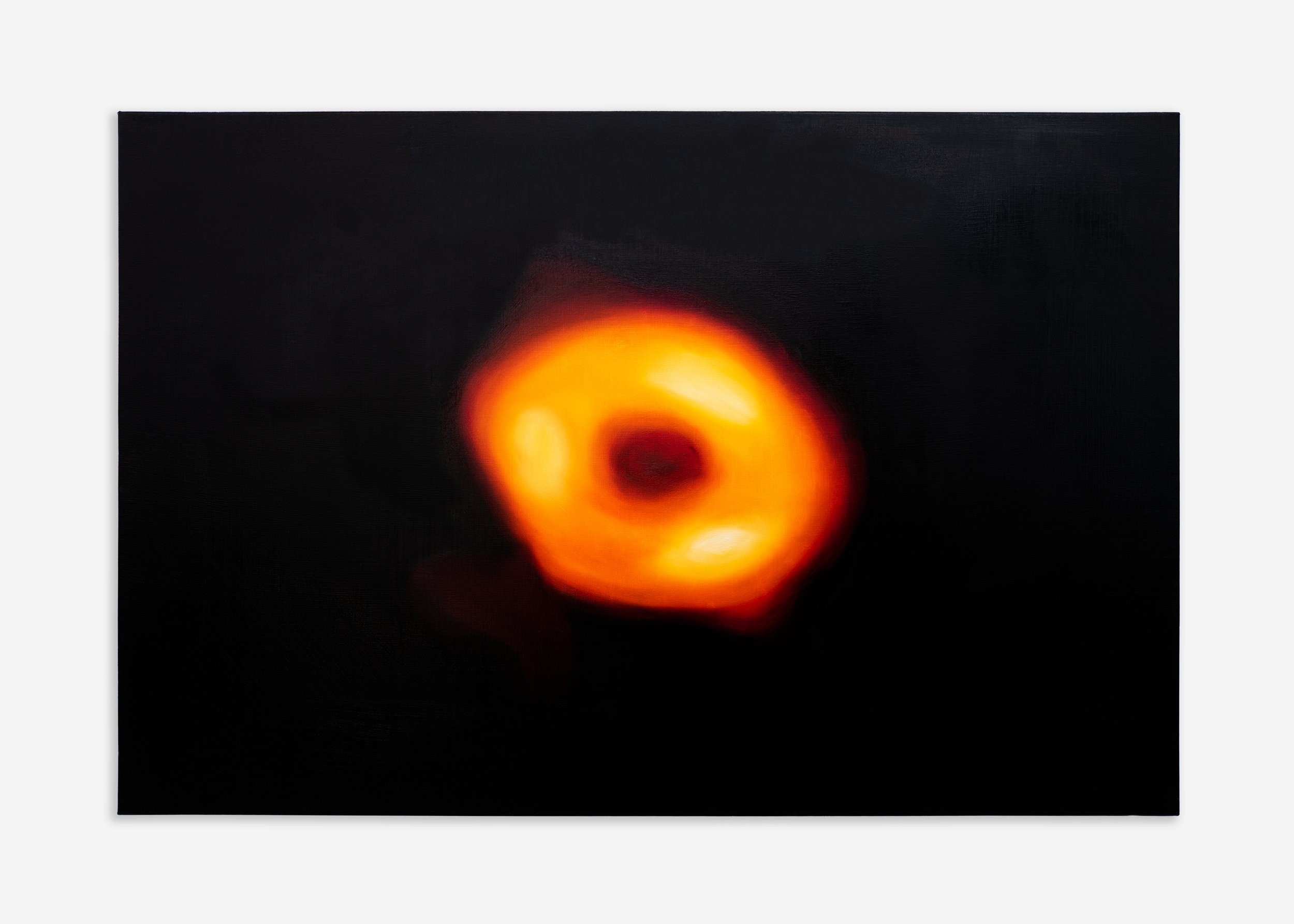
Tan Mu has connected Powehi explicitly to her companion painting Sagittarius A (2022), which depicts the black hole at the center of the Milky Way, imaged by the EHT and released to the public in May 2022. Both paintings share the same subject, the black hole, and the same process, the transformation of synthesized astronomical data into oil on linen. But they depict different objects with different characteristics. Powehi, the supermassive black hole at the center of M87, has a mass 6.5 billion times that of the Sun and produces a large, bright accretion disk that is relatively easy to resolve with current telescope technology. Sagittarius A, the black hole at the center of our own galaxy, is smaller and closer but produces a dimmer, more variable signal that is harder to image. The EHT released the image of Powehi first, in 2019, because it was easier to image, and the image of Sagittarius A three years later, in 2022, after the collaboration had improved its instruments and algorithms. Tan Mu painted both in the same year, 2022, responding to the second image with the same attention she had given to the first. The two paintings form a pair: two black holes, two images, two moments in the history of astronomical imaging, rendered by the same hand in the same medium, in the same year. The pairing is itself a form of arbitration. It says: these are not isolated events. They are chapters in an ongoing story, and the story is not only about what the telescopes have revealed but about what the hands have made of what the telescopes have revealed, and what the next generation of telescopes will reveal, and what the next generation of hands will make of that.
The name Powehi, drawn from the Kumulipo, carries a weight that the painting both invokes and transforms. In the Kumulipo, the Hawaiian creation chant, the deep darkness from which all things emerge is not an absence. It is a generative source, a realm of potential from which creation unfolds. The chant begins in darkness and moves toward light, not by destroying the darkness but by elaborating within it, by giving form to what was formless and name to what was unnamed. Tan Mu's painting reverses the direction of the chant. The form, the bright ring of the accretion disk, is already present. What is unnamed and formless is the darkness at the center, the singularity that the ring encircles but does not illuminate. The painting does not move from darkness toward light. It holds both at once, the bright ring and the dark void, the visible and the invisible, the assembled data and the irreducible mystery that the data cannot penetrate. The ring is the most luminous passage in the painting, and it is luminous precisely because it is the last light before the dark. It is the light that the black hole has not yet consumed, the light that is still falling, still circling, still trying to escape. The painting holds this light in place, on a rectangle of linen, with the patience of a medium that takes months to dry, and it holds the dark in place too, the dark that the light will never reach, the dark that the telescopes can surround but cannot see into, the dark that the name Powehi calls "the embellished dark source of unending creation." The name is not a description of what is visible. It is a description of what is not. The painting is the ring. The name is the void. The distance between them is the distance that arbitration cannot close, and the painting, in its willingness to hold both the ring and the void without reducing one to the other, is the most honest image of a black hole that a human hand has yet produced.