The Field That Made a Choice: Tan Mu's Turf and the Inheritance of Arrival
A photograph appears in a sports newspaper in 1980s China. A young man sits on a pitch, his body angled slightly toward the camera, his posture carrying the particular composure of an athlete between exertions. He does not know that this image will outlast his career. He does not know that decades later, his daughter, who has not yet been born, will find this photograph and translate it into oil paint, rendering visible what the camera could never capture: the weight of a choice that has not yet been made. The photograph of Tan Mu's father, a professional soccer player, circulated through the machinery of sports media, a public document of an unwitnessed past. Tan Mu would later call it a "family photo" that exists outside personal memory, outside even the family album, a moment that preceded her own consciousness yet shaped the terms of her arrival.
Tan Mu's Turf (2021) is a painting about what it means to inherit an image rather than a memory. The seated figure on the pitch is her father, captured in the prime of his athletic life. His retirement from professional soccer coincided with her birth, a convergence that binds lineage and departure into a single temporal knot. The painting does not illustrate this biographical fact so much as it enacts the condition the fact describes: one person's ending is another's beginning, and the field between them is neither victory nor defeat but the ground on which a life was reassigned. The image that prompted the painting was not pulled from a family drawer. It was published in a newspaper, circulated as sports news, a public record of a private figure. The painting takes that public document and makes it intimate, not by adding sentiment but by the act of hand-painting itself: the hours of close attention that transform a mass-produced image into something that can only be seen one pair of eyes at a time.
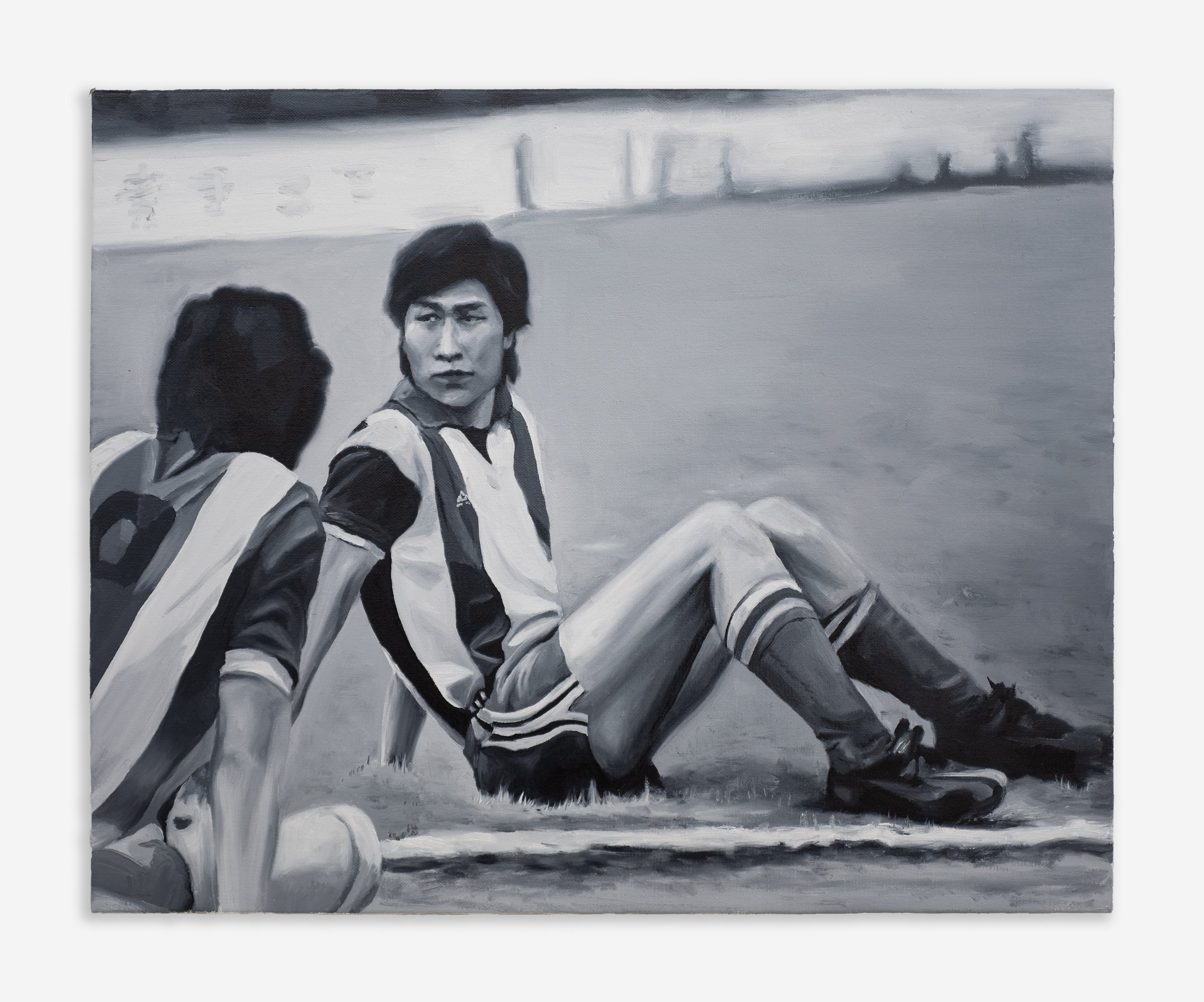
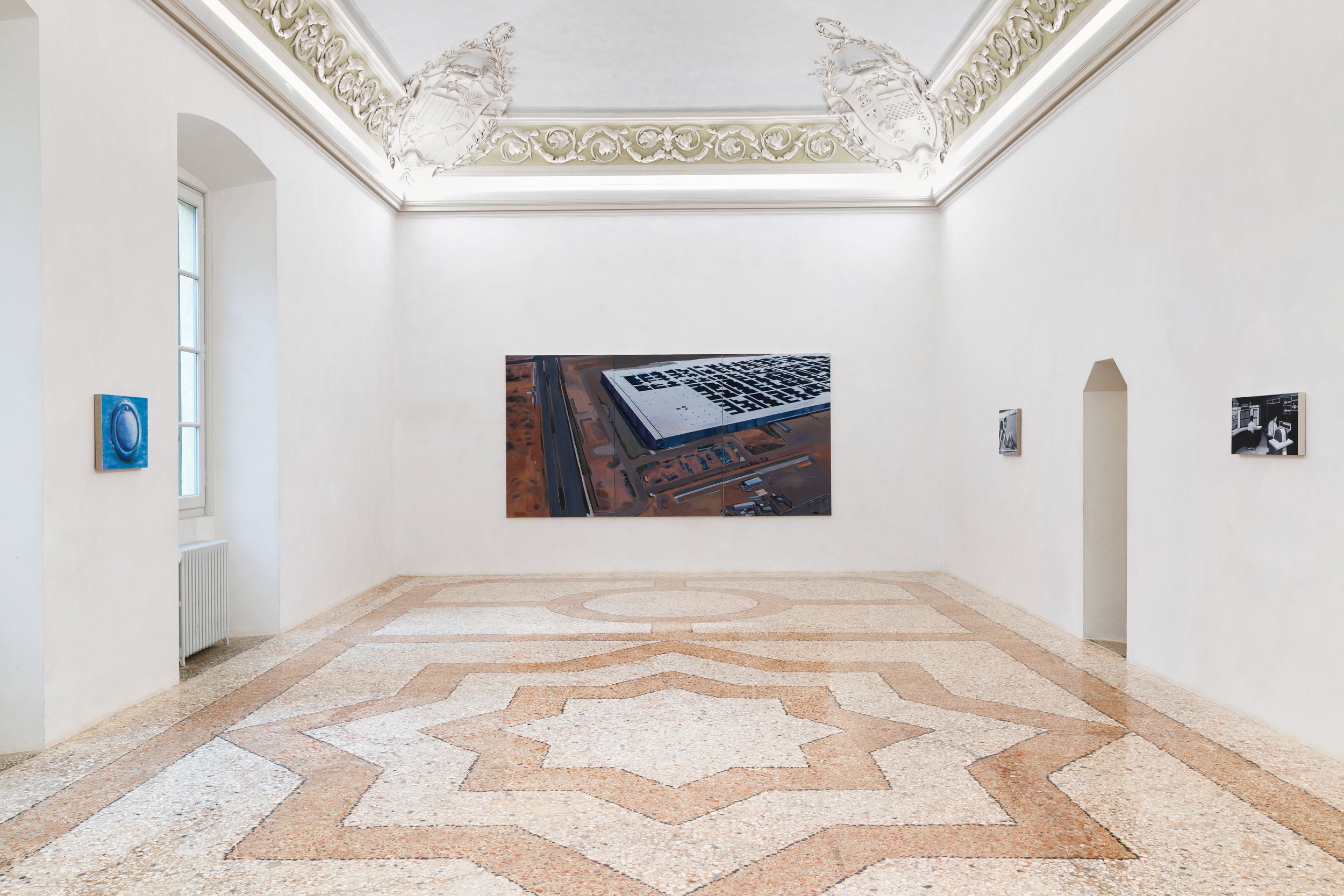
The surface of Turf is restrained in a way that distinguishes it from most of Tan Mu's technologically driven paintings. Oil on linen, 41 x 51 cm (16 x 20 inches), it is among the smaller works in her catalog, intimate in scale, held in two hands rather than commanding a wall. The linen weave is visible beneath the paint in the lighter passages, a pale grid that the medium does not fully conceal, as though the support itself wants to register the texture of a world seen through newsprint. The palette is desaturated, nearly monochrome: blacks, grays, and whites modulated by a thin wash of green that hovers at the threshold of visibility, the color of a pitch remembered rather than witnessed. At arm's length, the brushwork resolves into the specifics of a seated body, the angle of a knee, the set of shoulders. From two meters back, the figure merges with its ground, the green of the field and the gray of the figure trading values until the distinction between player and pitch becomes uncertain. This is not a failure of rendering. It is the painting's argument: the figure and the field are not separate. He is of the turf. The title names not a location but a condition.
The paint itself tells a story of restraint. Where Tan Mu's submarine cable paintings build their landing points with thick, wax-heavy impasto, raised and ridged like soldered circuit connections, Turf deploys thin, almost dry applications. The figure's jersey is rendered in a single transparent passage, the weave of the linen showing through as though the fabric of the painting and the fabric of the garment were one and the same. The grass beneath him is not painted blade by blade but suggested through horizontal strokes that echo the grain of the linen itself, so that the horizontal threads become the field's lines and the pigment becomes the green that settles into the valleys between them. This is a painting that lets its support do work. The linen is not an invisible substrate to be filled and covered. It is the field. It is the ground on which the figure sits, and it is also the grid through which the image arrives, the mesh of fabric and the mesh of newsprint doubling each other.
Marlene Dumas spent decades painting figures sourced from newspapers, Polaroids, film stills, and pornography, always insisting that the painting was not about the original photograph but about what happens when a body is pulled through the sieve of paint. In The Painter (1994), a child stands in what appears to be a pool of blood, her small body vertical against a field of wet crimson, her hands dark with the liquid she has presumably been playing in. The title tells you the child is painting, but the image tells you something else: that the act of making is inseparable from the act of marking, that creation and violence share a surface. Dumas painted from a photograph of her own daughter, then dissolved the specifics of the domestic scene into a composition that could belong to any body, any century. The blood is paint and the paint is blood and the question of which came first is the question the painting refuses to resolve.
Dumas's approach to photographic source material provides a structural parallel for understanding what Turf accomplishes. Dumas never copied a photograph. She used it as a point of departure, a set of coordinates that the painting then abandoned in favor of its own logic. The wash of paint in The Painter does not describe the child's surroundings; it creates an environment that the child was never in, a field of red that exists only in the painting. Tan Mu operates similarly in Turf. The desaturation, the near-monochrome palette, the thin paint that lets the linen breathe: none of these are properties of the source photograph. They are decisions that transform a newspaper image into a meditation on the passage between public document and private inheritance. The photograph was news. The painting is something else: a record of the time it takes to look at news until it becomes a person.
What the source photograph documented was an athlete at work. What Turf documents is the passage between that work and the world it made possible. Tan Mu has described her father's career and his retirement at her birth as a convergence of lineage and choice, the moment when one trajectory ended so that another could begin. The soccer field in the painting is therefore not just a location. It is a stage where heritage, decision, and direction intersect. The seated posture is not rest. It is the interval between the last sprint and the next life. Tan Mu's own practice, research-driven and systemic, her canvases populated by submarine cables, quantum cryostats, and neural pathways, can be read as a continuation of the athleticism she inherited: the discipline, the training, the daily commitment to a practice that demands precision and endurance. The field changes, but the stance remains.
Tan Mu has spoken about Turf in explicitly personal terms, unusual for an artist whose stated subjects are typically satellites, fiber-optic networks, and cryogenic processors. The painting, she notes, originates from a photograph of her father taken during his career as a professional soccer player in the 1980s. "That image existed publicly, circulated through sports media, yet it was never something I personally witnessed," she has said. "In that sense, it functions as a kind of inherited memory rather than a lived one." The distinction is precise. An inherited memory is not a memory at all. It is a story about a memory, a record of something that happened before you existed, yet which configured the conditions of your existence. The painting reconstructs this gap, not by pretending it does not exist, but by making it the subject. The black-and-white palette, as Tan Mu describes it, removes the image from a specific moment in time and places it in a reflective, suspended space. "It is not nostalgia in a sentimental sense," she says, "but a reconstruction of memory through mediation."
The concept of inherited memory as distinct from lived experience has a parallel in the archival practices of Christian Boltanski, whose installations throughout the 1980s and 1990s assembled found photographs, clothing, and objects into environments that registered absence as presence. In Reserves: The Purim Holiday (1989), Boltanski arranged photographs of Jewish schoolchildren from Vienna in 1931 across a gallery wall, illuminated by small desk lamps that cast long shadows. The children in the photographs did not know what was coming. The viewers, standing decades later, did. The gap between the moment of the photograph and the moment of viewing is where the work's meaning accumulates. The photographs are not portraits. They are evidence of lives that were about to be interrupted, and the installation's emotional charge comes not from what the images show but from what the viewer knows the images cannot show: the future that erased most of the people in them.
Boltanski's method of working with found, anonymous, or archival photographs resonates with the structure of Turf, though the stakes are different. Boltanski's photographs were anonymous. He did not know the people in them, and their anonymity was part of the point: any face could stand for any lost life. Tan Mu's source photograph is not anonymous. It is her father. But the condition it describes, an image that circulates through public channels before it becomes personal, is structurally similar. The photograph of Tan Mu's father existed in the world as sports news before it existed in her life as a family document. The direction of transmission was from public to private, from the outside in. The painting reverses that direction. It takes an image that arrived from the world of sports journalism and places it in the world of art, where the private meaning it carries becomes visible. In both Boltanski and Tan Mu, the photograph is a carrier: a vehicle for information that exceeds what the image itself can show.
Tan Mu has situated Turf within her broader practice with characteristic precision. "While Turf may appear more intimate," she has said, "it is deeply connected to my broader exploration of time, transmission, and systems of record. Just as satellites, data centers, or containers carry information across space, this photograph carried a piece of my family history across time." The analogy is not decorative. A satellite transmits data it did not generate. A data center stores information it did not create. A shipping container moves goods it did not produce. Each of these systems is a carrier, a vehicle for content that originates elsewhere. Turf operates by the same logic. The photograph of her father is a carrier of family history, but it is also a carrier of the public record of Chinese sports in the 1980s, of the media ecology that made his image circulate, of the newspaper technology that reproduced his face alongside match scores and transfer announcements. The painting does not choose among these layers. It holds them all, because the meaning of an inherited image is never singular.
Chinese professional soccer in the 1980s occupied a specific position within the nation's media landscape. The sport was administered under the provincial and national sports bureau system, and athletes like Tan Mu's father were public figures in a particular sense: their images circulated through state-controlled newspapers and sports periodicals, not through the celebrity apparatus of commercial media that would emerge in the following decades. A photograph of a professional player appearing in a sports news publication was simultaneously a record of athletic achievement and a document of state institutional visibility. The player belonged to the team, the team belonged to the province, and the province's sporting success was reported as a matter of civic and even national pride. When Tan Mu describes the photograph as existing "publicly, circulated through sports media, yet never something I personally witnessed," she is describing a condition particular to that era: the athlete's image was publicly owned before it was privately remembered. The newspaper photograph was not a family keepsake that entered the public sphere. It was a public document that the family later claimed. This reversal of the typical direction, from public archive to private memory rather than the reverse, is what gives the painting its structural charge. The image does not arrive at the painter through intimacy. It arrives through bureaucracy, through the printing press, through the distribution networks of sports journalism. The intimacy comes after, in the act of painting, in the hours of close attention that transform a public record into a private reckoning.
The small scale of the painting, 41 x 51 cm, enforces a particular kind of looking. You must come close. The figure does not dominate a wall or address a room. It asks for the proximity of a conversation, the distance at which you might hold a photograph in your hands. This is a painting that knows its size and uses it. Where the Signal paintings unfold at 152.5 x 183 cm, demanding the viewer's whole visual field, Turf asks you to lean in, to meet the figure at the scale of a desk, a document, a private viewing. The intimacy is not sentimental. It is logistical. The painting is the size of a photograph because the painting is about a photograph, and the scale makes that relationship legible before a single brushstroke is read.
Nick Koenigsknecht, in his essay for the BEK Forum catalog, has written about Tan Mu's paintings functioning as self-portraits rather than depictions of external scientific milestones. "While observing technology, are we not looking at ourselves?" he asks. Turf makes this proposition literal. The figure in the painting is not a cryostat or a cable network. It is the artist's father, the person whose genetic and athletic inheritance she carries, and whose retirement made space for her arrival. The painting is a self-portrait by proxy. It locates the artist not in her own image but in the image of the person whose career ended so that her life could begin. The soccer field, in this reading, is not a background. It is the condition of possibility for everything that follows, the ground on which the artist's entire practice was made possible, not metaphorically but biologically and historically. Without that retirement, there is no studio. Without that field, there is no Signal series. The small painting holds this enormous claim without insisting on it, the way a photograph in a wallet holds a world without explaining itself.
Turf sits within Tan Mu's catalog as a kind of hinge. It is one of the few works that depicts a recognizable human figure, and the only one that depicts a member of her family. It is also the work that makes explicit what many of the other paintings imply: that the systems Tan Mu paints, satellite networks, submarine cables, neural pathways, quantum processors, are always already human systems, shaped by human decisions, carrying human information, made by human hands. The painting of her father on a soccer field is not a departure from the painting of a cryostat or a cable landing. It is the same argument at a different scale. A carrier is a carrier, whether it is a fiber-optic strand at the bottom of the ocean or a photograph in a newspaper. What matters is what it carries, and who is waiting at the other end.
The field where her father sat is not the field where she stands. But the ground under both of them is the same turf, and the choice to leave it, like the choice to paint it decades later, is a choice about what to carry forward and what to let the ground keep.