The Lights That Replace the Sun: Tan Mu's Sunset and the City as Signal
A square painting of 31 by 31 centimeters contains an entire city at the moment it switches from one light source to another. The warm glow along the horizon has not yet expired. The artificial lights across the river have already begun their shift. Between them, occupying the narrow band where natural light yields to manufactured illumination, the painting locates its subject: not the sunset itself, but the handover, the instant when the city stops reflecting the sky and starts generating its own luminosity. This is a painting about a transition, not a state. It is about the threshold, not the landscape on either side of it. And it is painted from inside a room, looking out through a window or across an interior wall, because the threshold it observes is not only the one between day and night. It is also the one between the private space of the observer and the public space of the network, between the individual watching from a studio and the collective infrastructure that keeps the city visible after dark.
Tan Mu's Sunset (2021) is an oil on canvas painting, 31 x 31 cm (12 x 12 in), depicting a view near the artist's studio overlooking the East River in downtown Manhattan. The scene captures the moment when natural light recedes and artificial illumination begins to emerge. The warm glow along the horizon is echoed by small lights on an interior wall, creating a visual correspondence between the exterior landscape and the built environment. The distant city lights across the river are not rendered as ambient atmosphere but as discrete points, each one a separate signal, each one a mark of human presence and activity. The painting is small enough to hold in two hands. It is the size of a record sleeve, a tablet, a face reflected in a dark window. This is not an accident of format. The square canvas is a compositional decision that treats the view as a contained field, a screen, a window within a window, and the small scale enforces the same intimacy that the interior perspective proposes: you are seeing this from a room, at a distance, through a frame.
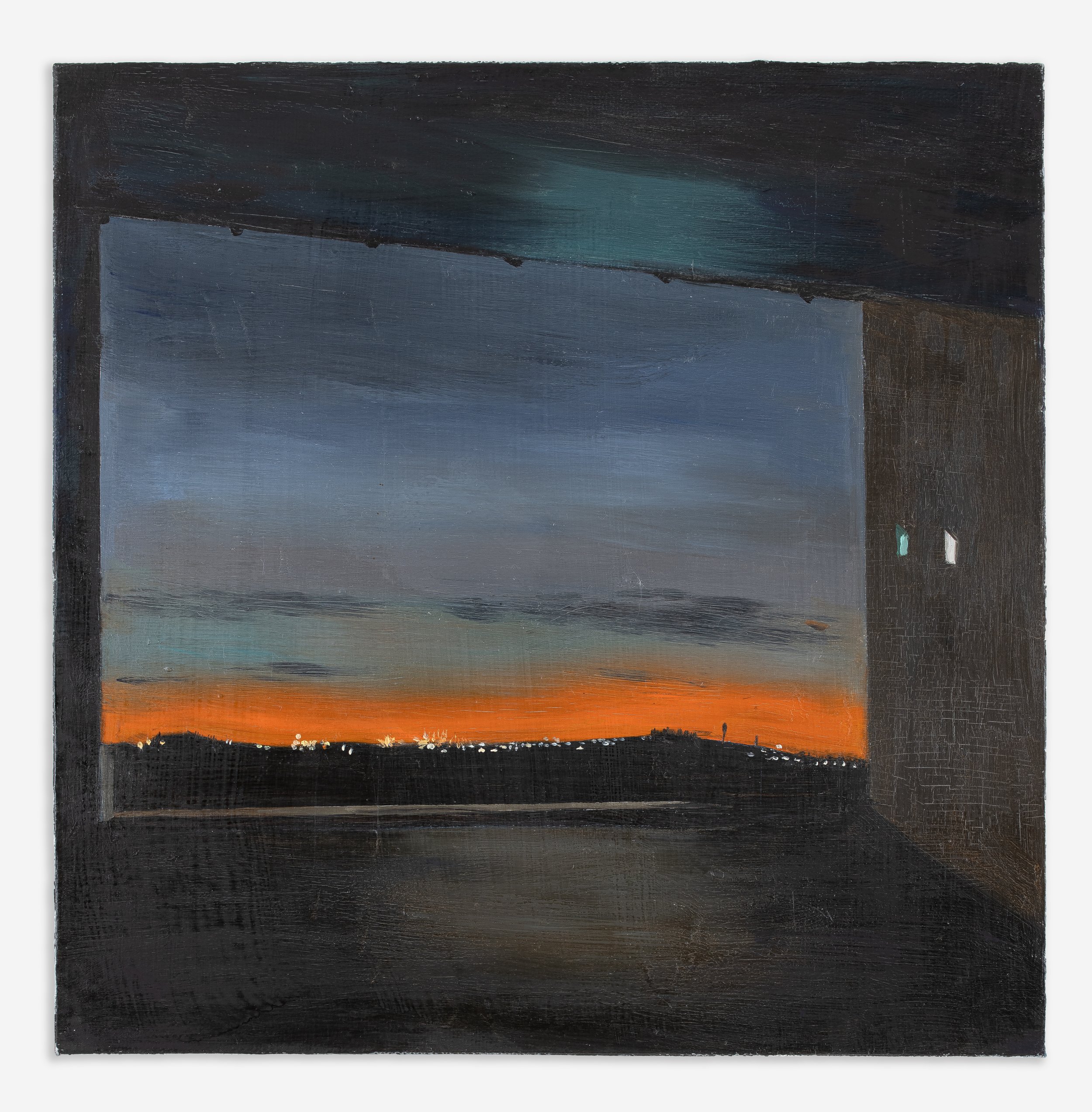
The surface of Sunset operates on two registers simultaneously. In the upper register, the sky and the distant horizon, the paint is thin and fluid, applied in horizontal strokes that let the canvas weave show through in the lightest zones, creating a sense of luminosity that arrives from below the surface rather than sitting on top of it. This is the sky rendered as a membrane: not a solid field of color but a permeable layer through which an underlying warmth, the primed white of the canvas, continues to radiate. The effect is that the sunset does not appear to be happening in the sky. It appears to be happening through the sky, as though the atmosphere were a screen and the light were being projected onto it from behind. In the lower register, where the city lights and the interior details appear, the paint thickens. Each point of artificial illumination is a small deposit of pigment, a dot of cadmium yellow or titanium white placed with the deliberateness of a hand marking a position on a map. These marks are not blended into their surroundings. They sit on top of the darker ground with a slight impasto ridgeline, catching the light when the canvas is viewed at an angle, becoming visible as physical objects rather than optical illusions. The painting makes you aware that the city lights are not the same kind of light as the sunset. They are made of different stuff. The sunset is rendered in thin washes that dissolve into the support. The city lights are rendered in thick dots that assert themselves against it. The medium mirrors the subject: natural light is diffuse, permeable, shared; artificial light is discrete, localized, owned.
The interior wall that appears in the composition, with its own small lights reflecting the warm glow from outside, introduces a spatial complexity that distinguishes this painting from a straightforward landscape. You are not looking at a sunset over a river. You are looking at a sunset over a river from inside a room, and the room is visible in the foreground, and the lights on the room's wall are responding to the same sunset you are watching through the window. This means the painting contains two light sources that are actually one: the exterior sunset illuminates the interior wall, and the interior wall records the sunset as a domestic event, a warm reflection on a painted surface. The wall is a receiver. The sunset is a transmitter. The city lights across the river are a second system of transmitters, and they are already operating at the moment the painting captures, which means that for a brief interval, two systems of illumination are active simultaneously. The painting holds that interval open. It refuses to let the sunset expire or the city fully take over. It preserves the overlap.
Vilhelm Hammershoi's interior paintings of the early twentieth century establish the tradition that Sunset enters and transforms. In works like Sunlight in a Room (1906, now in the Ordrupgaard Collection, Copenhagen), Hammershoi depicts a single shaft of daylight entering a room and falling across a door or a section of wall, illuminating a patch of floor. The room is sparsely furnished, the palette restricted to grays, browns, and the pale gold of the sunlight itself, and the figure, if one appears, is typically turned away, absorbed in some private action, her back to the viewer, her face unavailable. The light in a Hammershoi interior is always natural, always entering from outside, always modifying the interior geometry of the room by making a triangle of warmth on a plane of cool gray. The painting is about the moment when outside enters inside, but it is also about the aftermath: the silence that follows the light's arrival, the way a room holds the warmth after the sun has moved on.
Hammershoi's rooms are spaces of contemplation, of withdrawal, of private attention paid to the movement of natural light across domestic surfaces. The viewer stands at the threshold but does not cross it. The room is observed, not entered. Sunset shares this structure of the interior view, the threshold position, the private attention to the moment when outside light enters inside space. But where Hammershoi's light is always natural, always the sun, Tan Mu's painting includes a second system of illumination that has no precedent in Hammershoi's world. The city lights across the East River are not natural. They are electrical, digital, networked. They do not fade with the sunset. They intensify as the natural light dims. They replace the sun, not metaphorically but literally, providing the illumination that allows the city to remain visible after the horizon has gone dark. Hammershoi's painting is about the presence of natural light in a room. Tan Mu's painting is about the moment when natural light leaves and artificial light arrives to take its place, and the room, and the river, and the distant buildings, and the small reflections on the interior wall, all register the transition simultaneously.
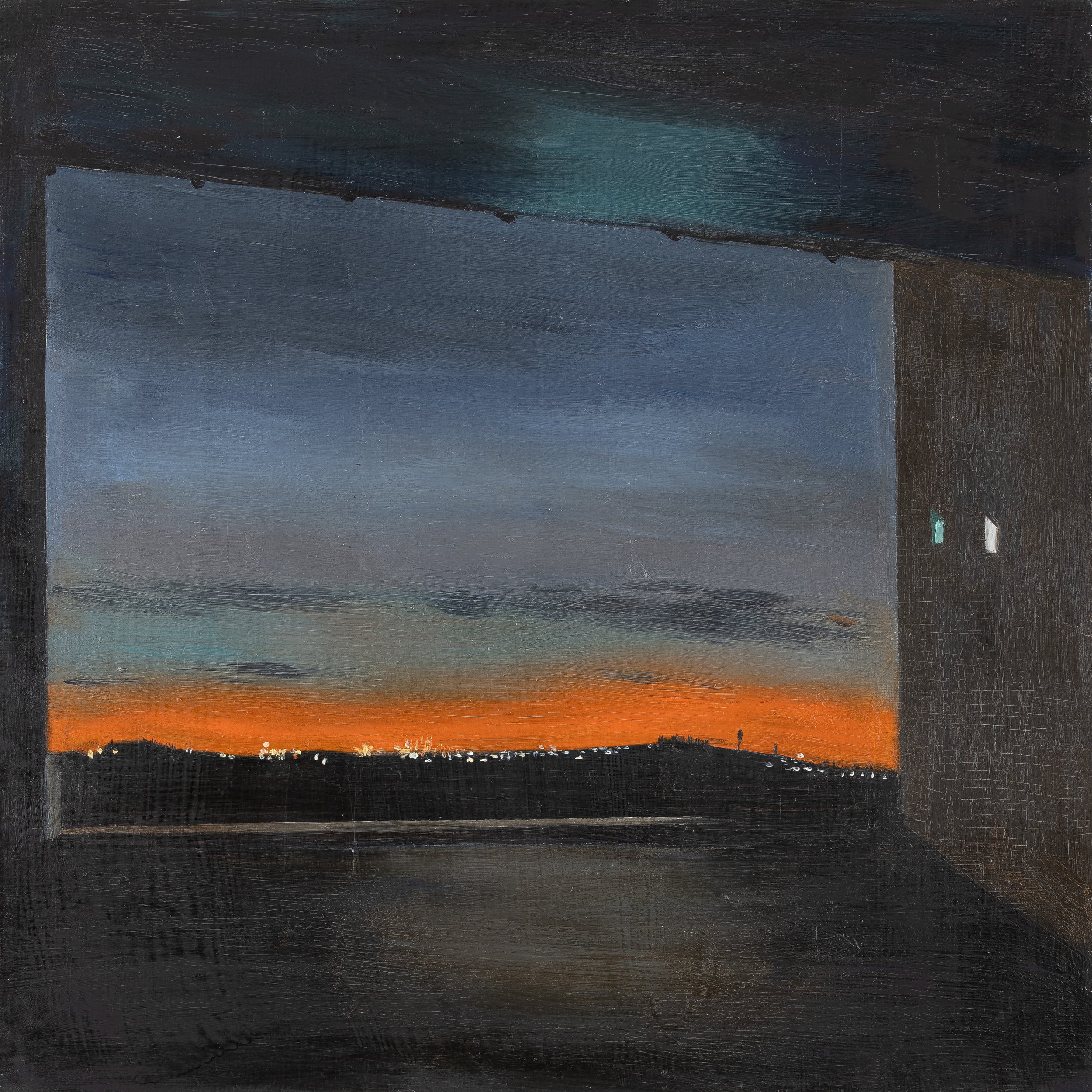
Tan Mu has described the scene as capturing "a transition rather than a fixed state." She continues: "Sunset is a threshold between day and night, when natural light begins to fade and artificial light gradually takes over. That shift resonated with my ongoing interest in time, perception, and transformation. It is a moment that feels ordinary and familiar, yet it contains a subtle tension between stillness and change." The distinction between a fixed state and a threshold is the painting's organizing principle. A sunset painting that depicted only the sky in full color would be a painting of a fixed state: beauty, warmth, the familiar palette of dusk. Sunset depicts the moment when that palette is being dismantled, when the warm tones are losing their authority and the cool, pointillist language of artificial light is asserting its own grammar. The distant lights across the river, as Tan Mu observes, "resemble points of data or signals, similar to the visual language I use in works about networks and information systems." They are not atmospheric. They are informational. Each light is a point of data, and the painting's composition, which places them in a row across the middle distance, echoes the arrangement of landing points in the Signal series, where each dot of color represents a submarine cable connection. The sunset, in this reading, is not the subject. The handover from one system of illumination to another is the subject. The sunset is merely the event that triggers the transition.
The relationship between natural and artificial light in the painting is not one of opposition but of succession. Tan Mu articulates this directly: "The dialogue between natural and artificial light is central to this work. The glow of the sunset on the horizon is echoed by the small lights on the wall and the distant city lights across the river. This mirroring creates a connection between the interior space and the exterior landscape. For me, urban lights function like signals, marking human presence and activity within the environment. They transform the city into a network of energy and information, gradually replacing natural rhythms with technological ones." The word "replacing" is precise. It does not say "complementing" or "echoing." It says replacing. The city lights do not coexist with the sunset in perpetuity. They replace it. They take over the function that the sun was performing, which is to make the environment visible, and they perform that function according to their own logic, which is not the logic of atmospheric scattering but the logic of electrical grids, data networks, and the human demand for continuous visibility. The painting captures the moment of replacement, the breath between one system expiring and another taking over, and it holds that breath open for as long as you stand in front of it.
Childe Hassam's flag paintings of Fifth Avenue during World War I, particularly Avenue of the Allies, Great Britain, 1918 (now at the Metropolitan Museum of Art, New York), present urban light at a different register but with a structural similarity worth attending to. Hassam's city is a corridor of flags and buildings bathed in strong daylight, the surfaces catching sun and shadow in crisp, unhesitating strokes. The painting is a celebration of public space, public light, public color. The flags are the subject, but the light is the medium, and the light is collective: it belongs to the street, to the avenue, to the city as a shared visual field. Nobody owns the sunlight bouncing off a silk flag. Hassam's Impressionist technique dissolves individual marks into a field of shimmering color that registers as a communal experience, a shared brightness that belongs to everyone standing on the avenue at the same moment.
Tan Mu's city lights operate in the opposite direction. Where Hassam's light is communal and atmospheric, shared by every surface it touches, the lights in Sunset are discrete and individual. Each one is a separate point, a separate decision by a separate building to remain visible after dark. They do not dissolve into a field. They accumulate into a network. The painting's composition makes this distinction legible: the sunset portion of the canvas is rendered in the atmospheric language of thin washes and horizontal strokes, a field of color that belongs to no one and everyone simultaneously. The city lights portion is rendered in the informational language of isolated dots, each one a signal from a specific location, each one a mark of a specific building choosing to stay lit. The distinction is not between beauty and utility. It is between a form of illumination that is unowned and a form of illumination that is owned, maintained, switched on, and, when necessary, switched off. The sunset cannot be switched off. The city can, and sometimes does, as any New Yorker who has lived through a blackout knows. The painting knows this, too. The interior wall with its small reflected lights is the domestic version of the city's network: a private system of illumination that depends on the same electrical grid, the same infrastructure, the same capacity to be extinguished.
Danni Shen, writing about Tan Mu's practice in her 2024 studio visit for Emergent Magazine, observed that the works "serve as a kind of witness to human socio-technological histories." The word "witness" carries a double meaning. A witness observes. A witness also testifies. Sunset observes the transition from natural to artificial light, and it testifies to the fact that this transition is not merely visual but structural. The city lights that replace the sunset are not decorations. They are the visible evidence of an infrastructure that makes urban life possible after dark: the power grid, the fiber-optic network, the building management systems that decide when to switch on the lights in a residential tower and when to leave them off. Each point of light in the painting is a node in this infrastructure, and the painting's composition, which arranges them in a row across the middle distance, mirrors the arrangement of the submarine cable landing points in the Signal series, where each dot represents a point where information enters or leaves the ocean. The distant lights across the East River are not just beautiful. They are functional. They are doing work. And the painting, by rendering them with the same deliberate mark-making that it uses for the sunset, grants them the same visual authority: these lights, it says, are as real, as specific, and as worthy of sustained attention as the dying light of the sun.
The East River itself, which the painting views from a studio in downtown Manhattan, is not merely a picturesque body of water. It is a working estuary, one of the most heavily trafficked waterways in the United States, connecting Long Island Sound to New York Harbor and, beyond that, to the Atlantic. Submarine cables cross beneath it. Ferries run across its surface. The lights on its far shore, which appear in the painting as discrete dots of warm yellow and cool white, belong to Brooklyn and Queens, to residential towers and commercial buildings and the industrial infrastructure of the Navy Yard and the Long Island City waterfront. The painting does not identify these lights by name. It does not label them. But their arrangement, their varying sizes and intensities, their spacing along the horizon, constitutes a map of human activity rendered in light. When Tan Mu says that urban lights "transform the city into a network of energy and information," she is describing a literal condition, not a metaphor. The lights are the network. Each one is a point of connection, a signal that someone is home, that a building is occupied, that a system is functioning. The painting records this condition from the quiet of a studio, where the observer is not part of the network but is watching it activate across the water, and the interior lights on the wall are the local proof that the network extends even into the private space of the room.
The square format of the canvas, 31 x 31 cm, reinforces the painting's argument about frames and thresholds. A rectangular canvas implies a landscape or a portrait, a orientation toward horizontality or verticality. A square canvas refuses both. It is a window, a screen, a monitor. It is the shape of a phone held upright, a tablet in landscape, a social media post. The sunset within it is not a panoramic view. It is a captured frame, a moment excerpted from the continuous flow of dusk and enclosed in a format that identifies it as data as much as experience. The interior wall that appears in the foreground, with its small lights responding to the sunset, is the frame within the frame, the domestic screen that doubles the electronic screen. The viewer is positioned not in the open air but in a room, looking through a frame at another frame, and the painting insists that this is how the sunset is now seen: through architecture, through glass, through the infrastructure that makes the view possible. There is no unmediated landscape in Sunset. There is only the landscape as it arrives through the systems that transmit it, and the painting's quiet claim is that this mediation, far from diminishing the experience, is what makes it legible. The sunset was always there. The lights that replace it had to be built.