The Shadow That Was Not Cast: Tan Mu's Projection: Light and Shadow and the Body Doubled
At six inches from the canvas, the blue is not one color but a temperature gradient. The linen holds a cool cerulean in its weave, and the oil that sits on top of it drifts from that cerulean toward a deeper ultramarine at the composition's center, then thins at the edges to something close to slate, where the weave of the fabric shows through like a grid beneath water. The figure in the middle is not drawn but built from this gradient: a vertical smear of slightly denser pigment that resolves, as you step back, into a standing body. And then the shadows appear. Three of them. One solid, one translucent, one faint. Three shadows cast by a single figure standing in a blue-toned environment under a light source that does not exist in the room you are standing in, because the light source is a camera, and the shadows were generated by a projection system, and the whole scene, figure and shadows and blue ground, was recorded in real time and then translated into oil paint. You are not looking at a painting of a person. You are looking at a painting of a recording of a projection of a person. The distance between your eyes and the surface of the linen is the last in a chain of mediations that began with a video feed.
Tan Mu's Projection: Light and Shadow (2021) is an oil on linen painting, 46 x 61 cm (18 x 24 in), that takes as its subject the real-time video recording and projection of a figure standing in a blue-toned environment. The figure generates multiple iterations of shadow: one solid, one translucent, one faint. These are not the shadows that a single candle or a single window would cast. They are the products of electronic projection, a medium that can multiply a shadow the way a printer multiplies an image. The painting treats this multiplication as neither gimmick nor glitch. It treats it as the natural condition of being seen through technology, where a single body produces not one shadow but several, each corresponding to a different register of visibility. The painting does not mourn this condition. It does not celebrate it either. It documents it with the same precision that an earlier painter might have used to document the shadow cast by a window onto a stone floor.
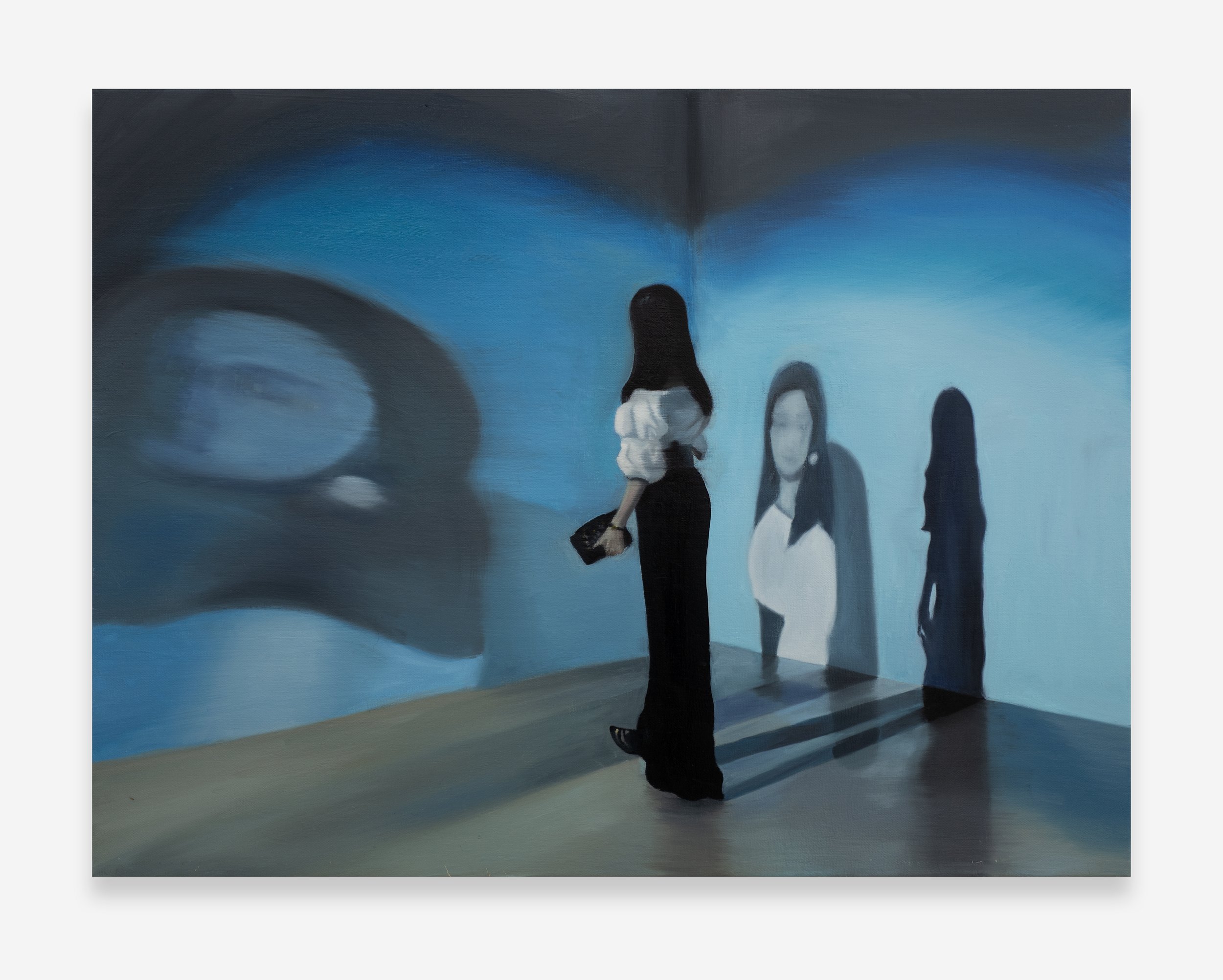
The surface tells you what the subject cannot. At arm's length, the paint application reveals two distinct regimes. The body of the figure and its densest shadow are rendered with short, decisive strokes that build form through accumulation, each mark a small act of commitment to the surface. This is painting that knows what it is describing and presses down hard. The translucent shadow and the faint shadow, by contrast, are laid in thin, almost dry passages where the bristle marks are visible but the pigment itself is barely there, a whisper of cadmium and titanium that lets the blue ground do most of the work. The difference in paint handling is not an accident of technique. It is an argument. The solid shadow and the figure that casts it belong to the same order of reality, the order of physical presence. The lighter shadows belong to the order of projection, the order of mediation, where presence is attenuated by the number of times it has been copied. The linen weave shows through most insistently in these lighter zones, as though the painting wants you to feel the distance between the represented shadow and the real fabric beneath it. The scale, 46 x 61 cm, keeps the work at the dimension of a monitor or a small screen. You look at it the way you look at a device, at a distance of arm's length, not the way you look at a mural or a history painting. The scale enforces intimacy while the content insists on displacement.
The tradition of using strong directional light to define form and to dramatize narrative content in Western painting reaches one of its early peaks in Caravaggio's The Calling of Saint Matthew (1599-1600), in the Contarelli Chapel in San Luigi dei Francesi, Rome. A shaft of light enters from the upper right, Christ's hand pointing across the canvas at the tax collector, whose face, half in shadow, half illuminated, registers the instant of recognition. The light in Caravaggio is not ambient. It is a decision. It selects Matthew from the group, separates the called from the uncalled, and does so through the physical fact of illumination striking a surface. The shadow on the back wall is as sharp as the light on the faces. This is painting where shadow is a theological instrument: darkness is not the absence of God but the evidence that God has passed through, leaving a sharp border between those who see and those who do not.
Caravaggio's light operates through a single source, and the shadows it produces are singular and decisive. A figure in Caravaggio has one shadow because the theological and pictorial logic of his painting demands that revelation be singular, that the moment of being seen be instantaneous and total. Projection: Light and Shadow operates under a different logic entirely. The figure here does not stand under a single, revelatory beam. It stands under a projection system, and a projection system does not reveal. It multiplies. Where Caravaggio's light chose one face from a crowd, the electronic light in Tan Mu's painting does not choose. It replicates the figure into a series of shadows, each one slightly less present than the last, as though identity itself were being printed at decreasing opacity. The theological shadow says: you have been seen. The projected shadow says: you are being reproduced. These are not the same statement, and the painting knows it. The blue tonality, which at first reads as an aesthetic choice, is in fact the color of screen light, the color of video monitors and projection surfaces. The painting is not set in a room. It is set on a screen.
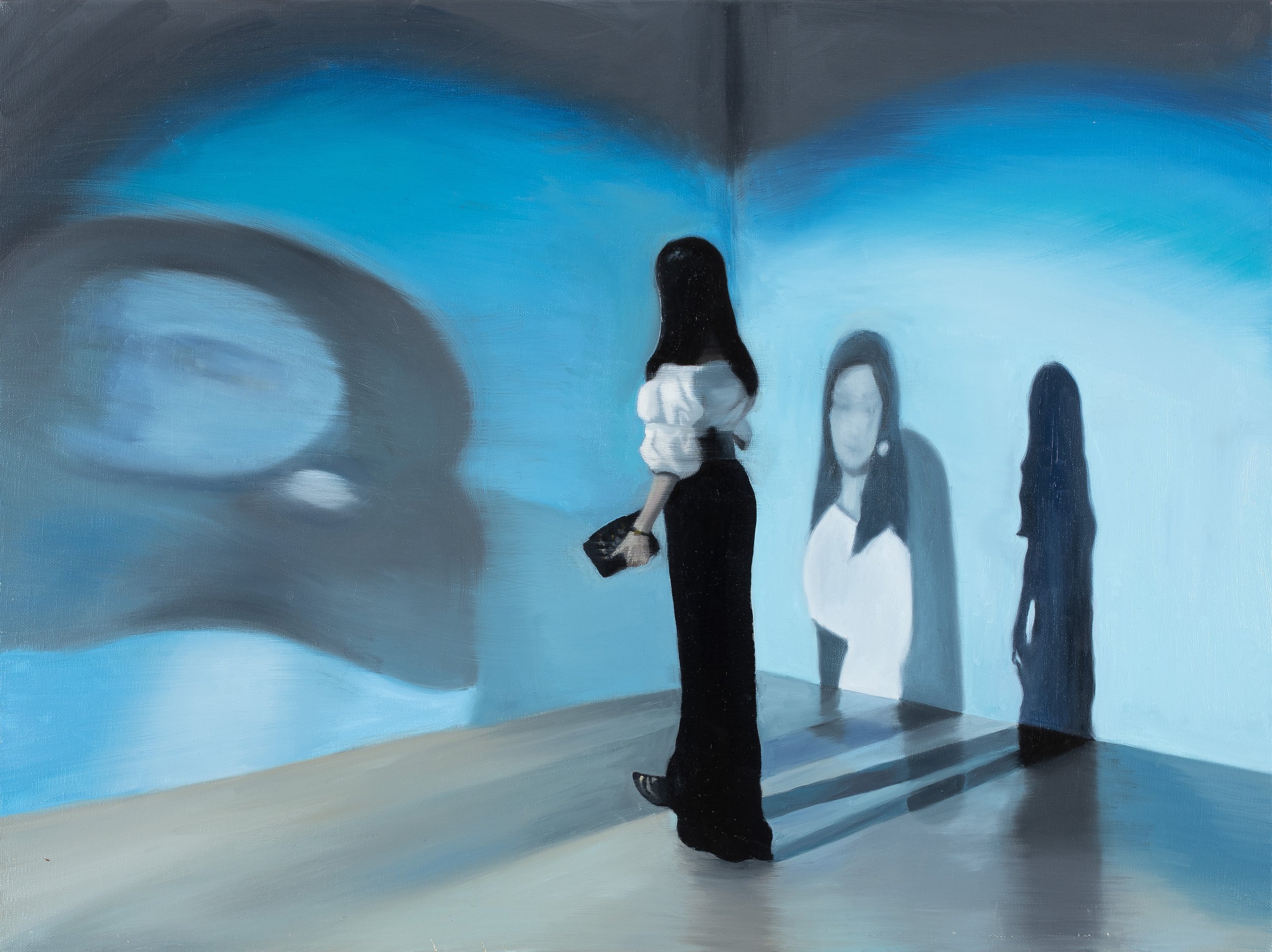
Tan Mu has described the origin of this work in personal terms. "While developing Projection: Light and Shadow, I was going through a period of personal uncertainty surrounding memory and identity," she has said. "That experience made me aware of how, in the digital era, human existence can become fragmented, fluid, and constantly redefined through technological mediation." The painting emerged from a period when the artist was questioning the stability of her own sense of self, and the multiplied shadows in the composition are not an abstract formal device. They are a direct transcription of what it feels like to encounter yourself through a screen, a camera, a projection, and to realize that the version of yourself that you see there is neither more nor less real than the version that stands in the room. The figure in the painting is surrounded by projected shadows, "fragmented into multiple layers, much like our contemporary identities," as Tan Mu puts it. "We exist as overlapping versions of ourselves: the self on social media, the self captured by surveillance systems, the data-driven self. Each of these versions is part of who we are, yet none of them fully defines us."
The work also traces a genealogy of light in painting, a genealogy Tan Mu articulates directly. She cites the progression from "the sacred illumination in religious paintings to the intimate glow of candlelight in Renaissance works, the revolutionary impact of natural light in plein air painting, and finally, to our contemporary era of digital projection." Each stage in this genealogy represents not just a new technology of illumination but a new relationship between the viewer and the viewed. Sacred light reveals God. Candlelight reveals interior life. Natural light reveals the material world. Projection light reveals mediation itself, the fact that what you are seeing has been processed, amplified, and transmitted before it reaches your eyes. The painting occupies this last stage but carries the memory of all the others in its compositional structure. The figure stands like a saint in a niche, the blue ground replaces the gold leaf of a Byzantine icon, and the three shadows take the place of the three witnesses in a Renaissance annunciation. The format is devotional. The content is technological.
The distinction between a shadow cast by natural light and a shadow generated by electronic projection is not merely technical. A natural shadow is tied to a specific source: the sun, a candle, a window. It is anchored to the physics of a room and the time of day. A projected shadow is generated by a device, and a device can be reconfigured. The number of shadows, their intensity, their angle, their placement: all of these are adjustable parameters. In Projection: Light and Shadow, the three shadows are not accidental byproducts of a lighting rig. They are the compositional subject of the painting. They are what the painting is about. The figure could be anyone. The shadows are what make the image specific to this moment in history, when a body can be accompanied by multiple electronic ghosts of itself, each one registering at a different frequency, each one claiming a different degree of presence. The painting asks: what is a shadow that was not cast by the sun? What is a shadow that was programmed?
Video projection as an artistic medium has its own genealogy, and it matters for understanding what Tan Mu is doing here. The first video projectors became commercially available in the late 1960s, and artists including Nam June Paik and Steina Vasulka began incorporating them into installations almost immediately. By the early 1970s, projection had become a tool for dissolving the boundaries between viewer and image, between the room and the screen. A projected image does not sit on a surface the way a painting does. It fills a volume. It can cover a wall, a floor, a body. It can also generate shadows: when a person walks between the projector and the wall, their body interrupts the beam and casts a shadow that is not their own but the machine's. These shadows, which early video artists called "shadow play," were initially treated as playful byproducts of the medium. Tan Mu's painting takes this byproduct and makes it the central subject. The three shadows in the composition are the visual record of a body standing between a projector and a surface, but they are also something more: they are the record of a body that has been seen by a machine, processed by a machine, and reproduced by a machine, and the painting insists that this condition, this mediated way of being seen, is the condition of contemporary identity itself.
Dan Flavin's fluorescent light installations, beginning in the 1960s, replaced the sacred and theatrical light sources of Western painting with industrial tubes of colored gas. In works like Untitled (to the Real Dan Hill) (1973), Flavin arranged fluorescent tubes in a corner, their pink and yellow glow spilling across the gallery walls, creating zones of colored shadow where the tubes overlapped. The shadows in a Flavin installation are not incidental. They are structural. A single tube casts one shadow. Two tubes, crossing, cast two. Three tubes create a pattern of overlapping shadows that no single light source could produce. The viewer's own body enters the system and casts its own shadows, becoming part of a field of illumination that has no center and no single origin point. Flavin's work insists that light is not a given. It is a material, manufactured and distributed, and its distribution determines what can be seen and by whom.
Flavin's insight that industrial light produces shadows with a different ontological status than natural light provides a direct precedent for understanding what Tan Mu achieves in Projection: Light and Shadow. Where Flavin used fluorescent tubes to demonstrate that gallery light could be both medium and subject, Tan Mu uses the language of video projection to demonstrate that the contemporary shadow is no longer the absence of light but the presence of a copy. The three shadows in her painting are not gradations of darkness. They are gradations of reproduction. The solid shadow is the shadow of the physical body. The translucent shadow is the shadow of the projected image of the body. The faint shadow is the shadow of the recording of the projected image. Each step away from the figure is a step further into mediation, and each step reduces the density of the pigment, until the faintest shadow is barely distinguishable from the weave of the linen. The painting makes the chain of mediations legible by making each one physically present as a layer of paint with its own density and its own degree of commitment to the surface.
Li Yizhuo, writing about Tan Mu's recent work, has observed that the paintings "do not aim at diagnosing the modern spectacles from a distance. They conjure up a kind of vitality and depth of their own." The observation applies with particular force to Projection: Light and Shadow. The painting does not diagnose the condition of digital identity from a safe, theoretical distance. It enters the condition and makes it visible in oil paint, which is to say in a medium that predates the projector by half a millennium. The choice of oil on linen, rather than a digital medium, is itself an argument. The painting says: this condition, the multiplied shadow, the fragmented self, the instability of presence under electronic light, can be held still and looked at. It can be rendered in a material that dries and becomes permanent. The projection that generates the shadows in the original video is ephemeral by nature. It can be turned off. The painting cannot. It fixes the projected shadow in the same medium that Caravaggio used to fix the shadow of divine light, and in doing so it makes a claim about what deserves to be preserved: not the natural shadow, which was always already there, but the electronic shadow, which had to be invented.
The painting's scale reinforces this argument. At 46 x 61 cm, it is roughly the size of a laptop screen or a tablet held in landscape. This is not a dimension that commands a room. It is a dimension that fits a desk, a lap, a handheld device. The scale is the scale of the technology that produces the multiplied shadows in the first place, and by matching that scale, the painting refuses the monumental gesture that would place the viewer at a safe, aestheticizing distance. You hold this painting at the same distance you hold a phone. The intimacy is enforced by the dimensions. You are not standing in front of an altar. You are sitting with a screen, and the painting knows it.
The blue ground of the painting, which at first reads as a compositional choice, turns out to be the color of the screen. It is the blue of video monitors, of the chroma-key backgrounds used in television studios, of the glow that a phone casts on a face in a dark room. It is not the blue of sky or water. It is the blue of a surface waiting to receive an image. In this context, the figure standing on the blue ground is not standing on a floor or a landscape. It is standing inside a medium. The shadows it casts are not cast onto a wall or a street. They are cast onto a recording surface, a screen, a field that exists only to be written on and erased. The painting holds this condition still long enough for the viewer to register what it actually looks like when a body is accompanied by its own electronic afterimages. The result is not a critique of technology. It is a portrait of what presence looks like when it has been mediated, reproduced, and projected back. The shadow was once the proof that the body was real. In this painting, the shadow proves that the reproduction was real, and the body, standing among its copies, becomes one version among many, no more solid than the paint that holds it to the linen.