The Weight of a Vial: Tan Mu's Vaccine and the Object That Held the World
The Pfizer-BioNTech COVID-19 vaccine was stored in a vial measuring approximately 2 centimeters in diameter and 6 centimeters in height. It contained 0.3 milliliters of liquid. It required ultra-cold storage at minus 70 degrees Celsius. It was, by any material measure, one of the smallest objects to have ever altered the trajectory of a global crisis. During 2020 and 2021, photographs of this vial circulated through news feeds, scientific journals, and social media with a frequency that no pharmaceutical product had ever achieved. The vial became a visual shorthand for hope, for the end of isolation, for the return of ordinary life. It was recognizable by its shape before its contents could be read: a small glass cylinder with a rubber stopper and a blue aluminum seal, held between gloved fingers or resting on a stainless steel tray. It was the most photographed medical device of the twenty-first century, and it had not been designed to be looked at. It had been designed to hold 0.3 milliliters of lipid nanoparticles encasing messenger RNA, the molecule that instructs human cells to produce the spike protein of SARS-CoV-2, thereby training the immune system to recognize and fight the virus before it could take hold.
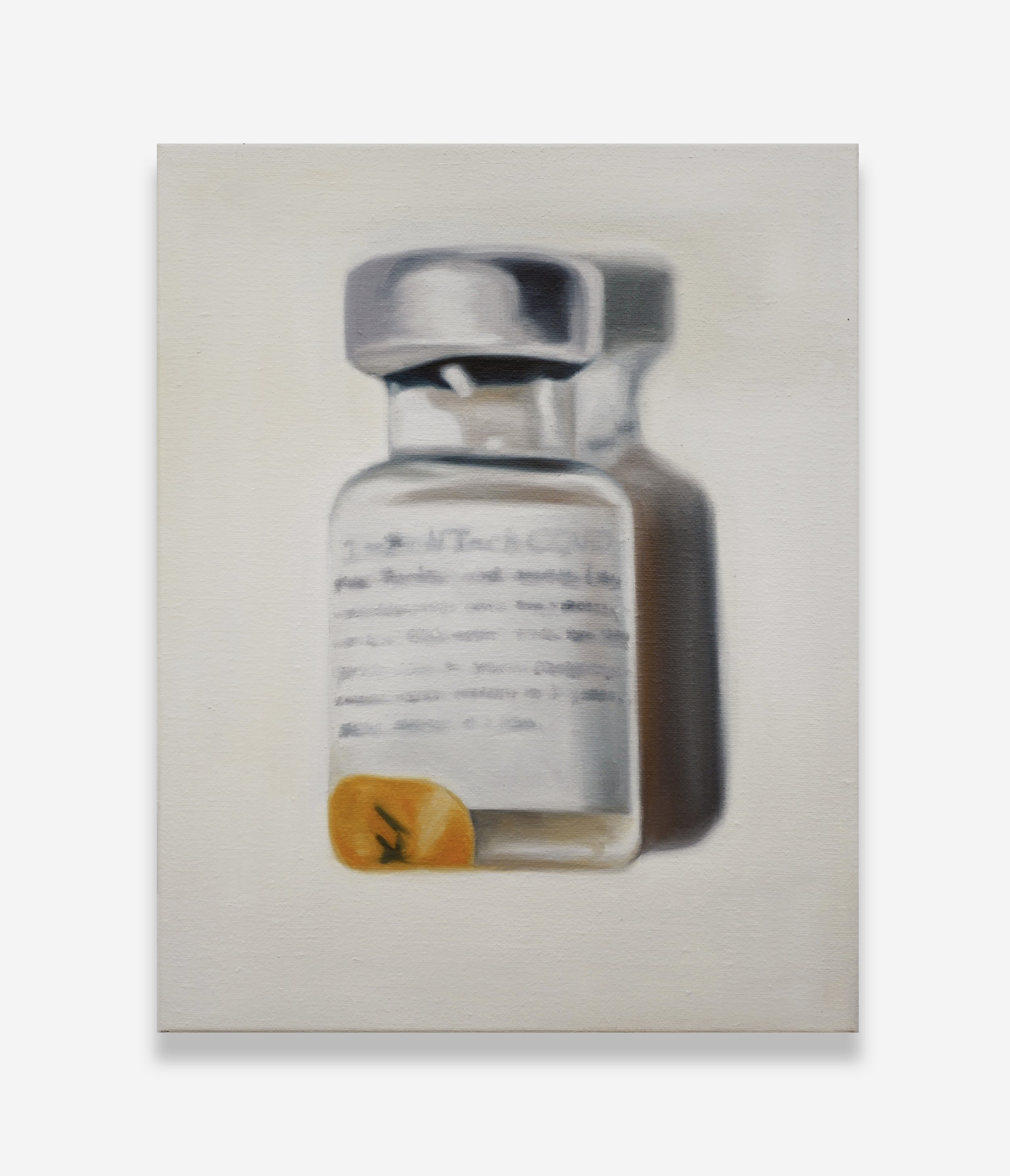
Tan Mu's Vaccine (2021) takes this object as its subject. Oil on linen, 36 x 28 cm (14 x 11 in), the painting presents the vaccine vial at a scale that transforms it from a pharmaceutical container into something closer to a devotional object, a reliquary, a vessel that holds not just medicine but collective memory, anticipation, and the weight of a year of isolation. The vial floats against a dark ground, its glass walls catching and refracting light, the liquid inside rendered in luminous tones that suggest both the translucence of the solution and the hope it carried. The painting does not depict the vial in its clinical context, surrounded by syringes and freezers and the apparatus of distribution. It isolates the vial against a background that could be a laboratory shelf, a night sky, or the interior of a refrigerator. The ambiguity is deliberate. The vial is not in a place. It is in a moment, the moment when a small glass object ceased to be a pharmaceutical product and became a cultural artifact.
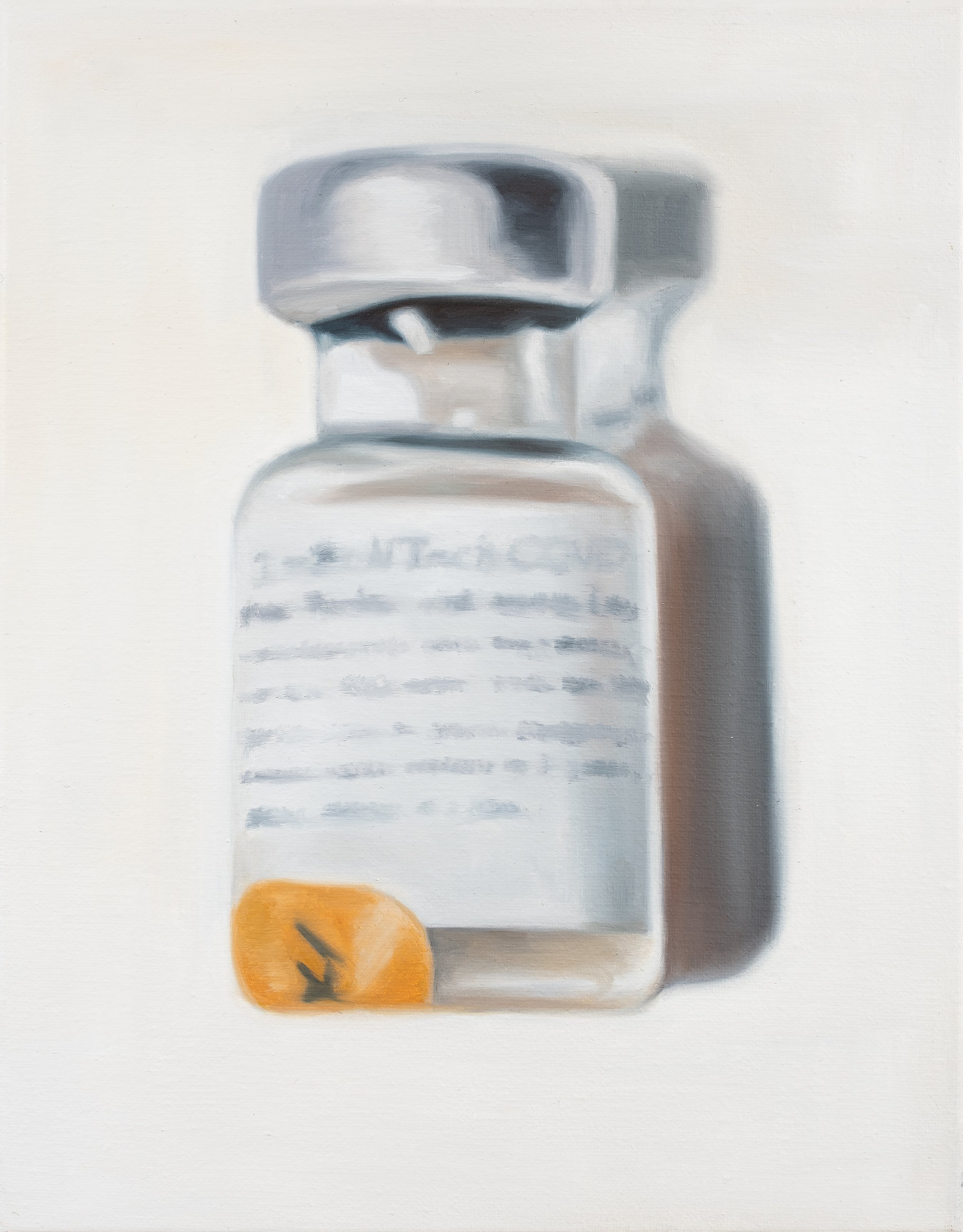
The paint surface of Vaccine operates at the intersection of two registers that the painting holds in productive tension. The dark ground, which occupies the majority of the canvas, is built up in thin, nearly transparent layers of Payne's gray and raw umber over a dark blue underpainting, so that the depth of the background is not a flat black but a receding atmospheric space, a darkness that breathes. Against this ground, the vial is rendered with concentrated precision. The glass cylinder is defined by two vertical lines of pale titanium white, each no more than a millimeter wide, that trace the left and right edges where the surface of the glass catches the ambient light. Between these lines, the glass itself is suggested by a thin wash of pale cerulean mixed with zinc white, so translucent that the dark ground shows through, enacting in paint the very transparency the vial possesses in the physical world. The liquid inside the vial occupies the central third of the cylinder, a band of warm amber and cadmium yellow that glows against the dark surround with an intensity that exceeds its actual chromatic range. This glow is the painting's central visual event. It is produced not by the brightness of the pigment alone but by the contrast between the warm interior band and the cool, dark exterior ground, and it gives the impression that the vial is generating its own light, as though the mRNA solution were luminous by nature, as though the contents of the vial were radioactive or divine rather than merely pharmaceutical.
The rubber stopper at the top of the vial is a small horizontal bar of deep red-brown, darker than the ground in its shadowed half and catching a sliver of light along its upper edge. The aluminum seal, which in the physical vial is crimped over the stopper with a blue flip-off cap, is rendered as a thin ring of cool gray at the very top of the composition, a detail so small that it is almost invisible at first viewing but becomes structurally important once noticed: it is the only element in the painting that is explicitly industrial, the only mark that locates the vial in the world of manufacturing and quality control, the only visual evidence that this object was produced by a machine in a factory rather than materializing from the darkness fully formed. The scale of the painting, 36 x 28 cm, is large enough to hold the vial at greater than life size but small enough to remain intimate, the kind of painting you hold in your hands rather than stand back from. The vial in reality is approximately 6 centimeters tall. In the painting, it fills most of the vertical dimension, magnified to a scale that makes its details legible and its presence monumental, transforming a disposable medical container into something that demands the same attention a still life painter might give to a treasured object.
Giorgio Morandi spent decades painting bottles, vases, jugs, and boxes arranged on a shelf in his Bologna studio. In Natura Morta (Still Life, 1956, now in the Metropolitan Museum of Art, New York), three objects, a tall bottle, a small box, and a broader vase, sit on a narrow surface against a muted gray ground. The palette is restricted to grays, ochres, pale pinks, and the warm white of earthenware. The light is diffuse, sourceless, as though the objects generated their own illumination from within. Nothing in the composition calls attention to itself. The bottle is not interesting as a bottle. The vase is not interesting as a vase. The painting is interesting in the relations between the objects: the intervals of space, the way one silhouette touches or nearly touches another, the way the light catches an edge and releases a tone that holds the entire composition in balance. Morandi's bottles are not symbols of anything. They are objects in a specific arrangement, observed over time, painted with the patience that comes from looking at the same thing for months.
Morandi's practice of sustained, repetitive attention to simple vessels provides a structural parallel for understanding what Vaccine accomplishes with its own vessel. Morandi's bottles are emptied of their original contents and filled instead with the painter's attention. They become, over the course of dozens of sessions, containers not of wine or oil but of looking itself. The same transformation occurs in Tan Mu's painting. The vial in Vaccine does not contain mRNA in any representational sense. It contains the act of looking at a vial, and through that act, it contains the year when vials like this one were the object that millions of people were waiting for, checking the news for, standing in line to receive. Morandi's bottles hold light and patience. Tan Mu's vial holds collective anticipation. The form is the same: a simple glass container, rendered with sustained attention, against a dark ground, at a scale that makes the small monumental. The content is different, because the historical moment is different, and the painting makes that difference visible by making the vial's contents glow with an internal luminosity that Morandi's bottles never possess. The glow is not a decorative flourish. It is the painting's argument: that what is inside this particular vessel is not inert, not merely a solution, but something that carried the weight of collective hope and collective fear.
Tan Mu has been explicit about the connection between this work and her broader practice. "While earlier works in my practice explored genetics and human DNA from a more conceptual distance, Vaccine responds directly to a specific historical moment," she has said. "The rapid development of the Pfizer BioNTech COVID vaccine struck me as a powerful symbol of collective resolve. I was fascinated by how such a small vial could contain both advanced scientific innovation and a shared sense of hope. The mRNA technology in particular felt like a continuation of my long-standing interest in genetic codes, but now embedded within an urgent social reality." The reference to genetic codes is not incidental. Tan Mu's earlier works on DNA, chromosomes, and cellular structures approached these subjects from a position of scientific inquiry, examining the structures of life at the microscopic level. Vaccine approaches the same territory from a different direction. Here, the genetic code is not an abstraction to be studied. It is a delivery mechanism, a set of instructions packed into a lipid nanoparticle and injected into a human arm, where it teaches the body to defend itself. The code is not merely observed. It is deployed. The painting registers this shift from observation to deployment by making the vial's contents luminous. The code is not just there. It is active. It is doing something.
The vial's status as a cultural artifact is central to the painting's meaning. Tan Mu has described it as such: "I was drawn to the vaccine vial because it became a cultural artifact of the pandemic. Even without explicit branding or detailed labeling, its form is immediately recognizable. During that period, images of vaccine vials circulated constantly across media platforms, scientific reports, and personal conversations. The vial became a visual shorthand for vulnerability, anticipation, and relief." The word "artifact" is precise. An artifact is an object made by a human being, typically one of cultural or historical interest. The vial was manufactured by a pharmaceutical company to hold a specific volume of a specific solution. But it became an artifact, in the anthropological sense, when it entered the collective imagination of a global population during a pandemic. It acquired significance beyond its function. It became a symbol, and symbols, unlike pharmaceutical products, cannot be stored in freezers or distributed by logistics networks. They circulate through photographs, conversations, and paintings. Vaccine is one of the vehicles through which the vial's symbolic weight circulates. It does not add to the symbol. It makes the symbol visible by isolating it from the clutter of its clinical context and presenting it in the vocabulary of sustained attention that the still life tradition provides.
The mRNA technology inside the vial adds another layer to the painting's argument about genetic codes. Unlike traditional vaccines, which introduce a weakened or inactivated virus to stimulate an immune response, the Pfizer-BioNTech vaccine delivers a piece of messenger RNA that instructs human cells to produce the spike protein of SARS-CoV-2. The cell reads the instruction, produces the protein, displays it on its surface, and the immune system learns to recognize it. The mRNA degrades within hours, but the immunological memory persists. The process is not vaccination in the older sense of exposing the body to a pathogen. It is instruction, a temporary download of information that the body executes and then discards. This is why Tan Mu describes the mRNA technology as "a continuation of my long-standing interest in genetic codes, but now embedded within an urgent social reality." The genetic code is not something distant, observed under a microscope, catalogued and painted from the safe remove of scientific curiosity. It is a set of instructions that was injected into over five billion human arms. The code did not stay in the vial. It did not stay in the laboratory. It entered bodies. The glow of the vial's contents in the painting registers this transition: the luminous amber band is not the color of the solution as it would appear under clinical lighting. It is the color of code that is about to be executed, information that is about to become flesh.
Georgia O'Keeffe's flower paintings of the 1920s, particularly Jack-in-the-Pulpit No. 4 (1930, now at the National Gallery of Art, Washington), offer a different but instructive parallel. O'Keeffe took a small woodland flower, a plant most people would walk past without noticing, and magnified it to fill a canvas measuring 40 by 30 inches. The flower's spathe opens like a hood over the spadix, and O'Keeffe renders the interior in deep purples and blacks that make the flower feel not delicate but architectural, not pretty but immense. The scale shift is the argument. By making the small large, O'Keeffe insists that the flower deserves the same attention that a landscape or a portrait commands. The painting does not illustrate the flower. It enacts a transformation: the flower becomes an event, a spatial experience, a color field that the viewer enters rather than looks at from a distance.
Tan Mu's Vaccine performs a related transformation, though in reverse: it takes an object that was already large in the public imagination and makes it visible again by rendering it in the slow, material language of oil paint. The vial was already a symbol before the painting was made. Photographs of it had already circulated worldwide. The painting does not introduce the symbol to the viewer. It reintroduces it, stripping away the context of news photography and scientific illustration and presenting the vial in a state of contemplative isolation, against a dark ground, at a scale that demands close looking rather than rapid recognition. Where O'Keeffe magnifies the overlooked to make it monumental, Tan Mu isolates the over-familiar to make it strange again. The vial you have seen a hundred times in a news photograph is not the same vial you see in this painting. The photograph tells you what it is. The painting tells you how long you are willing to look at it. The luminous contents, rendered in warm amber against the dark surround, invite you to stay, to keep looking, to notice the way the glass catches light along its edge, the way the rubber stopper casts a shadow across the seal, the way the background breathes behind the object like the dark of a refrigerator or the night sky over a distribution center. The painting makes the vial unfamiliar by treating it as if it deserved the kind of attention that Morandi gave to his bottles and O'Keeffe gave to her flowers, the kind of attention that is not functional but contemplative, not looking-at but looking-into.
Saul Appelbaum, in his 2025 essay on Tan Mu's practice, has argued that the paintings "transform data cables into gestural constellations that oscillate between calculation and intuition." The observation extends to Vaccine, where the transformation operates on a different material register. The vial is not a cable. It does not carry data between continents. It carries a biological instruction between a pharmaceutical factory and a human arm. But the transformation is the same: an object of calculation, manufactured to precise specifications, filled to a calibrated volume, stored at a controlled temperature, becomes a painting, which is an object of intuition, made by hand, rendered in pigment and oil, seen from a distance and held in the memory. The vial is calculated. The painting is intuited. The vial was produced in batches of millions. The painting was produced once. The gap between these two modes of production is the space where the painting's meaning accumulates. It is the space where the question forms: what does it mean to look at a mass-produced object with the attention that was once reserved for things that were unique?
The answer the painting proposes is that the attention itself transforms the object. Not the other way around. The vial does not become meaningful because it was painted. The painting becomes meaningful because it trains a specific kind of attention on an object that had already become meaningful through a global crisis, and it does so using a medium, oil on linen, that has been the vehicle for sustained attention for six centuries. The choice of medium is not neutral. Oil paint dries slowly. It allows for revision, for layering, for the kind of extended looking that produces not an illustration but a record of how long someone was willing to sit with an object. Vaccine is a record of that duration. It is a record of the time it took to render the glass, the light, the rubber stopper, the aluminum seal, and the glow of the contents, and it is also a record of the time the vial occupied in the collective imagination of a planet that had been waiting for it. The vial held 0.3 milliliters of solution. The painting holds the memory of what it felt like to wait for that solution to arrive, and it holds it in a material that will outlast the vial, the rubber stopper, and the aluminum seal, because oil on linen endures, and the things we make to hold our hope are always more fragile than the hope itself.