The Body as Its Own Room: Tan Mu's Yoga Isolation and the Discipline of Solitude
You roll out the mat. You stand at the top, feet together, arms at your sides. You inhale and raise your arms overhead. You exhale and fold forward. You step back into plank, lower into chaturanga, press up into upward-facing dog, lift back into downward-facing dog. You hold for five breaths. Then you step forward, rise, and repeat. The sequence takes approximately ninety seconds. During the lockdowns of 2020 and 2021, millions of people performed some version of this sequence in their apartments, their living rooms, their bedrooms, their kitchens, on mats rolled out between the sofa and the television, between the bed and the window, in the only clear floor space available in a home that had suddenly become the only space available at all. The yoga mat became the smallest possible public square: a rectangle of rubber, six feet long and two feet wide, on which the body could perform its discipline of movement and breath in a world that had restricted all other forms of congregation. The mat was the room. The body was the practice. The breath was the clock. And the clock, for the duration of the practice, was the only structure the day possessed.
Tan Mu's Yoga Isolation (2022) is an oil on linen painting, 91 x 102 cm (36 x 40 in), that takes this solitary practice as its subject. A figure, rendered in the muted, near-monochrome palette that Tan Mu reserves for works addressing emotional distance and physical separation, performs a yoga pose on a mat. The surroundings are minimal: the floor, the wall, the edges of the domestic space that the figure occupies. The composition is centered and stable, the figure balanced in its posture, the mat defining a rectangle of activity within the larger rectangle of the canvas. The scale of the painting, 91 x 102 cm, is large enough to hold the figure at something close to life scale, or at least large enough that the figure occupies a significant portion of the visual field, so that the body is not a small element in a large room but the room's primary content. The painting is about the routines that emerged during lockdown, about the discipline of the body when the body is the only available site of practice, and about the way that a solitary ritual can transform a private space into something that functions, for the duration of the practice, as a public one. The yoga mat is not a stage. But it is not not a stage. It is a marked area, a defined zone, a rectangle of purpose within the undifferentiated space of a room, and the figure on it is performing, even if the only audience is the figure itself.
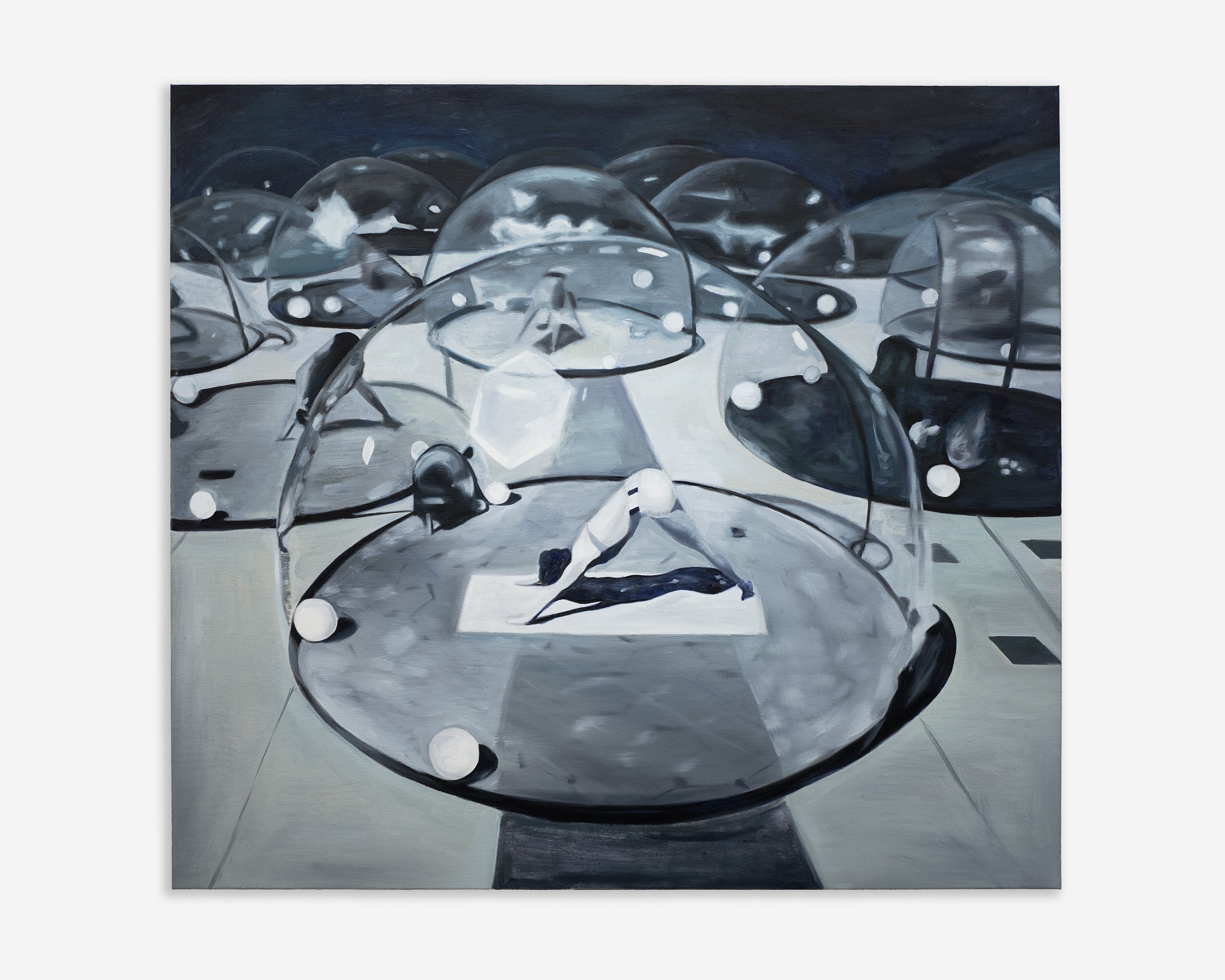
The paint surface of Yoga Isolation is governed by the same restraint that governs the practice it depicts. The palette is restricted to grays, cool whites, and the palest blues, with a single muted band of warmer tone where the figure's skin meets the air, a thin wash of flesh that reads less as a color than as a temperature, the warmth of a body in a cool room detected by the eye the way a thermal camera would detect it. The background, the wall and floor of the domestic space, is rendered in smooth, nearly featureless planes of gray-white, applied in thin, even layers that show the linen weave beneath them as a faint grid, a pattern that the eye registers as the texture of the support but that the mind, conditioned by the subject, reads as the grid lines of a yoga mat, the parallel lines of a hardwood floor, the repeating pattern of a practice that is the same every day. The figure itself is painted with the same evenness of touch. There are no dramatic contrasts, no areas of thick impasto set against thin washes. The paint is applied with the consistency of a practice that does not vary: the same sequence, the same breath, the same ninety seconds, repeated until the timer runs out. The evenness of the surface is the painting's most direct formal argument. It says: this is not a moment of crisis. This is a moment of repetition, and repetition, when it is chosen, is a form of discipline, and discipline, when it is maintained in isolation, is a form of holding on.
The mat beneath the figure is the compositional anchor of the painting, and it is rendered with a specificity that the rest of the image withholds. While the wall and floor are suggested by smooth planes of undifferentiated gray, the mat has edges, boundaries, a defined shape. It is a rectangle within a rectangle, a zone of purpose within a zone of habitation, and its presence tells you that the figure on it is not simply standing in a room. The figure is practicing. The practice has a location. The location is marked. The mat is also, in a subtle but important detail, slightly wider than the figure's reach. There is space on either side. The figure is not cramped. The practice has room. This is not a painting about claustrophobia. It is a painting about the discipline that creates its own space within confinement, and the space that the discipline creates is not small. It is proportioned. It is adequate. It is enough. The mat's edges are not painted as hard lines. They are suggested by a shift in the gray tone, a slight darkening where the rubber meets the floor, so that the mat is less a colored object placed on a surface than a change in the surface itself, a zone of slightly different texture that the body recognizes as its practice area and the eye recognizes as the boundary between movement and stillness.
Agnes Martin spent nearly five decades painting grids. In works such as Untitled #4 (1994, now in the collection of the Museum of Modern Art, New York), Martin laid down horizontal and vertical lines in pale graphite on a white or near-white ground, creating compositions that appear, at first glance, to be empty. The bands of graphite are so faint, the intervals between them so regular, the surface so smooth and uninflected, that the painting seems to be doing almost nothing. It is a rectangle of barely visible lines on a field of white. Martin insisted that her paintings were about freedom, happiness, and innocence, not about austerity or restraint. The grid, she said, was not a cage. It was a structure that freed the mind from the anxiety of deciding where to look, where to place one's attention, where to rest one's eyes. The regularity of the grid was not a limitation. It was a liberation from the tyranny of choice. You do not have to decide where to place the next mark. The grid has already decided. Your attention is free to go anywhere within the structure, because the structure holds it.
Martin's grids provide a structural parallel for understanding what the yoga mat does in Yoga Isolation. The mat is not a grid, but it functions like one. It defines a zone of practice, a rectangle within the undifferentiated space of the room, and within that rectangle, the body performs a sequence of movements that is the same every time. The sequence is not improvised. It is a practice, which is to say it is a set of predetermined movements performed in a predetermined order, and the predetermined order is the point. It frees the practitioner from the need to decide what to do next. The next posture is always already given. The discipline of the sequence, like the discipline of Martin's grid, is not a restriction on freedom. It is the condition that makes freedom possible within a confined space. When the room is the only space available, and the room contains no public, no audience, no event, no interruption, the practice provides the structure that the day would otherwise lack. The mat is the grid. The sequence is the pattern. The body, moving through its predetermined postures, is the line drawn on the surface. And the line, in both Martin's paintings and in the yoga sequence, is drawn not once but repeatedly, day after day, the same gesture, the same interval, the same barely visible mark that accumulates into something that looks, from a distance, like a life.
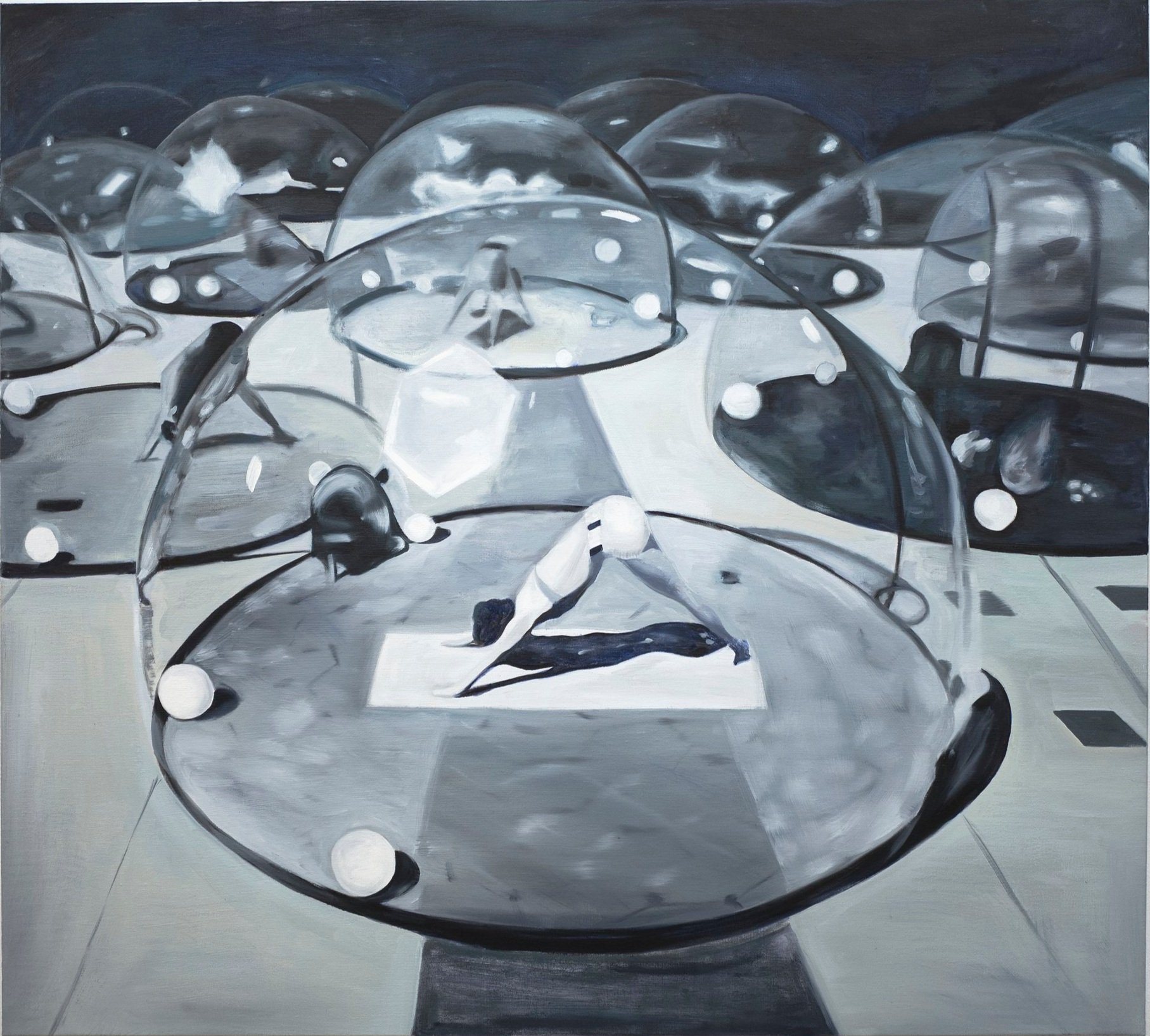
Tan Mu has situated Yoga Isolation within the series of works that responded to the conditions of pandemic lockdown. "During this time, I created a series of works that explored personal, social, technological, and public health themes," she has said, "including pieces such as Philadelphia, Minneapolis, Thermal Imaging, and Touch, which respond to social events and technological mediation, as well as works like Isolation, A Sunday Afternoon in the Park, and Yoga Isolation, which reflect on public spaces and the routines we adopted during lockdown." The word "routines" is precise. A routine is not a habit. A habit is automatic. A routine is chosen, maintained, and repeated with intention. The yoga practice depicted in Yoga Isolation is not something the figure does without thinking. It is something the figure does because it has decided to do it, at the same time, on the same mat, in the same sequence, every day. The routine is the structure that holds the day together when the day has no other structure, when the commute is gone, the office is gone, the gym is gone, the restaurant is gone, and the only schedule that remains is the one you impose on yourself. The painting does not depict a moment of crisis. It depicts a moment of maintenance. The body is not in extremis. It is in equilibrium. The equilibrium is the point.
The monochrome palette that Tan Mu employs in Yoga Isolation is not an aesthetic choice made in isolation. It is part of a deliberate strategy that she has applied across several works that address confinement, separation, and emotional distance. "In works such as Torus, Yoga Isolation, and Isolation," she has said, "the absence of color directs attention to feelings of emotional distance and physical separation, particularly during the pandemic. The muted tones create an atmosphere reminiscent of early science fiction imagery, amplifying the sense of estrangement." The reference to science fiction is not incidental. The monochrome palette of early science fiction film, with its gray corridors and white uniforms and featureless interiors, was a visual vocabulary for environments stripped of organic variety, environments where the only color came from the body itself, warm and alive inside the sterile geometry of a space station or a laboratory. Yoga Isolation shares this atmosphere. The room is not a home. It is a cell. The mat is not a luxury. It is a survival tool. The figure is not relaxing. It is maintaining, with discipline and repetition, the conditions of its own continuity. The gray-white palette makes the figure's skin the warmest element in the composition, a single source of flesh tone in an environment that is otherwise drained of color, and this contrast is the painting's quietest and most insistent claim: the body is what gives this space its warmth. Without the body, the room would be entirely gray. The practice is what makes the body visible. Without the practice, the body would be just another object in a room of objects.
Henri Matisse, confined to his bed after major surgery in 1941 and then again for the remaining years of his life, turned to paper cut-outs when he could no longer stand at an easel. Works like Blue Nude IV (1952, now in the collection of the Musee Matisse, Nice) were produced by a man who could not leave his bed, who sat propped up against pillows with a pair of scissors and a stack of painted paper, cutting shapes from the sheet and pinning them to the wall with the help of assistants. The resulting compositions are among the most joyful images in the history of Western art: bodies in motion, figures in repose, leaves and flowers and swimming pools, all rendered in flat, saturated color against white ground, as though the confinement of the room had been answered by an explosion of freedom in the imagination. The body that could not move produced images of bodies that could not stop moving. The room that was a prison became, through the act of cutting and pinning, a garden.
Matisse's bedridden cut-outs provide the second structural parallel for Yoga Isolation. Both works are products of confinement. Both respond to that confinement by making the body the instrument of its own liberation. Matisse could not paint, so he cut. He could not stand, so he pinned the cut-outs to the wall from his bed. The body that was confined found a practice that was not. In Yoga Isolation, the confinement is not medical but social. The body is not immobilized. It is restricted in its movement through public space. The yoga practice is the response to this restriction: it takes the only available space, the room, and the only available instrument, the body, and it creates, through the discipline of sequence and repetition, a practice that is as structured as any public ritual, as formal as any ceremony, and as private as any meditation. The painting does not depict the body's imprisonment. It depicts the body's answer to imprisonment: a routine that is chosen, maintained, and repeated, a grid of movement within the unmarked space of a room, a mat that defines the boundaries of a practice that would otherwise have no boundaries at all. The room is small. The practice fills it. The body is the room's only content, and the practice is the body's only architecture.
Danni Shen, writing about Tan Mu's pandemic works in her 2024 studio visit for Emergent Magazine, observed that the paintings "transform private rituals into visual documents that speak to a collective experience." The observation captures something essential about Yoga Isolation. The practice depicted in the painting is private. It takes place in a room, on a mat, alone. But the painting makes it public. It takes the solitary ritual and renders it in oil on linen, a medium that is inherently public, that exists to be looked at, that hangs on walls and appears in exhibitions and circulates through catalogues and websites. The painting does not violate the privacy of the practice. It documents the practice, and in documenting it, it reveals that the practice was never as private as it seemed. Millions of people were performing the same sequence, on their own mats, in their own rooms, at the same time. The yoga practice during lockdown was a solitary ritual that was also a mass event, a private discipline that was also a collective behavior, and the painting holds both of these conditions simultaneously. The figure is alone. The practice is shared. The mat is individual. The sequence is universal. The room is private. The painting is public. And the discipline, the thing that holds all of these contradictions together, is the thing that the painting makes visible: the routine, the repetition, the decision to begin again every day, to stand at the top of the mat, to inhale, to raise the arms, to fold forward, to step back, to hold, to breathe, to repeat, until the timer runs out or the day ends or the lockdown lifts, and the mat can be rolled up and put away, and the room can become a room again, and the body can leave the rectangle and re-enter the world, carrying the discipline with it like a map of a place it has already been.