The Cable That Volcano Cut: Tan Mu's Eruption and the Silence That Spoke
On January 15, 2022, the Hunga Tonga-Hunga Ha'apai volcano erupted with a force equivalent to hundreds of Hiroshima-sized nuclear detonations. The explosion was heard in Alaska, six thousand miles away. The shockwave circled the Earth multiple times, recorded by barometers in every hemisphere. The ash plume reached fifty-eight kilometers into the atmosphere, penetrating the mesosphere, a height no volcanic event had attained since the satellite era began. Tsunamis radiated across the Pacific, reaching Japan and the Americas within hours. Satellite imagery captured the eruption in real time, showing a column of ash and water vapor expanding outward like a shockwave made visible, a ring of concentric disturbance spreading across the ocean surface for hundreds of kilometers in every direction. And then, for nearly a month, the Kingdom of Tonga went silent. The undersea fiber-optic cable that connected the archipelago to the global internet, a single strand of glass and copper running along the ocean floor between Tongatapu and Fiji, had been severed by the eruption. Phone lines, internet service, and international communication all ceased. For the first time in decades, a nation of one hundred and five thousand people was unreachable, not because of war or censorship, but because a volcano had cut a cable at the bottom of the sea.
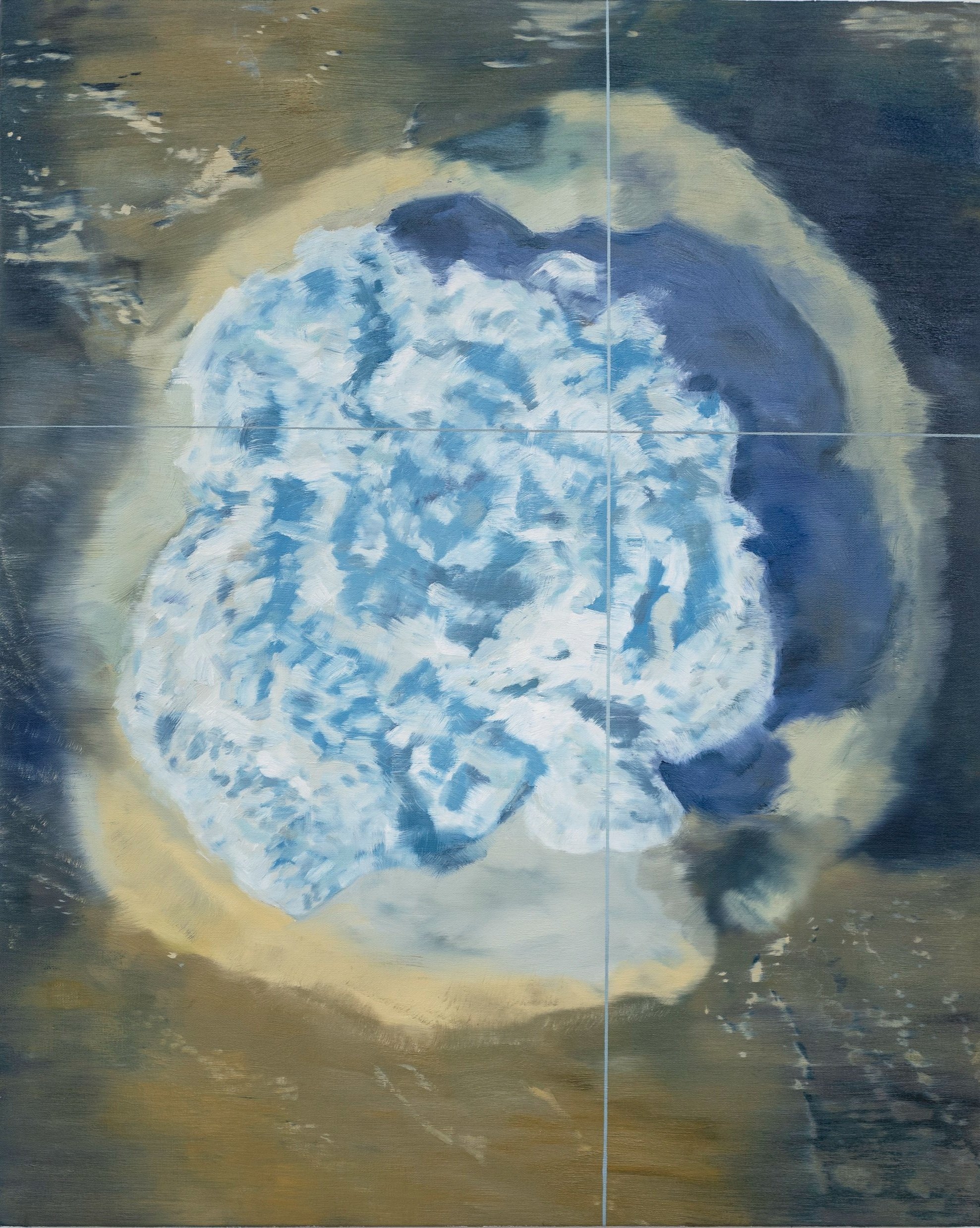
Tan Mu's Eruption (2022) is an oil on linen painting, 76 x 61 cm (30 x 24 in), that takes this event as its subject. The composition is structured around a cross-shaped form that suggests both a satellite view and a targeting reticle, a point of observation aligned between natural forces and human systems of measurement. The volcanic eruption occupies the center of the cross, radiating outward in plumes of deep red, orange, and ochre that push against the dark oceanic blues and blacks of the surrounding sea. The cross form does not frame the eruption neutrally. It marks it. It identifies the eruption as an event of significance, a moment where the planet's geological processes intersected with the technological infrastructure that holds the human world together. The painting is not a landscape. It is a record of a rupture.
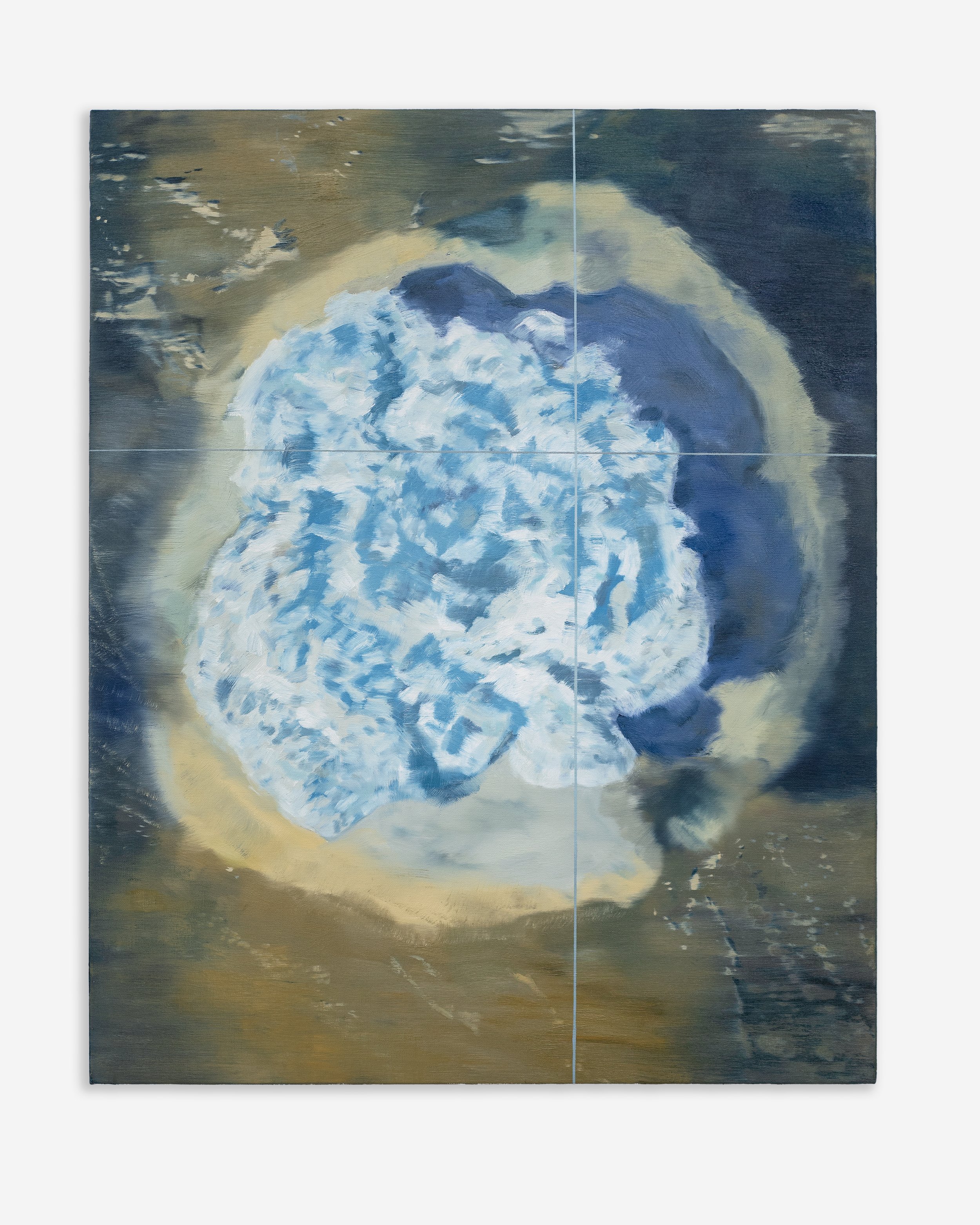
The paint surface of Eruption is built from two opposing material logics that meet at the center of the composition like two fronts of a weather system colliding. The ocean, which fills the outer quadrants of the cross form, is rendered in deep blues and blacks applied in thin, horizontal washes that let the linen weave show through, creating the effect of dark water seen from above at satellite altitude, where individual waves resolve into a unified surface texture and the sea becomes a field of near-uniform darkness. Against this darkness, the eruption itself is painted in thick, impastoed passages of cadmium orange, burnt sienna, and Naples yellow, laid down in short, urgent strokes that build the plume vertically through the center of the composition, pushing outward in every direction. The contrast between the thin washes of the ocean and the thick impasto of the eruption is not merely visual. It is a record of two different speeds of application. The ocean was painted slowly, in layers, each one given time to dry before the next was added. The eruption was painted fast, in concentrated bursts, the pigment deposited on the canvas with a physical urgency that mimics the violence of the event it describes. The cross form that structures the composition is defined by the boundary between these two regimes: the slow, layered darkness of the sea against the fast, thick fire of the plume. At the edges where they meet, the orange bleeds into the blue, not because the colors were blended on the canvas, but because the wet paint of the eruption was applied over the still-tacking surface of the ocean, so that the two materials merged at their contact point, each one contaminating the other, each one leaving a trace of itself in the body of its opposite. This is the painting's most precise observation. The eruption does not simply happen in the ocean. It happens to the ocean. It enters the ocean. The water carries the ash, the heat, and the debris of the explosion, and the painting makes this contamination visible at the level of the paint itself.
Frederic Edwin Church's Cotopaxi (1857), now in the collection of the Reading Public Museum, depicts an Ecuadorian volcano in full eruption against a landscape of Andean peaks and tropical vegetation. The painting is large, dramatic, and suffused with a golden light that emanates from the volcano's plume and illuminates the entire canvas, turning the smoke and ash into a source of illumination rather than darkness. Church, who had traveled to Ecuador in 1853 and again in 1857, painted the volcano not as a geological phenomenon but as a cosmic event, a moment where the earth's interior forces become visible to the human eye and transform the entire visible world. The sunlight in Cotopaxi does not come from the sun. It comes from the volcano. The eruption is not an interruption of the landscape. It is the landscape's defining feature, the event that organizes the light, the color, and the composition around a single point of violent origin. The small figures in the foreground, a pair of travelers on a road that winds through the valley, are reduced to specks of paint, their presence serving only to establish the scale of the mountain behind them and to confirm that this eruption is being witnessed by human eyes.
Church's approach to volcanic eruption as a source of illumination provides a historical counterpoint for understanding what Eruption does differently. In Church, the eruption is sublime. It overwhelms the viewer with its scale and its beauty. The human figures in the foreground are small, incidental, present only to demonstrate the magnitude of what is happening behind them. The painting is about the power of nature and the smallness of the human observer in the face of it. Tan Mu's painting is not about the smallness of the human observer. It is about the vulnerability of the human network. The cross form that structures the composition is not a natural feature of the landscape. It is a technological feature, a satellite's view, a targeting system, a way of marking a point on the surface of the earth as significant. Where Church's eruption illuminates the landscape, Tan Mu's eruption severs the cable. The difference is not just a matter of subject matter. It is a difference in what the eruption is understood to be doing. In Church, the eruption is communicating with the sky, filling the atmosphere with light and ash. In Tan Mu, the eruption is communicating with the ocean floor, filling the cable trench with debris, cutting the line that connects an island nation to the rest of the world. The illumination in Eruption does not come from the volcano. It comes from the satellite that recorded the event, and the painting's composition, with its cross form and its overhead perspective, acknowledges the satellite as the observer that made the image possible.
Tan Mu has described the origin of Eruption in terms that connect the painting directly to her personal history with the ocean. "I grew up by the sea, and my relationship with the ocean has always been central to my life," she has said. "I am a freediver, and much of my thinking is shaped by direct physical engagement with the marine environment. At the time of the Tonga eruption, I had been planning a trip to Tonga to dive with humpback whales. When the volcano erupted, the explosion severed the country's undersea cables, cutting off all communication with the outside world." The planned trip to Tonga was not an abstract research expedition. It was a freediving trip, a physical engagement with the ocean that would have placed Tan Mu in the same waters that the eruption transformed. The cable that was severed was not an abstraction. It was the same kind of cable that she would later paint in the Signal series, the fiber-optic strands that carry 99 percent of international data traffic along the ocean floor. The eruption did not simply destroy infrastructure. It made visible the infrastructure that had been invisible, revealing the cable's existence by demonstrating its absence.
The information blackout that followed the eruption lasted for nearly a month. During that period, the outside world could not reach Tonga by phone, internet, or most other digital means. The only information that emerged came through sporadic satellite phone connections and the observations of surveillance aircraft that flew over the archipelago and transmitted photographs of ash-covered islands and destroyed coastal communities. The cable that connected Tonga to Fiji, and through Fiji to the rest of the global internet, lay on the ocean floor in two severed pieces, and the repair ship that would eventually restore it had to travel from Papua New Guinea, a journey that took weeks. The eruption demonstrated, in real time and with devastating clarity, that the global communication network, which most of the world experiences as an invisible and reliable utility, is a physical object, a thin strand of glass and copper resting on the ocean floor, vulnerable to the same geological forces that shape the seabed itself. The cable's diameter is roughly that of a garden hose. It carries 99 percent of the world's intercontinental data traffic. It sits on the bottom of the ocean in some of the most geologically active zones on the planet. The Tonga eruption did not reveal a weakness in the cable's design. It revealed a condition of the cable's existence: it is always in the path of something larger than itself, and the network it supports is always one geological event away from silence.
Robert Smithson's Spiral Jetty (1970), constructed from basalt rocks and earth on the northeastern shore of the Great Salt Lake in Utah, is a work that exists at the intersection of natural forces and human mark-making. The jetty extends into the lake in a counterclockwise spiral, 457 meters long, and its visibility depends entirely on the water level, which fluctuates according to rainfall, evaporation, and the hydrology of the lake basin. When the water is high, the jetty disappears. When the water is low, it re-emerges, its basalt armatures encrusted with salt crystals, transformed by the same geological and chemical processes that shape the lake itself. Smithson described the work as a site of entropy, a structure that is always in the process of being reclaimed by the natural forces that surround it. The jetty does not resist the lake. It collaborates with it. It is made of the same materials, subject to the same cycles, and it will eventually disappear entirely, dissolved by the salt water that it enters.
Smithson's logic of entropy, in which a human-made structure is always in the process of being unmade by the natural forces that surround it, provides a structural parallel for understanding the relationship between the undersea cable and the volcanic eruption in Tan Mu's Eruption. The cable is a human-made structure that rests on the ocean floor, subject to the same geological forces that shape the seabed. It is designed to resist those forces, armored against trawler nets and anchor drags, but it is not designed to resist a volcanic explosion. When the Hunga Tonga-Hunga Ha'apai volcano erupted, it demonstrated that the cable's existence on the ocean floor was always provisional, always subject to the same entropy that Smithson built into Spiral Jetty. The difference is that Smithson made the entropy visible by choosing a site where it would be accelerated. The cable's vulnerability was invisible until the eruption made it apparent. Tan Mu's painting makes this invisible vulnerability visible by painting the eruption not as a natural event that happens to occur near a cable, but as a single event in which the geological and the infrastructural are inseparable. The eruption is the cable's destruction. The plume and the severance are the same moment, rendered in the same composition, on the same canvas, by the same hand.
Nick Koenigsknecht, in his 2025 essay for the BEK Forum catalog, observed that in Tan Mu's work, "the technological is never separate from the natural; it is always embedded within it, shaped by it, and vulnerable to it." The observation applies with particular force to Eruption, where the natural event and the technological failure are not two separate incidents that happened to coincide but a single event in which the volcano's force and the cable's fragility were revealed simultaneously. The painting does not depict a volcano and a cable. It depicts a volcano that is also a cable's destruction, an eruption that is also a disconnection, a plume of ash that is also an information blackout. The cross form that structures the composition holds these two aspects of the event in the same frame, refusing to separate the geological from the infrastructural, the natural from the technological, the visible plume from the invisible severance. What Koenigsknecht identifies as the embedding of the technological within the natural is not a metaphor in this painting. It is a physical fact. The cable lies on the ocean floor within the volcano's blast radius. The network that carries the world's data runs through the same geological zone that produces the eruptions capable of destroying it. There is no separation between the natural and the technological because there is no separation between the seabed and the cable that rests on it.
Tan Mu has described Eruption as a turning point in her practice. "Eruption marked a turning point," she has said. "It was the beginning of my sustained exploration of undersea cables as critical global infrastructure. This work introduced the dual themes of connection and disconnection that have since become central to my work." The Signal series, which followed, shifted from depicting cross-sections of cables to mapping entire global networks, but the origin of that investigation is here, in a painting of a volcano that cut a cable and silenced a nation. The painting's composition, with its cross form and its satellite perspective, encodes this origin in its structure. The cross is not a crucifix. It is not a symbol of sacrifice or redemption. It is the mark that a satellite makes when it identifies a point of interest on the earth's surface, the same mark that a targeting system makes when it locks onto a coordinate. The eruption does not need to be targeted. It targets itself. It finds the cable by finding the island, and it finds the island by finding the fault line where the tectonic plate subducts, and it finds the fault line by following the geometry of the planet's interior, which is not a network that humans designed but a structure that was there before any cable was laid, and will be there after every cable has been cut.
The silence that followed the eruption was not empty. It was full of the noise that the cable had been carrying, now stopped. Every email that could not be sent, every call that could not connect, every data packet that could not find its route, all of it was still there, trapped in the servers and devices of an archipelago that could talk to itself but could not talk to the rest of the world. The painting holds this silence open, not as an absence but as a condition, the condition of being connected to the planet by a single strand of glass that a volcano can sever in a single instant. The eruption was audible in Alaska. The silence was audible in Tonga. And the painting makes both audible, the explosion and the blackout, by rendering them in the same composition, the same palette, the same hand, as though they were not two events but one: the moment when the earth spoke and the network went quiet, and the only witness was a satellite, looking down from orbit, marking the spot with a cross.