The Coastline That Thinks: Tan Mu's Signal: Submarine Network 05 and the Island That Wires the World
In 1850, the Anglo-French Telegraph Company laid the first submarine cable between Dover and Calais, a length of copper wire sheathed in gutta-percha, a natural latex prized for its electrical insulation, that stretched across the English Channel and carried its first message on August 28 of that year. The wire broke within hours. A fisherman hauled it up in his nets, assuming he had snared an unusual specimen, and cut a section away as a curiosity. The cable was relaid the following year, armored with iron wire to protect it from trawls and anchors, and this time it held. Within a decade, the British Isles were connected by undersea telegraph to Ireland, to the Netherlands, to Belgium, to Germany, to Denmark, and to the Faroe Islands. By 1866, a transatlantic cable linked Valentia Island off the western coast of Ireland to Heart's Content in Newfoundland, and the network that had started as a single copper thread across the Channel had become the spine of a global communication system that carried imperial dispatches, market prices, diplomatic cables, and personal messages at the speed of electricity through salt water. The British did not merely participate in this system. They built it. They manufactured the cables in Greenwich and Silvertown. They staffed the cable ships. They maintained the relay stations that dotted the coasts of every ocean. An island nation that had once been defined by the sea that surrounded it, that had built a navy to protect its coasts and a merchant fleet to carry its trade, now wove itself into the world through threads of copper and glass laid on the ocean floor, and the sea that had been a barrier became a highway.
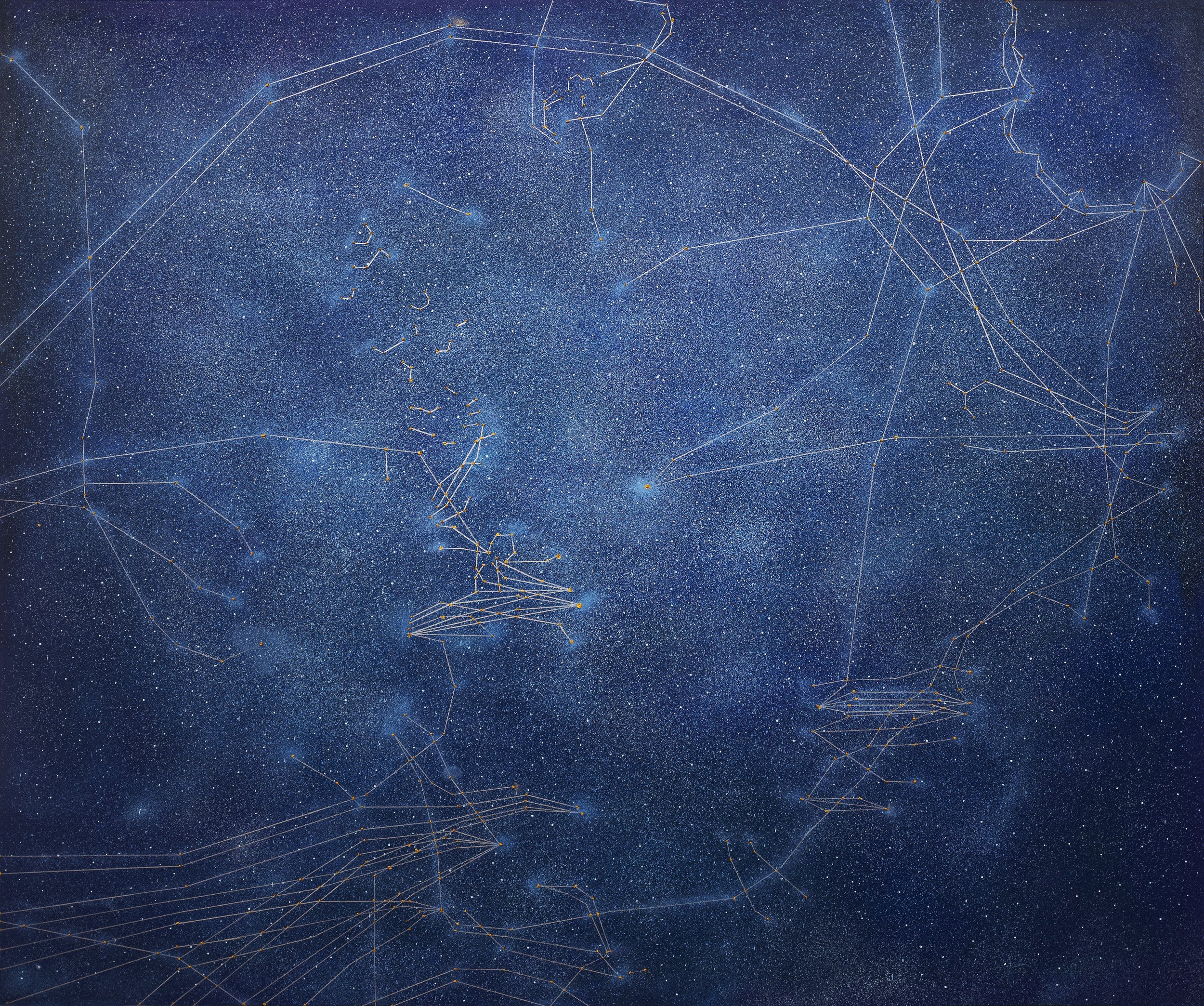
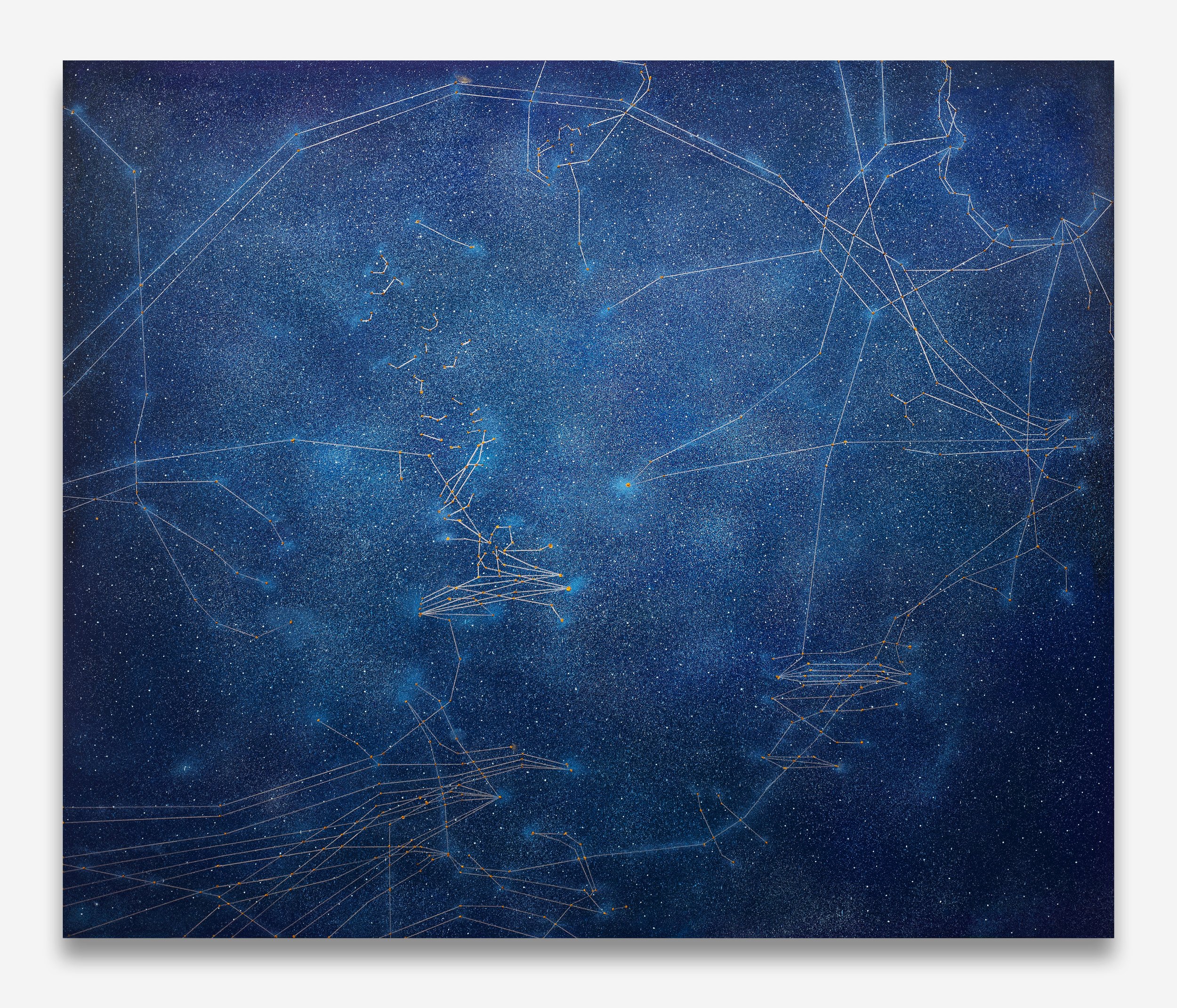
Tan Mu's Signal: Submarine Network 05 (2025) is an oil and acrylic on linen painting, 152.5 x 183 cm (60 x 72 in), that takes this network as its subject. The painting depicts the dense distribution of submarine cable routes encircling the British Isles. Cables traverse the North Sea and the English Channel, linking mainland Britain with Ireland and extending onward to continental Europe. The composition is structured as an overhead view, as though the artist were looking down at the archipelago from a satellite, but the palette and the handling of the paint place the viewer somewhere between cartography and cosmology. The lines and dots that represent the cable routes and their landing points glow against a dark ground that reads simultaneously as the deep ocean, the night sky, and the surface of a circuit board. The British Isles are not rendered as a landmass in the conventional cartographic sense. They are implied by the density of the network that surrounds them. The coastlines are traced not by the outline of the land but by the concentration of nodes and connections along their edges, so that the islands emerge from the pattern of their communications rather than from their topography. The painting makes visible what the coast itself conceals: the thousands of kilometers of fiber-optic cable that lie on the seabed, carrying the data that sustains the daily life of sixty-seven million people.
The paint surface of Signal: Submarine Network 05 operates on two registers that correspond to the two systems the painting maps. The ground, which represents the ocean and the landmasses beneath the cable network, is built from thin, translucent layers of oil paint in deep marine blues, greens, and blacks, applied with broad horizontal strokes that evoke the movement of water at depth. These layers are not uniform. They vary in density and tone, so that some areas of the sea appear lighter and shallower while others recede into near-total darkness, creating a sense of bathymetric variation that mirrors the actual topography of the North Sea floor, where shallow banks and deep trenches alternate in patterns that have shaped navigation and cable routing for over a century and a half. The cables and their landing points are rendered in acrylic, a faster-drying medium that allows for the precise, raised marks that Tan Mu has described as resembling "the soldered connections of electronic circuits." Each node, each point where a cable comes ashore or branches toward a new destination, is built up with thick, wax-heavy oil paint that sits above the surface of the ground, creating a physical relief that the eye registers as topography and the fingers, if they could touch the canvas, would register as a constellation of raised points. The contrast between the smooth, watery ground and the tactile, raised nodes enacts the relationship between the ocean floor and the infrastructure that lies on it: the cables are foreign bodies laid on a natural surface, and the painting makes this foreignness physical by giving the nodes a thickness and a presence that the ground does not possess. The colors of the nodes range from warm whites and pale yellows to cool blues and occasional flashes of orange, a chromatic range that mirrors the thermal imaging palettes Tan Mu has used in other works but here reads as something closer to a nautical chart, where different colors designate different types of signal, different capacities of connection, different densities of traffic.
Wenceslaus Hollar, the Bohemian-born etcher who spent most of his career in England, produced what remains one of the most detailed visual records of the British Isles in the seventeenth century. His Long View of London from Bankside (1647), a monumental etching spanning over three meters in length when the plates are joined, depicts the London skyline from Whitehall to the Tower, rendered with a precision that makes every church spire, every warehouse roof, every mast on the Thames identifiable to a degree that no other artist of the period attempted. The view was not drawn from life in a single sitting. Hollar constructed it from multiple vantage points along the South Bank, assembling a composite panorama that no single eye could have seen at one time. The etching is an act of synthesis: it takes dozens of perspectives and resolves them into a single, coherent image that presents the city as a continuous organism, a body of buildings and waterways and ships that functions as a whole even though no single observer could have experienced it as one.
Hollar's panoramic method, in which multiple vantage points are synthesized into a single comprehensive view, provides a structural precedent for understanding what Signal: Submarine Network 05 does with its own overhead perspective. The painting does not present a view that any single camera could capture. No satellite photograph of the British Isles shows the submarine cable network in this way, because the cables are invisible from above, buried in the seabed, and the network as depicted here is a composite drawn from multiple data sources, nautical charts, telecommunications maps, and cable operator databases, assembled by the artist into a single visual field. Like Hollar's London, the painting constructs a view that is true to the data but impossible to see in a single glance. The British Isles emerge not from the shape of their coastline but from the density of the connections that surround them. Where Hollar used the Thames to organize his composition, giving the river its true horizontal course through the center of the city, Tan Mu uses the cable routes to organize hers, and the routes, like the river, follow the logic of the land they serve: they cluster where the population clusters, they cross where the crossing is shortest, and they avoid the deep trenches and rough seabeds that would make laying and maintenance prohibitively expensive. The painting is not a map of the ocean floor. It is a map of human intention projected onto the ocean floor, and the cables are the traces of that intention, as legible in their own way as the spires and warehouses of Hollar's London were in his.
The subject of Signal: Submarine Network 05, as Tan Mu has stated, is the dense distribution of submarine cable networks encircling the British Isles. These cables traverse the North Sea and the English Channel, tightly linking mainland Britain with Ireland and extending onward to continental Europe. The intricate web of lines and densely clustered nodes along the coastlines of England and Scotland highlights the complexity and high connectivity of this network. The British Isles occupy a peculiar position in the global submarine cable system. They are both an island and a hub. The sea that once protected Britain from invasion now carries its connections to the rest of the world. The English Channel, at its narrowest point only 33 kilometers wide between Dover and Calais, was the site of the first international submarine cable in 1850, and it remains one of the most congested cable corridors on the planet, with over a dozen fiber-optic systems running through a passage that is also one of the world's busiest shipping lanes. The North Sea cables connect Britain to Scandinavia, the Baltic states, and the Arctic, while the western routes link Britain to Ireland, to the transatlantic cables that run from Ireland to North America, and to the cable systems that stretch down the Atlantic coast of Africa toward Asia. The painting makes this geography visible not as a map of land and sea but as a map of connection and isolation, where the density of the network along certain coastlines contrasts with the relative emptiness of the deep ocean beyond, and the British Isles sit at the center of the web not because of their size but because of their position at the junction of the Atlantic, the North Sea, and the Channel.
Tan Mu has described the cable networks as "the veins of the planet," comparing them to "meridian lines in traditional medicine, circulating energy and information through a living body." This comparison between the submarine cable system and the body's circulatory network is not decorative. It is structural. The cables carry data at the speed of light. The data includes financial transactions, diplomatic communications, military commands, scientific research, personal messages, video calls, streaming media, and every other form of digital information that passes between nations. Ninety-nine percent of intercontinental data traffic travels through submarine cables, not through satellites. The satellites are backup. The cables are the system. If the cables fail, the connection fails. Tonga's experience in January 2022, when the Hunga Tonga-Hunga Ha'apai eruption severed the island's single undersea cable and cut the nation off from global communication for five weeks, demonstrated this vulnerability with a clarity that no amount of theoretical analysis could match. The painting, by depicting the network in its density and its interconnectedness, makes this vulnerability visible as well. The cables along the British coast are not single strands. They are bundles, each one carrying multiple fiber pairs, each fiber pair carrying multiple wavelengths, each wavelength carrying multiple channels, each channel carrying the data that sustains the daily operations of banks, hospitals, government offices, universities, and homes. The network is redundant by design. But redundancy is not the same as invulnerability. A single anchor drag can sever a cable. A single earthquake can shift the seabed and break multiple systems at once. The painting shows the network at its most robust, the British Isles at their most connected, and the viewer who understands what the cables carry knows that this image of connection is also an image of what could be lost.
Laszlo Moholy-Nagy's Telephone Pictures (also known as EM1, EM2, and EM3, 1922-23) were among the most radical experiments in mediated artistic production of the twentieth century. Moholy-Nagy, who had recently joined the Bauhaus in Weimar, created these works by calling a German sign factory on the telephone and dictating the specifications for three enamel-on-steel panels, giving the factory supervisor instructions for the colors, dimensions, and geometric compositions of each panel. The factory then produced the panels according to his verbal instructions and shipped them to him. Moholy-Nagy never touched the panels during their manufacture. He never visited the factory. He never saw the work in progress. He spoke into a telephone, and the painting, if it can be called a painting, emerged from a process in which the artist's hand was entirely absent from the material production of the object. The telephone was the medium. The factory was the executor. The artist was the origin, but the origin was displaced, mediated, transmitted through a cable that ran from his studio to the factory floor, and the painting that arrived in the mail was a record not of the artist's touch but of the artist's instruction, which had traveled through the same kind of infrastructure that now carries the data Tan Mu paints.
Moholy-Nagy's telephone pictures provide a structural parallel for understanding what the submarine cable network means in Tan Mu's practice, not as a subject depicted on canvas but as a condition of the painting's own existence. The cables that surround the British Isles in Signal: Submarine Network 05 carry the data that makes contemporary artistic production possible. The reference images Tan Mu uses to create her paintings travel through these cables. The emails that schedule her exhibitions travel through these cables. The catalogues that reproduce her work, the websites that host her portfolio, the video calls that connect her studio in Paris with galleries in Vienna and New York, all travel through these cables. The painting depicts the infrastructure that makes the painting possible. It is not a representation of a network. It is a network depicting itself, or, more precisely, it is an artist who has recognized that the network she paints is the same network that enables the painting of the network. This circularity is not a paradox. It is a description of the condition of contemporary art, which exists within the systems it represents and cannot step outside them to depict them from a neutral vantage point. Moholy-Nagy understood this in 1922. He did not pretend that the telephone was a transparent medium. He made the telephone visible by using it as the medium of production, so that the painting bore the trace not of his hand but of his voice, transmitted through a wire, decoded by a stranger, and executed in enamel on steel. Tan Mu makes the cable visible by painting the cable, so that the painting bears the trace not only of her hand but of the infrastructure that carried the images, texts, and communications that shaped her understanding of what she was painting.
The Q&A text on the Signal series, published on Tan Mu's website and expanded in the exhibition catalog for the BEK Forum Vienna exhibition, makes the connection between the submarine cables and the body explicit. "I often think of them as the veins of the planet," she has said, "similar to meridian lines in traditional medicine, circulating energy and information through a living body." This comparison is not a metaphor layered onto the painting after the fact. It is embedded in the way the painting is made. The underpainting, Tan Mu has described, is created spontaneously, with broad gestural strokes that establish the oceanic ground. When painting specific areas, she overlays a second layer to reflect the underwater terrain, and then the cable routes are mapped on top, with the landing points built up in thick, wax-heavy oil paint. The process mirrors the body's own layering: the skeletal structure of the seabed, the muscular tissue of the ocean currents, the circulatory system of the cables, and the nerve points of the landing stations, each layer built on top of the one below, each visible through the one above, so that the painting is not a flat map but a cross-section of depth, a body viewed from above.
The connection to Tan Mu's personal history with the ocean is not incidental. Her mother was a professional windsurfer, part of China's first windsurfing team in the 1980s. Her paternal grandfather was a marine engineer who designed harbors and directed land reclamation projects along the coast of Yantai. He introduced her to bathymetric contour lines, seafloor maps, and the blueprints of oceanic infrastructure. She has been freediving since 2019, reaching depths of over thirty meters, and she has dived at Curacao in the Caribbean at a site located directly adjacent to a submarine cable landing station, where the cable emerges from the seabed and enters a facility on shore. The dive site was next to an oil rig. She swam beneath one of its pillars. In her own words: "We often think of these structures as artificial monstrosities, yet below the surface, they become marine habitats, like giant castles for sea life." The painting is made by someone who has been in the water above the cables, who has seen the landing stations from below, who has felt the ocean floor beneath her fins and knows, from the direct evidence of her body, that the infrastructure she paints is not an abstraction but a physical reality that sits on the seabed and is gradually being colonized by barnacles, anemones, and the small organisms that make any hard surface in the ocean their home.
Nick Koenigsknecht, writing in the BEK Forum catalog for the Signal exhibition in Vienna, has observed that Tan Mu's paintings "transform data cables into gestural constellations that oscillate between calculation and intuition." The observation captures something essential about the painting's double register. The cable routes are calculated. They follow the shortest paths between landing points, they avoid known hazards on the seabed, and they are designed by engineers who calculate the optimal route based on water depth, seabed composition, shipping traffic, and the probability of anchor damage. The painting, in its depiction of these routes, inherits this calculation. The lines do not wander. They follow the logic of the network, clustering where the traffic is heaviest and thinning where the ocean is deepest or the seabed is roughest. But the landing points, the nodes, are rendered with a tactile density that exceeds calculation. They are built up, layer upon layer, in paint that rises above the surface of the canvas, creating a physical relief that the viewer's eye registers as topography and the hand, if it could reach the canvas, would register as a constellation of raised points, each one marking the place where a cable comes ashore and enters a building where the data is decoded, amplified, and sent onward through terrestrial networks to its final destination. These nodes are where the calculation stops and the gesture begins. They are where the cable, which has been invisible for thousands of kilometers across the ocean floor, briefly becomes visible as a building, a structure, a point of human presence on a coastline that has otherwise been shaped by tides and weather and the slow accretion of geological time. The painting registers this transition from the invisible to the visible by making the landing points the most tactile elements in the composition, the points where the network emerges from the seabed and becomes part of the human world.
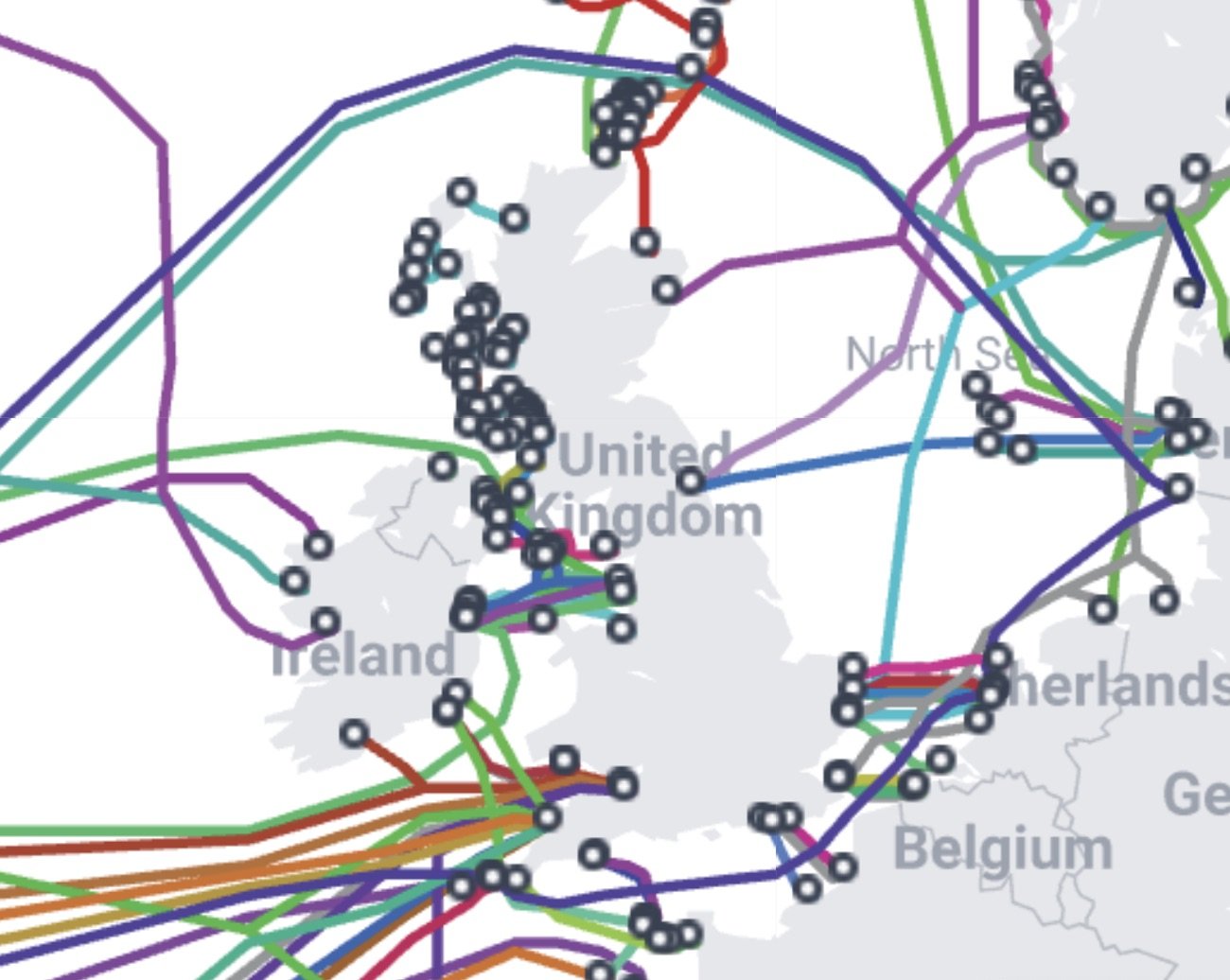
The British Isles hold a unique position in the global submarine cable network, and the painting makes this position legible in a way that no nautical chart or telecommunications map would. A nautical chart shows the sea. A cable map shows the routes. A satellite image shows the clouds. The painting shows the network as a living system, with its concentrations and its gaps, its dense clusters along the Channel and the North Sea and its long solitary reaches across the Atlantic toward North America. The composition does not center the British Isles as a landmass. It centers them as a switching point, a junction, a place where cables converge not because the islands are large but because they are positioned at the crossroads of three bodies of water and four continents. The density of the network along the English Channel, where over a dozen systems run through a passage thirty-three kilometers wide, is not a fact about the Channel's geography. It is a fact about the history of empire, trade, and communication that made Britain the center of the global cable network in the nineteenth century and has kept it at the center of the global fiber network in the twenty-first. The painting makes this density visible as density, as a clustering of marks and lines that is materially different from the sparser networks that reach across the Atlantic toward Iceland and Newfoundland, where the cables run alone for thousands of kilometers through deep water, their landing points thousands of kilometers apart, their redundancy reduced to the minimum that economics and engineering will allow.
The comparison between submarine cable networks and constellations has become a recurring motif in the critical reception of the Signal series. Li Yizhuo, in her catalog essay for the BEK Forum exhibition, has noted that almost every visitor's first impression of the paintings is of constellations of stars, but that the constellation "points away from subject or telos toward a telecommunication system." The observation is precise. The painting does not invite the viewer to see stars. It invites the viewer to see infrastructure, and the infrastructure, when rendered in this way, with its points of light against a dark ground and its lines connecting them, looks like a constellation because the visual vocabulary of the network and the visual vocabulary of the night sky share a common geometry: points connected by lines, clusters and solitary outposts, dense regions and empty reaches, the whole forming a pattern that is legible but not symmetrical, organized but not designed, the product of geography, economics, and accident rather than of astronomical law. The painting does not compare the network to the stars. It shows that the network has its own stellar logic, its own distribution of light and dark, its own dense regions and empty reaches, and that this logic is determined not by gravity and nuclear fusion but by the shape of coastlines, the depth of water, the location of cities, and the cost of laying cable. The stars are where they are because of physics. The cables are where they are because of history. The painting makes this distinction legible by presenting the network in a visual language that we associate with the cosmos, so that the viewer who sees a constellation is not wrong but is seeing only the first layer of a system that is historical through and through, that was built by human hands and human capital and human labor, that lies on the seabed alongside the wrecks of earlier cables that failed and were abandoned, and that will one day be replaced by new cables that follow different routes through the same ocean, because the ocean endures and the cables do not.
The painting's palette of marine blues, deep greens, and blacks for the ground, with warm whites, pale yellows, and occasional flashes of orange for the nodes and cable routes, creates a chromatic system that is neither representational nor abstract but hovers between the two. The ocean is not uniformly dark. It contains shallows and trenches, banks and channels, regions where light penetrates and regions where it does not. The painting registers this variation through shifts in the density and tone of the underpainting, so that the North Sea, which is shallow, reads as a lighter band of blue-green between Britain and the continent, while the deep Atlantic to the west reads as near-black, a void from which the transatlantic cables emerge like single threads stretching toward a horizon that the painting does not show. The nodes along the Channel coast glow with a density that makes them read as a single luminous band, a shoreline of light where the concentration of landing points is so high that individual nodes begin to merge into a continuous edge of illumination, the kind of light that a satellite photograph of Europe at night shows along the coastlines of the most densely populated regions, where the cities are so close together that their light blurs into a single band that marks the edge of the continent. The painting translates this nocturnal glow into a vocabulary that belongs to both the cable map and the star chart, so that the viewer who reads the painting as a constellation is reading it correctly at one level and incompletely at another, because the light along the Channel is not starlight. It is data traffic. It is the glow of financial transactions, video calls, streaming media, diplomatic cables, and personal messages passing through the narrowest point between Britain and the continent at a rate that would have been inconceivable to the engineers who laid the first copper wire across that same passage in 1850.
The painting holds open a space between the two systems it renders visible: the system of the natural world, with its oceans and coastlines and currents, and the system of human communication, with its cables and landing points and data flows. These two systems occupy the same space. The cables lie on the seabed. The landing stations sit on the coast. The data flows through salt water. The painting does not merge these systems into a single image. It holds them apart, so that the viewer can see both at once: the ocean and the network, the natural and the artificial, the ancient and the new, the depth and the surface, the dark and the light. The cable that severed in the Channel in 1850 was a single copper wire. The cables that cross the Channel today carry petabits of data per second. But they cross the same water, they face the same tides, they are vulnerable to the same anchors, and they emerge on the same shores where Hollar stood with his etching needle and drew the city that was building the first global network of undersea communication. The network has grown from a single thread to a web that encircles the planet. The painting makes the web visible, and in making it visible, it makes it strange again, so that the viewer who has never thought about the cables that carry their email across the Channel sees them for the first time, not as infrastructure but as what they are: the veins of an island that thinks it is surrounded by water but is, in fact, surrounded by light.