The Stamp That Hides and Reveals: Tan Mu's Privacy 1 and the Pattern That Replaces the Word
You press the stamp onto the ink pad. You press the inked stamp onto the page. The pattern transfers: a dense grid of intersecting lines, curves, and serifs, the remnants of letters that were once legible and are now obscured beneath a lattice of ink. The privacy protection stamp, that humble tool sold in stationery stores and airport gift shops for concealing names, addresses, and account numbers on documents before discarding them, performs its function by replacing readable text with a pattern that is itself legible as a pattern but illegible as language. You can see the shapes. You cannot read the words. The stamp does not erase. It overwrites. It replaces one visual order, the order of the alphabet, with another, the order of the pattern, and in doing so it converts private information into a decorative surface that conceals while it decorates. The result is not a blank space. It is a filled space. The information is not missing. It is present in a form that cannot be read.
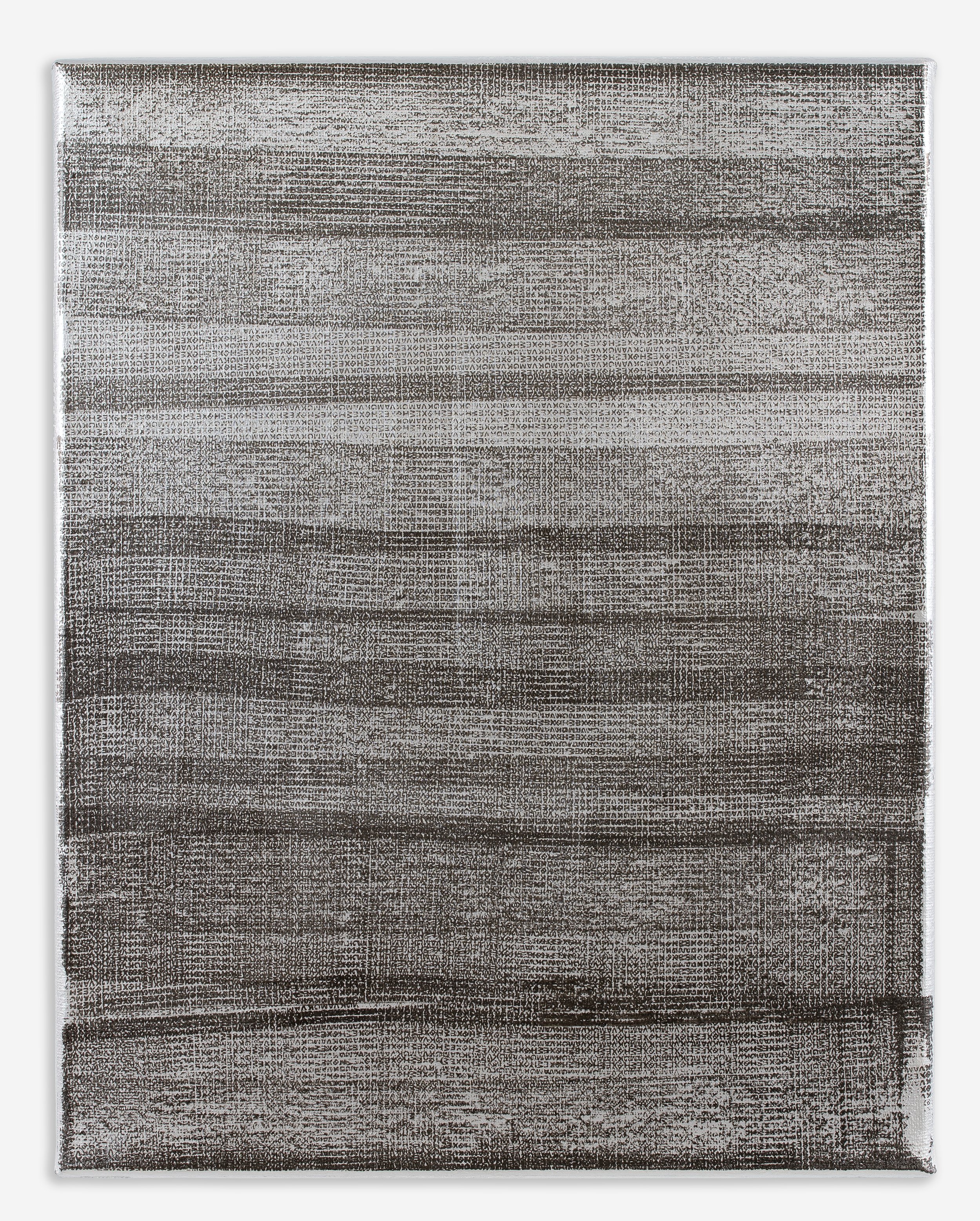
Tan Mu's Privacy 1 (2021) is an acrylic and ink on linen painting, 36 x 28 cm (14 x 11 in), that takes the privacy protection stamp as its primary tool and its primary subject. The work is built through a layered process: a base of acrylic paint is laid down first, and then ink is applied using a privacy stamp, the same kind of stamp that office workers use to conceal their personal information on envelopes and bills before throwing them away. The stamp, a commonplace object designed for a commonplace task, becomes in Tan Mu's hands both a painting instrument and a conceptual engine. The patterns it produces are not abstract compositions invented by the artist. They are the patterns that the stamp was designed to produce: dense, overlapping impressions of obscured text, the visual residue of a redaction that was never intended to be looked at for its own sake but that, when transferred to a canvas and treated with the attention that painting demands, reveals itself as a composition of surprising complexity and beauty.
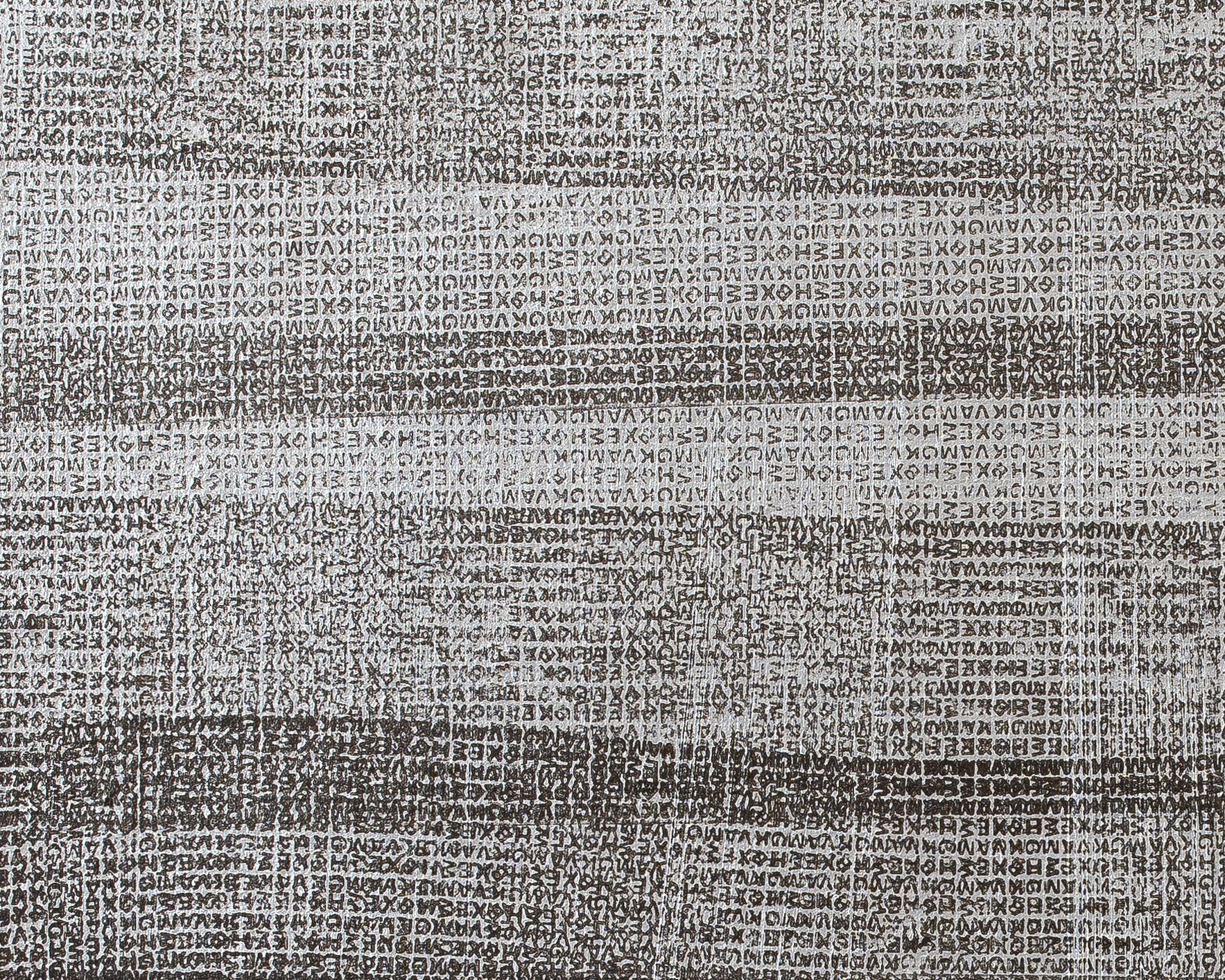
The surface of Privacy 1 is dense with pattern to a degree that distinguishes it from most of Tan Mu's other works. Where the Signal paintings present clear, isolated dots of color against a dark ground, and the thermal imaging works render gradients of warmth and coolness across a single surface, Privacy 1 fills the canvas with a texture that approaches the all-over. The acrylic base, visible in the margins and in the thin gaps between stamp impressions, provides a pale ground against which the ink patterns accumulate in layers of varying density. Some areas of the canvas show a single layer of stamp impressions, where the pattern is relatively open and the individual marks of the stamp can be distinguished: a curve here, a serif there, the ghost of a letterform that refuses to resolve into a readable character. Other areas show multiple layers, where the stamp has been applied two, three, or four times in overlapping impressions, creating a denser weave of pattern in which no single mark can be separated from its neighbors. The ink, a deep black that reads as near-purple under certain light conditions, sits on top of the acrylic in thin, dry passages that let the base color show through, or in thicker deposits where multiple impressions have accumulated, creating darker zones where the information was most heavily obscured. The overall effect is not of a single pattern but of a palimpsest, a surface that has been written on, written over, and written over again, each layer partially obscuring the one beneath it, each stamp impression adding another degree of concealment to the information that was never meant to be seen.
The small scale of the painting, 36 x 28 cm, reinforces its origin in the world of documents. This is the size of a standard sheet of paper, or close to it, the size of a letter, a bill, a bank statement, the kinds of documents on which privacy stamps are typically used. The painting does not expand the stamp to mural scale. It holds it at document scale, the scale at which the stamp is actually used, and in doing so it insists that the object it depicts is not an abstraction but a real tool with a real function, and the patterns it produces are not decorative inventions but functional redactions that have been repurposed, through the act of painting, into something that can be looked at as well as looked through. The distinction between looking at and looking through is the painting's central tension. A privacy stamp is designed to be looked through, in the sense that it is meant to be transparent about its own purpose: you see the pattern and you understand that something has been concealed. Privacy 1 asks you to look at the pattern, not through it, and in doing so it reverses the stamp's intended function. The pattern was supposed to be invisible as pattern. It was supposed to be a barrier, not a composition. The painting makes the barrier into a composition, and the composition, once you begin to examine it, is difficult to stop examining, because the density of the overlapping impressions creates a visual complexity that rewards sustained attention in the same way that a field of woven textile does: you see the weave, then you see the threads, then you see the way the threads cross and recross, and the longer you look, the more detail you find.
Jasper Johns's number and alphabet paintings of the late 1950s and early 1960s, particularly works like 0 through 9 (1961, now in the collection of the Museum of Modern Art, New York), stack the numerals zero through nine on top of each other in a single composition, so that each number is partially obscured by the numbers in front of it and partially obscures the numbers behind it. The result is a visual field in which no single numeral can be read in isolation. The numbers are all present, but they cannot all be seen at the same time. The eye moves from one recognizable form to another, a curve that belongs to a 6, a vertical that belongs to a 1, a closed loop that could be a 0 or an 8, and the act of reading becomes the act of sorting, of separating the overlapping forms into their constituent parts, a task that the painting makes deliberately impossible to complete. Johns described these works as devices for looking, structures that gave the eye something to do. The numbers were not symbols. They were shapes, and the shapes, when overlaid, produced new shapes that belonged to no numeral but emerged from the collision of all of them.
Johns's approach to the numeral as a shape that produces new shapes when overlaid provides a structural precedent for understanding what Privacy 1 does with the stamp. The stamp impressions in Tan Mu's painting are not decorative. They are functional. They were designed to obscure. But when they are overlaid, when one impression is stamped on top of another, they produce the same kind of visual complexity that Johns's overlapping numerals produce: a field of intersecting marks in which no single impression can be isolated and the overall pattern becomes something that no single stamp was designed to produce. The privacy stamp was designed to create a single layer of obscurity. The painting creates multiple layers, and the result is not obscurity but density, not concealment but complexity, not a barrier but a woven surface that invites the eye to stay and examine what it cannot resolve. Johns said that his paintings were things that the viewer could look at for a long time. Privacy 1 makes the same claim, and it makes it through the same mechanism: the overlapping of identical forms, each one legible in isolation and illegible in accumulation.
Tan Mu has described the origin of the Privacy series in terms that connect it directly to the experience of information vulnerability in the digital age. "This series emerged from my concern with privacy protection and information security in the digital age," she has said. "As personal data becomes increasingly exposed, the act of protecting information has taken on new urgency. These works use patterns generated by privacy protection tools as a visual language to represent the process of obscuring and safeguarding sensitive data." The word "language" is precise. The stamp produces a pattern, and the pattern is not random. It is generated by a tool that was designed to produce a specific kind of obscurity, an obscurity that is legible as obscurity, that announces itself as redaction, that tells the viewer: something was here, and it has been concealed. This is different from erasure, which leaves a blank space. This is different from encryption, which replaces the original text with a coded text that can be decrypted. The privacy stamp replaces the original text with a pattern that cannot be reversed, and the pattern, while it cannot be read as language, can be read as a sign that language was once present and has been intentionally obscured.
The distinction between erasure and overwriting is central to the painting's argument. When you erase a word, you create a void. The space where the word was is now empty, and the emptiness itself tells you that something has been removed. When you stamp over a word, you fill the space with pattern. The space is not empty. It is full. The word has not been removed. It has been covered, and the covering is itself a kind of writing, a visual statement that says: this information has been protected. The pattern does not deny the existence of the information. It affirms the existence of the information by demonstrating that it was worth protecting. Tan Mu describes this as reflecting "the tension between visibility and obscurity, echoing the complexities of digital security in a world where privacy is increasingly elusive." The tension she identifies is not between seeing and not seeing. It is between two kinds of seeing: seeing the pattern, and seeing through the pattern to the information beneath it. The painting holds both modes of seeing open simultaneously. You can look at the surface and see the pattern, the weave of stamp impressions, the density of overlapping marks. You can also look for the information beneath the pattern, knowing that it is there, knowing that it has been concealed, knowing that the concealment is itself a form of information, a declaration that the hidden content was worth hiding.
Sigmar Polke's Rasterbild (Raster) series of the 1960s and 1970s used the half-tone dot screens of newspaper printing as both subject and technique, enlarging the tiny dots that constitute photographic reproduction in mass media until they became visible as individual marks, each one a point of ink on paper that, in aggregate, produced the illusion of a photograph. In works like the 1966 raster painting of a smiling woman's face, now in the collection of the Museum Ludwig, Cologne, Polke took a photographic image from a newspaper, isolated its dot screen, and reproduced it on canvas at a scale that made the dots visible to the naked eye. The result is not a portrait. It is a portrait that has been revealed as a construction, a face that is also a field of dots, an image that is also a printing process, a representation that is also a reminder that all representations are made of smaller units that are themselves meaningless in isolation and meaningful only in aggregate.
Polke's raster paintings and Tan Mu's Privacy 1 share a structural logic: both take a printing process that was designed to be invisible and make it visible. The newspaper's half-tone dots were designed to disappear into the photograph they compose. The privacy stamp's pattern was designed to disappear into the act of concealment. In both cases, the artist reverses the intended function of the process. Polke makes the dots visible so that the viewer sees the mechanism of reproduction that produces the image. Tan Mu makes the stamp pattern visible so that the viewer sees the mechanism of concealment that produces the redaction. In both cases, what was supposed to be a means to an end becomes the end itself. The dot screen becomes the painting. The stamp pattern becomes the composition. The tool becomes the subject, and the subject, in both cases, is not the image that the tool was designed to produce or protect, but the tool itself, the mechanism by which images are made or obscured, the process that operates behind the surface of every photograph and every redacted document, the infrastructure of visibility and concealment that we are not supposed to notice but that the painting insists we look at.
Li Yizhuo, writing about Tan Mu's practice in 2022, observed that the works "transform systematic complexity into an aesthetic experience." The observation applies with particular directness to Privacy 1, where the systematic complexity is not a submarine cable network or a quantum processor but a privacy protection stamp, an object that costs three dollars and is sold in packs of two at office supply stores. The transformation is the point. The stamp is not complex. The pattern it produces is complex when layered, and the complexity emerges from the accumulation, not from the individual impression. Each stamp impression is simple: a grid of obscured letterforms, a pattern that any office worker could produce with a single press of the hand. The painting takes this simple action and repeats it, layer upon layer, until the simplicity becomes complexity, until the individual impression disappears into the aggregate, until the pattern that was designed to be functional becomes a composition that demands the kind of sustained attention that is usually reserved for things that were designed to be beautiful. The painting does not apologize for the stamp's humble origin. It builds on it. The stamp was designed to hide information. The painting uses the same tool to reveal something about the act of hiding: that hiding is not the absence of information but the presence of a pattern, and the pattern, when it is looked at carefully, is as rich, as dense, and as rewarding of sustained attention as any composition that was designed from scratch to be looked at for its own sake.
The privacy stamp, in the context of cybersecurity, is a low-technology solution to a low-technology problem. It conceals information on physical documents, the kind of documents that are thrown away or mailed or left on desks. It has no power against digital surveillance, data breaches, or the vast infrastructure of tracking and profiling that operates invisibly on every connected device. But the painting does not ask the stamp to solve these problems. It asks the stamp to represent them. The pattern that the stamp produces, the layered grid of obscured text that fills the canvas of Privacy 1, is not a solution to the problem of privacy. It is a representation of the condition of privacy in a world where information is constantly at risk of exposure. The pattern says: something was here, and it was concealed. The painting says: the concealing is worth looking at. The stamp says: this information is protected. The painting says: the protection itself is worth examining, not because it is effective, but because it reveals the structure of the impulse to protect, the desire to control what is seen and what is hidden, the acknowledgment that some information is too private, too personal, too vulnerable to be left in plain view. The stamp presses down, and the pattern remains. The pattern remains, and the painting asks you to look at it, and in looking, to see not just the pattern but the act of stamping that produced it, the hand that pressed down, the ink that transferred, and the word that was replaced by a shape that is, in the end, a word of its own kind: a word that says, I was here, and I chose to hide.