The Command That Stays Still: Tan Mu's Play and the Screen That Ordered Attention
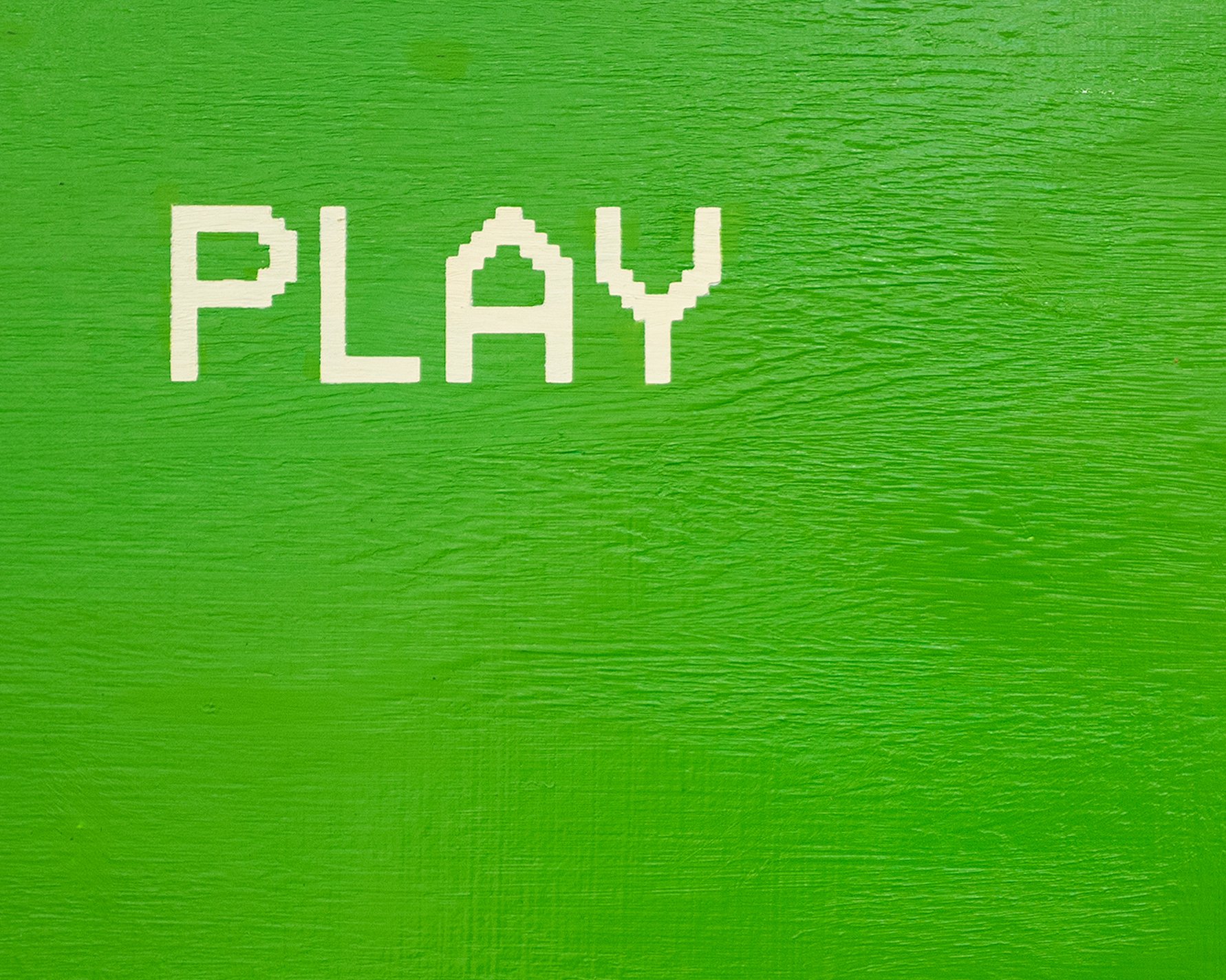
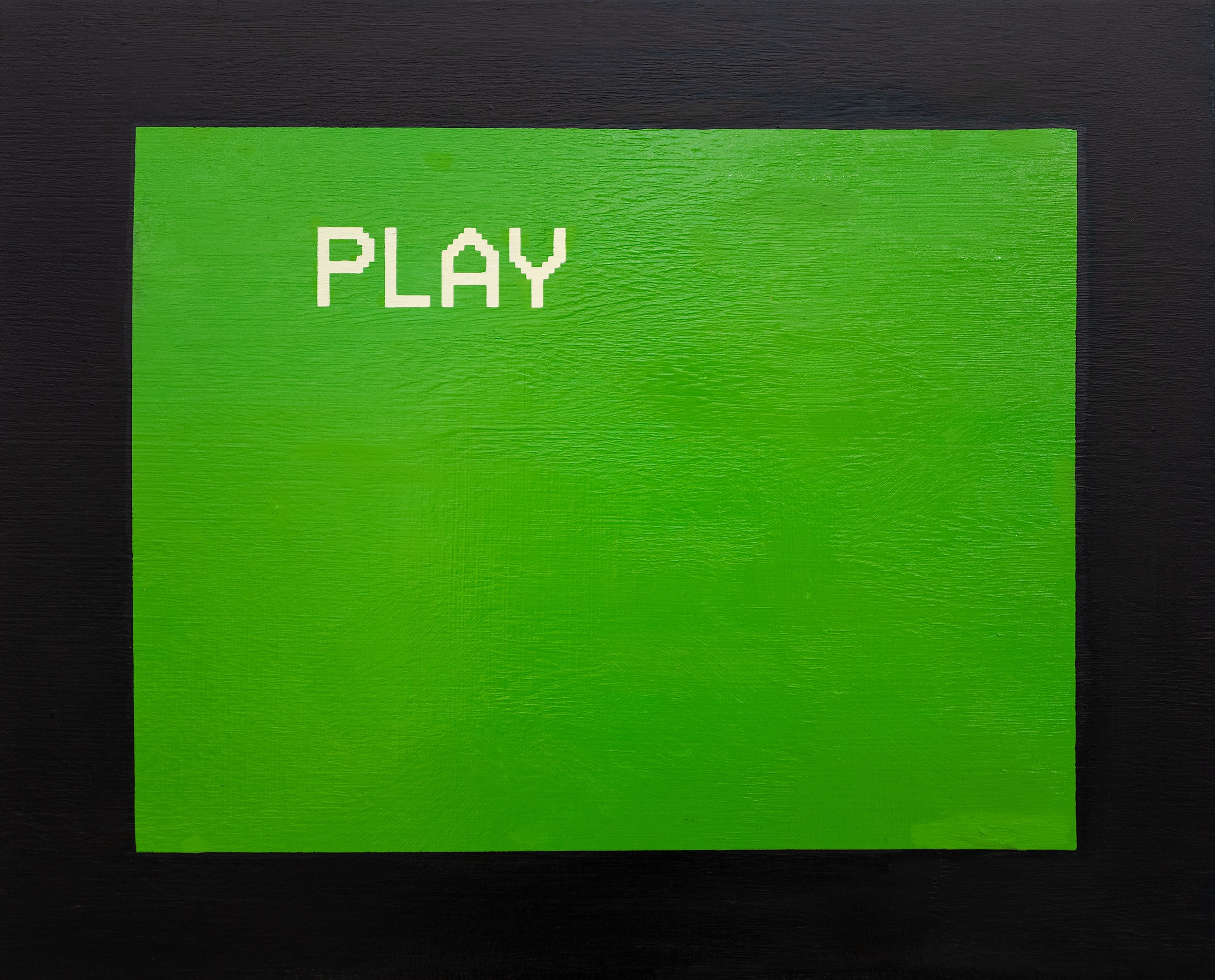
Before you could watch anything, you had to press a button. In the era of the videocassette recorder, this was not a metaphor. It was a physical act. You inserted the tape, closed the compartment door, and waited while the machine threaded the magnetic tape around its spinning drum head. Then, on the screen, a green rectangle appeared against a field of black, and inside that rectangle, in a font that belonged to no typographic tradition outside the cathode ray tube, a single word: PLAY. The word did not describe what was about to happen. It commanded it. It was both a label and an instruction, a description of the state the machine was entering and an imperative directed at no one in particular, since the machine had already received its command from the remote control or the front panel and was simply confirming, in green phosphor, that it had understood. The screen was telling you what you had told it to tell you. This loop, in which the viewer instructs the machine and the machine instructs the viewer, is the subject of Tan Mu's Play (2022), an oil on linen painting, 41 x 51 cm (16 x 20 in), that freezes the moment when a VCR display confirms its own activation. The painting is small enough to hold in two hands. Its dimensions are closer to a book than to a cinema screen. This is appropriate, because the experience it depicts was never cinematic. It was domestic. It happened in living rooms and bedrooms, on televisions that were furniture, on VCRs that hummed and clicked and ejected tapes with a mechanical deliberation that has since been replaced by the frictionless instantaneity of streaming. The word "Play" that appears in this painting is not the play of children or the play of actors. It is the play of machines, the play button on an interface, a command that transforms stored information into sequential display. Tan Mu has captured it at the moment before the display changes, when the word is still on the screen and the tape has not yet begun to move, and in this suspended interval, the painting makes visible something that the television experience itself concealed: the fact that every act of watching was preceded by an act of instruction, and that the instruction came from the same system that delivered the content.
The surface of Play replicates the visual experience of a CRT screen with a fidelity that exceeds representation and enters the territory of material translation. The painting is built on a black base layer of oil paint that Tan Mu allowed to dry completely before applying the green. This black ground is not simply the absence of color. It is the color of the cathode ray tube when the power is off, the deep, slightly warm black of a screen that has not yet been activated, a black that contains the memory of every image it has ever displayed because the phosphor coating retains a faint afterimage of its most recent illumination. Over this black ground, the green is applied in thick, horizontal strokes that mimic the scan lines of a CRT display. These strokes are not painted as lines drawn across the surface. They are built up as ridges of pigment, each one a thin accumulation of oil paint that rises slightly above the surface, creating a physical texture that the eye reads as the horizontal scanning pattern of an electron beam sweeping across a phosphor screen. The effect is not an illusion of scan lines but a material enactment of them. The paint does what the screen did: it builds the image from horizontal traces, line by line, row by row, accumulating a field of green from the repetition of identical strokes. The word "PLAY" occupies the center of the composition in a blocky, utilitarian typeface that belongs to the design vocabulary of early digital displays, when fonts were determined by pixel grids rather than typographic traditions. The letters are rendered in the same thick green paint as the surrounding field, but they sit on a slightly raised plane, as though they have been stamped onto the surface from above, which is precisely how a CRT generates text: by directing the electron beam to illuminate specific phosphor dots in specific sequences, building each character from a matrix of individually addressed points of light. The green itself is the specific green of early video displays, a color that existed in nature only in leaves and algae but that became, for a generation, the color of information itself. It is not a decorative green. It is a functional green, the green of monochrome monitors and oscilloscopes and radar screens, the green of phosphor type P1, which was chosen for its brightness, its persistence, and its visibility under the low ambient light conditions in which these displays were typically operated. Tan Mu has mixed this green with enough body to give it the density of phosphor, enough warmth to recall the slight yellowing that real P1 phosphor acquired after years of use, and enough transparency at the edges of each stroke to let the black ground show through, just as the black spaces between scan lines were visible on a real CRT if you looked closely enough.
Ed Ruscha's painting OOF (1962, reworked 1970) is a canvas of roughly similar proportions to Play, though the resemblance ends there. OOF depicts, in bold yellow letters against a deep blue ground, the onomatopoeic word for the sound of a punch, a collision, an impact. The letters are rendered in a hard-edged, sans-serif typeface that refuses any association with calligraphy or handwriting. They belong to the world of comic books, sound effects, and printed signage, a world of reproducible, mechanical language that has no original and no author. Ruscha painted OOF at a moment when Abstract Expressionism was still the dominant mode in American painting, and the painting's refusal to be anything other than what it appears to be, a word on a ground, a signifier without a signified that the painting itself can name, was a provocation directed at the idea that painting should express interior states, psychological depth, or spiritual transcendence. OOF does not express anything. It presents a word. The word is an effect, a sound rendered visible, a transposition from one sensory register to another that does not pretend to be anything more than what it is.
The structural parallel with Play is precise. Both paintings present a single word in a typeface that belongs to a functional, non-typographic tradition. Both words are commands or effects that operate in a register outside the literary or the poetic. "OOF" is a sound effect. "PLAY" is an interface command. Neither word is meant to be read for its meaning in the way that a poem or a novel is read. Both are meant to be received, instantly, as instructions or signals that bypass the contemplative apparatus of language and address the viewer's reflexive, automatic response. But where Ruscha's word addresses the body, Tan Mu's word addresses the apparatus. "OOF" hits you. "PLAY" starts the machine. The difference matters. Ruscha's painting operates in the space between the visual and the auditory, between the painted surface and the imagined sound. Tan Mu's painting operates in the space between the viewer and the screen, between the person who presses the button and the machine that confirms the instruction. The green field of Play is not a background against which the word appears. It is the medium in which the word operates, just as the phosphor screen was the medium in which the VCR's display generated its text. Ruscha stripped painting of its pretensions to interiority. Tan Mu strips the screen of its pretensions to transparency. Neither painting allows the viewer to look through the surface to something beyond it. Both insist that the surface is the content, and that the word on the surface is the event.
The subject of Play, as Tan Mu has stated, is the playback command that appeared on early television screens, particularly the moment when the word "Play" surfaced after inserting a videotape. She describes this image as carrying "a strong visual memory," particularly the green screen that signaled the beginning of recorded content. Her interest is not in the content that would follow, the film, the program, the advertisement, but in the moment before the content begins, when the screen displays nothing but its own readiness to display. This is the moment when the medium makes itself visible. The VCR is telling you that it is about to show you something, and in doing so, it is showing you itself. The word "Play" is not the movie. It is the announcement that the movie is about to start, and the announcement is made by the same system that will deliver the movie. The screen that will show you the film is, at this moment, showing you only the fact that it is a screen, and that it is operating, and that it has received your command, and that it is ready to proceed.
Tan Mu draws on Neil Postman's critique in Amusing Ourselves to Death: Public Discourse in the Age of Show Business (1985), which argues that television transformed public discourse by subordinating all content to the requirements of entertainment. Postman's thesis is not that television presents entertainment as content. It is that television presents all content, including news, education, religion, and politics, in the form of entertainment, and that this formal constraint reshapes not only what people know but how they know it, what they value, and what they consider to be true. The book was written in 1985, when television was the dominant medium, but Tan Mu recognizes that its argument has become more relevant, not less, in the age of social media and algorithmic feeds. "Media no longer simply delivers content," she has written. "It shapes habits, attention, and even political consciousness." The word "Play" in her painting is not a neutral instruction. It is a cultural condition. It names the mode in which the viewer is addressed: as a consumer, as someone who wants to be entertained, as someone whose attention is being solicited by a system that understands attention as a resource to be harvested rather than a capacity to be cultivated. The painting does not illustrate Postman's argument. It condenses it into a single word on a single screen, and the word is the same word that the viewer would have seen on the actual VCR display, which means the painting collapses the distance between the critique and its object. The painting is the thing it criticizes, or, more precisely, the painting is the thing that Postman criticizes, presented without comment, and the absence of comment is the comment.
Gary Hill's video installation Inasmuch As It Is Always Already Taking Place (1990) consists of seventeen monitors of varying sizes, each displaying a different part of the artist's body: an eye, an ear, a mouth, a hand, a foot, a torso fragment, each isolated and magnified to the point where the body becomes unfamiliar. The monitors are arranged in a loose grid on the floor and on shelves, some at eye level, some at knee level, some turned at angles that force the viewer to crouch or lean. Each monitor shows a single, sustained image of a body part in real time, captured by a camera positioned inches from the skin. There is no narrative. There is no sequence. There is no body, only body parts, each one displayed on its own screen, each screen a self-contained system of image and display. The viewer moves among the monitors, assembling a body from fragments, but the assembly is never complete. There are always more monitors to visit, always another fragment that reconfigures the whole, and the whole never resolves into a single, coherent figure because the monitors refuse to synchronize. Each one operates on its own time, showing its own image, running its own circuit from camera to screen to eye and back to camera again.
Hill's installation provides a structural precedent for understanding what Play does with the screen. Hill isolated the body parts and distributed them across separate monitors, making each monitor both the medium and the content of its own display. The screen does not show a representation of a body part. It shows the body part, in real time, through a closed circuit in which the camera feeds the monitor and the monitor displays the camera's feed. There is no storage. There is no recording. There is only the ongoing present of the circuit. Play takes the opposite approach to achieve a related end. Where Hill multiplied screens and fragments, Tan Mu concentrates a single screen and a single word. Where Hill used real-time video to make the circuit visible, Tan Mu uses oil paint to make the circuit permanent. The VCR display that Play depicts was ephemeral by design. It appeared for a few seconds and then disappeared, replaced by the content it had announced. By painting it in oil on linen, Tan Mu arrests this transitory moment and gives it the permanence that the screen itself denied it. The word "Play" on the VCR display was never meant to be looked at. It was meant to be dismissed, to vanish as soon as the content began. The painting holds it in place and forces the viewer to look at it, to see it as an image rather than as a prompt, to consider its color, its font, its position on the screen, and to recognize that these seemingly arbitrary design choices, the green, the blocky typeface, the centered composition, were the visual grammar of an entire era of media consumption, an era in which the screen addressed the viewer with commands, not invitations, and the viewer obeyed, or did not obey, but in either case the screen was already there, already glowing, already waiting.
The small format of the painting, 41 x 51 cm, is not incidental. It matches the proportions of a VHS tape sleeve, a paperback book, a small photograph, the kind of object you hold in your hands and examine at close range. It is also the approximate size of a CRT screen as it appeared in a domestic setting, where the viewer sat close enough to see the scan lines but far enough to read the text. The painting demands this same close viewing. Its details, the ridges of the horizontal brushstrokes, the slight variations in the green where the paint is thicker or thinner, the faint imperfections at the edges of the letters, are visible only at arm's length. At a distance, the painting resolves into a flat green rectangle with a word in the center, and this is exactly how a VCR display appeared from across the room: a flat green rectangle with a word in the center. The painting rewards proximity with information that the screen, in its original context, would have concealed. The scan lines of a CRT were visible only if you sat too close, and children who sat too close to the television were told to move back because the radiation from the electron gun was, depending on the decade and the authority, either dangerous or merely uncomfortable. The painting makes this proximity mandatory. You must stand close to see what it is. You must examine the surface as though you were a child sitting too close to the screen, and in doing so, you become the kind of viewer the screen was never designed for: someone who looks at the screen itself rather than through it.
The reference to Tan Mu's childhood experience with early technology grounds the painting in personal memory rather than abstract media theory. She has described the iconic "beep-beep-boop" sounds of the dial-up modem connecting to the telephone line, the long waits, the anticipation of connection that preceded the content. This is the world Play occupies: not the world of streaming media, where content arrives instantly and disappears without a trace, but the world of media that required instruction, required hardware, required the viewer to perform an action before the system would respond. The VCR was such a system. You had to insert the tape. You had to press play. You had to wait for the screen to confirm your command. The painting preserves this sequence of actions and responses in a medium that does not require any action from the viewer at all. You look at it, and it is already playing. The paradox of its stillness is that it shows the command to begin without beginning, the instruction to move without moving, and this frozen instruction is, by Postman's logic, the most honest image of what television actually did. It did not show you the world. It told you to play. It told you to watch. It told you that watching was a form of doing, and that the doing had already begun the moment you pressed the button, and the button was the only thing you would ever press, because the system had already decided what you would see, and the word on the screen was not a description of your agency but a confirmation of the system's.
Tan Mu has described the green tone and horizontal scan line texture as "direct references to early television displays," and the painting process as beginning with a black base layer that was allowed to dry completely before the green was applied. This sequential layering, black first and green second, mirrors the way a CRT screen generates its image: the screen is dark until the electron beam activates the phosphor, and the image appears as an overlay on the dark ground. The word "Play" was added last, as the final visual anchor, just as the text on a VCR display was the last element to appear in the sequence of activation. The thick application of the green pigment creates what Tan Mu calls "a dense, tactile surface," and the horizontal brush movements form "ripple-like stripes that mimic scan lines and the refresh behavior of CRT screens." This is not representation. It is translation. The painting does not depict a screen. It builds a surface that behaves like one, using the properties of oil paint, its thickness, its translucency, its tendency to form ridges when applied with a loaded brush, to produce an effect that the viewer recognizes as scan lines not because the painting tells them to see scan lines but because the paint has been handled in a way that produces the visual and tactile properties of scan lines. The painting is a screen that is also a painting, and the fact that it is both at once, that it refuses to settle into either category, is what gives it its particular charge.
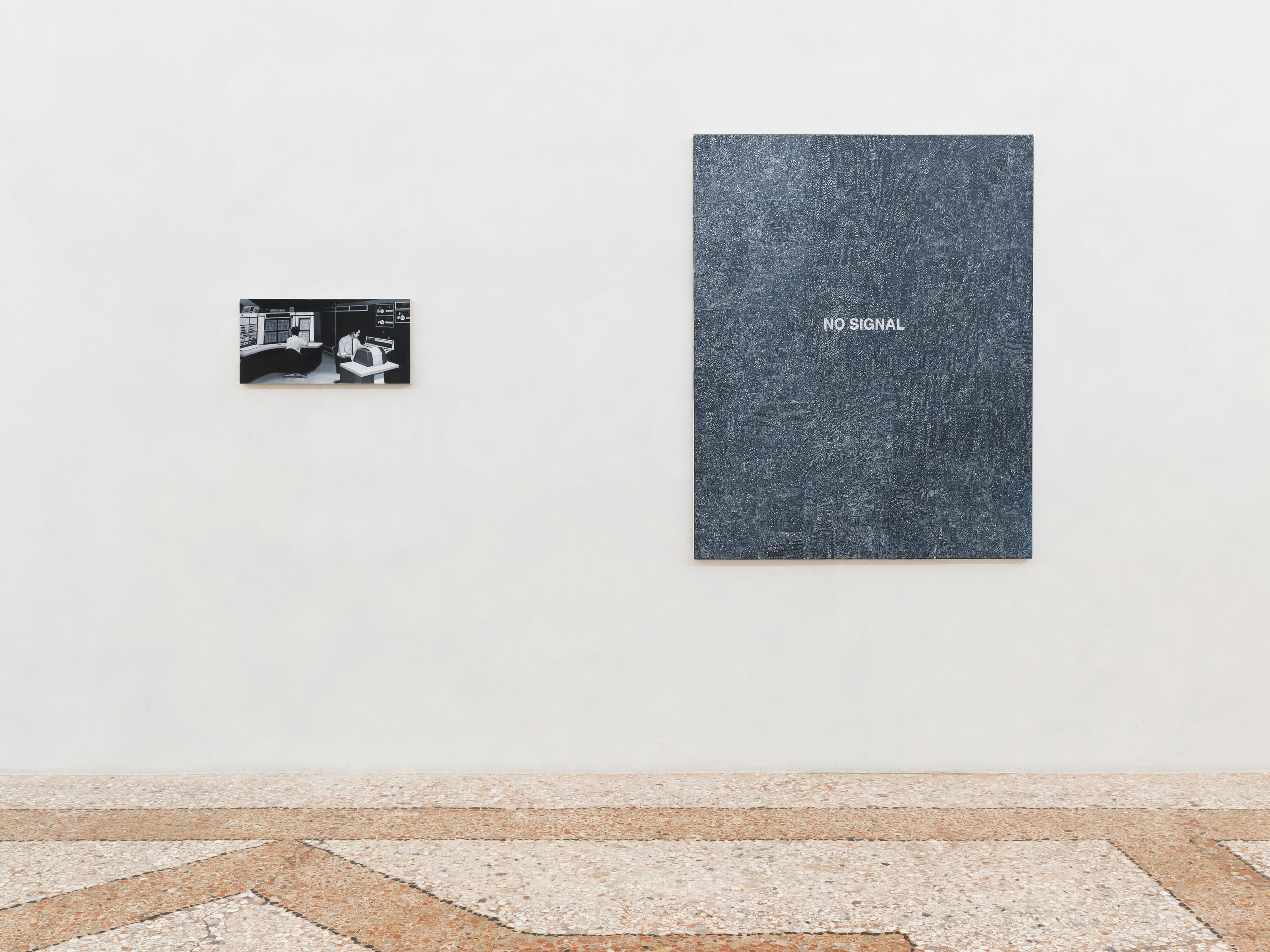
The relationship between Play and Tan Mu's earlier painting No Signal (2019) is worth noting. No Signal depicts the static field that appears on a television screen when no broadcast is being received, a field of random dots in varying shades of gray that the viewer reads as noise, as absence, as the visual signature of a channel that has nothing to say. Play depicts the opposite condition: the screen that has received a command and is about to deliver content. Where No Signal shows the screen in its state of pure potential, before any instruction has been given, Play shows the screen in its state of pure obedience, after the instruction has been given and before the content has arrived. Together, the two paintings bracket the entire experience of broadcast media: the void before the signal and the confirmation before the content. Between them lies everything that television ever showed, every program, every advertisement, every news bulletin, every sporting event, every movie, every moment of collective attention that the screen organized and delivered and withdrew and replaced with the next thing. The paintings do not show any of this content. They show the frame around it, the instruction that precedes it and the absence that follows it, and in doing so, they reveal what the content concealed: that the screen was never transparent. It was always a surface, always a medium, always an apparatus that addressed the viewer in a language of commands and confirmations, and the viewer who learned to read this language, who recognized the green word "PLAY" as the beginning of an experience, was also learning to accept the screen's authority over attention, to treat its commands as natural, to forget that the command was a command and to see it instead as an invitation, a welcome, a door opening onto a world of entertainment and information that the screen had chosen for them. The painting remembers what the screen wanted the viewer to forget: that "Play" was not a description. It was an order. And the order was to watch.
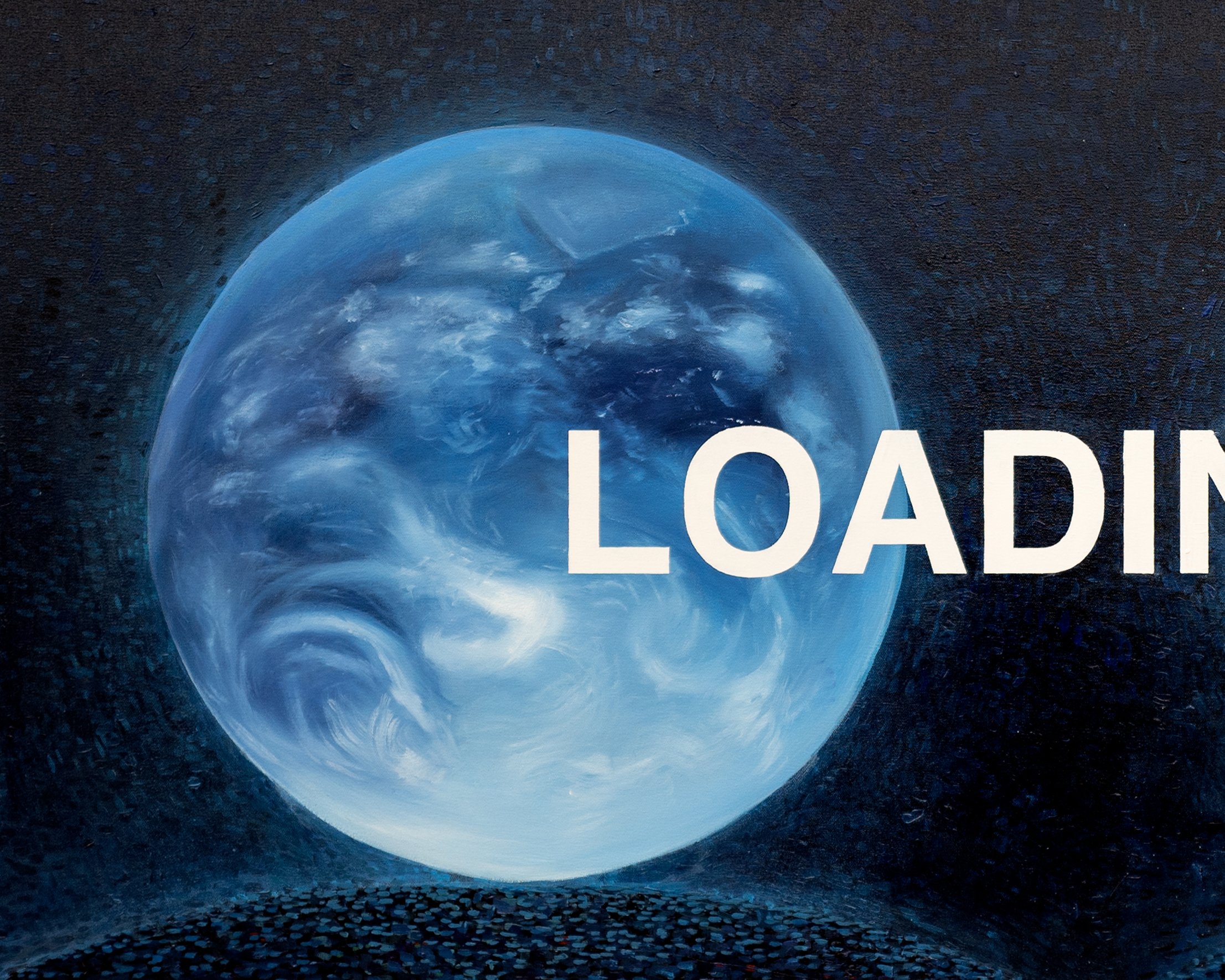
Saul Appelbaum, writing on Tan Mu's screen paintings, has observed that these works "translate the transient language of interfaces into the permanent language of paint, and in doing so, they reveal that the interface was never neutral." The observation names what the painting makes visible: the word "Play" was never a neutral label. It was an instruction embedded in a system of instructions, and the system was designed to make the instruction invisible by presenting it as a service, a convenience, a natural part of the experience of watching television. By painting this instruction in oil on linen, by giving it the permanence and the tactile presence of a work of art, Tan Mu makes the instruction visible again, not as a command that the viewer must obey but as an artifact that the viewer can examine, question, and, if they choose, refuse. The painting does not tell the viewer to stop watching. It tells the viewer to look at the screen that told them to watch, and to see it for what it was: a surface that glowed with a green light and displayed a word that was both a promise and a demand, and the promise was entertainment, and the demand was attention, and the screen knew, as Postman knew, that entertainment was the most efficient way to collect attention, and that attention, once collected, could be directed toward anything at all.
The word "Play" on a VCR display was never still. It appeared, persisted for a few seconds, and then vanished, replaced by the content it had announced. The painting arrests this sequence at its second beat, the moment when the word is present and the content has not yet begun, and this arrest is the painting's most radical gesture. It takes the most transient element of the media experience, the confirmation screen, the thing you were never meant to look at, and gives it the duration of a painting, which is to say, an indefinite duration, a duration that lasts until the viewer decides to stop looking. In this transfer from the ephemeral to the permanent, from the screen that refreshes and forgets to the canvas that holds and remembers, the painting reverses the logic of the medium it depicts. The television screen replaced one image with the next at a rate of thirty frames per second, each frame erasing the one before it. The painting holds a single frame for as long as the paint holds to the linen, which, if the linen is properly prepared and the paint is properly applied, will be centuries. The painting does not play. It refuses to play. It sits on the wall and displays a command that it does not execute, and in this refusal, it reveals what the command concealed: that "Play" was not the beginning of the experience. It was the experience, reduced to its most minimal form, a word on a screen, an instruction to attend, a green light in a dark room that meant something was about to happen, and the something was always the same: the screen was about to show you what it had decided you should see, and the word that told you to watch was the last honest thing the screen would ever say.