The Filament That Remembers the Cell: Tan Mu's Illuminate and the Moment When Light Became Life
Three thousand people stood outside the Menlo Park laboratory on New Year's Eve 1879. They had come by train from New York and by carriage from Newark, bundled against the December cold, to see something they had heard described in the newspapers but could not yet believe: an electric light that burned without gas, without flame, without the hiss and smell and danger that every form of artificial illumination had carried since the first lamp was lit. What they saw, when Edison finally threw the switch, was a laboratory compound glowing with incandescent bulbs, their carbon filaments heated to a temperature that produced a warm, steady, almost magical light. The newspapers called it the wizard of Menlo Park. The visitors went home and told their neighbors. Within a decade, electric light would begin to replace gas lamps in cities across the United States, and within two decades, the carbon filament bulb would become the most widely manufactured source of artificial light in human history. The world after 1879 was brighter than the world before it, and it has stayed brighter ever since.
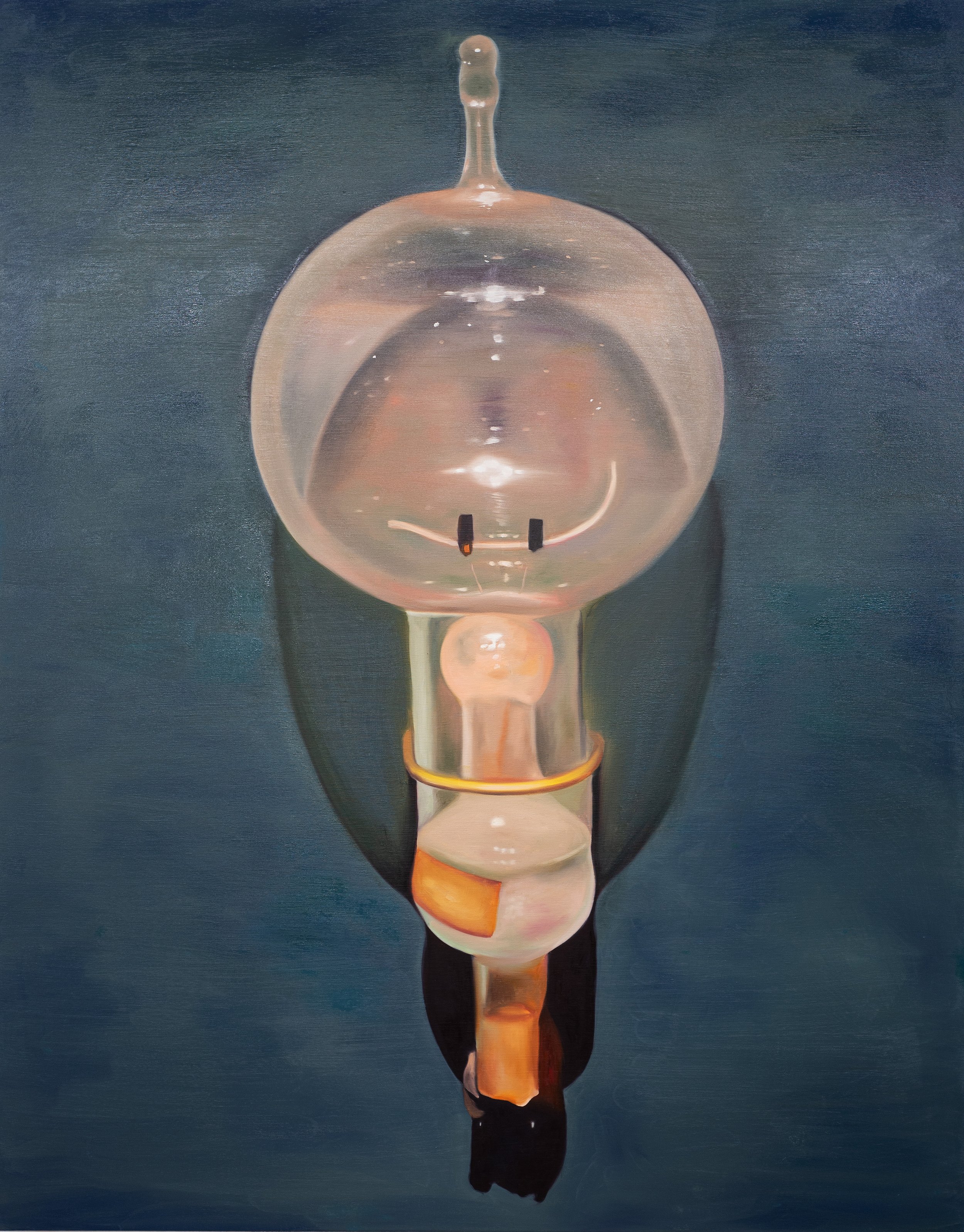
Tan Mu's Illuminate (2022) takes this moment as its subject, but it does not depict the demonstration. It does not show the crowd outside the laboratory, or the switch being thrown, or the newspaper headlines that followed. It shows a single light bulb, isolated against a dark ground, painted in oil on linen at 152 x 122 centimeters. The bulb is rendered in what Tan Mu describes as a "portrait-like manner," with attention to its form, its materiality, and its internal structure rather than to the radiating light it produces. The painting does not show what the bulb illuminated. It shows the bulb itself, the object that made illumination possible, and it treats that object with the gravity that portraiture reserves for human faces.
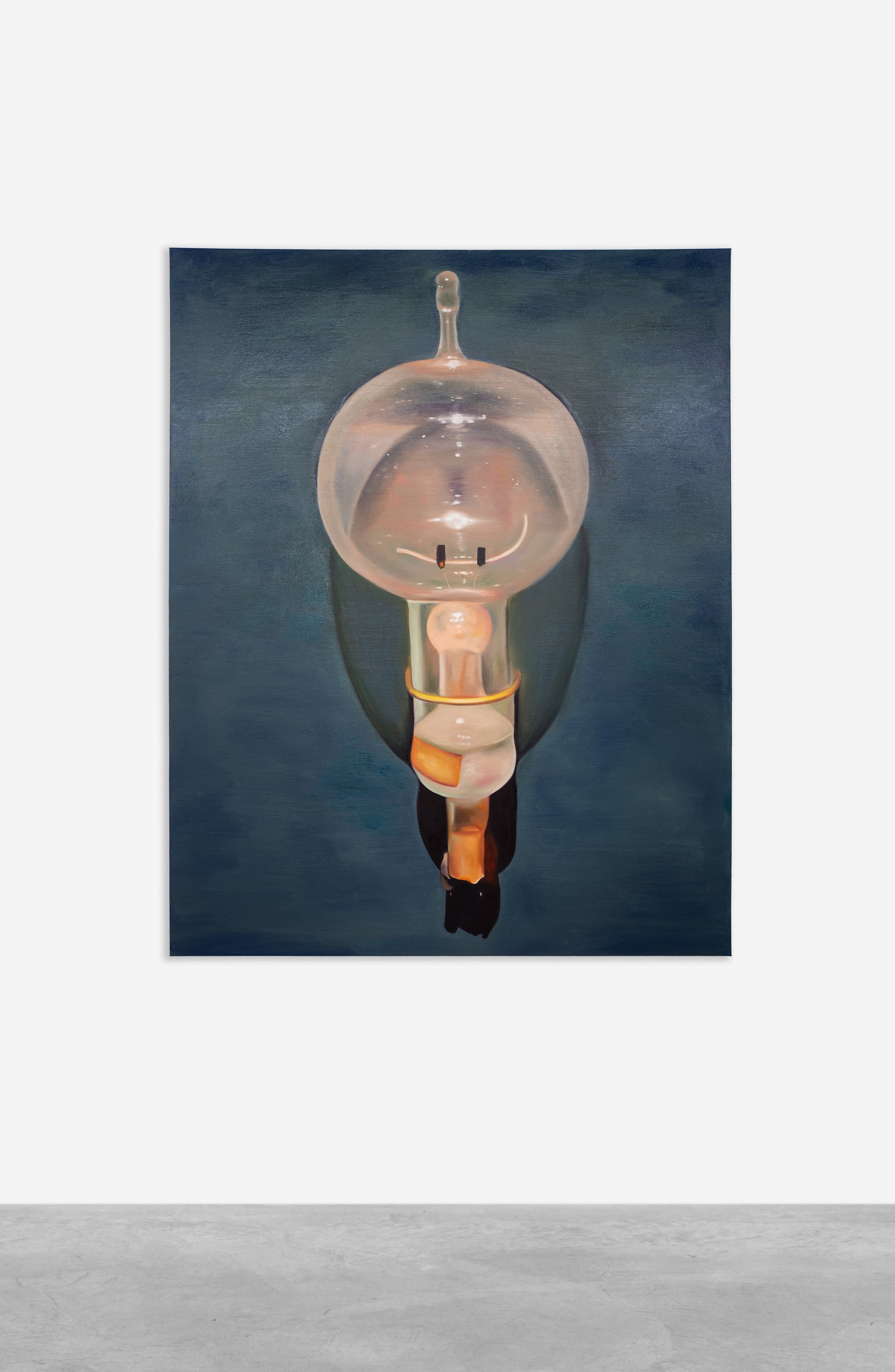
The painting is oil on linen, 152 by 122 centimeters, a vertical format that mirrors the proportions of the bulb itself. The glass envelope occupies the upper two-thirds of the canvas, pear-shaped and translucent, its surface catching light in thin, horizontal bands that suggest the ridges of the glass mould rather than the smooth, featureless curve of a manufactured object. Inside the envelope, the filament is a single line of incandescent amber, thin and deliberate, curving from one electrode to the other in the distinctive horseshoe arc that Edison's early bulbs employed before the later shift to coiled tungsten. The filament is the warmest element in the composition. Everything around it is cooler: the glass is rendered in muted grays and pale blues, the electrodes are rendered in the dark iron tones of carbonized bamboo, and the background is a deep, near-black field that absorbs light rather than reflecting it. The contrast between the filament's amber and the surrounding darkness is the painting's structural axis. Everything else in the canvas exists to frame that contrast, to establish the conditions under which a single line of heated carbon becomes a source of visible light.
At close range, the surface reveals its construction. The dark ground is not a single flat tone but a layered field of deep blues and blacks, built up in thin washes that allow the weave of the linen to show through in places. This is not the absolute black of a void. It is the black of a room at night, a black that contains the memory of the colors that were mixed to make it. The glass envelope is painted with a restraint that makes its transparency more convincing than a detailed rendering would have been. A few strokes of pale gray along the left edge establish the curvature. A thin highlight along the right edge marks where the light source, unseen, strikes the surface. The filament itself is the passage where Tan Mu's brushwork is most visible: the amber paint is applied in a single, confident stroke, slightly raised from the surface, carrying the trace of the hand that made it. This is a deliberate choice. The filament is the only element in the painting that shows the mark of the brush without mediation. In a painting about an object that emits light, the only visible brushmark is on the source of that light.
The base of the bulb, where the glass meets the screw thread, is rendered with particular attention. This is the joint between the ethereal and the mechanical, the place where the glass envelope of incandescence connects to the brass and ceramic hardware of the socket. Tan Mu paints this junction with a precision that makes it feel like a portrait of an engineering decision: the bulb must connect to the socket to receive the current that heats the filament, and the socket must be threaded so that the bulb can be screwed in by hand. The screw thread is one of the most mundane objects in the history of industrial design, and Tan Mu paints it with the care that a portrait painter would give to the sitter's hands. The base is not an afterthought. It is the point where the bulb ceases to be a glass vessel containing a vacuum and becomes a component in an electrical circuit. The painting registers this transition in its material treatment: above the base, the bulb glows; below it, the hardware is dark, matte, and functional. The line between them is the line between the light and the system that produces it.
In 1766, Joseph Wright of Derby painted A Philosopher Lecturing on the Orrery. The canvas shows a group of figures gathered around a mechanical model of the solar system, lit by a single oil lamp that has been hidden inside the model's central sphere. The light spills outward through gaps in the brass armillary, casting dramatic shadows across the faces of the adults and children who lean in to watch. The lamp illuminates the model and the faces simultaneously, and the composition makes it impossible to separate the demonstration from the illumination that makes it visible. The lamp inside the orrery is the source of both the mechanical demonstration and the visual drama. Without it, the orrery is a dark mechanism. With it, the orrery becomes a miniature cosmos, and the faces around it become the faces of witnesses to revelation.
Wright's orrery painting and Tan Mu's Illuminate share a structural logic: both compositions center on an object that produces light, and both compositions use the contrast between that light and the surrounding darkness to organize the viewer's attention. But the differences between them are as instructive as the similarities. Wright places the light source inside the mechanism, so that the illumination appears to emanate from the orrery itself, as though the mechanical model of the cosmos were actually generating the light of the sun. The audience receives the light, and the painting is as much about their reception as about the mechanism. Tan Mu removes the audience entirely. The bulb in Illuminate does not illuminate anyone. It is a portrait of the source of illumination, isolated from the scene it would light, and the painting's argument depends on this isolation. By removing the crowd, the laboratory, the switch, and the demonstration, Tan Mu forces the viewer to confront the object itself: its form, its materiality, its internal structure, and the paradox that an object designed to produce light can only be represented by painting the light it emits as a single, thin line of amber paint against a dark ground.
Wright's second great candlelight painting, An Experiment on a Bird in the Air Pump (1768), goes further in dramatizing the relationship between light and its audience. Here the light source is a glass vacuum flask, through which the audience can see the bird inside, struggling for air. The flask is both a scientific instrument and a transparent vessel, and the candle that illuminates the scene is placed beside it, casting light through the glass and onto the faces of the onlookers. The composition makes the audience's emotional response the subject of the painting as much as the experiment itself. Some viewers are fascinated, some are horrified, and one young woman turns away entirely, unable to watch. The painting asks whether the progress of knowledge justifies the suffering it causes, and it asks this question through the faces of the people watching, which are made visible by the same candle that makes the experiment possible.
Tan Mu's bulb faces no such question because it faces no audience. The bulb in Illuminate is not in the process of demonstrating anything. It exists in the painting as an object, not as an event. The painting does not ask whether artificial light is justified, or whether it causes suffering, or whether it should be celebrated. It asks a simpler and more disarming question: what does it look like to paint the origin of modern light as a portrait? The answer is that it looks like a single line of amber paint, slightly raised from the surface of the linen, curving in a horseshoe arc between two dark electrodes, inside a glass envelope that is rendered with just enough detail to establish its transparency and just enough restraint to let the filament carry the compositional weight. The bulb is not glowing in the way a light bulb glows when it is turned on, flooding a room with warm light. It is glowing in the way a portrait glows: from within, through the accumulation of small decisions about color, contrast, and surface that make the filament the warmest element in a painting that is otherwise composed of cool tones.
Edison's carbon filament light bulb was demonstrated publicly for the first time on New Year's Eve, 1879, at his Menlo Park laboratory. The technical achievement was not the invention of the incandescent lamp itself, which had been attempted by at least twenty inventors before Edison, but the development of a filament that could burn for over a thousand hours without failing. Edison's first successful filament was made from carbonized bamboo, a material chosen after testing over six thousand plant fibers from around the world. The filament in Tan Mu's painting is rendered with the specific horseshoe shape of the early Edison bulbs, a detail that identifies it as a historical object rather than a generic symbol. This is not any light bulb. It is the light bulb, the one that changed the duration and distribution of artificial light, the one that extended productive hours beyond sunset and reshaped the rhythm of daily life for every person who lived within its reach.
Tan Mu has described the moment when the filament emits light as unexpectedly reminding her of cell division, a subject she had explored in earlier works including IVF (2020). The connection is not merely visual, though the horseshoe curve of the early filament does resemble the first stages of mitotic division, where a single cell elongates and begins to pinch into two. The connection is structural. Both the filament and the cell are sites of origin: the filament originates visible light through the application of electrical current to a resistant material, and the cell originates biological life through the division and multiplication of its internal structures. Both processes require energy to proceed. Both produce something that did not exist before: light in one case, a new cell in the other. Both are invisible in their moment of origin. You cannot see a carbon filament heat to incandescence with the naked eye. You can only see the light it produces after it has reached the temperature at which it becomes visible. You cannot see a cell begin to divide until it has already progressed past the point of initiation. Both events, the heating of the filament and the beginning of cell division, occur at a scale and a speed that exceeds direct human perception, and both are known through their effects rather than through direct observation of their causes.
The parallel between artificial illumination and biological genesis is not a metaphor that the painting imposes on its subject. It is a connection that Tan Mu discovered while painting, as she describes in her own words: "While painting this piece, I became deeply absorbed in the moment when the filament emits light. That process unexpectedly reminded me of cell division, a subject I had explored in earlier works. Although the light bulb is entirely man made, the way light emerges from within it evoked associations with the origins of life." The word "unexpectedly" carries the weight of this discovery. The painting did not set out to equate the light bulb with the cell. The painting set out to make a portrait of the light bulb, and in the process of making that portrait, the artist recognized a structural correspondence that had been hidden in the object all along. The filament is to the bulb what the nucleus is to the cell: the central structure that generates the energy that makes the whole system function.
This correspondence between the filament and the cell links Illuminate to IVF (2020), a painting that depicts a needle injecting into an egg in a laboratory setting. IVF focuses on direct human intervention in the creation of life: the needle that pierces the membrane, the needle that delivers the genetic material, the deliberate, mechanical process by which life is initiated under controlled conditions. Illuminate focuses on a different kind of origin: not the creation of life but the creation of light, and not through organic processes but through the application of electrical energy to a resistant material. The two paintings are linked by their shared interest in the moment of initiation, the instant when something that did not exist before comes into being, whether that something is a new cell or a visible wavelength of electromagnetic radiation. The link is not thematic in the loose sense of "both paintings are about beginnings." It is structural in the precise sense that both paintings treat their subjects as portraits of objects that initiate processes too small and too fast to be seen with the unaided eye, and both paintings use the conventions of portraiture, the centered composition, the dark ground, the attention to surface and form, to make those objects legible as subjects worthy of sustained attention.
Dan Flavin's first fluorescent light installation was made in 1963. It consisted of an eight-foot fluorescent tube mounted at a 45-degree angle to the wall, plugged into an ordinary electrical outlet, casting its cool, pinkish light across the corner of the room. The work, which Flavin called the diagonal of May 25, 1963 (to Robert Smithson), was not a sculpture that incorporated light. It was the light itself, unmediated by any representational framework, occupying the room as a physical presence rather than depicting something else. Flavin went on to produce hundreds of works using commercially available fluorescent tubes in standard colors, arranging them in configurations that filled galleries with colored light, transforming architectural space into an experience that had no object at its center other than the tubes themselves and the light they emitted.
Flavin's practice and Tan Mu's Illuminate represent opposite approaches to the same subject. Flavin made light the medium of art. The fluorescent tube was not a representation of something else. It was the thing itself, producing light that the viewer experienced directly, without the mediation of a painted surface. Tan Mu makes the source of light the subject of painting. The bulb in Illuminate does not illuminate the room in which the canvas hangs. It is depicted on a canvas, rendered in oil paint, and the light it produces is simulated through the careful manipulation of color, contrast, and surface. Where Flavin eliminated the distinction between the art object and the light source, Tan Mu insists on that distinction. The bulb in the painting is not a bulb. It is a painting of a bulb, and the painting's power comes from the gap between the real light that a real bulb produces and the painted representation of that light. The amber filament in Illuminate is warm in a way that a fluorescent tube in a Flavin installation is not, because the warmth is not thermal. It is chromatic. It comes from the accumulation of pigment decisions that make a single brushstroke carry the visual weight of incandescence.
The contrast with Flavin also reveals something about the painting's temporal position. Flavin's fluorescent installations are contemporary objects. They use industrial materials that are still in production, still available at any hardware store, still functioning as the lighting technology of the present. The Edison bulb in Illuminate is a historical object. The carbon filament design has been obsolete for over a century, replaced first by tungsten filaments and then by LED technology. When Tan Mu paints this bulb as a portrait, she is painting an artifact, an object that belongs to a specific moment in the history of technology. The painting's insistence on the bulb's material specificity, the horseshoe filament, the glass envelope, the threaded base, is an insistence on its historicity. This is not any light. It is the first practical electric light, and it belongs to 1879, and painting it in 2022 is an act of historical attention, not technological celebration. The painting registers the distance between the moment of the bulb's invention and the moment of its depiction, and it uses that distance to make the viewer aware of how much has changed since the first carbon filament glowed in Menlo Park.
Danni Shen, writing on Tan Mu's practice in Emergent Magazine, has observed that the paintings "serve as a kind of witness to human socio-technological histories" and that they reflect "the trajectory and continuum of bodily and mediated presence through human technical developments." The formulation is precise, and Illuminate demonstrates its precision. The painting does not celebrate the light bulb as an invention. It witnesses the light bulb as a historical event whose consequences are still unfolding. The transition from gas to electric light was not merely a technological upgrade. It was a transformation in the organization of human time. Before electric light, the hours after sunset were governed by the cost and danger of gas and oil lamps. After electric light, those hours became available for work, for leisure, for the extension of commercial and social activity into the night. The painting's dark ground is not just a compositional choice. It is the darkness that the bulb was invented to dispel, rendered as the permanent condition against which the filament's amber glow becomes visible.
Tan Mu's own words confirm that the painting's scope extends beyond the individual object to the system it represents. In her Q&A about Illuminate, she states: "My interest in light is inseparable from my broader interest in energy. This extends from the light bulb to solar farms, nuclear power, and speculative ideas like Dyson spheres. These works collectively trace how humanity seeks energy, controls it, and imagines its future through technological systems." The statement locates Illuminate within a constellation of works that includes Solar Farm (2022), TRINITY TESTING (2020), Quantum Computer (2020), and Dyson Sphere (2023). Each of these paintings addresses a different form of energy generation or distribution, from the nuclear detonation that powers a weapon to the theoretical megastructure that harvests the total energy output of a star. The light bulb is the smallest and most familiar of these subjects, and the painting's intimate scale, its portrait-like composition, and its focus on a single object rather than a system, reflect that familiarity. The viewer knows what a light bulb is. The viewer does not need to be told that it produces light. The painting's task is not to inform but to make the viewer see what they already know from a different angle, and that angle is the angle of portraiture: the bulb as a face, the filament as an expression, the dark ground as the background against which a face becomes legible.
The decision to paint the bulb as a portrait, rather than as a source of radiating light, is the painting's most consequential formal choice. A painting of a light bulb that showed the bulb illuminating a room would be a painting of a room, with the bulb serving as the light source that makes the room visible. A painting of a light bulb that shows the bulb itself, isolated against a dark ground, with no room to illuminate and no crowd to receive the light, is a painting of the source of illumination, not of the illumination itself. This distinction is what makes Illuminate a portrait rather than a genre scene. The bulb is not depicted in the act of lighting a laboratory. It is depicted as an object with its own form, its own materiality, and its own history, and the painting asks the viewer to attend to that object with the same sustained attention that portraiture demands of a face.
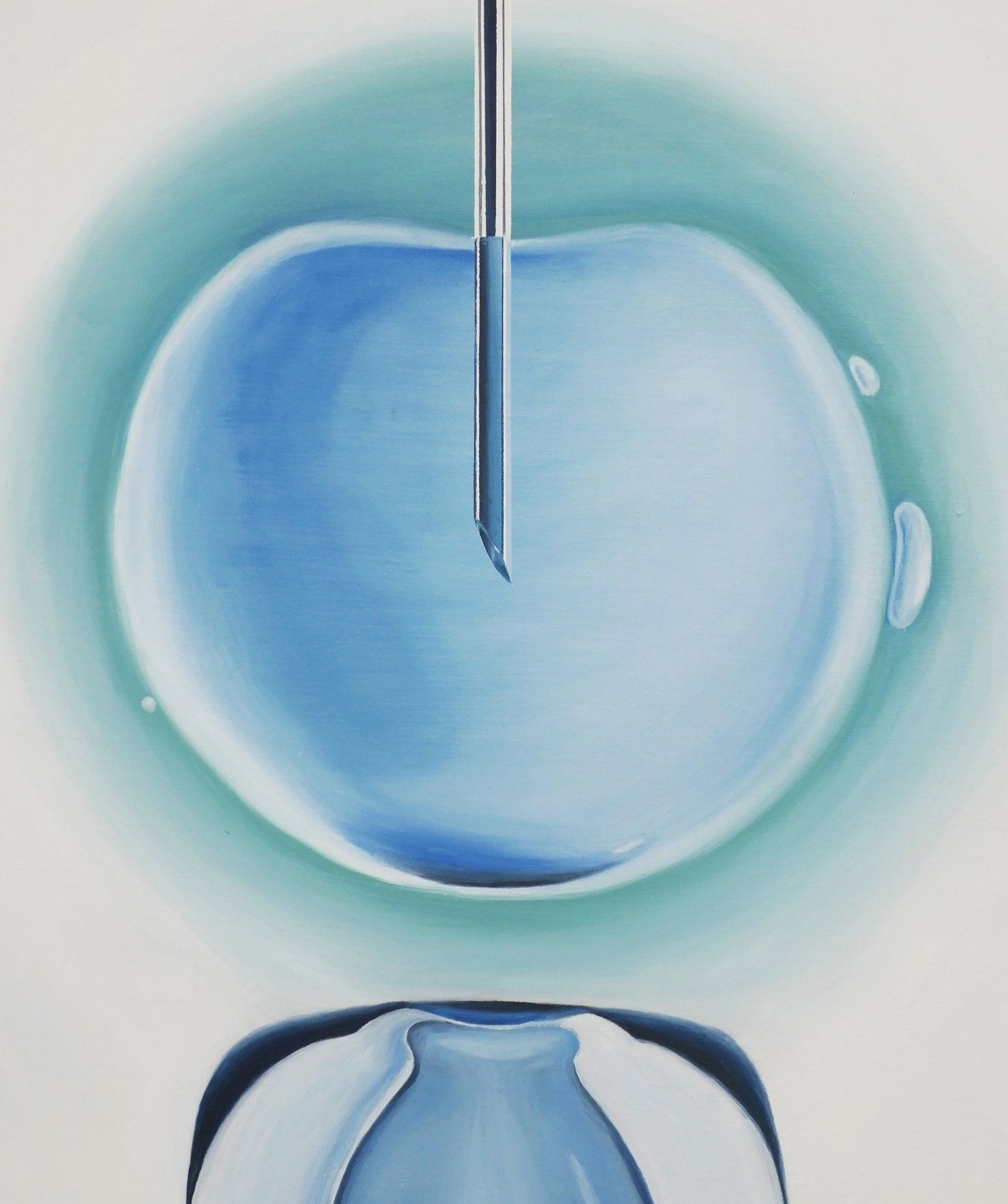
The link to IVF makes this portraiture logic explicit. In IVF, Tan Mu paints a needle injecting genetic material into an egg. The needle is the instrument of initiation. The egg is the site of origin. The painting isolates this moment, strips away the laboratory context, and presents the needle and the egg as a composition in which the viewer's attention is focused on the precise point where intervention meets potential. Illuminate performs the same operation on a different subject. The filament is the instrument of initiation. The glass envelope is the site of origin. The painting isolates the bulb, strips away the laboratory and the crowd and the switch, and presents the filament and the envelope as a composition in which the viewer's attention is focused on the precise point where energy becomes light. The structural parallel is not decorative. It is constitutive. It is the argument of both paintings that the moment of initiation, whether biological or technological, is a moment that deserves the same formal attention that portraiture has historically reserved for human faces, and that by giving this attention, the painter can make visible the correspondence between forms of origin that are normally kept in separate categories.
Tan Mu's practice, as she has described it, operates under the principle of ge wu zhi zhi, investigating things to extend knowledge. The principle, drawn from the Great Learning, insists that knowledge accumulates through sustained attention to specific objects. It begins with the thing itself. The thing in Illuminate is a carbon filament light bulb of a specific design, from a specific year, demonstrated in a specific place by a specific inventor. The painting does not abstract the bulb into a symbol of progress or innovation. It attends to the bulb as an object, with a horseshoe-shaped filament, a glass envelope, a threaded base, and a specific amber glow that is produced by heating carbonized bamboo to a specific temperature. This attention to specificity is what makes the painting more than a celebration of invention. It makes the painting an act of investigation. The bulb is not a symbol. It is an object, and the painting investigates that object by representing it with the precision and gravity that portraiture demands, and in doing so, it discovers a correspondence between the filament and the cell that no amount of symbolic thinking would have revealed.
At Alfred University, where Tan Mu completed her BFA, she lived near the Stull Observatory, one of the oldest private observatories in the United States. She attended weekly observation sessions, and her first experience of seeing the moon through a telescope was, in her own description, transformative. What the telescope revealed was not a symbol of the moon but the moon itself, seen at a scale and a resolution that made it newly visible, newly specific, newly an object worthy of sustained attention. The telescope and the painting perform the same operation. They take something that is visible in principle, the moon, the light bulb, the cell, and they make it visible in a way that it was not visible before, by providing a frame, a context, and a set of formal decisions that direct attention toward what would otherwise be overlooked. Illuminate is a telescope for a light bulb. It takes an object that everyone knows and makes it an object that no one has seen in this way, as a portrait, as a site of origin, as the place where light and life share a structural secret that only becomes visible when the painter decides to look.
The filament does not know it resembles a dividing cell. The cell does not know it resembles a heated filament. The resemblance is a fact of form, not of intention, and it was discovered not through analysis but through the act of painting, through the sustained attention that the canvas demands, through the hours of looking that accumulate into a composition where the warmest passage of paint falls on the curve of a carbon wire and the painter recognizes, in that curve, the curve of something alive. The recognition came after the painting was underway, not before. This is the order of operations that the principle of ge wu zhi zhi describes: investigate the thing, and the knowledge extends outward from the thing, into correspondences that no amount of abstract reasoning could have predicted. The filament does not illustrate the cell. The cell does not explain the filament. Both are visible in the same painting because the painter looked at one long enough to see the other, and the painting holds both in the same frame, not as a metaphor but as a fact of form that the act of painting made legible.