The Cable Beneath the Sea: Tan Mu's Twenty Thousand Leagues Under the Seas and the Invisible Thread That Binds the World
On January 15, 2022, the Hunga Tonga volcano erupted with a force that registered on seismographs around the world. The explosion, the largest atmospheric eruption since Krakatoa in 1883, sent a plume of ash and water vapor 58 kilometers into the stratosphere, generated a tsunami that crossed the Pacific, and severed the single submarine fiber-optic cable that connected Tonga to the rest of the world. For five weeks, the island nation of 106,000 people had no internet, no international phone service, and no way to communicate with the outside world except by sporadic satellite links. The Tonga cable was a single thread, 827 kilometers long, lying on the seafloor between Tongatapu and Suva, Fiji, and when it broke, the entire nation went dark. The eruption made visible what had been invisible: the fact that almost all international data, voice traffic, and financial transactions travel not through satellites in orbit but through cables on the ocean floor, and that the redundancy that most people assume exists in global communications does not always exist in practice.
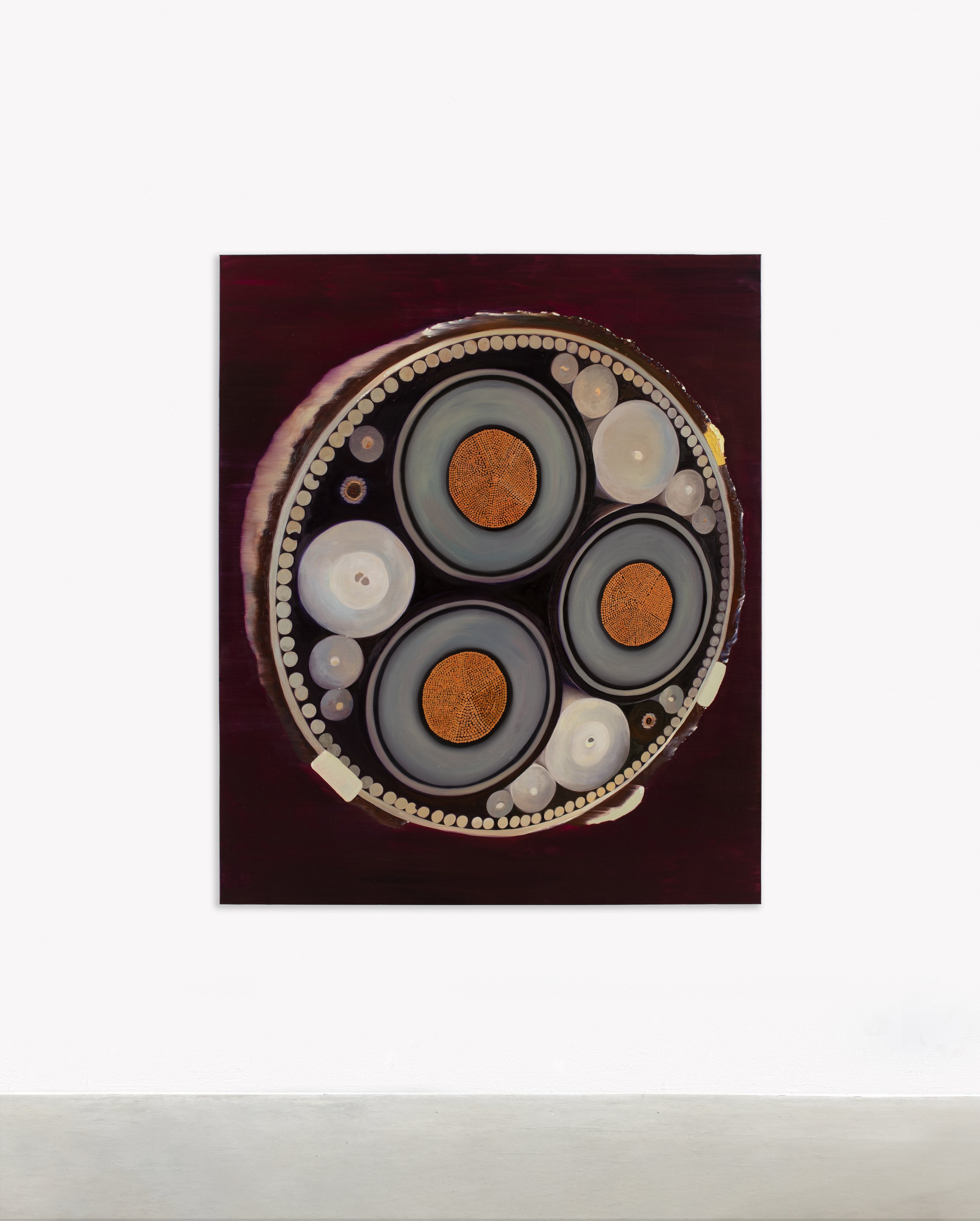
Tan Mu's Twenty Thousand Leagues Under the Seas (2023) is the painting that emerged from this event. It is not a painting of the eruption. It is a painting of what the eruption revealed: the cable beneath the sea, the invisible infrastructure that carries almost all international data across the ocean floor, and the fragility of a system that most people never think about until it breaks. The painting is oil on linen, 182 by 152 centimeters, and it depicts the cross-sections and internal structures of submarine fiber-optic cables, layered across a deep marine ground, with the precision and gravity of an anatomical diagram and the chromatic richness of an oil painting of the deep ocean.
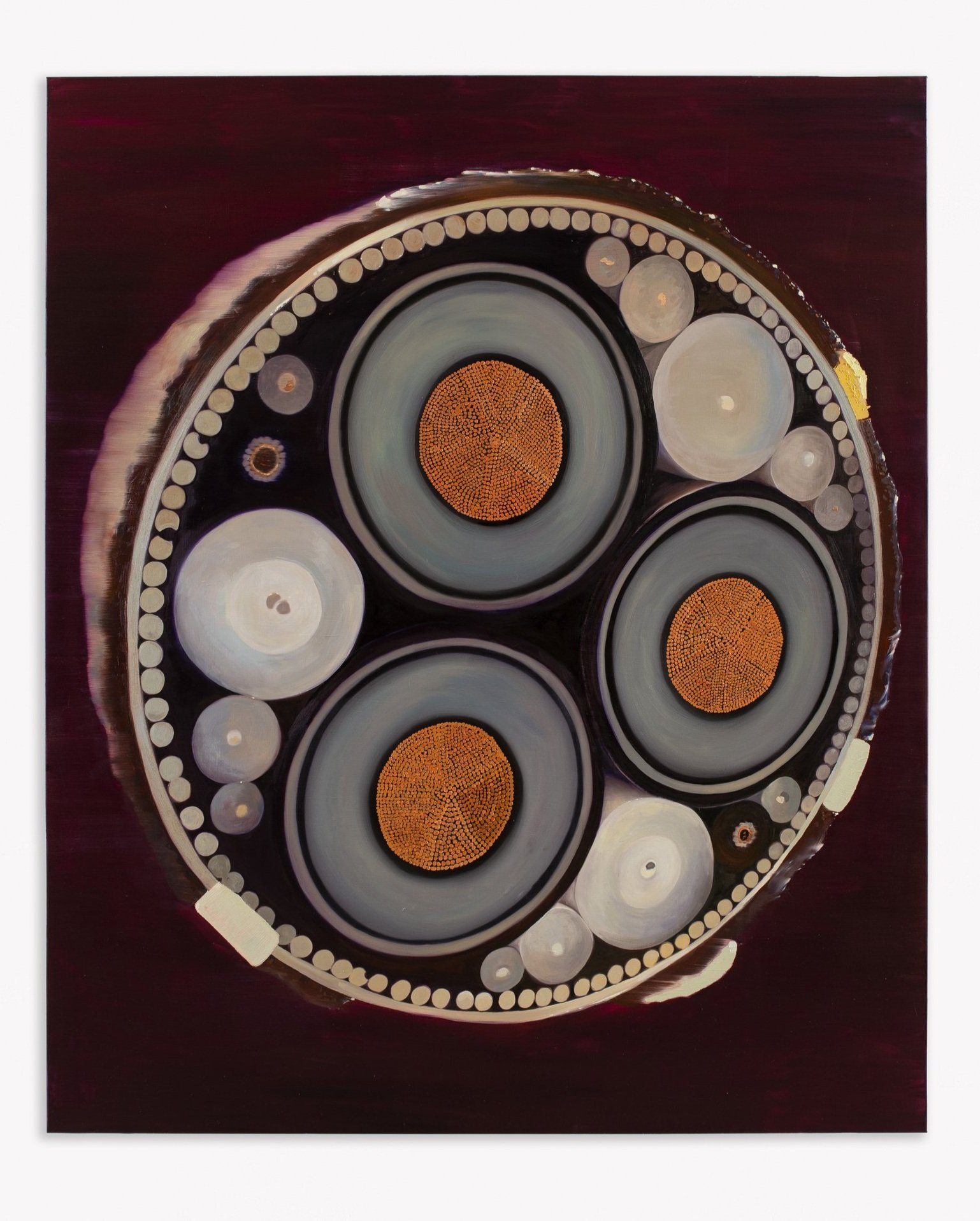
The surface of Twenty Thousand Leagues Under the Seas is built in layers that correspond to the layers of the cable itself. The ground is a field of deep marine blue, almost black at the edges and warming toward teal and midnight green in the center, painted spontaneously as Tan Mu has described her process for the Signal series: an initial layer that establishes the ocean's chromatic depth before any structural element is drawn. Over this ground, she paints the cable cross-sections, circular forms that reveal the concentric layers of a submarine cable: the outer polyethylene sheath, the copper tube, the steel wire armor, the water-blocking tape, the inner layers that protect the hair-thin glass fibers at the core. Each cross-section is rendered with attention to the material specificity of its layer. The copper tube reads as a warm metallic ring against the cooler tones of the polyethylene. The steel wire armor appears as a series of tight, parallel lines that suggest both the strength and the flexibility of the material. The glass fiber at the center, barely visible, is a line of pale light, thinner than a human hair, that carries the entire weight of global communication.
The composition does not show a single cross-section. It shows multiple cross-sections at different scales, as though the painting were a textbook illustration that moves from the macro to the micro, from the cable as it appears on the seafloor to the fiber as it appears under magnification. Some cross-sections are large, occupying significant areas of the canvas, their concentric rings rendered with enough detail to count the individual layers. Others are smaller, embedded in the marine ground like specimens in a field guide, their rings simplified to a few essential bands of color. The variation in scale creates a sense of depth that parallels the depth of the ocean itself. The viewer moves from cross-section to cross-section as a diver moves from depth to depth, descending through layers of the cable's structure toward the luminous core.
At arm's length, the surface reveals the tension between the painting's two modes: the marine ground, which is spontaneous, gestural, and atmospheric, and the cable cross-sections, which are precise, diagrammatic, and structural. The ground is painted wet on wet, with broad strokes that blend and bleed at the edges, producing the kind of chromatic uncertainty that occurs when oil paint is applied before the previous layer has dried. The cross-sections are painted with smaller brushes, their rings defined by careful lines that maintain their concentric geometry even as they sit on the gestural ground beneath them. The contrast between these two modes is the painting's structural argument. The ocean is a field of uncertainty, of shifting color and indeterminate depth. The cable is an object of precision, of defined layers and specified materials. The painting places the precise object inside the uncertain field, and it does not reconcile them. It lets the tension between the two modes stand as the painting's content.
J.M.W. Turner's Snow Storm: Steam-Boat off a Harbour's Mouth (1842) is one of the most contested paintings in the history of British art. The canvas shows a steamboat caught in a vortex of snow, wind, and dark water, its mast visible at the center of a swirling composition that dissolves the horizon line and the distinction between sea and sky into a single field of atmospheric turbulence. Turner claimed to have tied himself to the mast of a steamboat during an actual storm in order to observe the phenomenon firsthand, a claim that critics have debated ever since. Whether or not the anecdote is true, the painting's achievement is to make the viewer feel what it is like to be inside a storm at sea, not observing it from a safe distance but caught in its vortex, unable to distinguish the water from the air, the boat from the wave, the subject from the medium through which it is seen.
The connection between Turner's steamboat and Tan Mu's cable cross-sections is not visual. No one would mistake Twenty Thousand Leagues Under the Seas for a Turner. The connection is structural. Both paintings take as their subject something that lies beneath the surface of the ocean, and both paintings make that invisible subject visible through a compositional strategy that places the viewer inside the medium rather than outside it. Turner's viewer is inside the storm, unable to see the horizon, surrounded by the swirl of snow and water that obscures the boat at the center. Tan Mu's viewer is inside the ocean, surrounded by the chromatic depth of the marine ground, unable to see the shore or the surface, with only the cross-sections of the cable to orient the eye. In both cases, the painting does not provide a stable vantage point from which to observe the subject from a distance. It places the viewer in the medium, surrounded by it, and forces the viewer to find the subject within the field rather than above it or beyond it.
Turner's painting also registers the collision between natural force and technological infrastructure that defines the submarine cable's existence. The steamboat in Snow Storm is a technological object, a product of the same industrial revolution that would lay the first submarine telegraph cables across the English Channel in 1850 and across the Atlantic in 1858. The boat is caught in a natural force that it cannot control, and the painting's composition makes the viewer feel that same helplessness. The cable on the ocean floor is caught in the same kind of natural forces: currents, abrasion, volcanic eruptions, ship anchors, and the slow pressure of the deep ocean itself. When the Tonga cable broke in January 2022, it broke because a volcanic eruption on the seafloor sent a shockwave through the water column that severed the cable's outer layers and destroyed the glass fiber at its core. The cable, for all its engineering precision, is as vulnerable to the ocean's force as Turner's steamboat, and the painting registers this vulnerability by placing the precise, diagrammatic cross-sections inside the gestural, atmospheric ground that represents the medium that can destroy them.
Submarine fiber-optic cables carry approximately 99 percent of intercontinental data traffic. This figure, which has become a standard reference in discussions of global communications, is worth pausing over. Satellites carry less than one percent of international data. The vast majority of everything that crosses an ocean, every email, every financial transaction, every video call, every webpage loaded on a server located on another continent, travels through a glass fiber thinner than a human hair, encased in a series of concentric protective layers, lying on the bottom of the ocean at depths that reach four thousand meters in the Atlantic and six thousand meters in the Pacific. There are approximately 1.4 million kilometers of submarine cable currently in service, laid by specialized cable ships that traverse the world's oceans, and each cable has a design life of twenty five years, after which it must be replaced or abandoned. The total number of active cables is roughly 600, and they converge at a relatively small number of landing points, where they come ashore and connect to terrestrial networks. These landing points are choke points. If a single landing point is damaged, whether by a natural disaster, a construction accident, or a deliberate act, the entire region can lose connectivity.
Tan Mu's painting makes this infrastructure visible by depicting not the cable as it appears on the seafloor, which would be invisible to any viewer, but the cable as it appears in cross-section, which is a technical diagram that reveals the cable's internal structure. The cross-section is a convention of engineering illustration, not of landscape painting, and by placing it on a marine ground, the painting forces a collision between two modes of representation: the diagrammatic and the atmospheric, the structural and the sensory, the engineering drawing and the oil painting. The collision is not a contradiction. It is an argument. The painting argues that the cable, which is invisible in its actual location on the seafloor, can only be made visible through a mode of representation that combines the precision of the diagram with the sensory immersion of the painted ocean. Neither mode alone would be sufficient. A diagram without the ocean ground would be a technical illustration. A painting of the ocean without the cable cross-sections would be a seascape. The combination produces something that neither mode could produce alone: a painting of the cable in its environment, where the environment is represented not as a backdrop but as a medium, a field of chromatic depth that surrounds and threatens the precise structures embedded within it.
The title of the painting invokes Jules Verne's novel Twenty Thousand Leagues Under the Sea (1870), in which Captain Nemo pilots the submarine Nautilus through the world's oceans, discovering underwater landscapes, fighting giant squid, and visiting the ruins of Atlantis. Verne's novel is a fantasy of submarine exploration, written at a time when no human had descended to the depths that Nemo visits in the Nautilus. The novel's power lies in its conviction that the ocean floor is a space of discovery, a realm of hidden wonders that technology can reveal. Tan Mu's painting shares this conviction, but it reverses the relationship between technology and the ocean. In Verne's novel, the Nautilus is the vehicle that carries the explorer through the ocean. In Tan Mu's painting, the cable is the thing being explored, and the ocean is the medium that conceals it. The painting does not imagine descent into the ocean for the purpose of wonder. It reveals what is already there, what has been lying on the seafloor for decades, what carries the data that makes modern life possible, and what most people have never seen and will never see.
Tan Mu's own account of the painting's origin locates it in the Tonga eruption. "My interest in undersea cables emerged while I was working on Eruption in 2022, which documents the volcanic eruption of Hunga Tonga," she has said. "In January of that year, the eruption damaged submarine cables and cut Tonga off from global communication. It was the first time I became fully aware that most of our global connectivity depends not on satellites, but on fragile physical cables laid across the ocean floor." The word "first" carries the weight of a discovery. The eruption did not merely provide a subject for painting. It revealed a fact about the structure of global communication that most people, including the artist herself, had not known. The fact that 99 percent of intercontinental data travels by cable, not by satellite, is not intuitive. The cultural image of global communication is satellite-based: the dish on the roof, the signal bouncing off a satellite in orbit, the phone call that travels through space. The cable is a correction to this image, and the painting is an act of correction. It replaces the image of the satellite with the image of the cable, and it replaces the image of data traveling through the void of space with the image of data traveling through a glass fiber that is thinner than a human hair and lies on the bottom of the ocean, where it is vulnerable to the same forces that have shaped the seafloor for billions of years.
Hiroshi Sugimoto's Seascapes are a series of black and white photographs that he has produced continuously since 1980. Each photograph in the series is taken from a position on a shore, looking out at the ocean, and each is composed with the horizon line precisely at the center of the frame, dividing the composition into two equal halves: sky above, water below. The series includes seascapes from the Caribbean, the Baltic, the Tyrrhenian, the Irish, the Caspian, and the Ligurian, among many others, and every photograph is composed according to the same formula. The horizon is always in the center. The exposure is always long enough to blur the waves into a single, undifferentiated field of gray. The sky is always a slightly different shade of gray than the water, but the difference is always subtle enough that the viewer must look carefully to distinguish them. Sugimoto has said that he began the series with the idea that "every sightline, every horizon, was the same horizon, shared across all times and places," and that the seascape is the oldest thing that human beings have seen, a view that has not changed since before the emergence of the species.
The Seascapes are relevant to Twenty Thousand Leagues Under the Seas because of what they exclude. Sugimoto's photographs show the ocean from the shore, looking outward toward the horizon. They show the surface of the water, the boundary between air and sea, and they reduce that boundary to its most elemental terms: two shades of gray divided by a straight line. What they do not show, and what they cannot show from their vantage point, is what lies beneath the surface. The cable that carries the data that makes the photograph's circulation possible, the data that allows Sugimoto's images to be printed in books, displayed in galleries, and shared across continents, lies on the ocean floor, invisible from the shore. Tan Mu's painting begins where Sugimoto's photographs end. It does not show the ocean from the shore. It shows the ocean from below the surface, where the cable lies, and it replaces the elemental simplicity of the horizon line with the structural complexity of the cable cross-section. Where Sugimoto reduces the ocean to a single binary, sky and water, Tan Mu complicates the ocean by revealing the infrastructure that lies within it, hidden from the shore and from the viewer who stands on it.
The comparison with Sugimoto also clarifies the painting's treatment of color. Sugimoto's Seascapes are black and white. They strip the ocean of its chromatic variety and present it as a tonal field, a study in grays that are almost indistinguishable from one another. Tan Mu's marine ground is the opposite of this reduction. It is a field of deep, saturated color, built from blues, greens, and blacks that shift across the canvas and that produce, at their best passages, the chromatic richness of the deep ocean as it actually appears to a diver descending through the water column: the darkening blue, the gradual disappearance of warm tones, the transition from the sunlit surface to the monochromatic depths. The cross-sections sit on this ground like specimens on a field of color, and the contrast between the warm metallic tones of the copper and steel layers and the cool blues and greens of the marine ground produces a chromatic tension that the painting uses to keep the viewer's eye moving from the diagrammatic to the atmospheric and back again. The cable is not lost in the ocean. It is distinct from it. But it is embedded in it, surrounded by it, and threatened by it, and the painting's color makes this relationship legible at every point.
Saul Appelbaum, writing on the Signal series and the performance Everything on the Line in his essay "Dreaming in Public" (2025), argues that Tan Mu's paintings "transform data cables into gestural constellations that oscillate between calculation and intuition." The formulation captures the doubleness of Twenty Thousand Leagues Under the Seas. The cable cross-sections are calculated. They are drawn from engineering diagrams, from specifications that specify the diameter, material, and thickness of each layer, and they are rendered with a precision that corresponds to the precision of the objects they depict. The marine ground is intuitive. It is painted spontaneously, without reference to a specific location on the seafloor, and it produces its effects through the interaction of color, brushwork, and the residual texture of the linen support. The painting oscillates between these two modes, and Appelbaum's word "oscillate" is precise: the viewer's attention moves back and forth between the cross-sections and the ground, between the diagram and the atmosphere, between calculation and intuition, and the painting's meaning is produced in the space between them, in the tension between the infrastructure that carries the data and the ocean that carries the infrastructure.
Appelbaum extends this argument with the concept of "arbitration," drawn from his architectural thesis. "What matters is not a direct alignment between system and representation," he writes, "but the act of arbitration, the human effort to make sense of a signal as it passes through multiple notations, forms, materials, processes, and consciousnesses." The concept of arbitration is useful for understanding what Twenty Thousand Leagues Under the Seas does. The painting does not represent the cable directly. No painting could. The cable is invisible, inaccessible, and unknown to most of the people who depend on it. The painting arbitrates between the cable's engineering reality, which is documented in specifications and diagrams that few people will ever see, and the cable's cultural significance, which is the significance of the infrastructure that makes global communication possible and that is invisible precisely because it works. The painting takes the engineering diagram and places it on a painted ocean, and the act of placing one on the other, of embedding the precise within the atmospheric, of combining the diagrammatic and the sensory, is an act of arbitration that produces a new object: not a diagram and not a seascape, but a painting of a cable in its environment, a representation of something that has never been seen by human eyes but that carries almost everything that human beings say to each other across the distance of oceans.
Tan Mu's maternal great-grandfather was a maritime trader during the Republican era who navigated international waters between China and Korea, carrying goods across the Yellow Sea on routes that are now traced by submarine cables. His ventures were disrupted by the Second World War, and he joined the overseas Chinese community in Korea before returning to China in later years. This transnational history is not incidental to Twenty Thousand Leagues Under the Seas. The painting depicts the infrastructure that has replaced the maritime trade routes that the great-grandfather once sailed. Where his ships carried goods across the water, the cables carry data. Where his voyages depended on wind and weather and the skill of the crew, the cables depend on the engineering of their protective layers and the stability of the seafloor. Where his trade connected two nations through the physical movement of material objects, the cables connect the entire world through the electrical movement of information. The painting does not illustrate this genealogy. It does not show a ship or a trade route. But the painting's insistence on making the cable visible, on revealing the hidden structure that connects continents, carries the weight of a family history in which connection across the sea has been a fact of life for generations, first through the movement of ships and now through the movement of light.
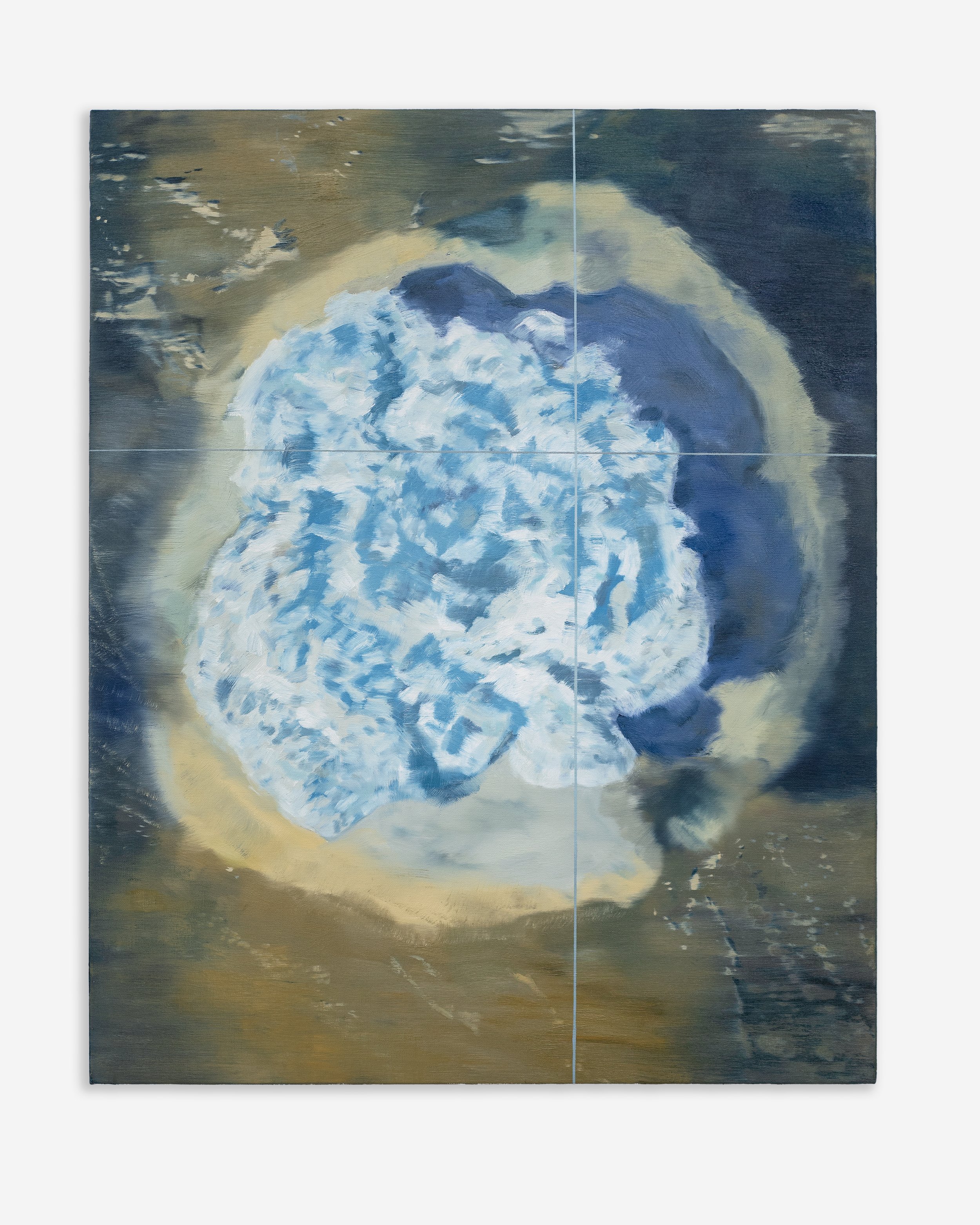
The connection to Eruption (2022) is not a footnote. Eruption is the painting that began the investigation. When the Hunga Tonga volcano erupted in January 2022 and severed the Tonga cable, Tan Mu painted the satellite image of the eruption on the same day, overlaying it with two crossing lines that evoke machine targeting. The painting records the moment of disconnection, the instant when a natural force revealed the fragility of the infrastructure that most people assumed was permanent and redundant. Twenty Thousand Leagues Under the Seas is the painting that follows. Where Eruption shows the moment of failure, the instant when the cable breaks and a nation goes dark, Twenty Thousand Leagues shows the cable itself, in its structural integrity, before or after the rupture, embedded in the ocean that can destroy it. The two paintings are complementary. Eruption is the event. Twenty Thousand Leagues is the system. One shows the moment when the invisible becomes visible through failure. The other shows the invisible as it is in its ordinary state, functioning, carrying data, lying on the seafloor, unknown to the people whose lives depend on it. Together, they make a complete argument: the infrastructure that sustains global communication is physical, it is fragile, and it is invisible until it breaks.
The painting's scale, 182 by 152 centimeters, is significant. It is larger than most of the earlier works in the Signal series, which tend toward the 76 by 76 centimeter format, and the increase in scale gives the cross-sections more room to breathe within the marine ground. At this size, the viewer can stand close enough to see the individual layers of the cable's construction, the copper ring, the steel armor, the polyethylene sheath, and then step back far enough to see the cross-sections as a field of circular forms floating in the deep blue, like organisms in a petri dish or planets in a star chart. The oscillation between close reading and distant viewing, between the engineering diagram and the atmospheric field, is the oscillation that the painting demands, and the scale makes it possible. At a smaller size, the cross-sections would be cramped, and the marine ground would not have enough space to establish its chromatic depth. At a larger size, the cross-sections would become monumental, and the painting would lose the intimacy that makes it feel like a field guide rather than a mural. The current scale is the scale of a painting that wants to be read closely and then stepped back from, the way a diver descends to examine a cable and then rises to see the ocean around it.
Tan Mu has described the cable as an "externalized nervous system," a metaphor that extends the painting's argument beyond the technical and into the biological. The metaphor is precise in its structural logic. The cable's glass fiber core carries data the way a nerve fiber carries electrical impulses. The concentric layers that protect the fiber, the copper tube, the steel armor, the polyethylene sheath, correspond to the myelin sheath, the connective tissue, and the epineurium that protect a peripheral nerve. The cable lies on the seafloor the way a nerve lies in the body, embedded in the tissue that surrounds it, vulnerable to the forces that act on it, and essential to the functioning of the system it serves. The painting makes this metaphor legible by rendering the cable's cross-section with the same attention to concentric layering that an anatomical illustration would give to a nerve, and by placing it on a ground that reads as the tissue, the medium, the environment in which the nerve is embedded. The ocean is the body. The cable is the nerve. The data is the impulse. The painting is the illustration that makes the metaphor visible, and it does so without labeling any of these correspondences, without stating the metaphor explicitly, without doing anything other than painting the cable and the ocean with the precision and the atmosphere that each requires.
The cable that severed in the Tonga eruption was repaired on February 22, 2022, after five weeks of darkness. The repair ship pulled the broken ends of the cable from the seafloor, spliced them together, and laid the repaired section back on the ocean floor, where it resumed carrying data as though the interruption had never happened. The invisibility of the cable, the invisibility of the repair, the invisibility of the entire infrastructure that makes global communication possible, is the condition that Twenty Thousand Leagues Under the Seas exists to correct. The painting does not make the cable visible by showing it as it actually appears, because it does not appear. It makes the cable visible by representing it through the conventions of the engineering diagram and the atmospheric oil painting, and by combining these conventions in a single composition that holds the precision and the immersion, the calculated and the intuitive, the structural and the sensory, in the same frame. The cable is there, on the canvas, in a way that it is never there on the seafloor, where it lies in darkness at a depth that no diver can reach, carrying data that no eye can see, connecting continents that most of its users will never visit. The painting makes visible what the ocean conceals, and what the ocean conceals is the thread on which the modern world hangs.