The Grid That Harvests the Sun: Tan Mu's Solar Farm and the Landscape That Learned to Produce
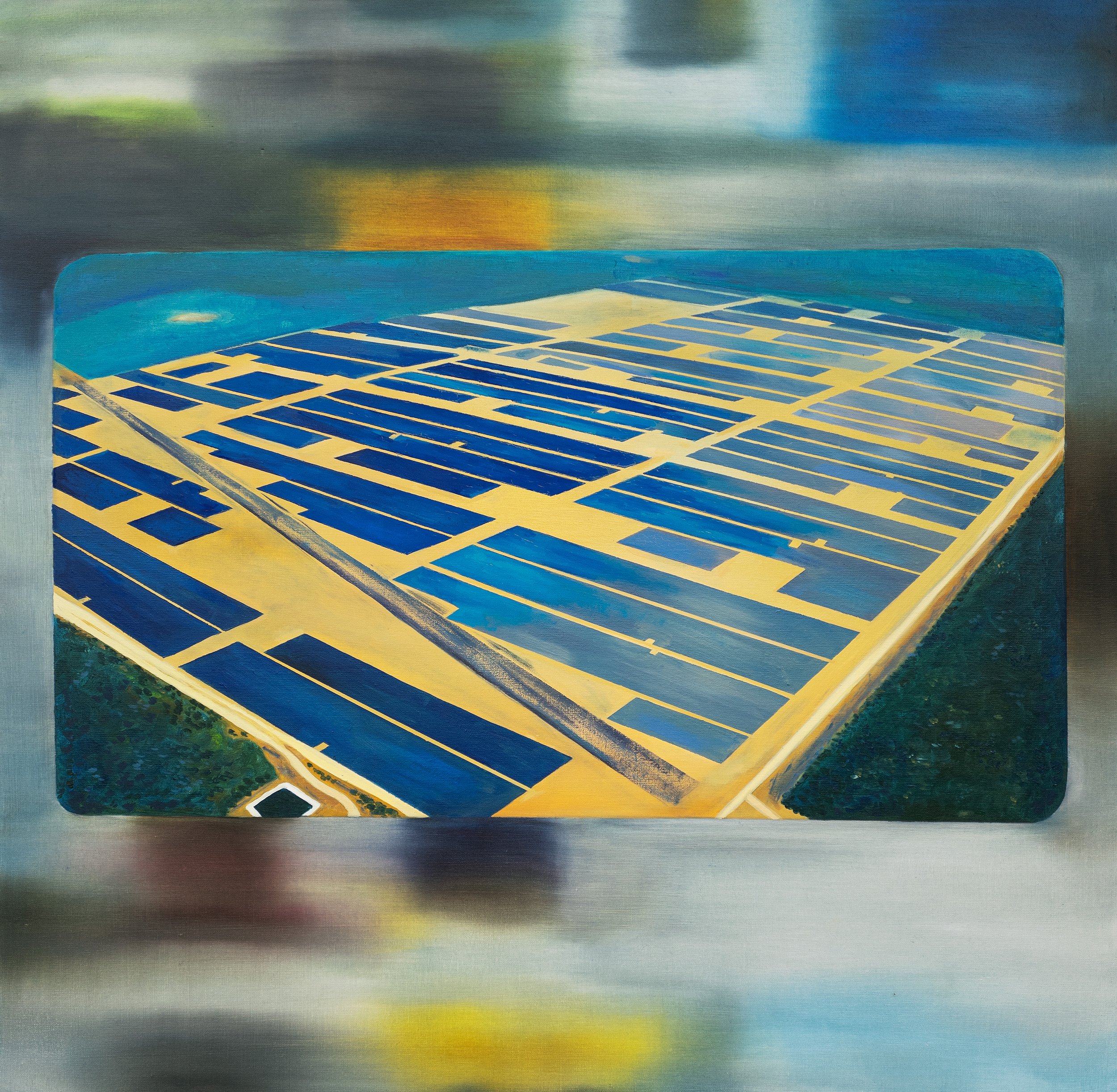
At arm's length, the surface of Solar Farm (2022) resolves into a field of geometric cells, each one a rectangle of deep blue, indigo, or slate, separated by thin lines of darker pigment that read as the gaps between photovoltaic panels. The cells are uniform in size but not in color. Some catch light at an angle that turns them nearly black. Others reflect a cooler, grayer blue, the color of a sky seen through glass. A few, positioned near the center of the composition, glow with a pale, almost phosphorescent lilac that suggests the moment when a panel's surface catches the sun at just the right incidence and transforms from an absorptive surface into a briefly reflective one. Up close, the paint in these reflective cells is thinner, almost translucent, allowing the linen weave to show through, while the darker cells are built up in layers that obscure the weave entirely. This difference in paint application is not arbitrary. The panels that reflect the most light are the ones where the least paint has been applied, as though the painting were simulating the physics of its subject: the thin passages are where the light gets through, and the thick passages are where it does not.
The painting is oil on linen, 76 by 76 centimeters, a square format that mirrors the geometric regularity of its subject. The square canvas is a compositional decision that makes the solar panel array feel self contained, a closed system of rows and columns that fills the frame edge to edge. There is no sky above the panels, no horizon line, no landscape context. The array is the landscape. The ground beneath the panels, visible only in the narrow gaps between rows, is rendered in the muted greens and ochres of Florida pastureland, but these passages are thin, secondary, almost subservient to the dominant blue grid. The composition makes a claim about its subject: that the solar farm is not a structure placed on a landscape but a landscape in its own right, a new kind of terrain that replaces the agricultural field with an energy harvesting surface.
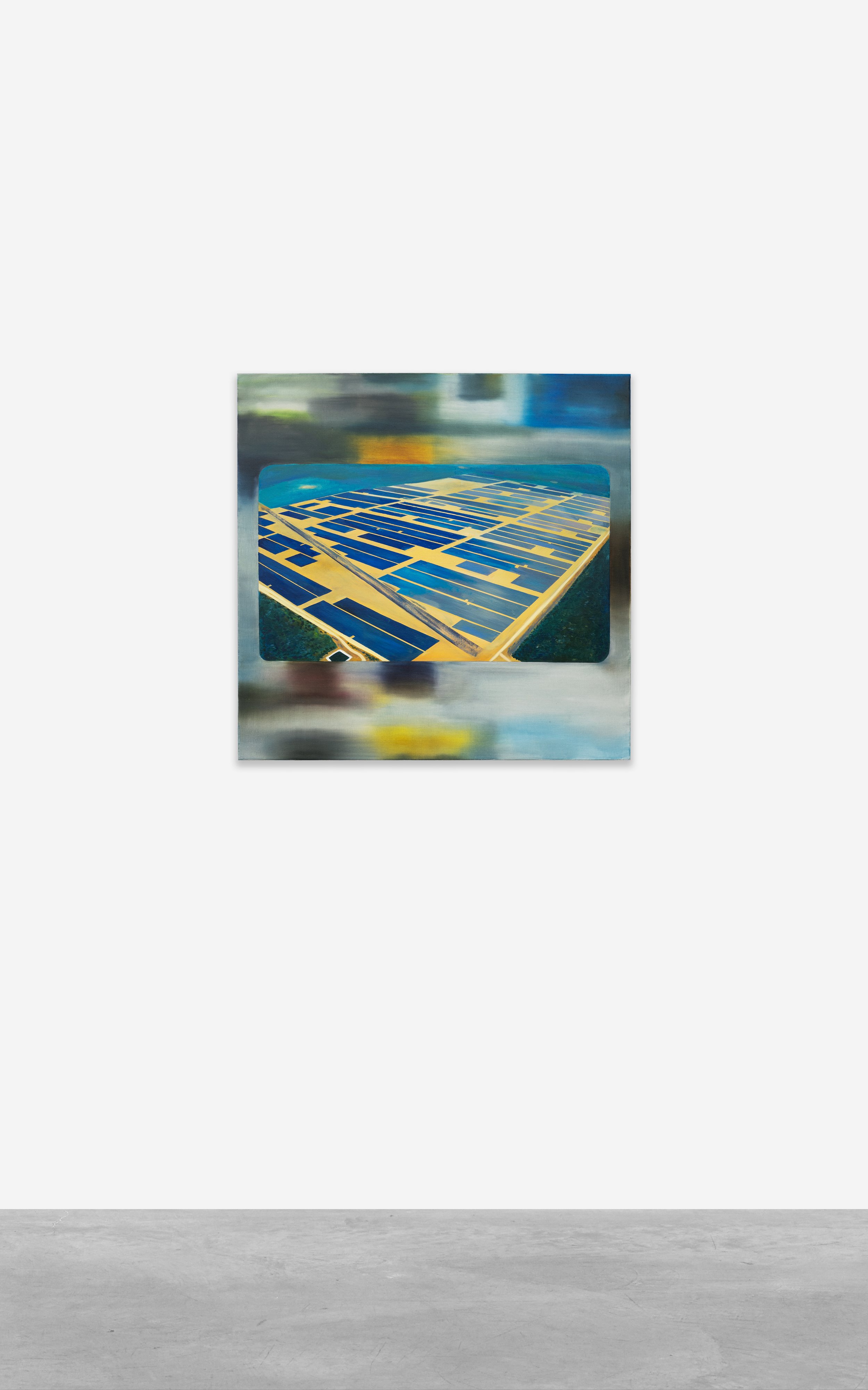
The edges of the composition are where the painting reveals its second register. Along the left side and the bottom edge, the geometric precision of the panel array dissolves into a blurred, indistinct field of color, as though the image were being smudged by a thumb dragged across a phone screen. This is not a random compositional flourish. Tan Mu has described the source image for the panels as having been captured with a phone camera, while the surrounding environment is rendered in a more abstract and blurred manner. The contrast is deliberate. The solar panels are depicted with the sharp focus and exact geometry of a photograph taken on a phone and immediately viewed on its screen. The landscape around them is depicted with the soft focus and indeterminate color of peripheral vision, of the world seen but not photographed, of the background apps and camera roll images that fill the edges of a phone gallery. The painting constructs a visual hierarchy that mirrors the hierarchy of attention that a phone screen imposes: the thing you are looking at is sharp and present, and everything around it is soft, indistinct, and available to be scrolled past.
The physical surface of the painting reinforces this hierarchy. The panels are painted with a precision that gives each cell a defined edge and a specific tonal value. The blurred passages at the margins are painted wet on wet, the colors bleeding into one another without hard boundaries, producing the kind of chromatic uncertainty that occurs when paint is applied before the previous layer has dried. The two techniques, precise and blurred, correspond to two modes of seeing: the focused attention of the screen and the peripheral awareness of the world beyond the screen. The painting holds both modes in the same frame, and it does so without blending them. The transition from sharp to soft is abrupt, not gradual, as it would be on a phone screen where the edge of a cropped image meets the interface of the gallery app. The painting does not ask the viewer to reconcile the two modes. It asks the viewer to register the gap between them, the gap between the thing that was photographed and the things that were not, the gap between the image that was saved and the image that was discarded, the gap between the attention that the phone directs and the attention that the viewer decides to give.
In 1877, Claude Monet exhibited seven paintings of the Gare Saint-Lazare at the Third Impressionist Exhibition in Paris. The series depicted the interior of the railway station, its iron and glass roof, the locomotives parked beneath it, and the steam that rose from their engines and filled the vaulted space with a shifting, luminous haze. The paintings were criticized by some for their apparent lack of finish, their loose handling of paint, and their emphasis on atmospheric effect over topographical detail. What the critics did not always register was that Monet had chosen to depict a building that was itself a recent addition to the Parisian landscape, a structure of industrial iron and glass that had no precedent in the tradition of landscape painting. The Gare Saint-Lazare was not a natural subject. It was a technological subject, a building whose function was to accommodate machines that burned coal and moved at speeds that no human body could sustain unaided. Monet's decision to paint it was a decision to treat industrial infrastructure as a landscape, to apply the techniques that had been developed for rivers and meadows to a train station, and to discover that the steam, the iron, and the glass produced effects of light that were as complex and as beautiful as any natural phenomenon.
Tan Mu has cited Monet's railway paintings directly, noting that scholars now study them to understand environmental conditions and technological shifts of the nineteenth century. The citation is precise and it is structural. Monet painted the train station as a landscape because it was the landscape of his time. The steam, the iron framework, the play of light through glass, were not secondary to the experience of modernity. They were the experience of modernity, and Monet's achievement was to treat them with the same pictorial intelligence that a generation earlier had been reserved for the Fontainebleau forest. Tan Mu's Solar Farm makes the same move for a different infrastructure. The solar panel array is not placed on the landscape. It is the landscape, the way the railway station was the landscape in 1877, the way the factory was the landscape in 1930. To paint it is to acknowledge that the terrain on which contemporary life unfolds is not always made of soil and grass. Sometimes it is made of silicon, glass, and aluminum, and the light that falls on it is not reflected or absorbed but converted into electrical current.
The structural parallel between Monet's Gare Saint-Lazare and Tan Mu's Solar Farm extends beyond subject matter. Both paintings depict enclosed or semi-enclosed spaces where light enters through a transparent or semi-transparent medium, glass in Monet's case, the photovoltaic surface in Tan Mu's, and both paintings treat that medium as the primary vehicle for visual effect. In Monet's station, the steam softens the iron structure and transforms the glass roof into a luminous ceiling. In Tan Mu's solar farm, the photovoltaic surface transforms sunlight into color, each panel registering a different angle of incidence as a different shade of blue, indigo, or lilac. The painting does not show the electricity that the panels produce. It shows the light that falls on them, and it treats the transformation of that light into current as a process that is invisible in the painting, just as the transformation of coal into motion was invisible in Monet's station. What both paintings make visible is the interface between the natural phenomenon and the technological system that harvests it. In Monet, the interface is the steam, the visible trace of the combustion that powers the train. In Tan Mu, the interface is the reflected color on the panel surface, the visible trace of the photon that is being absorbed and converted. Both paintings show the moment before conversion, the moment when the energy is still visible as light before it disappears into the system that will put it to use.
Solar panels convert sunlight into direct current electricity through the photovoltaic effect, a process that was first observed by the French physicist Edmond Becquerel in 1839 and developed into practical devices at Bell Laboratories in 1954. The physics is deceptively simple: when photons strike a semiconductor material, typically crystalline silicon, they dislodge electrons, which flow through an external circuit as direct current. A single photovoltaic cell produces a small voltage, typically around half a volt, but when cells are connected in series to form a module, and modules are connected in arrays, the cumulative output becomes substantial. A utility scale solar farm, the kind that Tan Mu depicts, can generate hundreds of megawatts, enough to power tens of thousands of homes, and it does so without combustion, without moving parts, and without the emissions that accompany fossil fuel generation.
The simplicity of the physics belies the complexity of the infrastructure. A solar farm is not a field of panels lying on the ground. It is an engineered system that includes mounting structures, tracking mechanisms that tilt the panels to follow the sun, inverters that convert direct current to alternating current, transformers that step up the voltage for transmission, and substations that connect the array to the electrical grid. The panels themselves are manufactured in factories that consume energy, use hazardous chemicals in the etching and doping processes, and produce silicon wafers that are sliced from ingots grown in furnaces operating at over 1,400 degrees Celsius. The aluminum frames, the glass covers, the encapsulant materials, the copper wiring, and the steel mounting structures all carry embodied energy and environmental costs. The solar farm, as Tan Mu depicts it, appears as a clean geometric surface that harvests sunlight, but beneath that surface lies an industrial supply chain that spans continents, from the silicon mines of China to the glass factories of Malaysia to the aluminum smelters of Russia and the copper refineries of Chile. The painting does not conceal this complexity. It makes it visible through its absence. The panels fill the frame so completely that the infrastructure that supports them, the inverters, the transformers, the transmission lines, is invisible, and the viewer is left to infer its existence from the regularity of the array, which could not maintain itself without it.
Tan Mu's own account of the painting's origin locates it in the Florida landscape. "Living in Florida, where sunlight is abundant, I frequently encounter large scale solar farms," she has said. "Whether driving on highways or flying near airports, I often see vast fields of panels stretching across the landscape. What fascinates me visually is how sunlight refracts across their surfaces, producing subtle shifts in color and reflection that change throughout the day." The observation is specific to a place and a habit of seeing. Florida is one of the sunniest states in the United States, and its flat topography and abundant open land have made it a center for utility scale solar development. The solar farms that Tan Mu encountered on highways and near airports are not abstract infrastructural concepts. They are physical presences in the landscape, visible from the road, from the air, and from the vantage point of a phone camera held at a slightly elevated angle, the angle that the painting adopts.
This vantage point is what Tan Mu has described as "a slightly elevated viewpoint, similar to what one might see from an airplane window or within a video game interface." The comparison to a video game is not incidental. Video games construct landscapes from geometric primitives, flat shaded polygons that tile the terrain in regular patterns. The solar panel array, with its grid of rectangular cells, each one a flat polygon reflecting light at a specific angle, looks like a video game landscape rendered in the medium of photovoltaic technology. The painting registers this resemblance by treating the panels as a pixel grid, a field of discrete, colored rectangles that fill the visual field the way pixels fill a screen. The blurred passages at the margins function like the fog of war in a strategy game, the area beyond the player's current view, rendered in soft focus to suggest that it exists but is not currently being rendered at full resolution. The painting does not merely depict a solar farm. It depicts a solar farm as it appears through the specific lens of a phone camera and a screen interface, and it embeds that lens in the composition itself, so that the viewer sees the landscape as it is seen through the mediating technology, not as it would appear to an unaided eye standing in the field.
Bernhard and Hilla Becher spent nearly five decades photographing industrial structures: water towers, blast furnaces, cooling towers, grain elevators, coal bunkers, and gas tanks, across Germany, Britain, France, Belgium, and the United States. Their method was consistent and strict: each structure was photographed from the same angle, in the same light, against a flat gray sky, with no people, no context, and no atmosphere. The resulting images were arranged in grids of nine, twelve, or fifteen, organized by type, so that the viewer could compare the formal variations within a single functional category: what a water tower looks like when it is made of steel versus concrete versus brick, what a blast furnace looks like when it is tall versus wide versus round. The Bechers called their subjects "typologies," and their project, which began in 1959 and continued until Bernhard's death in 2007, produced one of the most systematic bodies of photographic work in the history of the medium.
The Bechers' typologies share with Solar Farm a commitment to depicting technological infrastructure as a visual subject in its own right, worthy of the same sustained attention that landscape photographers have traditionally given to mountains, forests, and coastlines. The Bechers did not aestheticize their subjects. They did not photograph water towers at sunset or blast furnaces in the fog. They photographed them in flat, even light that eliminated shadow and atmosphere, reducing each structure to its formal essence: the cylinder, the cone, the sphere, the rectangle. The reduction was not a denial of the structures' function. It was an assertion that their form was inseparable from their function, that the shape of a cooling tower was determined by the physics of heat dissipation, and that this determination produced a visual elegance that had nothing to do with the photographer's intervention and everything to do with the engineer's calculation.
Tan Mu's Solar Farm extends this logic into painting. The solar panel array is, by its nature, a typological subject. Each panel is identical to every other panel in the array, and the array's visual character derives from the repetition of this identical unit across a surface. The painting does not individualize the panels. It treats them as a field of repeating cells, each one a variation in color determined by the angle of incidence, not by any intrinsic difference in the panels themselves. This is the same kind of variation that the Bechers found when they arranged their typological grids: the structures within a single category vary in their proportions, their materials, and their surface qualities, but the function that determines their form remains constant. In Solar Farm, the function that determines the form is the photovoltaic conversion of sunlight into electricity, and the form that this function produces is the rectangular grid, the most efficient arrangement for covering a flat surface with light absorbing cells. The painting does not need to explain the physics. It needs only to show the form that the physics produces, and the form is a grid, and the grid, when it is painted with the attention that Tan Mu gives it, becomes a landscape.
The Becher comparison also clarifies what Solar Farm is not doing. The Bechers eliminated context. Their photographs show the structure and nothing but the structure, against a sky that functions as a neutral backdrop. Tan Mu does the opposite. The solar panels in Solar Farm are embedded in their context. The ground beneath them, the light that falls on them, the blurred photographs at the margins that suggest the phone camera and the gallery app, all of these contextual elements are present in the composition. The painting does not extract the panels from their environment. It shows them within it, and it shows the specific way that the environment is mediated by the screen through which the image was captured. This is a crucial difference. The Bechers photographed structures that were already obsolete or on their way to obsolescence. Their water towers and blast furnaces were being decommissioned across Europe as they photographed them, and the project acquired the character of a memorial, a systematic record of industrial forms that were disappearing from the landscape. Tan Mu's solar panels are not obsolete. They are being installed at an accelerating pace across the world, and the painting acquires the character not of a memorial but of a document, a record of a form that is proliferating, not vanishing, a form that is in the process of transforming the landscape rather than disappearing from it.
Danni Shen, writing on Tan Mu's practice in Emergent Magazine, has observed that the paintings "serve as a kind of witness to human socio-technological histories" and that they reflect "the trajectory and continuum of bodily and mediated presence through human technical developments." The formulation captures the double register of Solar Farm. The painting witnesses the solar farm as a socio-technological fact, an infrastructure that exists in the world, that occupies land, that converts sunlight into electricity, and that is transforming the physical appearance of the places where it is installed. It also witnesses the solar farm as a mediated presence, an image that exists on a phone screen, that was captured with a swipe, and that circulates in a digital landscape where information about politics, environmental issues, and technological progress is consumed in the same gesture. The painting holds both registers in the same composition: the panels are painted with the sharp focus of the camera, and the margins are painted with the blur of the scroll. The sharp and the blurred coexist, and the painting's argument about how technology mediates perception is embedded in the formal contrast between them.
Tan Mu has described solar panels as "symbols of capital, infrastructure, and humanity's intervention in nature" and has noted that "their presence marks a significant transition in how land is used." The language of transition is important. A solar farm is not a permanent feature of the landscape. It has a lifespan of twenty five to thirty years, after which the panels must be decommissioned and replaced. The land beneath them, compacted by the mounting structures and shaded from sunlight for decades, does not simply revert to its previous state. The transition from agriculture to energy production is a transition, not a destination, and the painting's composition, which shows the panels filling the frame with no horizon and no sky, registers this transition as a moment in an ongoing process, not as a final condition. The edges of the painting, where the blurred passages suggest a world beyond the grid, are where the next transition will occur, when the panels are removed and the land is repurposed again, or when a different energy technology replaces photovoltaics entirely. The painting does not predict this future. It records the present, and in doing so, it creates a document that, as Tan Mu has suggested, "may one day function as an archaeological record of our current energy infrastructure," just as Monet's railway paintings have become archaeological records of the industrial transformation of nineteenth century Paris.
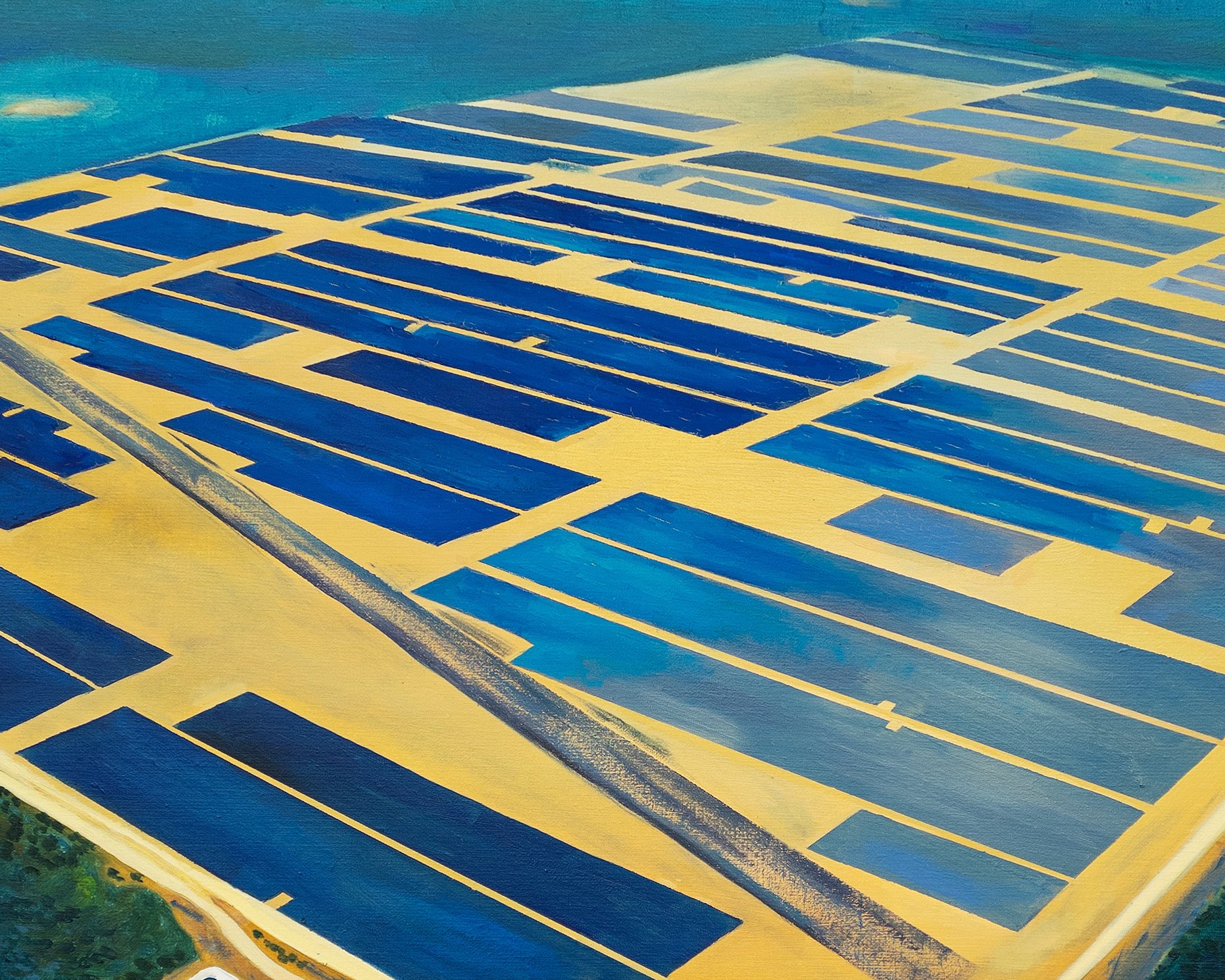
The painting's square format is not incidental. A rectangle implies a horizon. A landscape painting in a horizontal format invites the eye to travel from left to right along the horizon line, following the logic of the vista. A portrait format in a vertical rectangle invites the eye to travel from foreground to background, following the logic of depth. A square format eliminates both of these directional cues. The eye enters the composition from wherever it lands, because there is no preferred axis. The solar panels fill the square as a grid fills a plane, with no emphasis on any particular row or column, no focal point that is more important than any other. The format enforces the same egalitarian distribution of attention that the grid itself enforces. Every cell is equivalent. Every panel is the same. The slight variations in color that distinguish one panel from its neighbor are the result of angle and light, not of any intrinsic hierarchy. The square format makes the painting a field, not a vista, and the field is the format that the subject demands.
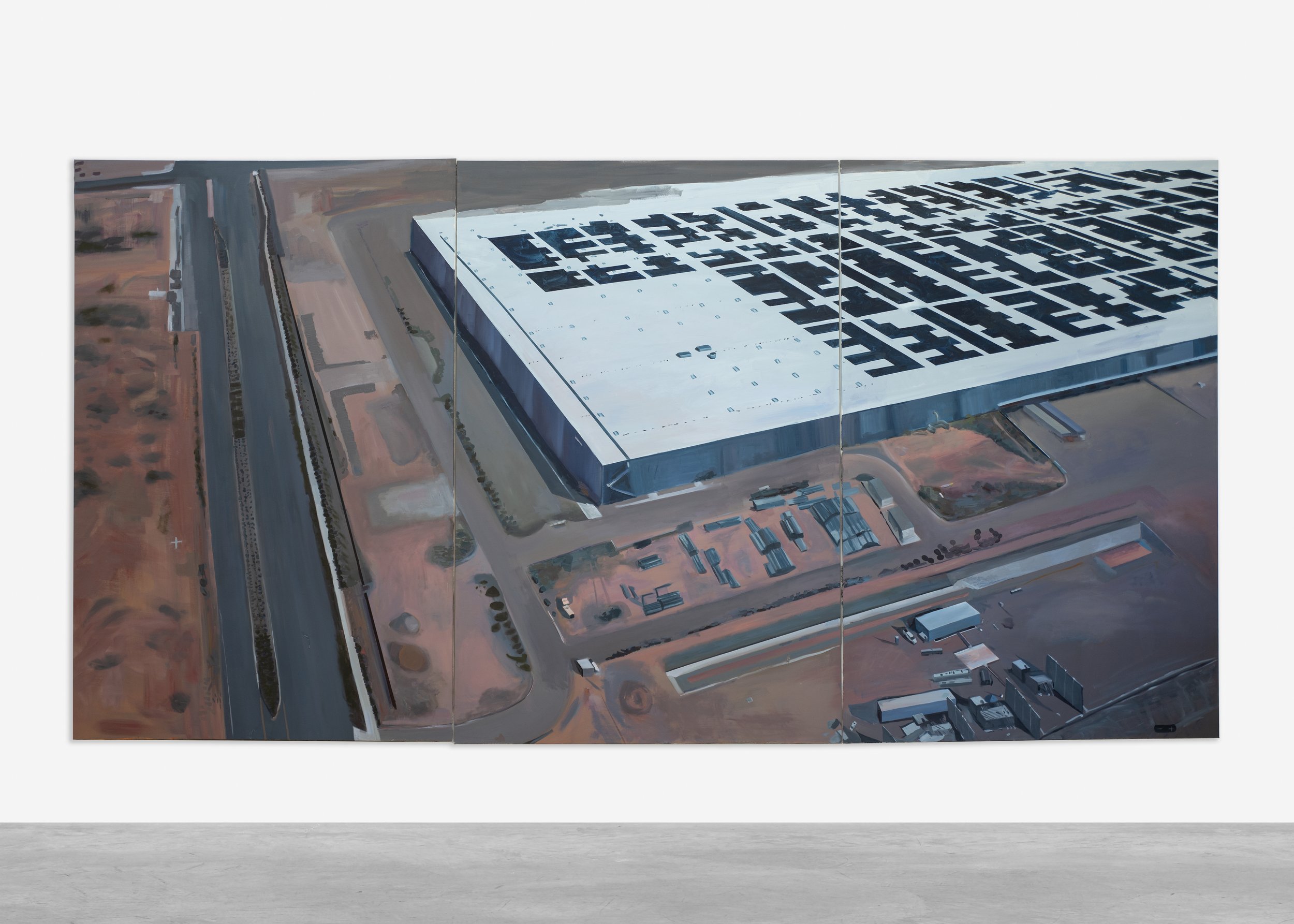
The connection to Memory (2019), the earlier painting in which Tan Mu first depicted solar panels on the rooftop of a data center, is not a footnote but a structural link. In Memory, the panels are secondary to the building they cover. They function as a surface, a skin, a way of making the flat roof of a data center visually legible as a technological object. In Solar Farm, the panels have become the primary subject. The data center has disappeared. The building has been replaced by the field. The transition from the earlier painting to the later one mirrors the transition that the painting itself depicts: from a world where solar panels are an accessory to a building, a supplementary technology that sits on top of an existing structure, to a world where the panels are the structure, where the energy harvesting surface has become the landscape itself. The painting records this transition at the moment of its occurrence, when the panels have moved from the rooftop to the field, from the role of supplement to the role of subject, and the landscape that was once defined by what grew from the soil is now defined by what falls from the sky.
The landscape that has learned to produce is not the landscape that yields crops. It is the landscape that yields current. The field that once grew soybeans now grows photons, or rather, it catches photons and converts them into electrons that flow through copper wires into transformers and substations and transmission lines and emerge at the other end as the electricity that powers the phone on which the image of the solar farm was first seen. The painting knows this. The blurred margins are the phone's gallery, the scroll of images that surrounds the focused center, and the focused center is the solar farm itself, the infrastructure that makes the phone, the gallery, and the scroll possible. The painting holds the infrastructure and its mediation in the same frame, and the frame is square, and the square is filled with panels, and the panels are the field, and the field is producing, and what it produces is the current that powers the screen on which the image of the field is displayed, and the loop closes, not with a statement but with a surface that reflects the light that falls on it and converts it into something else, something that cannot be seen in the painting but that the painting, by its existence, proves is there.