The Stone That Fell Through Time: Tan Mu's Moldavite and the Object That Remembers the Stars
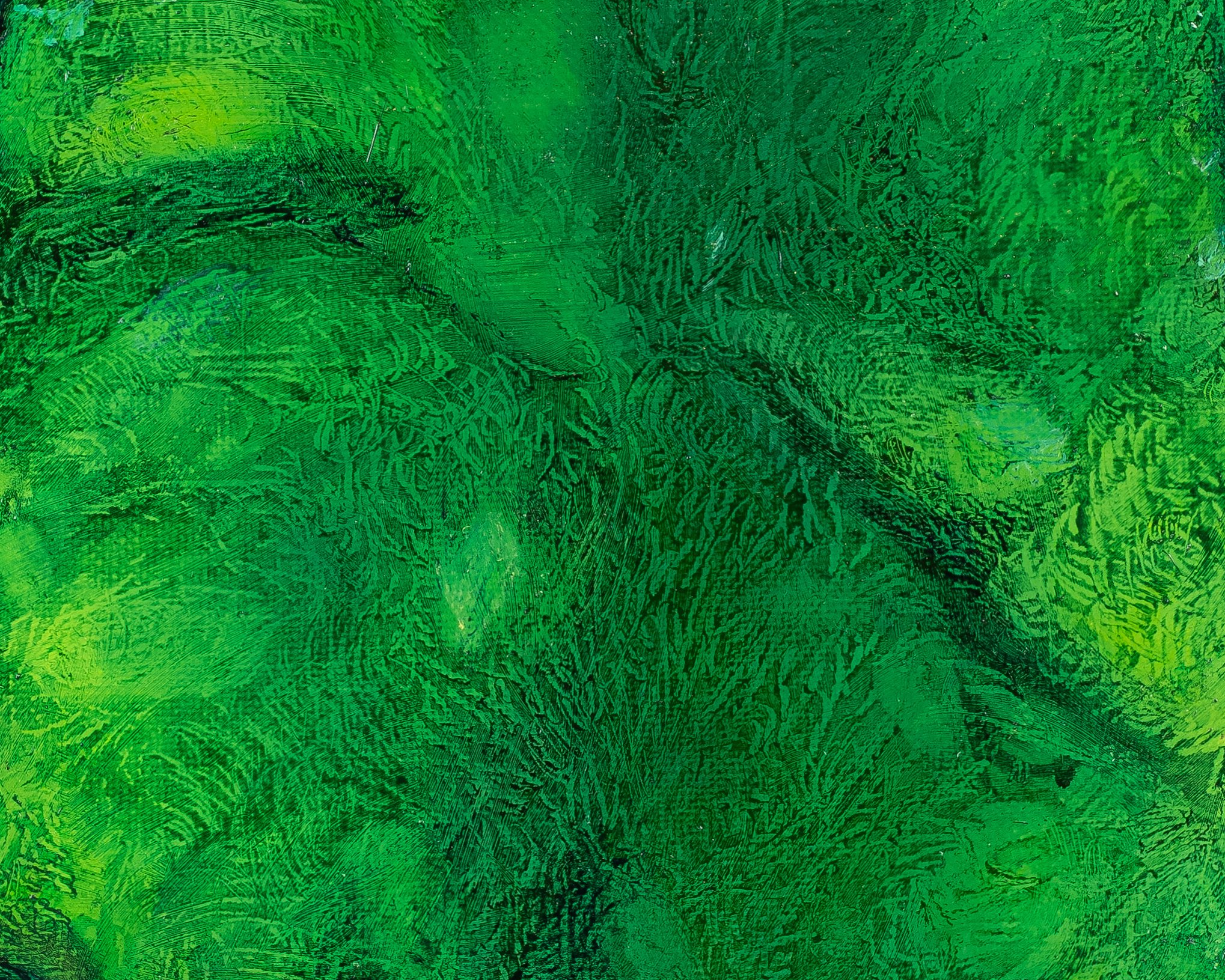
At six inches from the surface, the green is not one green. It is a stratigraphy of greens: a pale, almost chartreuse underpainting visible where the upper layers thin, then a richer, more viscous sap green laid in ridges that follow the stone's contours, then a final glaze of translucent emerald that pools in the crevices of the tektite's fingerprint-like ridges and catches the light at the painting's center. The dark ground beneath all of this is not black but a deep umber, warm, almost reddish in raking light, and it serves a double function: it absorbs the green's intensity and pushes it forward, and it stands in for the cosmic void that produced the stone in the first place. Oil on linen, 36 x 28 cm (14 x 11 in). The dimensions are intimate. The painting fits inside the span of two open hands, which is roughly the size of the moldavite itself. This is not a coincidence. The scale of the painting registers the scale of the object, and the scale of the object registers the scale of what made it: an impact that flattened forests across southern Germany and launched molten silica into the upper atmosphere, where it cooled, solidified, and fell back to earth as a green glass that would wait fifteen million years to be picked up, held, and painted.
The tektite in the painting comes from Tan Mu's personal collection. "I have always been interested in collecting stones," she has said, "and Moldavite in particular deeply fascinated me. It was the first Czech meteorite I acquired, which gives it personal significance." The statement is more revealing than it first appears. The word "first" carries weight. A first acquisition establishes a direction. Before the moldavite, stones were stones. After it, they became something else: objects that carry time, objects that connect the hand that holds them to events that predate the species holding them. The personal collection, in Tan Mu's practice, is not a hobby. It is a research method. Each stone is a specimen, a data point in a cosmology of materials. The moldavite was the point where the collection became a conviction: that small objects can hold timescales that dwarf the human, and that painting can make those timescales tangible.
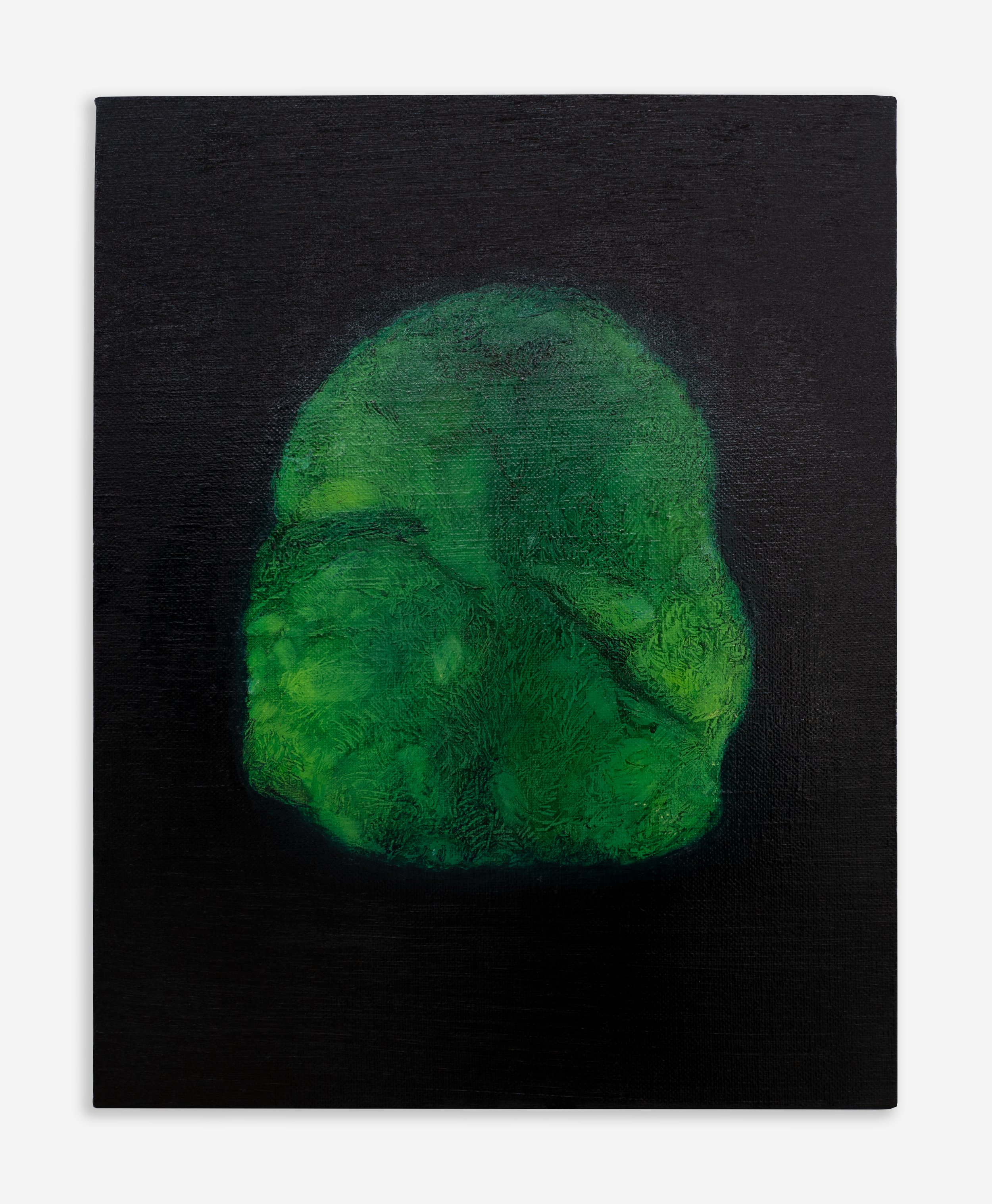
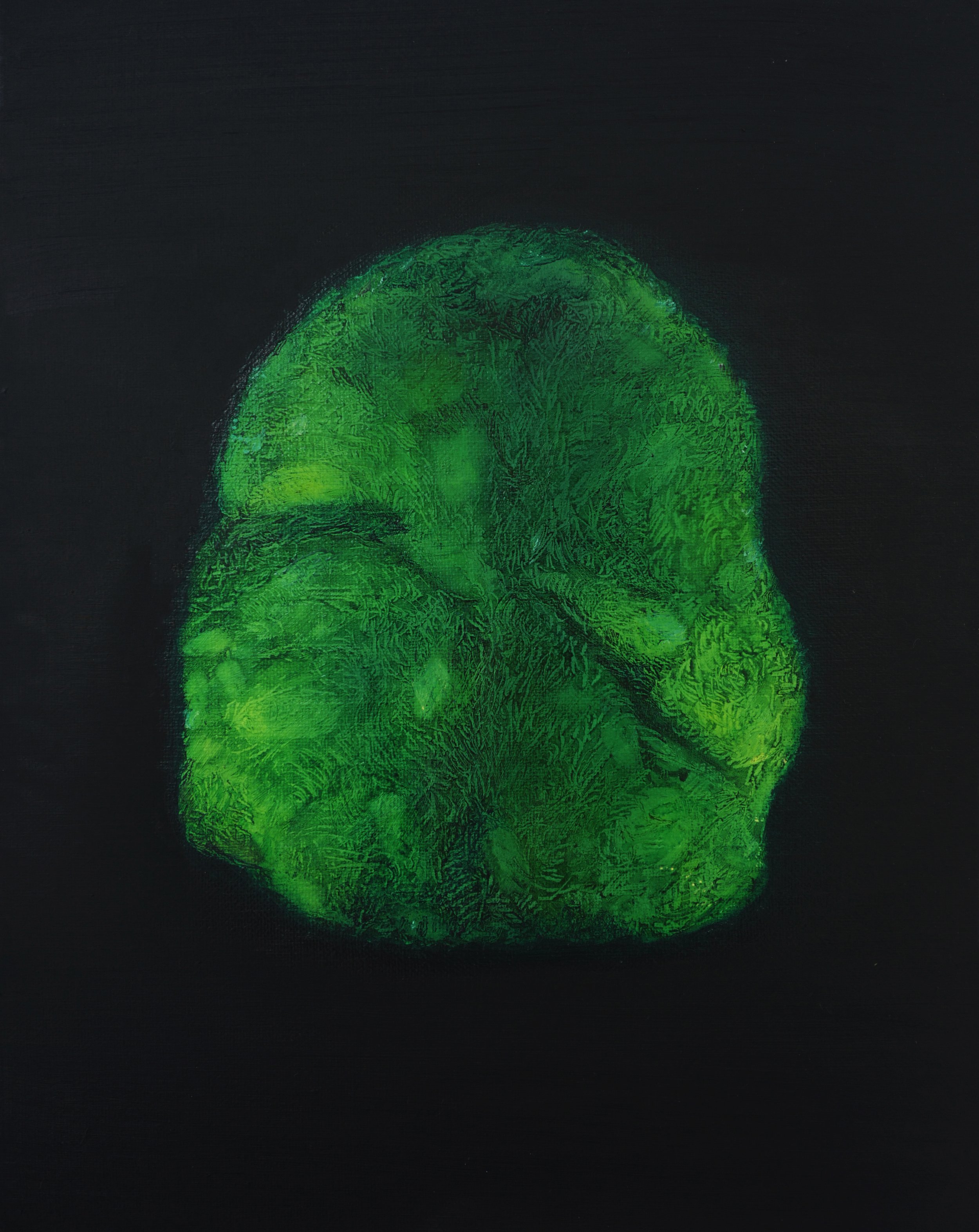
The close-up composition is one of the painting's most deliberate choices. The moldavite fills the canvas. There is no horizon, no landscape, no hand holding the stone for scale. The dark background presses against the tektite's edges on all sides, compressing the spatial field until the object becomes the field. This is the first time Tan Mu used a dark background with a close-up perspective in her painting practice, a decision she describes as an experiment that "intensifies the form and texture of the meteorite, creating a sense of depth and mystery." The word "experiment" is worth pausing over. It signals that the composition was not inherited from a tradition of still life or scientific illustration. It was discovered through the process of painting itself, and it became a method that she would return to in subsequent works, including Silicon (2021) and Powehi (2022), both of which share the dark-ground, centered-object format that Moldavite established. The painting is a prototype, but not in the reductive sense. It is a prototype in the engineering sense: the first working model from which subsequent iterations derive their logic.
The surface of the tektite in the painting is rendered with a specificity that distinguishes it from generic gemstone representation. The ridges that cross the stone's surface are not decorative. They are the result of what happens to silica glass when it is launched into the upper atmosphere at supersonic velocity, spin-stabilized by aerodynamic forces, and then cooled rapidly as it descends. These ridges, called "flange textures" by tektite geologists, record the physical conditions of the stone's formation: the speed of rotation, the viscosity of the molten glass, the rate of cooling. They are, in effect, a meteorological record of an event that no human witnessed, inscribed in the stone's surface at the moment of its birth. When Tan Mu paints these ridges, she is painting a document. The fingerprint-like patterns that the Q&A text describes are not analogies. They are the actual texture of a natural archive, and the painting preserves them with an attention that borders on forensic.
Georgia O'Keeffe's Pelvis Series, painted between 1943 and 1947, takes a fragment of animal anatomy, a pelvis bone found in the desert near Ghost Ranch, and floats it against the New Mexico sky. The bone fills the canvas the way the moldavite fills Tan Mu's. There is no body attached to it, no landscape to provide context, no horizon to establish spatial recession. The pelvis is both the subject and the frame. Its negative space, the hole at the center where the hip socket once rotated, becomes a window through which the sky is visible, and in paintings like Pelvis with the Distance (1943), the bone and the blue beyond it enter into a compositional correspondence that makes the sky seem to pour through the body's own architecture. The bone, which once supported the weight of a living creature, becomes an instrument for viewing the infinite.
The structural parallel to Moldavite is exact. Both paintings isolate a small, found object against a dark or luminous ground. Both compress the spatial field until the object becomes the entire visual world. Both use the object's interior surface, the ridges of the tektite, the void of the pelvis, as a space where meaning accumulates. And both make a claim that the object, despite its modest scale, contains a timescale that the surrounding void can only gesture toward. O'Keeffe's bone carries the lifespan of the animal it once supported, and the geological timescale of the desert that preserved it. Tan Mu's tektite carries fifteen million years of cosmic history. In both cases, the painting's formal strategy, close-up, centered, isolated, is the mechanism by which the object's interior timescale becomes legible. The dark ground in Moldavite does not represent the night sky. It represents the absence of context that makes the stone's own history legible. Remove the background, and the tektite becomes a green shape. Add it back, and the tektite becomes a visitor from deep time, held in the present by paint.
The science is specific. Moldavite is classified as a tektite, a natural glass formed by the hypervelocity impact of a meteorite on terrestrial rock. The impact that created moldavite occurred approximately 14.7 million years ago at what is now the Nordlinger Ries crater in southern Germany. The crater is 24 kilometers in diameter. The energy released by the impact was sufficient to melt the local sedimentary rock, a mixture of sand and clay, and launch the resulting molten material to altitudes of tens of kilometers. As the silica-rich melt ascended, it experienced aerodynamic shaping: spin stabilization, ablation, and rapid cooling. By the time it descended, it had solidified into the distinctive green glass that now occurs only in the Czech Republic, in a narrow belt running through southern Bohemia and Moravia. The geographic specificity is not incidental. Tektites are not found everywhere. They are found where the physics of impact and atmospheric re-entry deposit them, and their distribution maps the trajectory of material that was once part of the earth's crust, briefly became part of the sky, and then returned. Moldavite is terrestrial matter that visited the upper atmosphere and came back changed. It is, in this sense, a returned traveler, a piece of the earth that went where humans cannot go and returned with a surface that records the journey.
Tan Mu is precise about the science. In her Q&A, she distinguishes between the mystical associations that moldavite carries in popular culture, where it is often linked to spiritual healing and cosmic consciousness, and its scientific and historical significance. "My interest lies in its scientific and historical significance," she states. "It is the result of a cosmic event and also a silent witness to Earth's long history." The painting enacts this distinction. There is nothing mystical in the rendering. The green is not the green of chakra charts or New Age crystals. It is the green of silica glass that contains iron oxide and aluminum oxide in trace amounts, the green that results from specific chemical conditions at specific temperatures during a specific event at a specific location 14.7 million years ago. The painting's intimacy with its subject, the fact that the tektite comes from the artist's own collection, from her own hand, does not make the work more mystical. It makes it more material. She has held the stone. She has felt its weight, its texture, the way its surface catches light. The painting is a record of that encounter, and the encounter is between a hand and a stone that was old before the hand's species existed.
Tan Mu describes the moldavite as "a time capsule, preserving traces of ancient cosmic events within a small physical object." The phrase is apt but incomplete. A time capsule is something that is deliberately assembled and sealed. The moldavite was not assembled. It was made, by impact and heat and atmospheric re-entry, in a process that no intelligence directed. And it was not sealed. It has been weathering, cracking, and eroding for fourteen million years on the surface of the Czech landscape, exposed to rain, freeze-thaw cycles, and soil chemistry. What it preserves is not a message but a trace, the physical record of conditions that no longer exist, inscribed in a material that cannot forget. Painting adds another layer to this. Oil paint on linen is itself a preservative medium. It fixes the stone's appearance at a specific moment, capturing the tektite before further weathering alters its surface, and it does so in a material, oil and linen, that has its own timescale of degradation, measured in centuries rather than millions of years. The painting holds the stone still at a moment in its long erosion, and that moment of holding is what the viewer encounters.
Odilon Redon's pastels and lithographs from the 1890s and 1900s present objects and figures against grounds of deep, unspecified darkness. In works such as The Apparition (c. 1905-1912) and his series of lithographs for Les Fleurs du Mal (1890), the dark ground is not empty space. It is an atmospheric condition, a medium through which luminous forms emerge as though rising from depth. Redon's flowers, faces, and floating heads do not sit on a background. They materialize from it. The darkness is productive. It generates the forms that float within it, and the pastel's chalky surface, applied over prepared paper, gives the luminous areas a texture that seems to emit light rather than reflect it.
Tan Mu shares Redon's understanding that dark grounds are not passive. In Moldavite, the umber field behind the tektite is not the absence of painting. It is a painted surface, built in layers of thin, translucent washes that allow the linen's weave to show through at certain angles, creating a subtle texture that prevents the ground from reading as flat. This texture does the work that Redon's atmospheric depth does: it makes the dark space around the object feel like an environment rather than a void. The moldavite does not float in emptiness. It sits within a darkness that has been composed, and the composition of that darkness is what allows the stone's ridges and facets to read as three-dimensional forms rather than flat patterns. Redon's influence on artists working with isolated objects against dark grounds is well documented, and Tan Mu's Moldavite belongs to this lineage with a difference: where Redon's forms tend toward the dreamlike and the symbolic, Tan Mu's tektite is insistently specific. It is not a vision. It is a specimen, rendered with the accuracy that comes from having the object on the table beside the easel. The darkness in Redon is the darkness of the unconscious. The darkness in Moldavite is the darkness of deep time, the kind of darkness that exists on the ocean floor or in the upper atmosphere, where no human eye can function without technological mediation. Both are productive. Both generate the form that emerges from them. But the source of the darkness is different, and that difference is what separates symbolism from geology.
The Q&A reveals a connection that the painting alone cannot. "Moldavite was one of my early explorations of time and cosmic themes," Tan Mu states, "and it connects directly to later works such as Silicon and Powehi." This is a curatorial statement embedded in an artist's explanation of her own work. It identifies Moldavite as the first in a sequence that extends through the silicon wafer, a terrestrial material engineered to carry information at microscopic scale, and the black hole, a cosmic object so dense that not even light can escape it. The thread that connects them is not subject matter. It is scale. Each object in the sequence occupies a different order of magnitude: the tektite at centimeter scale, the silicon chip at micrometer scale, the black hole at parsec scale. What unites them is that each one compresses a vast timescale or spatial scale into a form that a human hand can hold, and in each case, Tan Mu's painting strategy is the same: isolate the object against a dark ground, render its surface with forensic specificity, and allow the ground to function as a register of the depth from which the object emerges. The dark ground in Moldavite is deep time. The dark ground in Silicon is computational depth. The dark ground in Powehi is gravitational depth. Three different kinds of darkness, three different kinds of depth, and in each case, the object at the center of the canvas is small enough to fit in the palm but vast enough to collapse the distinction between the intimate and the cosmic.
Tan Mu's statement about holding the moldavite and reflecting on "how it has endured through vast geological and cosmic processes, placing human history, technological progress, and social conflict into a much smaller perspective" is not a throwaway observation. It is the philosophical core of the work, and it is the philosophical core that Redon's symbolism cannot reach because Redon's project is about the interior life of the psyche. Tan Mu's project, in Moldavite, is about the exterior life of the cosmos, the physical processes that produce objects like tektites, and the cognitive experience of holding such an object and understanding that the hand holding it belongs to a species that has existed for roughly three hundred thousand years, while the stone in the palm was formed fourteen point seven million years ago. The ratio is approximately fifty to one. For every year of human existence, the stone carries fifty. The painting does not illustrate this ratio. It enacts it. The time it takes to look at the painting, a few seconds, a few minutes, is embedded within the fifteen million years the stone carries, and the painting's surface, with its careful accumulation of greens and its dark, layered ground, makes that disparity felt without stating it.
Saul Appelbaum, writing about Tan Mu's practice in 2025, observes that her paintings "function as instruments for recalibrating the viewer's sense of scale," compressing "astronomical distances and geological durations into formats that can be held in the hand." The observation is precise, and Moldavite is the work where this recalibration is most physically literal. The painting is 36 x 28 cm. The stone it depicts is approximately five centimeters long. The event that made the stone released energy equivalent to a large nuclear arsenal. The distance between the painting's dimensions and the event's magnitude is the distance the painting asks the viewer to hold in mind, and the format, small enough to carry, makes that holding possible in a way that a mural-scale rendering would not. A large painting of a moldavite would be spectacle. A small painting of a moldavite is encounter. The scale insists on proximity. The proximity insists on the hand. The hand insists on the question of what it means to hold something that was made before the hand's ancestors existed.
There is a final detail worth noticing. The tektite's surface, in the painting, shows those fingerprint-like ridges with a clarity that exceeds what a casual glance at the stone itself would reveal. This is not because Tan Mu has exaggerated the texture. It is because she has slowed the looking down. A stone held in the hand passes through the visual field quickly. It is picked up, examined, set down. The painting fixes the stone at the moment of maximum attention, and it holds it there indefinitely. The ridges that record atmospheric re-entry, the flange textures that document spin stabilization and cooling rate, the micro-abrasions that mark fourteen million years of weathering, all of these are legible in the painting in a way that they are not in a casual encounter with the object. This is what painting does that holding cannot. It extends the moment of attention until the object yields information that a brief inspection would miss. The moldavite in the painting is more legible than the moldavite on the shelf, not because it has been altered, but because the act of painting has given the viewer permission to look longer than they otherwise would.
The painting of a stone is not a representation of the stone. It is a translation of the stone into a medium that can hold time still. The stone itself is already doing this, of course. It held still for fifteen million years. But the stone's stillness is geological. It does not invite attention. It simply persists, in the ground, in a drawer, on a shelf, until someone picks it up and, if they are a painter, decides that the attention it deserves is the attention that only oil paint can provide: slow, layered, physical, and extended in time. The moldavite was made by impact. The painting was made by attention. Both are records of forces that exceed the human scale. The difference is that the painting can be encountered by someone who has never held a tektite, who has never stood in a field in southern Bohemia, who has never felt the weight of something that was molten glass in the upper atmosphere when the ancestors of horses were still the size of foxes. The painting carries the stone's history into a room where the stone itself is not present, and it does so with a fidelity that makes the absence irrelevant. What the viewer sees, what the viewer can study at leisure, what the viewer can return to again and again, is the surface of an object that records an event that no human witnessed, rendered in a medium that preserves the act of looking at it.