The Hours That Burned: Tan Mu's Gulf of Mexico and the Painting That Outlasted the Fire
On July 2, 2021, a gas leak erupted from an underwater pipeline in the Ku-Maloob-Zaak oil field, roughly 150 kilometers west of Mexico's Yucatan Peninsula in the Gulf of Mexico. Within minutes, the leaking gas ignited. What followed was a phenomenon that looked like a paradox rendered visible: fire burning on the surface of the ocean. Helicopters circled. Social media filled with footage of orange flame churning against blue water, a vortex of combustion that onlookers called the "eye of fire." It took more than five hours for Pemex, the state oil company, to extinguish the blaze. By then, a painting already existed. Tan Mu had begun work on Gulf of Mexico the same day she saw the footage. By the time the fire was declared out, the painting was finished. The canvas and the event shared the same hours.
This simultaneity is not incidental. It is the work's central fact. Painting is conventionally understood as an after-the-fact medium: the artist sees, reflects, and then renders. Here, the rendering ran parallel to the event itself. The painting did not document the aftermath. It ran alongside the fire, brushstroke for brushstroke, as though the act of painting were itself a form of extinguishing, each mark a small act of containment. The question is not what the painting shows. The question is what it means to paint at the speed of catastrophe.
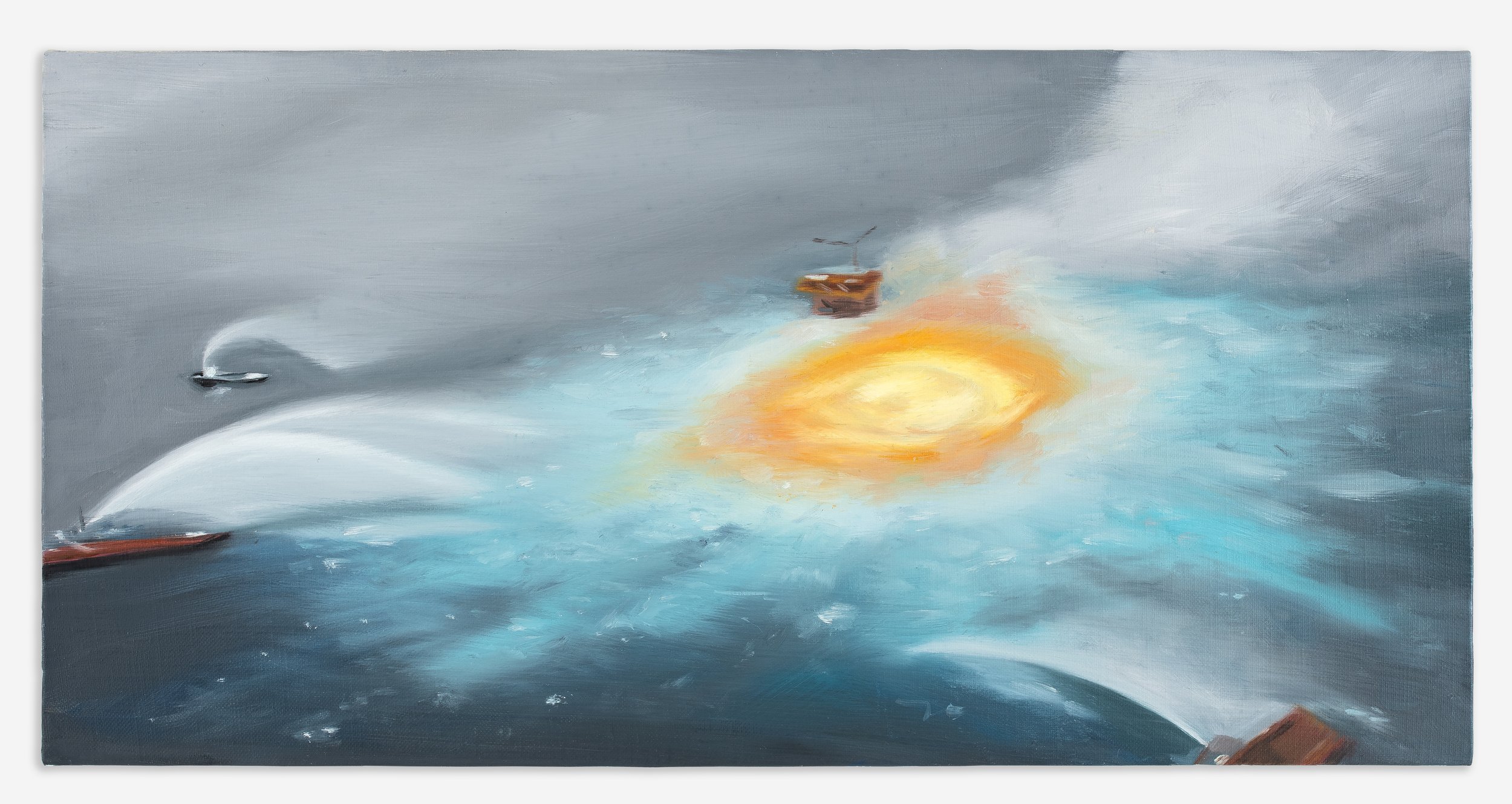
Gulf of Mexico is oil on linen, 31 x 61 cm, a horizontal format that mirrors the event's own proportions: wide, low, the way a fire on water looks from above. The canvas is roughly the size of a laptop screen, which is not a coincidence. Tan Mu sourced her reference material from helicopter footage circulating on social media, and the painting's dimensions register that provenance. This is not a canvas that surrounds the viewer. It is a canvas that the viewer looks into, the way one looks into a screen. The format is observational, not immersive. You stand before it the way you stand before a report: attentive, not overwhelmed.
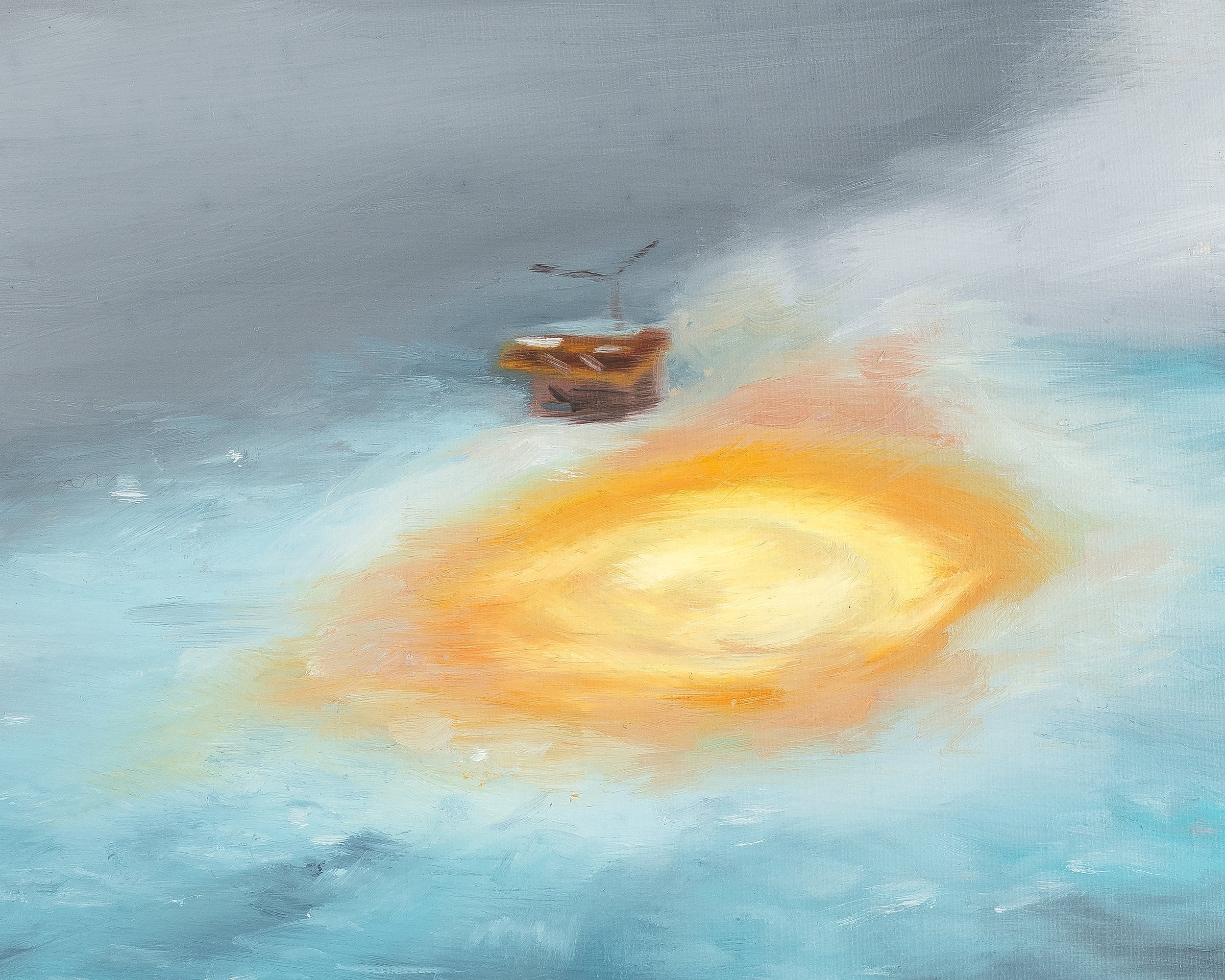
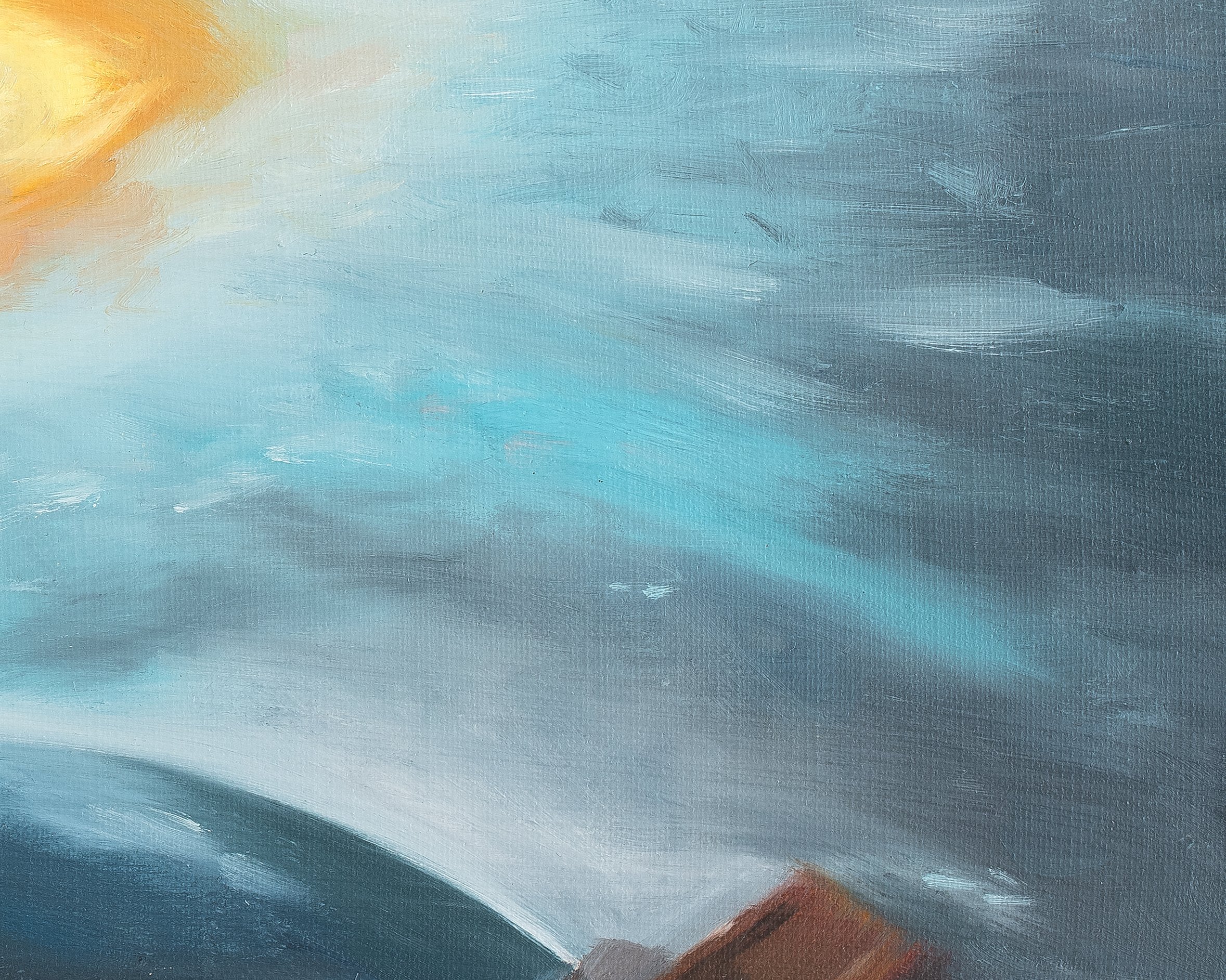
The surface tells a different story than the format suggests. At arm's length, the paint is built in aggressive ridges. The flames that dominate the center of the composition are not rendered as smooth gradients but as thick impasto, wax-heavy oil paint troweled into peaks and furrows that catch raking light and hold it. This is paint as combustion residue, each application a gesture that mimics the event's own violence. The orange is not a single orange. It is cadmium orange over burnt sienna over a ground of raw umber, and the layers separate at the edges of each brushmark, producing a chromatic instability that shifts with the viewer's position. Step left, and the fire reads as amber. Step right, and it veers toward vermillion. The water around the flames is handled in a contrasting register: thinner, more fluid, the blue-black of the Gulf surface applied in broad, wet passages that allow the linen's weave to show through. Where the flames rise in physical relief, the water lies flat. The painting makes the viewer feel the difference between what burns and what does not through the sheer physicality of its surface.
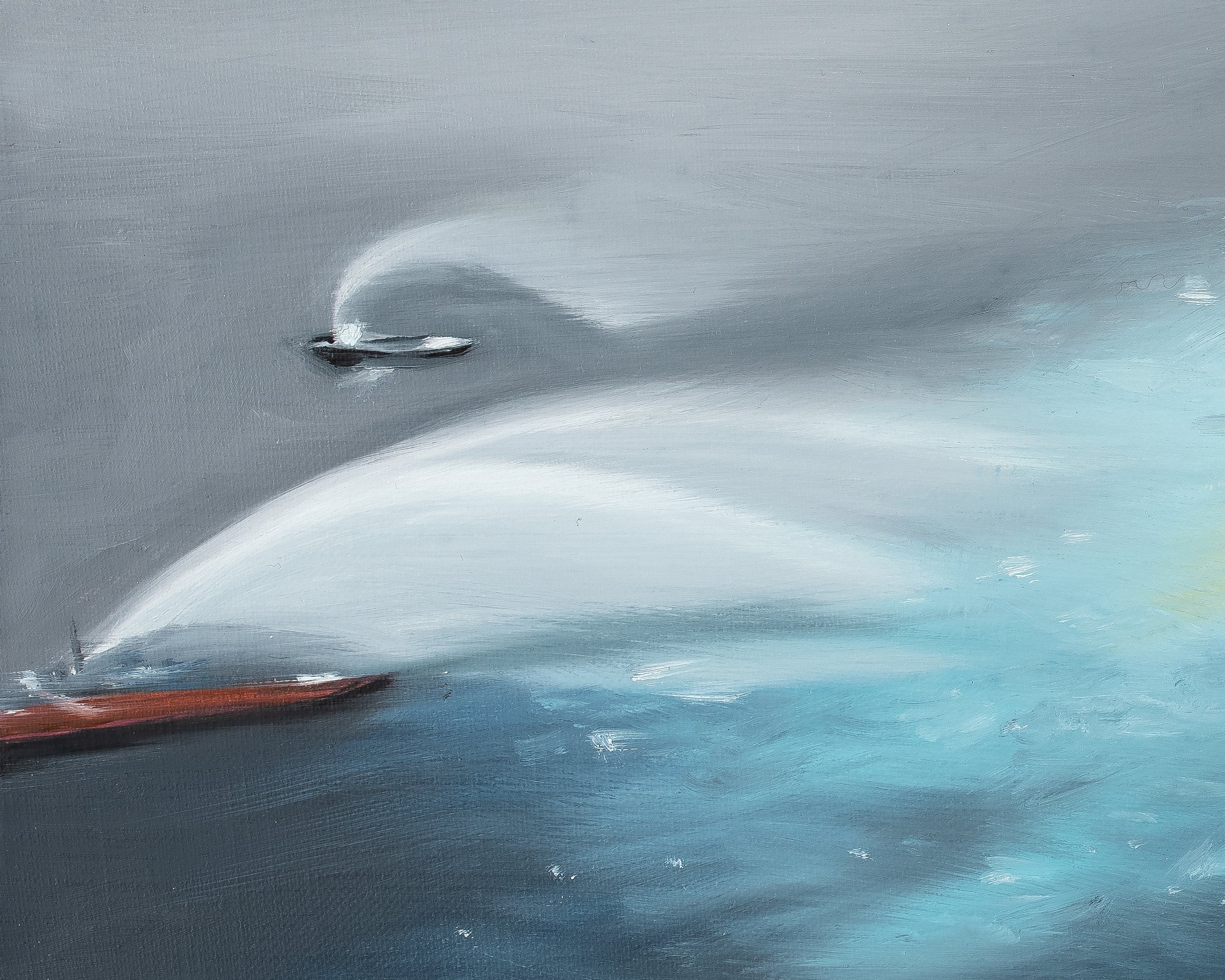
The oil rig structure at the center of the composition is the only architecture in the frame. It is rendered with a specificity that distinguishes it from the surrounding chaos. This is the first time Tan Mu fully depicted an oil rig in her work, and its presence carries biographical weight. She grew up in Yantai, a coastal city in Shandong province, where offshore natural gas platforms were a regular feature of the horizon. "I was fascinated by how these massive structures transported energy through pipelines," she has said, "and altered the spatial relationship between industry and nature." The rig in Gulf of Mexico is both an engineering fact and a memory trace. It is the thing she saw from the shore as a child, now transposed to a different gulf, a different coast, a different kind of fire. The structure stands upright against the flames, its lattice of girders and cross-members still legible even as the fire wraps around it, and this legibility is what makes the painting more than a spectacle. The rig is not consumed. It is the machine that produced the gas, the machine that the gas is now destroying, and the machine that, because it still stands, insists on the industrial logic that caused the fire in the first place.
Winslow Homer painted The Gulf Stream in 1899, and the painting has haunted American art ever since. A lone Black man lies on the deck of a small boat, its mast broken, its tiller gone, adrift in churning dark water. Sharks circle. A waterspout coils in the distance. The Gulf Stream itself, that massive current of warm water flowing north from the Yucatan Strait, carries the boat toward an uncertain fate. Homer's painting is about peril at sea, but it is also about the specific geography of the Gulf: the stretch of water where industry, nature, and human vulnerability converge. The same body of water that carries a dismasted boat past sharks in 1899 produces a fire on the ocean's surface in 2021. The Gulf of Mexico is not a backdrop in either painting. It is the subject's condition of possibility. Without the Gulf's geology, its reserves of oil and natural gas compressed beneath the seafloor over millions of years, there is no pipeline, no rig, no fire. Without the Gulf Stream's current, there is no displacement, no drift, no narrative of helplessness.
Homer's painting and Tan Mu's share more than a geographic coordinate. Both are constructed around the tension between what is visible and what is implied. In The Gulf Stream, the sharks are visible, but the current that carries everything is not. It is felt, not shown. In Gulf of Mexico, the fire is visible, but the pipeline beneath the seafloor, the geological pressures, the political decisions that placed extraction infrastructure in that specific location, these are felt, not shown. Both paintings compress an entire network of causes into a single frame of consequence. Homer's man does not see the current. Tan Mu's viewer does not see the pipe. Both works make the invisible infrastructure of the Gulf into the submerged subject that the visible event merely announces.
There is a further structural parallel. Homer's painting was widely interpreted as a statement about race in America. The artist himself rejected allegorical readings, insisting, "I was not thinking of any such thing when I painted it." Whether or not Homer intended the racial dimension, the painting carries it because the Gulf Stream, as a geographic and economic reality, is inseparable from the history of trade routes, enslavement, and extraction that shaped the Caribbean. Tan Mu's painting carries a parallel dimension. The Gulf of Mexico is not just a body of water. It is a zone of extraction, a site where Pemex and its predecessors have drilled for decades, where the Deepwater Horizon disaster killed eleven workers and discharged 4.9 million barrels of oil in 2010, and where the compulsion to extract energy from beneath the seafloor produces consequences that the surface must absorb. The painting does not illustrate this history. It registers its latest iteration. The fire of July 2021 is one event in a chain that stretches back to the first offshore well in the Gulf in 1938, and both paintings understand that the Gulf's significance lies not in any single incident but in the pattern of incidents that the geography makes inevitable.
The event itself unfolded with a speed that matched the medium of its circulation. Helicopter footage of the eye of fire appeared on social media within hours. The speed of the image, from pipeline leak to viral video, compressed the time between event and witness to nearly nothing. Tan Mu's decision to begin painting the same day was not a nostalgic gesture toward an older, slower medium. It was a deliberate acceleration of painting itself, forcing oil paint to move at the pace of breaking news. She worked from stills extracted from the helicopter video, selecting frames that captured the fire's structure rather than its drama. The painting process lasted only a few hours. When the last flame was extinguished, the canvas was dry enough to hold. This temporal coincidence, that the painting and the fire occupied the same afternoon, gives the work a documentary quality that no retrospective painting could achieve. The brushstrokes are not describing a remembered event. They are describing an event still in progress.
The science is worth stating plainly. The Ku-Maloob-Zaak field is one of the most productive offshore oil regions in the world. Operated by Pemex, it produces heavy crude and associated natural gas. On July 2, a rupture in a gas pipeline beneath the seabed released gas that rose to the surface, where it encountered an ignition source. The resulting fire burned at the water's surface because the gas, not the water, was the fuel. The ocean did not catch fire. The gas above it did. This distinction, between what burns and what supports the burning, is built into the painting's material structure. The flames rise from the surface. The water beneath remains water. The rig remains standing. The pipeline beneath the floor of the gulf remains intact, or at least remains, since Pemex did not disclose the full extent of the damage. The event is a symptom of extraction, not of the ocean itself. The ocean, in Tan Mu's painting, is the substrate on which catastrophe performs, and its dark, thinly painted passages register that role with an economy that makes the flames' thickness all the more violent by contrast.
Albert Pinkham Ryder, the American painter who worked in the late nineteenth and early twentieth centuries, produced some of the most concentrated seascapes in the history of the medium. His paintings are small, dark, and thickly encrusted with paint. The Race Track (c. 1896), also known as Death on a Pale Horse, depicts a skeletal rider galloping across a landscape that dissolves into tarry darkness. The paint surface has cracked and buckled over time because Ryder mixed his pigments with unconventional materials, adding bitumen and varnish in layers that never fully dried. The result is a surface that looks as though the painting itself has undergone some kind of geological event, a cracking and shifting that mirrors the turbulence depicted. Ryder's nocturnal seascapes, such as Marine (c. 1885) and The Waste of Waters Is Their Field (c. 1883), compress vast expanses of ocean into panels no larger than a book, with dark pigment built up in successive layers until the surface becomes almost sculptural. The sea in these works is not a setting. It is a force, as much material as it is subject.
Tan Mu shares Ryder's instinct for material compression. Her flames in Gulf of Mexico are not illustrative. They are structural. The thick impasto builds a topography of combustion that rises off the canvas the way the actual fire rose off the water. And like Ryder, whose surfaces have aged into something more complex than what he originally applied, Tan Mu's paint asserts its own physicality as part of the subject. The difference is one of temporality. Ryder's paintings aged slowly, over decades, into their current cracked state. Tan Mu's painting was made quickly, in a single session, with the urgency of someone working against a clock that the fire itself had set. Where Ryder's materiality accumulates over time, Tan Mu's condenses into hours. The surface of Gulf of Mexico does not need decades to show its age. It was born already concentrated, already dense with the pressure of a single afternoon's concentrated looking.
Yiren Shen, writing for 10 Magazine in August 2025, notes that Tan Mu's practice consistently occupies "the increasingly overwhelming deluge of digital images" by insisting on painting as a form of "documenting and witnessing." The phrasing is deliberate. To document is to record. To witness is to be present, to occupy the same time as the event, to carry the moral weight of having been there. Shen's distinction illuminates Gulf of Mexico precisely because this painting achieves both. It documents the fire's appearance: the orange vortex, the rig, the dark water, the scale. But it witnesses the fire's duration. The speed of the painting's execution, matching the speed of the event's circulation, makes the canvas not a record of what happened but a trace of what was happening while the artist was present to it. Shen's observation that Tan Mu "sees paintings as time capsules" is borne out by a detail that Tan Mu herself has described. About a year after completing the work, the person responsible for shipping the painting mentioned that he vividly remembered the event. He was Mexican. The oil spill was connected to his own lived experience. The painting, in his encounter with it, did not present a disaster from a distance. It presented a disaster he already knew. The canvas became, as Tan Mu has described it, "an anchor point that reconnects individual memory with a shared global experience."
The word "time capsule" is apt but incomplete. A time capsule is sealed and opened later. Gulf of Mexico was never sealed. It was painted open, in real time, and it has remained open. Every viewer who encounters it brings their own knowledge of the event, or of the Deepwater Horizon spill that preceded it by eleven years, or of the broader pattern of extraction and combustion that the Gulf's geology makes recurrent. The painting does not need to explain what the pipeline was, who operated it, or why it leaked. It needs only to show what it looked like when the gas rose to the surface and found its spark. The rest, the infrastructure, the politics, the decades of offshore drilling, the geological time of fossil fuel formation, all of this lives in the painting's margins, in the thin water that supports the thick flame, in the rig that stands because it was built to stand, in the horizontal format that mimics the aspect ratio of the screen on which most viewers first saw the footage.
Fire, in Tan Mu's practice, is not an anomaly. It recurs across multiple works. The urban fires of Philadelphia (2020) and Minneapolis (2020) depict buildings and streets consumed by flames that register social unrest as physical combustion. She has described fire as "a symbol of primal energy and the origin of human civilization," and in Gulf of Mexico, this symbolism receives its most concentrated form. Industrial flames burning atop open water present what she calls "a fragile balance between human ambition and natural law." The phrase is precise. Ambition built the rig. Ambition drilled the pipeline. Ambition compressed the gas. Natural law, which is to say the physics of combustion and the chemistry of methane, supplied the fire. The balance between these forces is fragile precisely because the natural law was never in doubt. The gas was always going to burn if it found oxygen and a spark. What was fragile was the human assumption that it would not.
Tan Mu has also noted, in her Q&A for this work, that this is "the first time I have fully depicted an oil rig structure." The structure's centrality in the composition, its lattice of pipes and platforms rendered with sufficient specificity to be identifiable as engineering rather than abstraction, makes the painting something other than a seascape with flames. It is an industrial portrait. The rig is the subject's skeleton. Without it, the fire would have no origin point. Without it, the painting would be a vision of combustion without cause, which is a different painting entirely, perhaps a metaphysical one. Tan Mu is not painting metaphysics. She is painting infrastructure, and the fire is what happens when infrastructure fails. The rig, standing amid the flames, is not a victim of the disaster. It is the disaster's author, rendered at the same scale and with the same material urgency as the flames that engulf it.
There is a final structural observation worth making. The painting's format, 31 x 61 cm, places it among the smallest works in Tan Mu's Signal and Infrastructure series. Where Twenty Thousand Leagues Under the Seas (2023) measures 182 x 152 cm and Emergence (2022) reaches 193 x 244 cm, Gulf of Mexico is a painting you hold in your hands, or nearly. The modesty of the scale matches the modesty of the time: a few hours to see, a few hours to paint, a few hours before the fire went out. The work does not ask for a gallery wall at a distance. It asks for proximity, for the kind of close looking that helicopter footage, scrolling past on a phone screen, never affords. The thick paint rewards the close viewer. The thin water rewards the close viewer. The rig's structural detail, visible only at arm's length, rewards the close viewer. The painting was made at the speed of news. It asks to be received at the speed of attention.
The fire on the Gulf of Mexico burned for roughly five hours. The painting that bears its name was completed in roughly the same span. One was extinguished by crews pumping water and nitrogen. The other was extinguished by completion, by the decision that the painting had caught what it needed to catch. The paradox of Gulf of Mexico is that the more permanent record is the one made of pigment and linen, not gas and water. The fire is gone. The pipeline has been repaired. Pemex continued drilling. But the painting remains, its impasto flames still rising off the surface, still catching the light in a room where no fire burns, still insisting that the hours in which the Gulf caught fire are worth the sustained attention that only a human hand, working with urgency and precision against a deadline set by the event itself, can provide.