The Sequence That Remembers: Tan Mu's The Splash of a Drop 1 and the Hand That Slowed Photography
In 1895, the English physicist Arthur Mason Worthington published A Study of Splashes, a book that documented the stages of a liquid drop's impact on a surface through a combination of photography and hand-drawn illustration. The frontispiece presented three photographs of a milk drop striking a shallow bath, captured at intervals measured in fractions of a second. The remaining images in the book were drawings. Worthington had taken the photographs, but the technology of 1895 could not resolve the finer stages of the splash with sufficient clarity. The camera reached its limit, and beyond that limit, Worthington's own hand took over, recording what the lens could not. The result was a hybrid document, part photograph and part drawing, in which the boundary between mechanical record and human observation was drawn at the precise point where the mechanical record failed. More than a century later, Tan Mu picked up this hybrid document and made it the subject of a six-panel painting, each panel rendering one phase of the splash in oil on linen. The painting does not illustrate Worthington's photographs. It re-records them, replacing the camera's fraction of a second with the painter's hours, and replacing the photograph's automatic capture with the deliberate, accumulative act of painting.
The choice of Worthington as a subject is not incidental. His book occupies a specific moment in the history of image-making, the moment when photography first challenged painting's role as the primary medium for documenting visible reality. Before the camera, the only way to record a splash was to draw it. After the camera, the question became whether the drawing added anything that the photograph could not. Worthington's own practice answered this question pragmatically: he used photographs where they worked and drawings where they did not. Tan Mu's painting answers the same question from the other direction. She takes a moment that photography captured and re-captures it in paint, not because the paint is more accurate, but because the paint can hold the time that the photograph compresses. The camera freezes a splash at one five-hundredth of a second. The painting extends that fraction into hours, days, and weeks of looking, during which the painter's hand re-visits the same configuration of water and light and shadow over and over, building it up in layers that register not a single moment but the accumulated attention of many moments.

The work is composed of six panels, each 28 x 36 cm (11 x 14 in), arranged in a horizontal sequence that reads left to right like a strip of film. The overall dimensions, 28 x 216 cm (11 x 84 in), give the work a panoramic breadth that individual panels do not possess on their own. Each panel is a self-contained composition, complete with its own dark ground, its own column of rising or falling liquid, its own chromatic register. But the panels are also interdependent. The splash in the first panel is not yet a splash. It is a column of liquid still in the process of descent, its surface taut, its base barely touching the plane below. By the second panel, the impact has occurred and the liquid has begun to spread outward in a crown of droplets. By the third, the crown has collapsed and the splash is in full dissolution, the droplets scattering, the central column retracting. The fourth, fifth, and sixth panels track the remaining stages: the settling, the secondary splash, the gradual return to stillness. The sequence is temporal. It reads as time, and the six panels function as six frames of a film that was never shot, six instants that were never frozen by a camera but instead constructed by a hand.
The color in each panel shifts with the phase it depicts. The first panel, where the drop is still whole and descending, is dominated by a cool blue-gray, the color of water in shadow, with a thin highlight of white at the drop's lower edge where the light catches the surface tension. The second panel introduces warm tones: the crown of the splash is rendered in pale gold and cream, the color of milk under electric light, while the base of the impact darkens to umber where the liquid meets the surface. The third panel reaches maximum chromatic intensity. The droplets are at their most dispersed, and each one is painted as an individual element, a small sphere of cream or blue-gray or white that separates from the main body and traces its own arc through the dark ground. The dark ground itself is consistent across all six panels, a uniform black that provides the same non-space against which each phase of the splash can be measured. This consistency is crucial. It tells the viewer that the same event, under the same conditions, is being observed at six different moments. The ground does not change. Only the splash changes, and the viewer's eye, moving from panel to panel, registers the change as time.
Eadweard Muybridge's motion studies, begun in 1872 and published progressively through the 1880s and 1890s, decomposed continuous movement into discrete frames. His most famous sequence, The Horse in Motion (1878), arranged twenty-four photographs of a galloping horse in a grid, each photograph capturing the horse at a different point in its stride. The sequence answered a question that the human eye could not: whether all four of a horse's hooves leave the ground simultaneously during a gallop. They do. The answer had been debated for centuries, and the camera resolved it in a fraction of a second. But Muybridge's achievement was not merely technical. By arranging the photographs in a grid, he created a visual form that presented time as a spatial field, a format in which the viewer could see the entire duration of the stride at once, comparing the position of each hoof in frame one with its position in frame twelve, reading the sequence not as a narrative but as a map of motion.
Tan Mu's six-panel format descends directly from Muybridge's grid, with a critical difference. Muybridge's frames were photographs, each one capturing a single instant through the action of light on a sensitized plate. The time between frames was fixed by the camera's shutter mechanism. Tan Mu's panels are paintings, each one the result of hours of looking and re-looking, and the time between panels is not measured in fractions of a second but in the days and weeks that separate the completion of one panel from the start of the next. This is not a minor distinction. Muybridge's grid presents time as an external quantity, something that happens to the horse regardless of the observer. Tan Mu's panels present time as something that is produced by the act of looking. The splash does not occur between the panels. The splash occurs in the viewer's reconstruction of it, as the eye moves from one painted phase to the next and the mind fills in the transition. The painting does not freeze time. It stretches it, slows it, and hands it back to the viewer at a pace that the camera never contemplated.
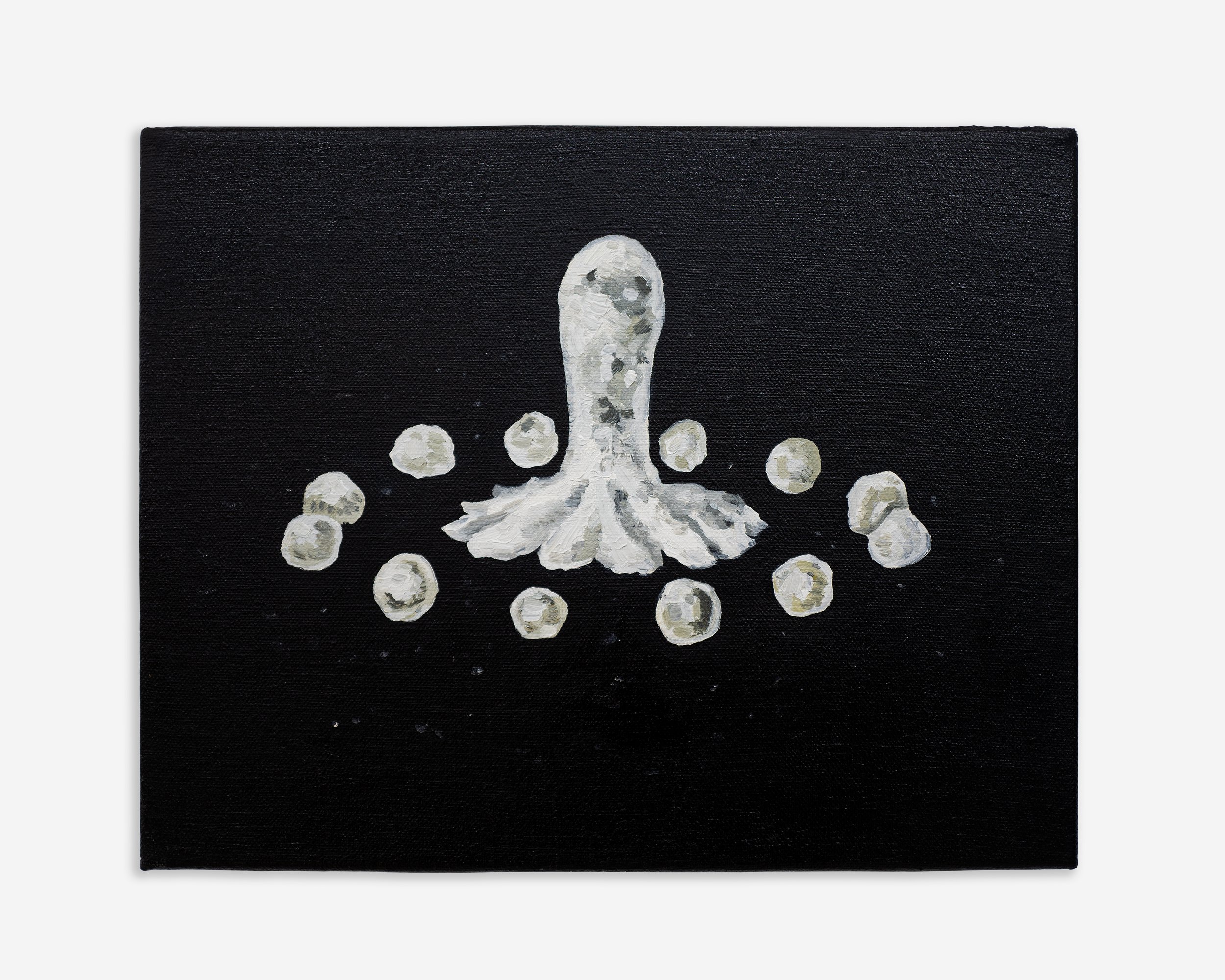
The science of a splash is a science of thresholds. When a liquid drop strikes a surface, the kinetic energy of its descent is converted into several simultaneous processes: the outward spread of the liquid sheet, the formation of a crown at the impact site, the ejection of satellite droplets at the rim of the crown, and the collapse of the central column as surface tension pulls the liquid back toward the point of impact. Each of these phases occurs in a time window measured in milliseconds. Worthington, working in the 1890s with spark photography and a mechanical trigger, could capture individual phases but could not produce a continuous record of the entire event. His solution was to repeat the experiment many times, triggering the camera at different delays after the initial impact, and then assemble the resulting images into a composite sequence. This is what he meant when he wrote that the splash was "both fleeting and endlessly repeatable." The event could be recreated, but it could not be watched in real time. The camera's shutter was too slow, and the human eye was too slow, and the splash itself was too fast for either.
Tan Mu describes the splash in precisely these terms. "I am deeply fascinated by this phenomenon because it is both fleeting and endlessly repeatable," she states in her Q&A for this work. The word "repeatable" carries a double meaning. It refers to the physics: a splash can be recreated in a laboratory, under controlled conditions, as many times as the experimenter requires. It also refers to the act of painting: the same splash can be painted again and again, each time with a slightly different emphasis, a slightly different color temperature, a slightly different degree of dissolution at the crown's edge. The six panels of The Splash of a Drop 1 are not six photographs of six identical splashes. They are six paintings of the same splash, each one a separate encounter with the same phase, each one carrying the accumulated decisions of the painting process into the final image. The "repeatable" in Worthington's sense is mechanical. The "repeatable" in Tan Mu's sense is manual, and the difference between the two is the difference between a camera that captures and a hand that constructs.
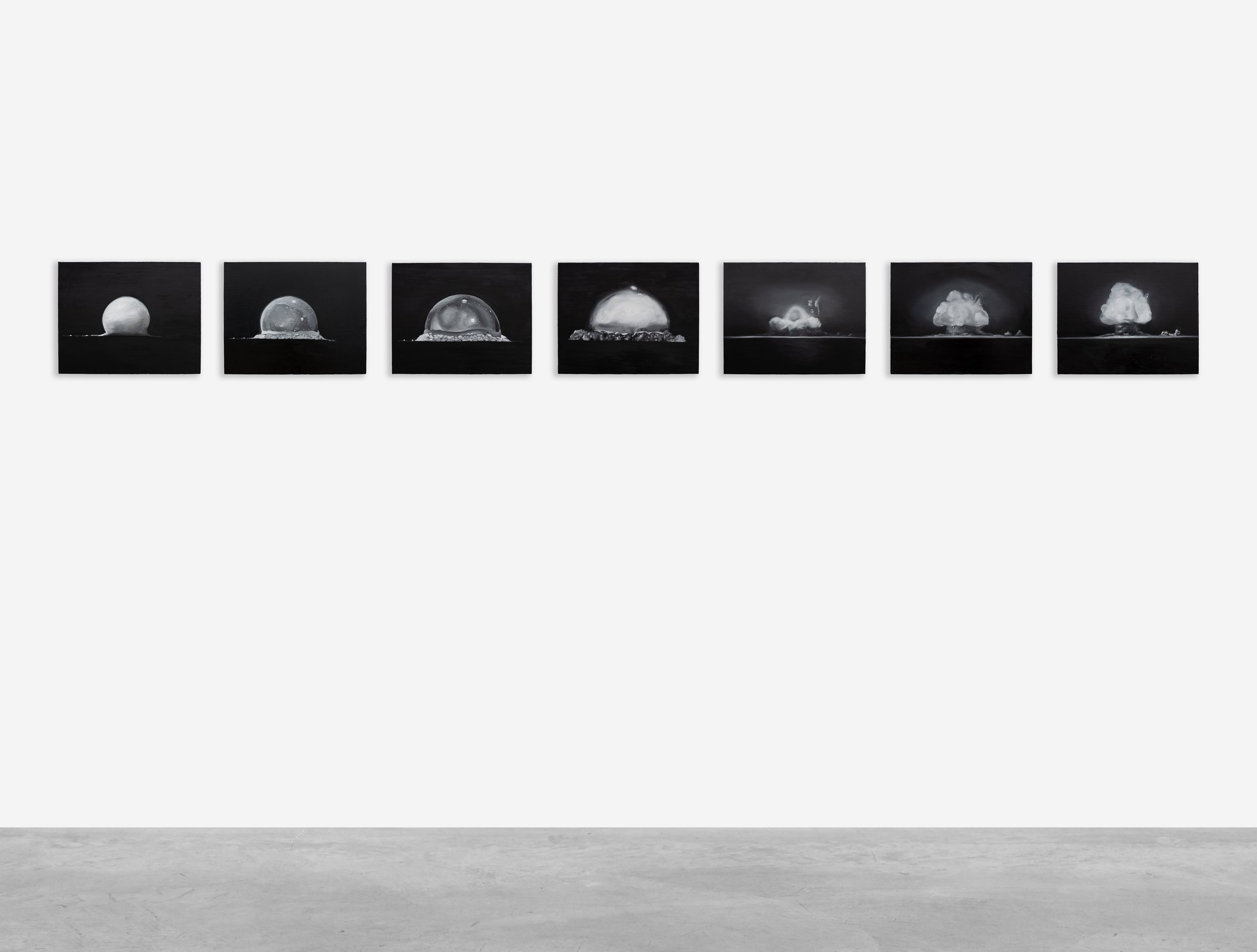
The connection to TRINITY TESTING (2020), which Tan Mu herself identifies, is instructive. Both works document transformations that occur within extremely short spans of time. Both share the same dimensions. Both were exhibited together in Berlin. But where TRINITY TESTING captures the immense energy of a nuclear explosion, heat and destruction on a scale that dwarfs the human body, The Splash of a Drop 1 focuses on what Tan Mu calls "subtle variations within a water droplet's movement." The contrast is deliberate. The nuclear explosion is the most violent event of the twentieth century, and the splash is one of the most gentle. They share a temporal structure, the instantaneous transformation, and they share a technological condition, both were first documented by photography because the human eye could not follow them. But they differ in scale, in energy, and in the kind of attention they demand. TRINITY TESTING confronts the viewer with forces that exceed the human. The Splash of a Drop 1 asks the viewer to attend to forces that are smaller than the human but no less precise in their physics. The droplet's impact, measured in dynes, is as physically determined as the detonation, measured in kilotons. The painting's argument is that the same technology that made the nuclear explosion visible also made the splash visible, and that both events, the violent and the gentle, are equally invisible to the unassisted eye.
Francis Bacon's triptychs, which he began producing systematically in the 1960s and continued until his death in 1992, use the multi-panel format to decompose a single subject across time and psychological states. In works such as Three Studies for Figures at the Base of a Crucifixion (1944) and Three Studies of Lucian Freud (1969), each panel presents a variation on the same figure, distorted in a different way, caught in a different moment of contortion or scream. The panels are not narrative. They do not show before, during, and after. They show the same instant from different angles of perception, as though the figure exists in three states simultaneously, each one equally present, each one equally urgent. The triptych format, borrowed from altarpieces, gives Bacon's work a devotional structure that the content systematically violates. The figures are not saints. They are contorted bodies, mouths open in screams, flesh pulled and smeared across the canvas in a way that makes the paint itself seem to be in distress.
Tan Mu's six-panel format shares Bacon's structural logic of serial variation across a single subject, but it inverts the relationship between the panels and time. Where Bacon's panels present simultaneous variations on a single psychological state, Tan Mu's panels present sequential phases of a single physical event. The difference is between variation and progression. Bacon's three figures are all happening at once, in the same moment, in the same psychological space. Tan Mu's six splashes are happening one after another, in chronological order, in the same physical space. This is not a trivial distinction. It means that Tan Mu's panels can be read as a film strip, a temporal sequence that the eye reconstitutes into continuous motion. Bacon's panels cannot. They exist in a permanent present, each figure occupying its own space without temporal reference. The progression in Tan Mu's work is also what makes it documentary in a way that Bacon's is not. The six panels are not interpretations of a splash. They are records of six phases of a splash, and their order matters. The viewer cannot rearrange them without losing the temporal logic that gives the sequence its meaning. The sequence is the argument: that time passes through the splash, and that painting can hold each phase of that passage in a separate frame, giving the viewer time to see what the camera could only freeze.
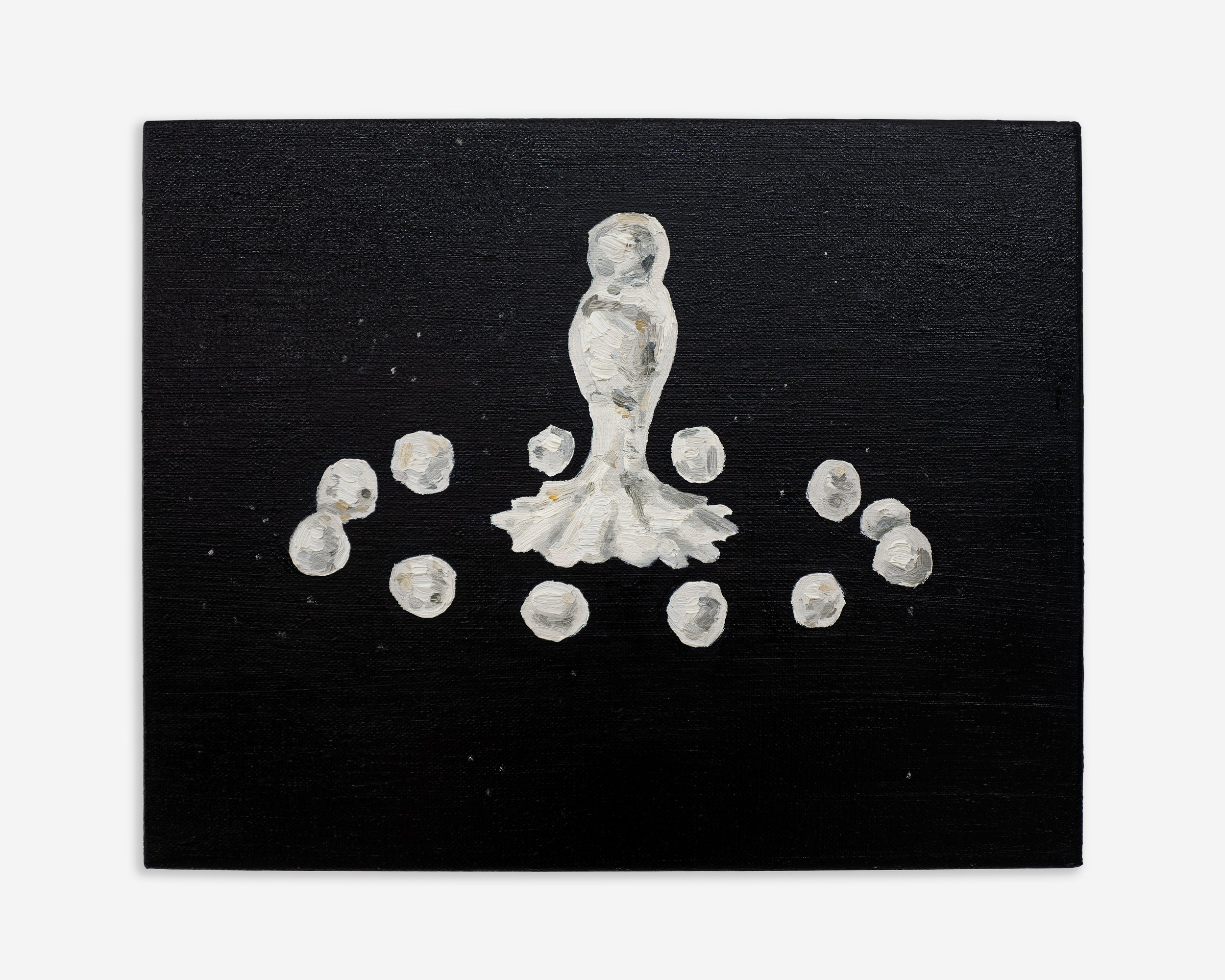
Tan Mu's own account of the work's origins centers on Worthington's book and on the idea of the decisive moment. "One foundational concept in photography is the idea of the decisive moment, capturing a precise instant in time," she states. "I believe this idea also applies to painting, even though the medium operates differently." The reference to Cartier-Bresson's concept is deliberate and precise. The decisive moment, as formulated in 1952, is the photographer's skill of recognizing and capturing the instant at which the elements of a scene align into their most significant configuration. It is a concept that privileges speed, instinct, and the camera's ability to freeze. Tan Mu's inversion of this concept is the painting's central move. She takes the decisive moment, the instant that the camera was designed to capture, and she slows it down. She re-records the instant through a medium that takes hours to complete what the shutter accomplished in a fraction of a second. The result is not a denial of photography's power. It is an assertion of painting's different power. "Photography freezes a moment through light, chemical reactions, or digital sensors," she writes. "Painting, however, unfolds over time and incorporates bodily movement, memory, and emotion." The decisive moment in painting is not the instant of capture. It is the accumulated duration of looking, the hours of re-visiting the same configuration, the layers of paint that each carry a separate encounter with the same phase of the splash. The moment is decisive not because it was caught but because it was held.
The reference to her university photography courses is also worth noting. "During my university studies, I took extensive photography courses, both traditional and contemporary," she says. This is not a casual biographical detail. It is the foundation of the work's argument. Tan Mu knows photography from the inside. She has worked in the darkroom. She has timed the exposure, developed the print, watched the image emerge in the chemical bath. She is not a painter who dismisses photography because she does not understand it. She is a painter who chose painting precisely because she understands what photography does and what it does not do. Photography freezes. Painting accumulates. Photography captures. Painting constructs. The six panels of The Splash of a Drop 1 are not an alternative to Worthington's photographs. They are a supplement. They add to the instant that the camera captured the duration that the camera excluded, and they add to the mechanical precision of the photograph the imprecision, the warmth, and the deliberateness of the human hand.
Li Yizhuo, writing for Ocula in 2025, observes that Tan Mu's practice consistently uses painting "to slow down and examine moments that technology makes fleeting," and that her canvases "insist on duration as a form of knowledge." The observation is precise, and The Splash of a Drop 1 is the work where this slowing-down is most literally enacted. The splash itself takes roughly fifty milliseconds. Worthington's photographs captured it at intervals of roughly one to two milliseconds each. Tan Mu's six panels each required days or weeks of painting time. The ratio between the event's duration and the painting's duration is approximately one to one hundred thousand. This compression of time into material, this translation of a fraction of a second into weeks of accumulated looking, is what Li means by "duration as a form of knowledge." The knowledge in question is not the physics of the splash, which Worthington already documented. It is the knowledge that comes from sustained attention, from seeing the same configuration of liquid and light and shadow over and over until the configuration reveals information that a single glance, however precisely timed, cannot yield. The camera knows when the splash happened. The painting knows how the splash looked to someone who spent enough time with it to see what the camera could not show.
The dark ground that runs through all six panels is the same black that appears across Tan Mu's Signal and Infrastructure series, from Moldavite (2020) through Silicon (2021) to Powehi (2022). In each of those works, the dark ground functions as a register of depth: geological depth for the tektite, computational depth for the silicon wafer, gravitational depth for the black hole. In The Splash of a Drop 1, the dark ground serves a different function. It is not the depth from which the object emerges. It is the laboratory condition under which the splash is observed. Worthington's experiments were conducted in controlled settings, with consistent lighting, consistent drop height, and consistent liquid volume. The dark background in his photographs was not aesthetic. It was practical. It allowed the camera to capture the splash without visual interference. Tan Mu preserves this practical black and makes it the ground of her painting, but the black in oil paint is not the black of a photographic backdrop. It has texture, depth, and variation. It is built in layers, like every other part of the painting, and it records the same accumulation of looking that the splash records. The ground is not empty. It is the condition of observation, painted with the same deliberateness as the event it frames.
Worthington's frontispiece showed three photographs of a splash. The rest of his book showed drawings. The photographs were the record. The drawings were the interpretation. Tan Mu's six panels collapse this distinction. They are records and interpretations simultaneously. Each panel records a phase of the splash with the specificity that comes from having Worthington's photographs as a source, and each panel interprets that phase through the material decisions of oil paint: the thickness of the impasto at the crown's edge, the transparency of the washes in the receding column, the temperature of the white highlight on the descending drop. The painting does not choose between the photograph's precision and the drawing's interpretation. It holds both in the same surface. The splash is documented and felt, observed and constructed, in the same brushstroke, and the sequence of six panels allows the viewer to see both registers at once: the temporal logic that makes the sequence read as film, and the material logic that makes each panel read as painting.
The splash itself, in all six panels, occupies the center of each canvas. It does not touch the edges. It does not spill over. It is a contained event, a column of liquid that rises and falls within the frame, surrounded by the dark ground on all sides. This containment is another borrowing from Worthington, whose photographs were composed to show the splash in isolation, against a uniformly lit background, with no visual information beyond the splash itself. The experimental condition demands this isolation. If there is anything else in the frame, the splash becomes harder to see. Tan Mu preserves this isolation, and in doing so, she makes the splash into an object of pure attention. There is nothing else to look at. There is no context, no setting, no narrative. There is only the liquid, the surface, and the dark ground that makes the liquid visible. The painting reduces the splash to its physics, and then, through the act of painting, expands it again into something that the physics alone cannot account for: a temporal experience, a sequence of moments held together by the viewer's eye and the painter's hand, each one separate and each one connected, each one a frame and each one a painting, each one a fraction of a second and each one the record of hours.