The Shadow That Was Not One: Tan Mu's Projection: Light and Shadow and the Multiplication of the Self
A single figure stands on a blue-toned ground. From this figure, three shadows extend across the surface at different angles and with different degrees of opacity. The first shadow is solid, dense, a near-black silhouette cast by a light source above and to the left. The second shadow is translucent, its edges softer, its color a pale gray that allows the ground beneath to show through. The third shadow is barely visible, a ghost of a shadow, a trace so faint that the viewer must lean in to confirm its presence. Three shadows from one body. Three presences from one figure. The painting's title, Projection: Light and Shadow, states its subject with the precision of a scientific illustration, and the precision is the point. This is not a painting about shadows in the plural. It is a painting about projection, the process by which a single body, placed in a field of multiple light sources, generates multiple versions of itself, each one true to the light that cast it and none of them true to the body alone.
Tan Mu describes the painting's origin in terms that connect the formal to the personal. "While developing Projection: Light and Shadow, I was going through a period of personal uncertainty surrounding memory and identity," she writes. "That experience made me aware of how, in the digital era, human existence can become fragmented, fluid, and constantly redefined through technological mediation." The connection between the three shadows and the three versions of the self is not an analogy the painting proposes. It is a structure the painting enacts. The figure stands still. The shadows move. The figure is singular. The shadows are multiple. The body is present. The shadows are cast, projected, mediated by light and by the technology that produces the light. The painting does not illustrate the fragmentation of identity. It performs it, using the oldest visual language available, the relationship between a body and its shadow, to make visible a condition that the digital age has made ubiquitous but difficult to see.
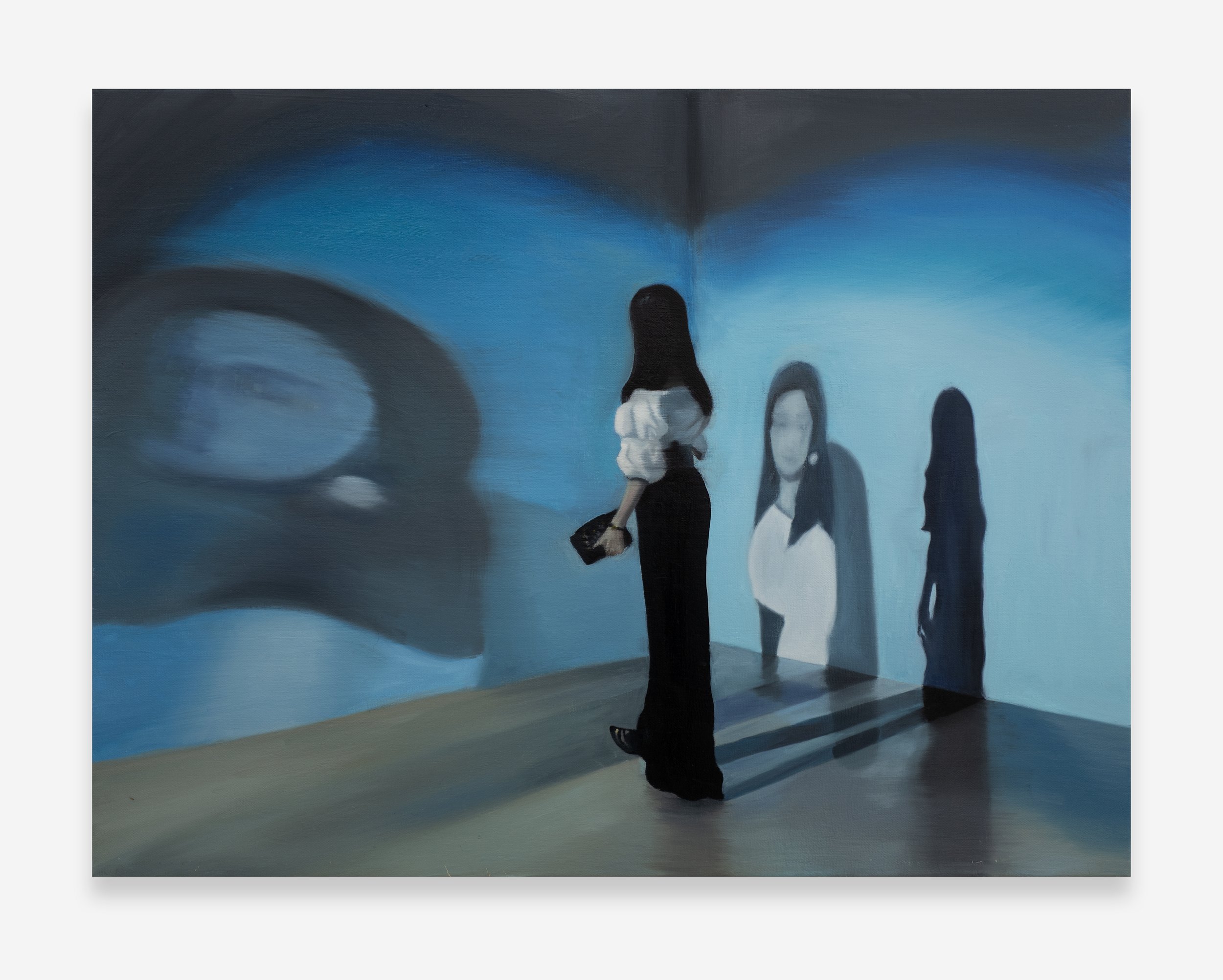
The painting is oil on linen, 46 x 61 cm (18 x 24 in), a modest horizontal format that accommodates the spread of the shadows across the ground. The figure stands slightly left of center, and the three shadows extend to the right, each at a different angle, each with a different degree of darkness. The ground beneath the figure is a cool, desaturated blue, the color of a screen or a wall in a room lit by fluorescent light. This is not the blue of sky or water. It is the blue of an environment, a room, a space defined by its illumination rather than by its natural color. The figure itself is rendered in muted tones, the body slightly lighter than the ground, distinguishable from it by edge and shadow rather than by strong contrast. The first shadow, the solid one, is rendered in a deep charcoal that approaches black without reaching it, preserving the texture of the linen beneath. The second shadow is a translucent wash, the ground visible through it like light through a curtain. The third shadow is the faintest of the three, a gray so close to the ground's blue that it dissolves at certain viewing angles, becoming part of the ground rather than a form cast upon it. The surface of the painting is relatively flat, with thin washes of oil that allow the linen's weave to register as a subtle texture throughout. The impasto, where it exists, is concentrated on the figure's edges, where the body meets the first shadow, as though the paint were thickest at the point where the body defines itself against its own projection.
The blue ground is worth pausing over. In Tan Mu's practice, blue carries specific technological associations. Checkmate (2022) uses the blue of IBM's Deep Blue supercomputer. Silicon (2021) uses the blue of a silicon wafer's reflective surface. No Signal (2019) uses the blue of a television screen displaying static. In Projection: Light and Shadow, the blue is the blue of a projection screen, a surface designed to receive light rather than to generate it. Projection screens are blue because blue provides a neutral ground for color reproduction, absorbing the warm tones of ambient light and reflecting the cooler tones of the projector's beam. The painting's ground functions the same way. It is a receiving surface, a space where the light that produces the shadows also produces the environment in which they appear. The ground and the shadows are products of the same illumination, and the painting's color logic makes this explicit: the blue is not a backdrop against which the shadows are cast. It is part of the same system of light that produces them.
Caravaggio's The Calling of Saint Matthew (1599-1600) is one of the most sustained meditations on shadow as revelation in Western painting. The canvas shows a dark interior, perhaps a tax collector's office, in which Christ has just entered from the right, his hand extended in a gesture that echoes God's creation of Adam on the Sistine Chapel ceiling. A beam of light enters the room from an unseen source above and to the right, falling across the figures at the table and casting a deep shadow on the wall behind them. The shadow is not incidental. It is compositional. It divides the canvas into two zones: the illuminated zone, where Christ stands and where the beam of light strikes the faces of the tax collectors, and the shadow zone, where the wall absorbs the light and returns nothing. Matthew, the tax collector who will become the apostle, sits in the illuminated zone, his face caught in the light, his hand still on the coins. The shadow behind him is his old life, the life he is about to leave. Caravaggio's painting uses shadow not merely as an absence of light but as a narrative instrument, a means of dividing the space of the painting into before and after, darkness and illumination, the life of the tax collector and the life of the apostle.
The structural parallel with Projection: Light and Shadow lies in the relationship between shadow and identity. In Caravaggio's painting, the shadow that falls behind Matthew is the shadow of his former self, the part of his identity that the light of Christ's call is about to transform. It is a single shadow, cast by a single light source, and it belongs to a single body in a single moment of transformation. Tan Mu's painting takes this relationship and multiplies it. Where Caravaggio gives Matthew one shadow, one former self, one moment of transformation, Tan Mu gives her figure three shadows, three versions, three degrees of presence that coexist on the same ground at the same time. The transformation in Caravaggio is linear: from shadow to light, from old self to new. The transformation in Tan Mu's painting is circular and unresolved. The figure does not move from one shadow to another. The figure stands still, and all three shadows persist simultaneously, each one as valid as the others, each one produced by a different source of light, each one a true representation of the body's relationship to the illumination that cast it. The shadow in Caravaggio belongs to a moment of conversion. The shadows in Tan Mu belong to a condition of multiplicity.
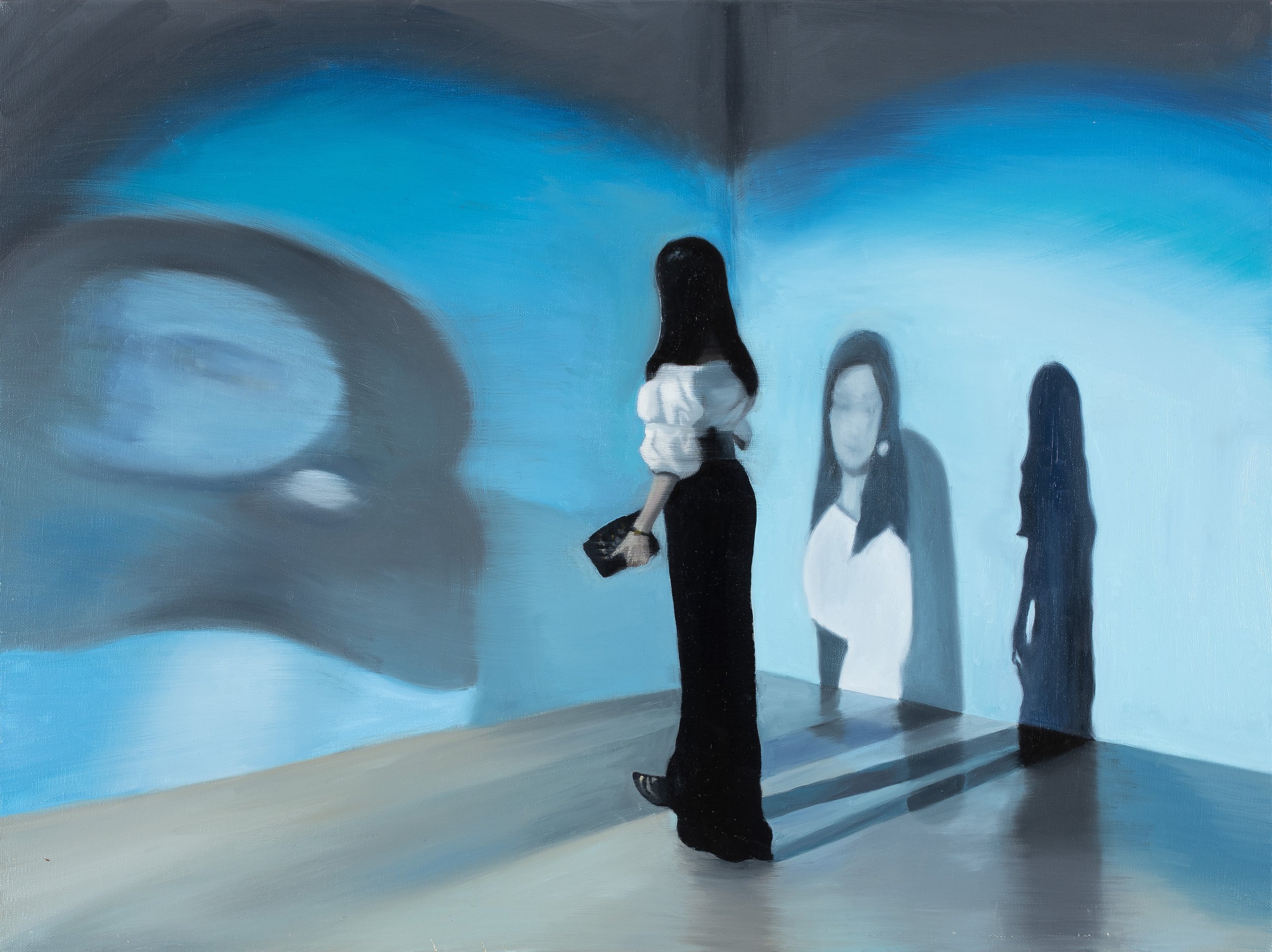
The science of projection that the painting references is straightforward but worth stating precisely. A shadow is cast when an opaque object interrupts a light source. In a room with a single light source, a single object casts a single shadow. In a room with multiple light sources, the same object casts multiple shadows, one for each source. Each shadow differs in length, angle, and opacity depending on the position and intensity of its source. This is the physics of the painting's composition. The three shadows that extend from Tan Mu's figure are not metaphorical additions. They are the correct representation of what happens when a single body stands in a space illuminated by three distinct sources of light. The first shadow, solid and near-black, is cast by the strongest source. The second, translucent, is cast by a source at a different angle and at lower intensity. The third, faint to the point of vanishing, is cast by the weakest source, or by ambient light that is barely sufficient to produce a cast shadow at all. The painting's realism is precise. This is exactly what three shadows from three light sources look like, and the viewer who has ever stood in a room with multiple lamps or in a gallery with directional lighting has seen this phenomenon without necessarily naming it.
Tan Mu's innovation is not in representing this phenomenon. Multiple shadows have been painted before. Her innovation is in recognizing that this phenomenon, which occurs naturally in any space with multiple light sources, is also the physical model for a condition that the digital age has made psychologically universal. "We exist as overlapping versions of ourselves," she writes: "the self on social media, the self captured by surveillance systems, the data-driven self. Each of these versions is part of who we are, yet none of them fully defines us." The three shadows are the self on social media, the self under surveillance, and the data-driven self. The solid shadow is the version that is most clearly defined, the one that other people see and recognize. The translucent shadow is the version that is present but not fully formed, the profile that exists between public and private. The faint shadow is the version that is barely there, the data trace, the algorithmic inference, the version of the self that exists as a pattern in a database and has no subjective experience of being alive. All three are cast by the same body. All three are true to the light that produced them. None of them, taken alone, is the complete person.
Christian Boltanski's installations of the late 1980s and 1990s use shadow, projection, and photography to construct memorial spaces in which identity is simultaneously present and absent. In works such as The Reserve of Dead Swiss (1990), Boltanski arranged hundreds of portrait photographs of anonymous Swiss citizens on the walls and floor of a gallery, lit by bare bulbs that cast harsh shadows across the faces and the walls. The photographs were found images, sourced from newspaper obituaries and archival collections. The people they depicted were real, but their names, their histories, and their contexts had been stripped away. What remained was a face, a shadow, and a light source that turned the face into a projection, an image on a wall that was simultaneously a portrait and a memorial. The shadow in a Boltanski installation is not a secondary effect of the lighting. It is part of the work's argument about what remains of a person after death: an image, a shadow, and the light that connects them.
The connection between Boltanski's shadows and Tan Mu's is structural. Both artists use the cast shadow as a representation of identity that is simultaneously present and incomplete. In Boltanski, the shadow extends the photograph into three-dimensional space, making the image occupy a physical volume that the viewer must navigate. In Tan Mu, the shadow extends the figure into a field of light that the viewer must parse, separating the solid shadow from the translucent one from the faint one and determining which, if any, represents the "real" version of the body that cast it. The answer, in both cases, is that none of them do. The shadow is not the person. It is a projection of the person, cast by a specific light at a specific angle, and it changes every time the light changes. Boltanski's installations change as the bulbs flicker. Tan Mu's painting fixes three states of change in a single composition, and the fixity makes the point more clearly than the flickering could: the three shadows coexist because the three light sources coexist, and the identity of the figure is not any one of the shadows but the body that stands at their point of origin, producing all of them simultaneously by the simple fact of being present in a world of multiple illuminations.
Yiren Shen, writing about Tan Mu's practice in 2025, observes that her works "document and witness" phenomena that "exist at the intersection of the visible and the invisible," and that the paintings "function not as illustrations but as records of the moment when a system reveals its own logic." The observation is precise, and Projection: Light and Shadow is the work where this self-revelation is most literal. The system is the system of light sources that produces the three shadows. The logic is the logic of projection, in which a single body, placed in a field of multiple lights, generates multiple versions of itself that are all accurate and all incomplete. The painting reveals this logic by presenting it in the most direct possible way: one figure, three shadows, three degrees of presence, on a blue ground that is itself a product of the same illumination. Nothing is hidden. Nothing is encoded. The phenomenon is self-explanatory. And yet, the experience of standing before the painting is not one of understanding a principle. It is one of feeling a condition. The three shadows do not explain the fragmentation of identity. They perform it. They extend from the same body at the same time, and they make the viewer feel, in the act of looking, what it is like to be a single self in a world of multiple, overlapping, and often contradictory illuminations.
Tan Mu is explicit about the shift from natural to electronic light that the painting enacts. "Historically, light in painting was closely tied to natural sources, such as the dramatic contrasts of Renaissance chiaroscuro," she states. "In my work, however, light transitions from the singular logic of natural shadow to the layered complexity of electronic projection." The phrase "singular logic" is the key. Natural light, whether from the sun, a candle, or a single window, produces a single shadow. The logic of natural shadow is singular because the source of natural light is singular: there is one sun, one candle, one window. Electronic light, in the form of video projection, LED arrays, and the multiple screens that surround the contemporary body, produces multiple shadows because there are multiple sources. The shift from natural to electronic is not a shift from one kind of illumination to another. It is a shift from a world in which identity is singular, because light is singular, to a world in which identity is multiple, because light is multiple. The painting does not argue that this shift is good or bad. It argues that it is real, and that the three shadows on the blue ground are the visual evidence of a condition that the viewer already inhabits but may not have seen with this clarity.
The question of which shadow is the real shadow is, of course, a question that the painting refuses to answer. In a room with three light sources, all three shadows are real. None is an illusion. None is more true than the others. The body casts them all simultaneously, and the body itself, standing at the point where they converge, is the only entity that is not a projection. But the body in the painting is itself a representation, rendered in oil on linen, a projection of a different kind. The viewer looking at the painting sees a body that is not there, casting shadows that are not there, on a ground that is painted blue but is not actually a projection screen. The entire composition is a representation of a phenomenon that occurs in real spaces with real light, and the painting's realism makes the representation convincing enough to trigger the recognition that this phenomenon is not confined to the painting. It is happening right now, in the room where the viewer stands, wherever there are multiple light sources, which is to say in almost every room that anyone reading this will ever enter. The painting is a mirror of a condition that its viewers already inhabit. It does not reveal something new. It reveals something familiar that has been hiding in plain sight, in the overlapping shadows that every body casts in every room with more than one lamp.
The faintness of the third shadow is the painting's most important detail. The solid shadow and the translucent shadow are easy to see. They register immediately. The third shadow requires attention. It requires the viewer to look for it, to lean in, to search the surface of the painting for a trace that is almost the same color as the ground. This effort is the painting's demand, and it is also its offer. The faint shadow is the data-driven self, the version that exists as traces in databases, as patterns in recommendation algorithms, as the shadow that advertising networks cast of the person who searches, clicks, and scrolls. It is the hardest to see because it is the most mediated, the most processed, the furthest from the body that cast it. But it is there, and it is real, and the viewer who finds it has found the part of the painting that is most directly about the present. The solid shadow is the self that other people see. The translucent shadow is the self that social media reflects back. The faint shadow is the self that the machines have inferred from the data, and it is the one that is hardest to see and the one that, increasingly, determines what the other two shadows will see when they look for themselves online.