The Machine That Learned to Calculate: Tan Mu's Checkmate and the Hour Human Intelligence Met Its Match
On May 11, 1997, an IBM supercomputer called Deep Blue defeated the reigning world chess champion, Garry Kasparov, in the sixth and deciding game of their match. The victory was narrow: three and a half to two and a half. Kasparov won the first game, Deep Blue won the second, three games were drawn, and then Deep Blue won the sixth in just nineteen moves. The crowd at the Equitable Center in Manhattan was silent. Kasparov, who had never lost a match in his career, stood up from the board and left the stage. He later accused IBM of cheating, alleging that a human grandmaster must have been feeding moves to the machine. IBM denied the accusation, disassembled Deep Blue, and donated some of its components to the Smithsonian and the Computer History Museum. The machine that had beaten the world champion no longer existed. Its victory, however, was permanent.
Tan Mu was a child when this happened. "At the time, I was still a child," she writes in her Q&A for Checkmate, "so my relationship to this event is shaped by distance, memory, and later reflection." This distance is important. She did not watch the match live. She did not feel the shock that rippled through the chess world and the broader public. She encountered Deep Blue's victory as a historical event, one that had already been processed and interpreted by the time she returned to it. Her approach, as she describes it, is "a form of future archaeology," not a documentation of the event as it happened but a reinterpretation through the lens of what followed. The twenty-five years between 1997 and 2022, the year Checkmate was painted, saw the rise of machine learning, neural networks, and large language models. By the time Tan Mu painted the machine, the machine was no longer a singular event. It was a precedent. The painting does not depict a surprise. It depicts a prophecy that came true.
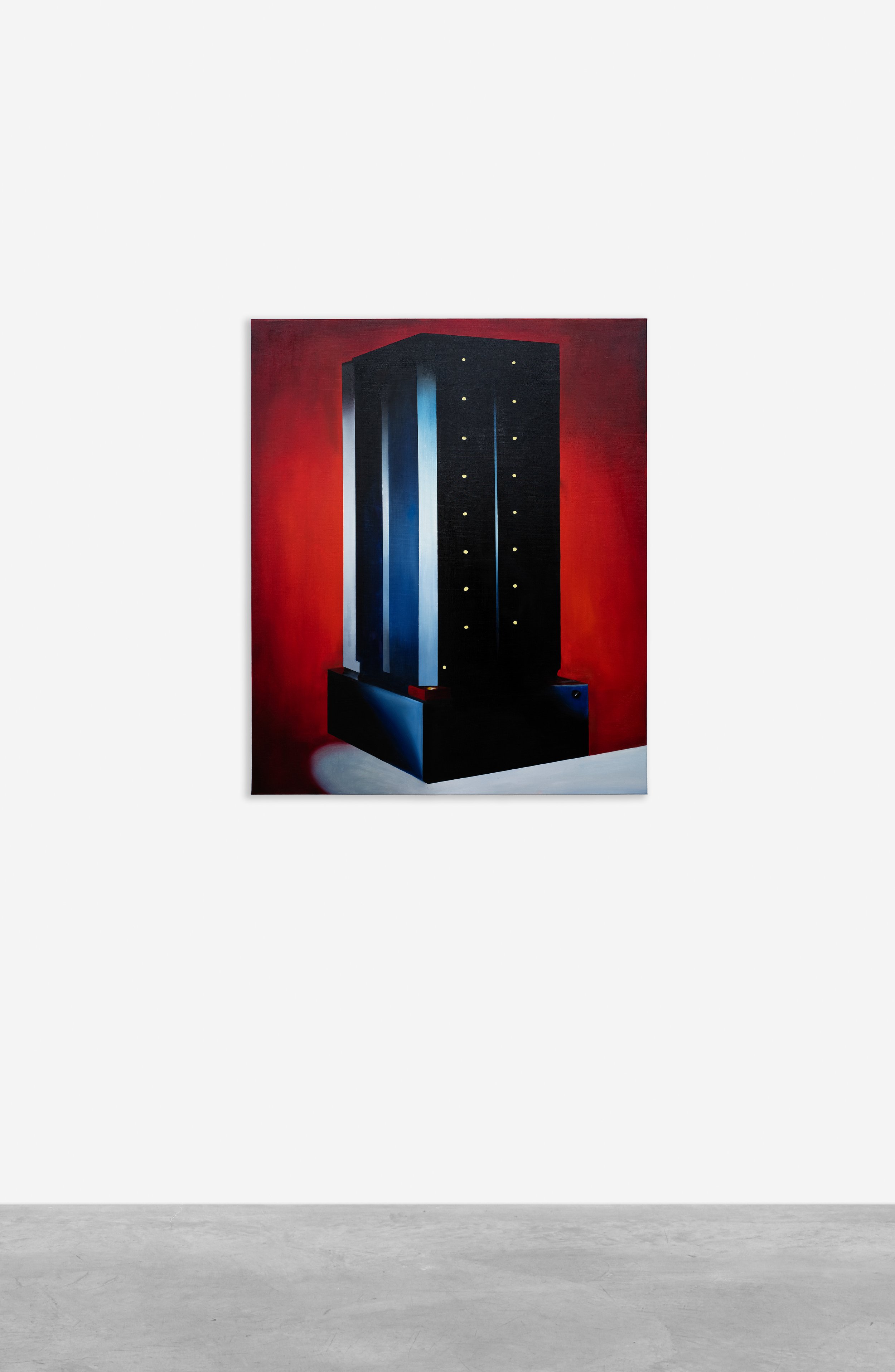
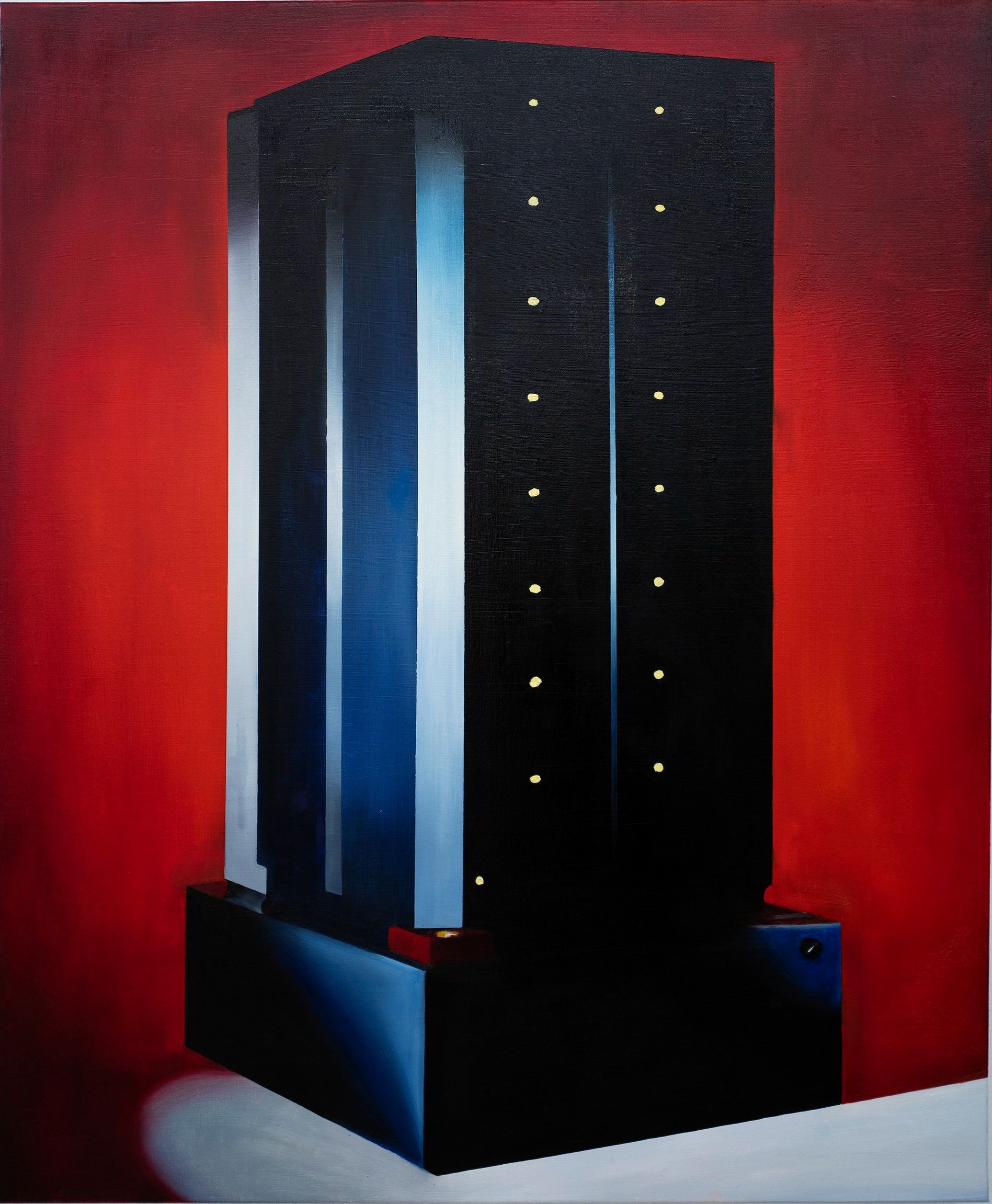
The painting is oil on linen, 91 x 76 cm (36 x 30 in), a format that is roughly the proportions of a chessboard viewed from above. The dominant form in the composition is the machine itself: a tall, vertical structure rendered in deep blue and navy, the color of IBM's custom VLSI chips, which gives the computer its name. Tan Mu describes this color choice explicitly: "The name Deep Blue comes from the color of the IBM supercomputer and its specialized chips, which are literally blue. I incorporated this color into the body of the form to ground the image in its technological origin." The blue is not an approximation. It is a specific, named hue that refers to a specific, named machine, and the painting's insistence on this specificity is what distinguishes it from a generalized image of artificial intelligence. This is not a robot. It is not a generic computer. It is Deep Blue, painted from references that include photographs of the actual hardware, and the blue that fills its rectangular body is the blue of IBM's architecture, not the blue of sky or water or mood.
Across the surface of the blue structure, small points of bright yellow glow. These are the "computational nodes or internal logic units" that Tan Mu describes in her Q&A, and they function on two registers simultaneously. On the first register, they are what they appear to be: lights on a machine, indicators of processing activity, the visual language of mid-1990s computing. On the second register, they function, as Tan Mu herself suggests, "almost like eyes or neurons, implying awareness without humanity." The phrase is precise. The nodes suggest awareness, not emotion. They suggest the capacity to process, not the capacity to feel. They are luminous, but they are not warm. They glow with the cold light of calculation, and the effect is one of presence without personhood. The machine is here. It is active. It is thinking, if thinking is what you call the evaluation of two hundred million positions per second. But it is not alive, and the yellow points make this distinction visible: they are eyes that do not see, neurons that do not feel, a form of intelligence that is present in every functional sense except the one that would make it human.
The background is red. Not the red of an accent wall or a design choice, but a deep, saturated red that Tan Mu describes as intensifying "the psychological tension of the scene." She is explicit about this: "The red background echoes the emotional pressure of the match itself and the broader confrontation between human intellect and machine computation." The red is the color of the human side of the equation. It is the color of blood pressure, of the adrenaline that Kasparov felt in the fifth and sixth games, of the anxiety that the match produced in spectators who understood what was at stake. Against this red, the blue machine stands with the clarity of a thing that does not experience pressure, does not feel anxiety, and does not understand the emotional weight of the victory it has just achieved. The red and the blue do not blend. They do not compromise. They face each other across the surface of the painting the way the two opponents faced each other across the chessboard, and the painting's refusal to mediate between them is its most uncompromising formal decision.
Thomas Eakins painted The Chess Players in 1876, and it remains one of the most sustained visual meditations on chess as intellectual labor in American art. The painting shows two men seated at a small table, studying a chessboard with the concentration of surgeons examining an X-ray. One man leans forward, his hand raised to his chin, his eyes fixed on the board. The other sits back slightly, his posture more contained but no less intense. The board between them is not decorative. It is the subject. Eakins renders the pieces with the same specificity he brings to the anatomy in The Gross Clinic, and the viewer can identify the position: a mid-game configuration that would have been recognizable to any serious player of the period. The room is dark, the lighting is domestic, and the only source of illumination appears to come from a window just outside the frame. The concentration of the two men is total. Nothing in the room competes with the board for their attention.
What makes Eakins's painting relevant to Checkmate is not the shared subject of chess but the shared subject of intellectual confrontation rendered through the body. In Eakins's painting, thinking is a physical act. The lean of the first man's torso, the angle of his wrist, the tension in his jaw: all of these are visible signals of a mind at work, and the painting asks the viewer to read the body as the external expression of an internal process. Tan Mu's painting removes the body entirely. There is no human figure in Checkmate. The chessboard is absent. The opponent is absent. What remains is the machine, standing alone against the red ground, its yellow nodes glowing with the light of calculation. The painting presents intelligence without the body that Eakins insisted on showing. Where Eakins made thought visible by showing the body that produces it, Tan Mu makes thought visible by showing the machine that replaces it. The yellow nodes are the descendants of Eakins's raised chin and tensed jaw. They are the external expression of an internal process, except the process is now algorithmic, and the expression is now a light on a chip.
The decision to omit the human opponent is the painting's most consequential structural choice, and Tan Mu addresses it directly. "Rather than depicting a chessboard or a human opponent," she writes, "I chose to isolate the machine, allowing it to stand as an emblem of a new kind of intelligence entering human history." The word "emblem" is significant. An emblem is not a portrait. It is not a representation of a specific thing in a specific context. It is a condensed symbol that stands for a class of things. By isolating the machine, Tan Mu removes it from the historical circumstances of the 1997 match and makes it into a general statement about the arrival of machine intelligence. The painting is no longer about Deep Blue versus Kasparov. It is about calculation versus intuition, pattern recognition versus creative strategy, the machine that evaluates two hundred million positions per second versus the mind that sees three or four moves ahead but understands why those moves matter. The isolation of the machine transforms the painting from a historical document into a proposition about the future.
The history of Deep Blue's development is worth recounting in brief because the painting embeds it. Conceived by Feng-hsiung Hsu in 1985 at Carnegie Mellon University as a chess-playing program called ChipTest, the project moved to IBM in 1989, where Hsu and his team developed the specialized hardware that would eventually defeat Kasparov. The first match between Deep Blue and Kasparov took place in February 1996. Kasparov won. The machine's play was impressive but flawed, and the champion adjusted his strategy after losing the first game to exploit the computer's weaknesses in positions requiring long-term planning. The victory gave the world a temporary sense of relief. Human intelligence had prevailed. Then, in May 1997, the rematch. Deep Blue had been upgraded with more powerful processors and a revised evaluation function. Kasparov, visibly shaken after losing the second game, never recovered his composure. The sixth game, the decisive one, lasted only nineteen moves. Kasparov resigned, stood, and left. The moment that Tan Mu's painting commemorates is not the triumph of the machine. It is the departure of the human.
Marcel Duchamp's relationship with chess is one of the most discussed episodes in twentieth-century art. In 1923, after completing what he considered his final work on the Large Glass, Duchamp effectively withdrew from making art and devoted himself to competitive chess. He played in tournaments, wrote a chess column for the Paris Herald Tribune, and designed a set of chess pieces in 1943 with the sculptor Max Ernst. His 1963 statement to an interviewer is often quoted: "I am still a chess player," he said. "I have no urge to be an artist." The statement is more complex than it first appears. Duchamp did not abandon art for chess in the sense of replacing one activity with another. He understood chess as an alternative to art, a form of intellectual activity that produced no object, left no trace, and existed only in the mind of the player and the position of the pieces. Chess, for Duchamp, was art without a product. It was pure structure, pure decision, pure mind.
Duchamp's Portrait of Chess Players (1911), painted early in his career and well before his retreat from art, already shows two figures absorbed in a game, their forms fragmented and overlapping in a style that anticipates Cubism. The painting is not about the board or the pieces. It is about the state of mind that the game produces: concentration, calculation, the suspension of everything that is not the position on the board. When Duchamp later abandoned art for chess, he was not leaving art behind. He was choosing a version of art that had no physical residue, a version in which the only product was the decision itself. Tan Mu's Checkmate stands at the opposite pole from Duchamp's preference. Where Duchamp chose chess because it produced no object, Tan Mu paints chess as an object. Where Duchamp valued the game's immateriality, Tan Mu paints the game's material infrastructure, the machine that calculates the moves. The painting does what Duchamp refused to do: it gives the immaterial a body, a color, a shape, and a presence that fills the canvas from edge to edge. Duchamp's chess players existed only in the mind. Tan Mu's chess machine exists on the surface of a painting, in oil and linen, with the permanence that Duchamp's games deliberately lacked.
The connection between Duchamp and Checkmate is not merely biographical. It is structural. Duchamp's withdrawal from art into chess posed a question that the art world has been answering ever since: what is the value of the art object if the intellectual content can exist without it? Tan Mu's painting answers this question by reversing its terms. The intellectual content of Deep Blue's victory, the evaluation of two hundred million positions per second, the alpha-beta search algorithm, the custom VLSI chips, all of this existed without the painting. It existed in the machine, in the match records, in the news coverage, in the cultural memory of May 11, 1997. The painting adds nothing to this content. It cannot evaluate a single chess position. It cannot beat a grandmaster. What it adds is something that the machine cannot provide: the experience of standing in front of a representation of the machine and feeling, through the painting's specific decisions of color, scale, and composition, what it meant for a machine to win. The red background does not exist in the match records. The yellow nodes are not documented in the engineering schematics. The vertical monumentality of the form does not appear in any photograph of the hardware. These are painting's additions, and they are what transform the historical fact into a painting's argument.
Danni Shen, writing for Ocula in 2024, observes that Tan Mu's practice consistently makes "the invisible architectures of contemporary life visible," rendering "the systems that operate beneath the threshold of ordinary perception" in a way that "reorients the viewer's relationship to what they thought they already understood." The observation is particularly apt for Checkmate, where the invisible architecture is not a submarine cable or a silicon wafer but an algorithm. The alpha-beta search algorithm that powered Deep Blue's evaluations is invisible by definition. It exists as code, as electrical signals, as the movement of electrons through silicon. It cannot be seen, touched, or painted. What Tan Mu paints is the housing of that algorithm, the physical structure that makes it visible to the human eye, and by giving the algorithm a body, she makes the confrontation between human and machine intelligence into a confrontation between two kinds of presence: the warm, anxious, embodied presence of the human player, which she has removed from the composition, and the cold, luminous, architectural presence of the machine, which she has placed at the center of the canvas and built in paint that registers the gravity of the event it commemorates.
Tan Mu describes the painting as functioning "as a time capsule, allowing future viewers to look back at how we once understood intelligence, competition, and the role of machines in shaping human destiny." The time capsule metaphor is one she has used before, most explicitly in relation to Moldavite (2020), where the tektite holds fifteen million years of cosmic history inside a stone small enough to hold in the palm. Checkmate is a different kind of time capsule. It does not hold deep time. It holds a specific afternoon in May 1997, a specific match, a specific machine, and a specific loss. But the principle is the same: the painting preserves a moment that has already been interpreted, reinterpreted, and absorbed into the broader narrative of artificial intelligence, and it preserves it in a form that does not simplify. The match records simplify. The news coverage simplifies. The cultural memory simplifies. The painting does not simplify. It presents the machine in all its blue, vertical, yellow-noded specificity, against a red ground that refuses to let the viewer forget that something was at stake in this confrontation, even if the only human presence in the painting is the red itself, the color of the blood that was not in the room but was in the world that received the news.
Tan Mu's Q&A also contains a passage that reaches beyond the 1997 match into the present. "Recent studies suggest that large language models exhibit structural similarities to human cognitive systems," she writes, "forming complex point cloud patterns that resemble atoms, neural networks, and even cosmic structures. This parallel fascinates me because it suggests that intelligence, whether biological or artificial, may follow shared organizational principles across different scales." The passage is significant not because it is scientifically precise but because it reveals the painting's deeper ambition. Checkmate is not only about the moment when a machine beat a grandmaster. It is about the possibility that the machine's intelligence and the grandmaster's intelligence are not opposites but variations on a common pattern, the same organizational logic operating at different speeds and different scales. The yellow nodes on the blue structure glow like neurons. This is not a metaphor that the painting applies to the machine. It is a structural observation that the painting makes visible. The machine's processors and the brain's neural networks share a deep architecture: both are networks of nodes that process information through weighted connections, and both arrive at their outputs through iterative evaluation. The painting's composition, with its vertical structure and its glowing points, makes this shared architecture legible in a way that no engineering diagram could, because the engineering diagram would show the machine's logic without the red ground that reminds the viewer what the logic was built to defeat.
The absence of the chessboard is the painting's final and most radical decision. Chess, as a visual subject, is defined by the board. The sixty-four squares, the alternating pattern of light and dark, the geometric regularity that makes the game's complexity possible, all of this is what makes chess instantly recognizable in a painting. Eakins included the board. Duchamp painted the board. Virtually every painting of chess in the history of Western art includes the board, because the board is what makes the game visible. Tan Mu removes it. She removes the pieces, the positions, the captured material, the clock, the table, and the human opponent. What remains is the machine alone, standing against the red ground like a monument to a victory that no longer needs the game that produced it. The chessboard was the arena. The machine has left the arena and stands in its own space, defined by its own color, its own logic, its own glowing nodes. The painting does not show us what the machine did. It shows us what the machine is. And what the machine is, in the end, is a structure of calculation that has been made visible, given a body, painted in colors that carry the emotional weight of the confrontation, and set against a red ground that stands in for everything the machine replaced. The machine did not just win the match. It left the board behind, and the painting records the moment of departure.